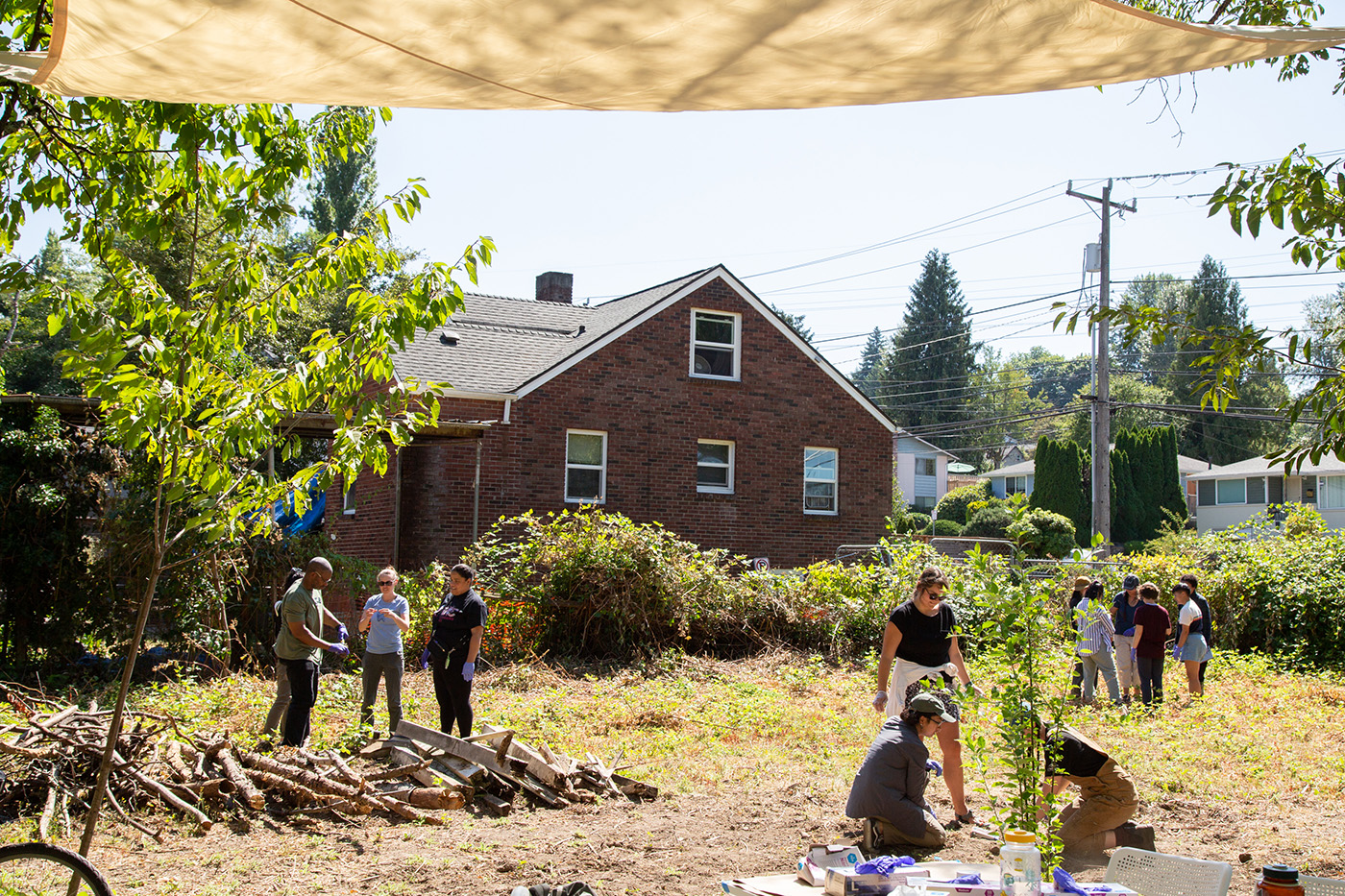
The Indigenous legend of Grandmother Camus is a story of love, sacrifice and transformation.
‘We chose this artwork as a welcome’: Grandmother Camus statue unveiled on Fourth Plain


As a photographer, you’re constantly seeking inspiration and exploring new ways to express your vision. Sometimes, the most impactful projects come from unexpected sources, challenging conventional ideas about what makes a compelling subject. This fantastic video explores two such projects that showcase the power of photography to elevate the ordinary and shed light on often-overlooked aspects of our world.
Coming to you from Ted Forbes with The Art of Photography, this insightful video explores the work of two photographers. Forbes shares his thoughts on why these projects are so significant and offers valuable insights into the photographers’ approaches. He highlights the importance of subject matter, printing processes, and layout in creating a cohesive and impactful body of work.
The first project, “Russian Soul” by Alain C.J. de Lotbinière, is a photographic essay documenting the spiritual side of the Russian people through their deep connection to Orthodox Christianity. Lotbinière’s black and white images capture the exquisite architecture of churches and monasteries, as well as the individuals who practice these traditions. Forbes praises Lotbinière’s ability to maintain a consistent aesthetic across diverse subjects, creating a unified and powerful narrative. He also emphasizes the importance of high-quality printing, particularly for black and white photography, and the effectiveness of Lotbinière’s minimalist layout that allows the images to speak for themselves.
The second project features four zines by Bernd Mayer, focusing on often-ignored subjects like garbage collection and marginalized communities. Mayer’s work dignifies these subjects with a sense of respect and beauty, reminding us that compelling stories can be found in the most unexpected places. Forbes commends Mayer’s ability to elevate the mundane and give a voice to those who are often unseen. He reads excerpts from Mayer’s zines, which offer further context and insights into the lives of the people he photographs.
Forbes concludes the video by discussing his own exploration of Japanese photography, highlighting the work of Jun Miki and his book “Samba Samba.” This personal project showcases Miki’s diverse talents, from architectural studies and portraits to vibrant depictions of Brazilian culture and Carnival celebrations. Forbes encourages viewers to explore photography from different cultures and historical periods, expanding their understanding of the medium and discovering new sources of inspiration. Check out the video above for the full rundown.

The yehaw Indigenous Creatives Collective, a nonprofit comprised of intertribal Indigenous artists, for several years has been working to establish a permanent home for Native arts and culture in Seattle.
. . .

Today we’re returning to a dark comedy classic that, although released in 2017, rings just as true in 2024. Directed by Swedish animator Niki Lindroth von Bahr, “The Burden” is a wildly wry musical that skewers loneliness, greed, beauty myths, and the existential woes of modern life through a lively cast of animal characters.
The award-winning short film visits a bleak supermarket, hotel, call center, and fast-food restaurant where employees break into song and dance, sometimes to the tune of common sales refrains. “Would you like to sign up for our money-back guarantee? Try our satisfaction guarantee?” monkeys croon. When an apocalypse hits the bizarrely relatable world, the characters jump at the chance for change.
Watch “The Burden” above, and find Lindroth von Bahr’s other films on Vimeo.


Do stories and artists like this matter to you? Become a Colossal Member today and support independent arts publishing for as little as $5 per month. The article The Burden: A Darkly Funny Musical Punctures Existential Dread with Unusually Cheerful Song and Dance appeared first on Colossal.


What’s all the fuss about? Photographers and artists have been fudging, faking, manipulating, and tinkering with photographs since the invention of photography.
Take Camille Silvy (1834-1910), for example. His image titled The Streets of London was made in 1859, only a few decades after the invention of photography and 132 years before Adobe Photoshop 1.0 was released, and was made by combining four separate negatives.
While it was a lot more hassle, and required more skill than writing a prompt for a generative AI engine, the final image is as fudged and fake as anything that might have been altered in DALL•E 3.0. However, Camille Silvy wasn’t entering his photo (montage) into a ‘Photographer of the Year’ competition; if he had, he might have gotten into a spot of bother.

A little over a century after Silvy’s meddling, AI and AI imagery are the hot topic du jour, and nowhere more so than in the world of photo competitions. There are plenty of stories of AI-generated images fooling judges and winning awards, and it’s easy to see how, as some of the results can be utterly convincing.
Perhaps the most notorious story emerged when German artist Boris Eldagsen went public with the fact that he won a Sony World Photography award with an AI-generated image (see below). He pulled the wool over various eyes – and made a bit of a scene about it at the awards night.
It became a hot topic for a while, and gave Eldagsen some notoriety. However, the incident raised some interesting discussion points. Many photo competitions have since updated their terms and conditions, and reevaluated their stance on where AI sits in the context of their agenda and, more importantly, where to draw the line.

For most competitions, the line sits somewhere around the acceptable use of some AI tools in image editing software such as Adobe Photoshop. It’s generally acceptable to modify and edit your own photographs using AI tools, typically with some caveat that you should stipulate this is the application process.
Many competitions will ask to see raw files before making a final decision. I’m a former creative director of Landscape Photographer of the Year, and we would do this to ensure that images hadn’t been manipulated too much.
This sentiment was echoed by Dan Calder of Close Up Photographer of the Year, who said, “Close-up Photographer of the Year is first and foremost a photography competition, so we won’t be accepting any images made with generative AI. During the latter rounds of judging, we will ask for raw files. And each entrant will confirm a declaration that no generative AI has been used”.
On the subject of image editing using AI tools, Calder adds, “Post-processing becomes a little trickier to adjudicate with the introduction of AI tools to Photoshop, etc. We are now open to creative post-processing techniques as long as we are informed about what has been done and that natural behavior is not misrepresented. We will continue to draw the line at AI-generated objects, animals, flora, landscape motifs that are added to the original picture”.

On a final note, Calder concludes that “over time, if photographers wish to start incorporating AI-generated elements to their pictures, then we will follow their lead and look to create a new category for them”.
Hugo Donnithorne-Tait, Awards Director of the British Photography Awards, has some interesting thoughts, too and says,” Like any new technology, getting angry at any disruption it causes is like shouting at the rainclouds. I’m convinced AI will be a watershed moment for so many industries and the great mega-trend of our generation – that said, there are important things to protect from it. Image integrity is one of those things, especially if you run a purist photography award as we do.”
“We built a secondary upload function so those who are considered for shortlisting can upload an original file or raw format file side by side with their image. While this used only to be requested when we suspected doctoring of imagery, we are going to implement it for all imagery due to AI. This will help us police the imagery and maintain the integrity of our shortlist. In the future, hopefully, a marriage of camera advances and blockchain technology can help us verify individual instances, creating an immutable catalogue of when moments were captured. Samsung has led the way with this to some extent. Their new smartphone (the Samsung Galaxy 24 Ultra) does have AI image editing built in, but it also has a function that ‘tags’ doctored images in the metadata. This is the kind of considered advancement we need, simple systems that let us see what is what”.

For the World Press Association (WPA), and photojournalism in general, integrity and authenticity hold a higher stake. I asked Andrew Davies from the WPA about its stance on AI, and he told me, “As a starting point, we do not view AI-generated images as photographs. They can simulate the look of a photograph, but by definition, it’s not the same. A photograph captures light on a sensor or film; it is a record of a physical moment. So, by definition, this is different from an image made with generative AI. Therefore, as a photography competition, we do not allow AI-generated images”.
Davies goes on to explain how the WPA approach the prevalence of AI. “We use a multilayered approach to spot fake or manipulated images: We verify the professionality of all entrants and the facts behind each story. The images are judged by industry professionals, and the original files are examined by two independent digital analysts.”
He adds, “I think the bigger issue is around trust in general. Scenes can be staged, the framing of images can be deceptive, photo manipulation is almost as old as photography itself, and digital editing software has been around for decades. Our contest is outside the 24/7 media cycle, and we do not have to work at the speed of social media. We can take time to check each finalist image carefully”.

For Davies, the bigger question is how people can continue to trust press and documentary photography in general, outside the realm of photo competitions. Davies explains that there are some technological solutions for tracking the origin of images, but these can’t tell you about the trustworthiness of the source. The WPA helped co-create a set of principles, compatible with those followed by many news organizations, that individuals and organizations can also adopt or adapt.
At the end of the day a purely AI generated image is not a photograph and therefore has no place in a photography competition.
It’s clear from my conversations that there’s currently a lot of fuss, debate and anxiety around the evolving nature of photography competitions in the new (ish) era of AI. After speaking with a number of competition organizers the consensus among them seems to be that while AI tools present new creative possibilities, safeguarding the integrity and authenticity of images remains crucial.
From established competitions like the British Photography Awards to revered institutions like the World Press Association, measures are being implemented to ensure transparency and uphold the essence of photography. As AI continues to shape the future of image making and photography, truth and integrity will remain the guiding principle for both creators and organizers alike, but, really, this has always been the case.
At the end of the day, a purely AI-generated image is not a photograph and therefore has no place in a photography competition; a photograph that’s been enhanced using AI tools might, but exactly what is acceptable depends on the competition and its core values, just as it’s always been.


Women had to disguise themselves in 1800s photographs of their babies due to early cameras’ long exposure times.
Photo: Tāmaki Paenga Hira Auckland War Memorial Museum.
It was the mid-1800s, and New Zealand mothers faced a dilemma.
Photography was sweeping the nation, and they wanted a likeness of their babies – but could not leave them sitting alone while the image was captured, which could take up to 45 seconds.
Enter a phenomenon that book editor Shaun Higgins calls the ‘hidden mother’: women preserved in early photos crouching behind chairs, or hidden under a shroud of fabric, propping up their young children.
In some photos, their disembodied hands could be seen emerging from a cloth, holding their babies tight “lest they topple over”.
An example of the ‘hidden mother’ is displayed on the front cover of Higgins’ latest book, A Different Light: First Photographs of Aotearoa.
Along with fellow editor Catherine Hammond, he pulled from the extensive photo collections of three major research libraries: Auckland Museum, Hocken Collections, and the Alexander Turnbull Library.
The resulting tome includes an array of portraits and landscapes, providing an insight to New Zealand’s colonial era.
Higgins told Saturday Morning that photography was introduced in Aotearoa in 1848, about a century after its invention in France.

The book’s co-editor Shaun Higgins.
Photo: Supplied
The earliest surviving photo taken in Aotearoa was a portrait of a “rather bewildered man” named Edward Catchpool, who sat for a portrait in Wellington in April 1852.
“He actually looks like a confused first-time Tinder user. It’s quite a funny portrait, but you have to put yourself in his shoes and remember that he’s never seen a camera before,” Higgins said.
Many people looked at early photographs and thought “gosh, it must have been pretty miserable back then”, he said – but their serious expressions were usually because they had to sit still for a long time.
“Dentistry was [also] not very good back then, so they don’t tend to want to do a big grin and show their mouth.”

The earliest surviving photograph taken in Aotearoa was this portrait of Edward Catchpool, taken in 1852.
Photo: Alexander Turnbull Library, Margaret Dunne collection.
Early photographers had to cart a cumbersome kit around New Zealand, Higgins said.
As well as their cameras and tripods, they had portable darkrooms – usually a small tent or a covered cart – because negatives had to be processed straight away.
One image included in the book, of the Pink and White Terraces, had been captured on a 50cm plate, he said.
“You think about a piece of glass that size being taken to the Pink and White Terraces, that’s when your imagination starts to go wild.”

An image of the Pink and White Terraces before they were lost in the 1886 Mt Tarawera eruption.
Photo: Tāmaki Paenga Hira Auckland War Museum
The camera’s body would have been at least as big as the plate, then there were the bellows and lens on top.
Higgins referred to it as the “giant megapixel camera of the time”.
The image would have been processed in a small tent nearby, “then they would have washed the plates in the waters of the terraces”.
Portraits of Māori were popular in those days, but many photographers exploited them for profit, Higgins said.

Kīngi Tāwhiao used photography to “spread his image around Aotearoa and the world”.
Photo: Tāmaki Paenga Hira Auckland War Memorial Museum.
The idea was that “Māori were a collectible”, and photographs the size of business cards, called carte de visite, were taken of anonymous sitters and mass produced.
Higgins said the sitters did not receive any payment for posing for the images, which became sought-after and frequently swapped, like trading cards.
Their portrayal could be contrasted with that of Kīngi Tāwhiao, who sought out portrait photographers and “embraced this technology as a way to spread his image around Aotearoa and the world”, he said.
“Instead of being for the benefit of Māori, this is actually the complete opposite – this is predominantly for a Pākehā collector audience.”


John Nicol Crombie, Commercial Bay from Point Britomart, 1859, albumen silver prints mounted on album page. (PHOTO: Tāmaki Paenga Hira Auckland War Memorial Museum.)


William Meluish, Dunedin, 1861, albumen silver prints, two-part panorama. (PHOTO: Hocken Collections Uare Taoka o Hākena, University of Otago)


Lawson Insley, Edward Catchpool, April 1852. (PHOTO: Alexander Turnbull Library, Margaret Dunne collection.)


Richard P. Leitch and unknown colourist, ‘Part of the town and harbour of Dunedin, the capital of Otago — from a photograph recently taken’, 1862, wood engraving, Illustrated London News, 30 August 1862. (PHOTO: Hocken Collections Uare Taoka o Hākena, University of Otago.)


Elizabeth Pulman, King Tāwhiao, Tūkāroto Matutaera Pōtatau Te Wherowhero, Ngāti Mahuta, 1882. (PHOTO: Tāmaki Paenga Hira Auckland War Memorial Museum.)


Charles Spencer, Trickling Buttresses, White Terrace, c. 1880s, mammoth-plate collodion silver glass negative, positive and negative views. (PHOTO: Tāmaki Paenga Hira Auckland War Memorial Museum.)


William Temple, The bush at Razorback. Gt South Road New Zealand, 1862–63. (PHOTO: Tāmaki Paenga Hira Auckland War Memorial Museum.)


Photographer unknown, Unknown sitter, c. 1890, crystoleum. (PHOTO: Tāmaki Paenga Hira Auckland War Memorial Museum.)