
Faculty development grants are split into three categories: term-long fellowship awards, targeted opportunity awards, and small grants.
Carleton College announces faculty development grants for 2024–25


Recently, a blog post published on the WPP website announced that generative AI would be permitted to be entered in the Open Format section of the competition — a category that is open to non-traditional, but still photography-based techniques, including overlaying text over images.

“We will permit the use of generative AI in the Open Format category, as long as entries incorporate lens-based still photography as the source and central part of the work,” the blog post stated, with a caveat that “Entries that solely contain artificially generated images will be disqualified from the contest.”
Following the release of the blog post, dozens of photographers signed an open letter on Medium stating that the decision “undermines” their work, while also calling out the WPP for “promoting” AI images on its Instagram feed.
“These images, which are in essence digital mashups drawing from existing photography, are often hard to distinguish from actual photographs, but are devoid of any connection to the real world,” the letter states.
“This connection to the real world, the world as it is, is at the core not only of photojournalistic practice, but of journalism in general. Both moves undermine what we do fundamentally.”
Compounding the issue has been WPP’s recent decision to publish a series of AI-generated images on its instagram feed, while asking if such an image “could win in the World Press Photo Contest?” The responses to the post were overwhelmingly negative.
“You just made my WPP award feel like a worthless piece of metal. This shows a complete lack of respect for the work we do, the risks we take and the reasons why we do it,” wrote Daniel Etter.
“AI generated images are images, not photographs. There should not be any discussion in a photo contest about that,” wrote photographer Martin van Lokven on a follow-up post.
Last week, the WPP announced that following feedback AI-generated images will continue to be excluded from the Open Format category.
“Thanks to the honest and thoughtful feedback over the past days, we have decided to change the rules for the Open Format category in our contest to exclude AI generated images,” the short statement confirmed.
“Both generative fill and fully generated images will be prohibited in the Open Format category (as was already the case in the other categories: Singles, Stories, and Long-Term Projects). This is in line with our long-standing values of accuracy and trustworthiness.”
At the same time, the WPP also updated its definitions of what it considers a “lens-based camera”, and its rules for image manipulation.
According to the updated terms, denoising, object selection, and adjustments to levels, colors, and contrast are permitted in all categories. However, AI tools such as enlarging and sharpening with programs such as Adobe super-resolution and Topaz Photo AI are not.


“Cloud songs on the horizon” (2023). All images are installation views of ‘Ranjani Shettar: Cloud songs on the horizon,’ Barbican Conservatory, © Max Colson, Barbican Art Gallery, courtesy of Barbican Centre, KNMA, Ranjani Shettar, shared with permission
Emerging from the lush, jungle-like conservatory at the Barbican is a collection of otherworldly sculptures that transform the venue into a site of metamorphosis. Largely made of muslin, reclaimed teak, and steel, the works were born in the rural Karnataka, India, studio of artist Ranjani Shettar, whose interest in nature’s resilience and adaptation is on full display at the iconic London space.
Shettar is known for her use of organic and industrial materials that she fashions into delicate, sometimes abstract, sculptures. In her solo exhibition titled Cloud songs on the horizon at the Barbican, the artist suspends pieces that appear like seed pods, plants, and other organisms within the 23,000-square-foot space. As viewers move along the pathways, the works seem to morph into different creatures and reflect the ways changes occur over time.
The Barbican’s glass ceiling plays a crucial role, as well, as it shifts perspectives depending on the time of day. Shettar softly illuminates some of the works when under the dark cover of night, adding that “natural light had to become an active ingredient of the sculpture-making, not a passive (one) that would happen later on. I had to consider it as a medium itself,” she says.
Cloud songs on the horizon is on view through March, and you can find more of Shettar’s works from Talwar Gallery.

“In the thick of the twilight” (2023)

“In the thick of the twilight” (2023)

“Cloud songs on the horizon” (2023)

Detail of “Cloud songs on the horizon” (2023)

“Moon dancers” (2023)

Detail of “Moon dancers” (2023)

Detail of “Cloud songs on the horizon” (2023)

“In the Wings of Crescent Moons” (2023)
Do stories and artists like this matter to you? Become a Colossal Member today and support independent arts publishing for as little as $5 per month. The article Ranjani Shettar’s Delicate Sculptures Entwine with the Lush Plant Life of the Barbican’s Conservatory appeared first on Colossal.

According to a recent news report, camera shipments are on the rise. This has to do largely due to the boom in camera sales in the Chinese market. Of course, manufacturers and consumers alike are bound to be pleased with these results. We all remember how bleak it was last year with the semiconductor chip shortage. So, is it all rosy for now in the competitive world of consumer photography? And what’s the forecast like for the coming months?
According to an article by Photorumors, a report on the website Digicame.Info says that camera sales are not just on the rise in China; they’re outshining the rest of the world in this regard. They’ve analyzed the latest stats on CIPA to come to this conclusion. The news site Newswitch also adds that the value of shipments to China increased by 33.9% to 83.9 billion Yen. In fact, in the first half of 2023, China exceeded the Americas in terms of shipment volume for many months.
A significant factor in the rise of sales here is due to the gradual phasing out of restrictions that kept Chinese consumers at bay during the Covid 19 pandemic. With life returning to standard, Chinese folks are showing a renewed interest in taking photographs. The domestic and foreign tourism boom also could have played a role, with people eager to document their travels with dedicated cameras outside of smartphones. The International Air Transport Association reports that Chinese air travel figures have almost reached pre-pandemic levels now. Chinese citizens are relishing the opportunity to travel freely within their country. Capturing the beauty of landscapes and the joy of their travel experiences using interchangeable lens cameras looks to be back on the rise.
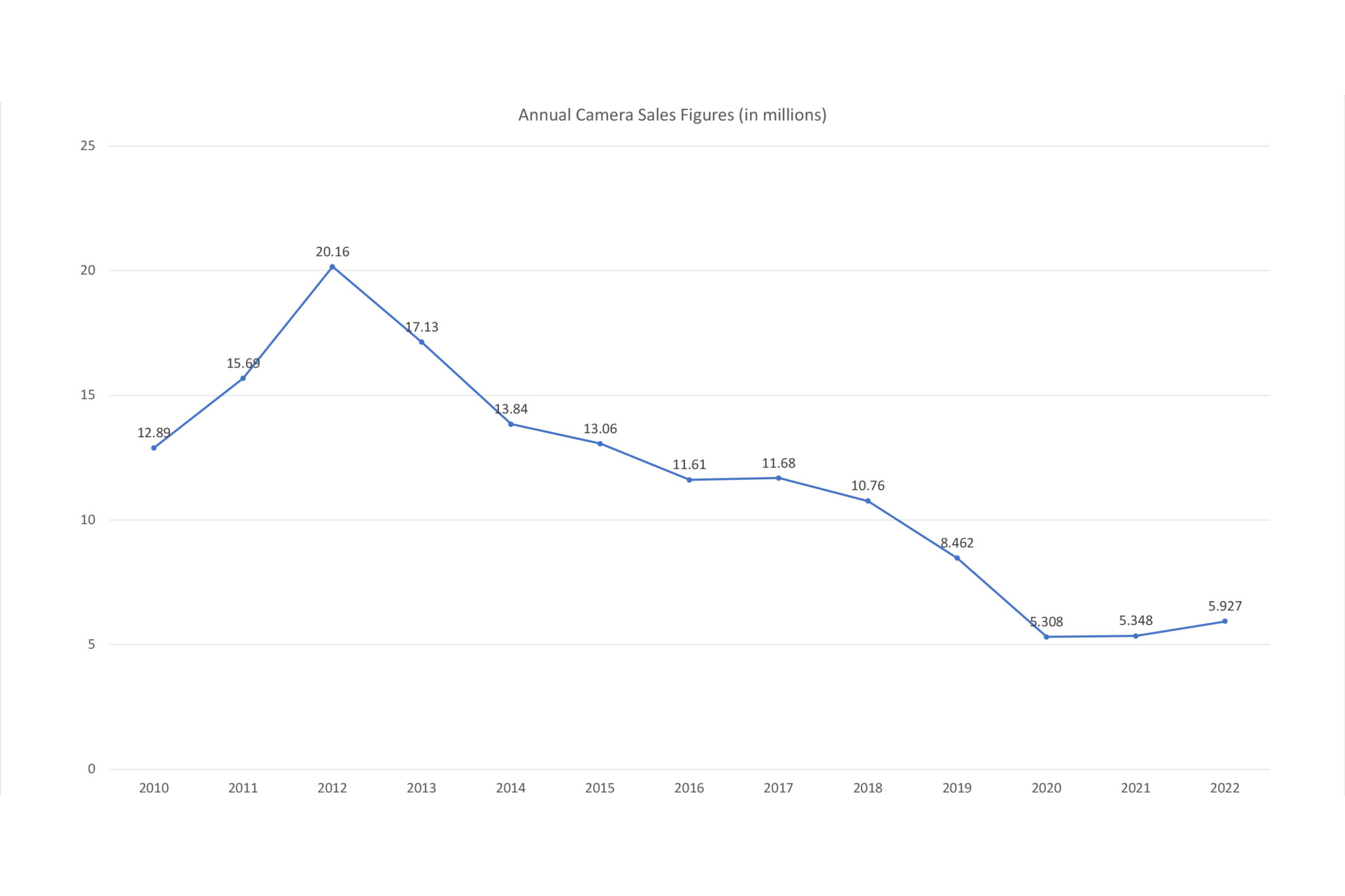
A shot in the arm for camera sales from any geographical region is always a reassuring sign. And when it’s the world’s most populated country exhibiting a welcome trend, camera manufacturers will breathe easy for a while. These trends usually catch on in other areas within a matter of months, anyhow. It’s no secret that the alarming slump in sales from 2020 to 2022 was threatening the industry as a whole. Yes, camera manufacturers did bring out newer models of cameras, but the overall picture wasn’t too good until possibly late last year. As the graph below indicates, camera sales have steadily dipped from 2012 until 2021, so these recent signs are pretty pleasing to see.
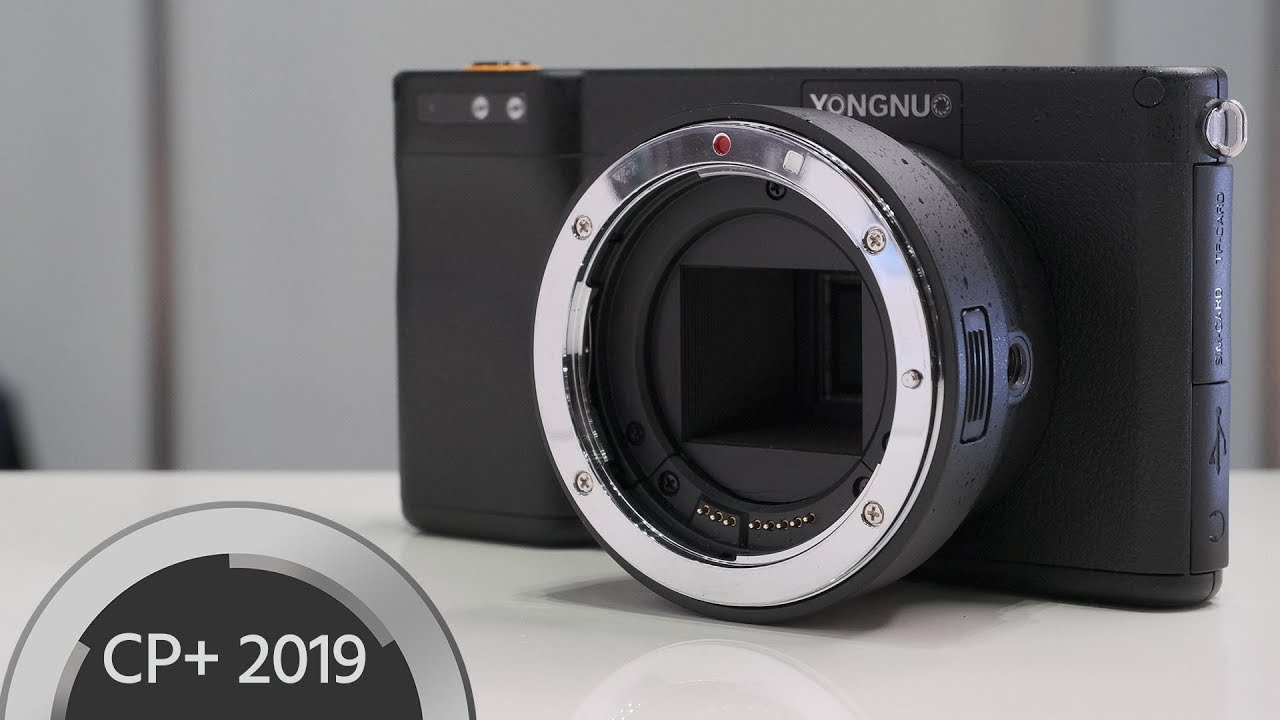
However, these stats are not completely surprising as China is steadily ramping up its economic growth, with the electronics market alone projected to hit USD 135.50bn in 2023. It honestly can’t be much longer until Japanese camera manufacturers start to feel the heat from Chinese companies in areas aside from lens manufacturing. Chinese companies have already made a mark in the photography accessories department, which is understandable since most accessories seem to be manufactured there. We also recently noted how Chinese 3rd party lens manufacturers are becoming game changers. They have established themselves as a force to be reckoned with, giving photographers a much broader choice to select from. In a few years, we might see powerful homegrown Chinese camera brands start competing with Canon, Nikon, Sony, and the like? Okay, Yongnuo did have a disastrous attempt at this back in 2019, but it’s fair to say they’ve probably learned from their mistakes since then.
It’s just a matter of time before more companies from China start innovating and rebranding themselves, giving future generations of photographers even more selection. Seagull Camera (est 1958) is still around; who knows if they intend to bring back some classic erstwhile models in digital avatars. For now at least, it’s great to see consumers in China getting their lives back on track. Let’s just hope that the ongoing wars don’t put too much of a dent in the global economy in 2024.
The lead image in this article is a screenshot from Photorumors.

Photographer Larry Fink, best known for his black-and-white photographs documenting American society, passed away at his home in Pennsylvania over the weekend at age 82.
Fink was celebrated for his distinct photographic style, which showed his subjects somewhat isolated from their surroundings thanks to his use of a handheld off-camera flash, and his authentic depictions of his diverse, wide-ranging subjects.
Photo series such as “Social Graces” and “Kindred Spirits” earned Fink a powerful and lasting reputation in photography and the art world at large. His work was showcased in publications like Vanity Fair and The New York Times Magazine, and he had numerous solo exhibitions at significant venues, including the Museum of Modern Art, the Whitney Museum, the Philadelphia Museum of Art, and many more.
In 2019, Fink’s work was displayed as part of a retrospective at the Fotografia Europea in Italy. He was also a two-time recipient of the John Simon Guggenheim Fellowships (in 1976 and 1979), a two-time awardee of the National Endowment for the Arts, and he won two Lucie Awards for Documentary Photography, alongside many other prestigious awards, achievements, and exhibitions.

In addition to Fink’s countless professional achievements, he also spent more than 50 years teaching at educational institutions, including Bard College, Yale University School of Art, Cooper Union, Parsons School of Design, and New York University.
The photographer continued working very late into his life, and his work was recently featured in a New York Times article on aging, something the photographer remarked on Instagram that he was “becoming well acquainted with.”
Given that Fink’s subjects spanned all socioeconomic levels within society, it is important to consider his political beliefs and ideologies when contemplating his work. Fink told Blind Magazine in 2021 that he “was born a communist,” and that his mother was a fearless communist organizer at a time when it was perilous to be associated with communism.
“My mother was a communist. She was an organizer, and she had no fear. She was a bourgeois also. She loved mink stoles. My father was a kind, patient man with a stamp collection. My folks had some money so they used to drive around in a Stutz Bearcat, go to Florida, and hang out. They liked leisure, parties and jazz music so my upbringing was a contradictory one,” Fink recalled to Blind Magazine.

Fink aimed to use photography to achieve political goals in the early 1960s when he moved to New York City. “I was photographing for the revolution. Everything I did out on the streets was not about whether or not I would get a story idea I could sell to Look magazine, it wasn’t my ilk,” Fink explained.
“Success wasn’t an interesting factor in my mind. It was victory, revolution, and the transformation of human emotional culture so that this would be a more magnificent place. Of course the revolution didn’t quite get there so I was left with a career,” Fink remarked.
And what a career it was. The renowned photographer always retained his drive to document and transform society through his artwork, which treated every subject, no matter their background and social status, with compassion and dignity.

Larry Fink’s work remains part of the Robert Mann Gallery’s collection. Speaking to PetaPixel on the phone, the gallery’s founder, Robert Mann, shared heartfelt sentiments about Fink as a friend and photographer.
“Larry was a dear friend. He and I had been associated since the late 1970s in one way or another,” Mann explains. “I found him to be a really unique individual. He marched to the beat of his own drum, and not just in personality, but also in his image making. He quickly established a unique style for himself that set him apart from all other artists.”
“He had sort of a rawness to it and a spontaneity to it, and yet he also had the gift of capturing the specific moment, the quintessential moment, and he had an ability to capture that moment and isolate it in a way that was just unique to him that no one else has I’ve ever seen replicate.”

“His legacy will live on. He’s leaving behind an expansive body of work and one that has delved into areas and shown social and psychological nuances and aspects of life that not many other artists have tackled in a similar way,” Mann continues.
Pointing to Fink’s iconic “Social Graces” series, the subject of multiple major exhibitions and an influential book, Mann explains that the epic body of work will go down in history as a significant milestone of photography. The images looked at the “haves” and “have nots” in society in a special way.
“You get a real flavor for who [Larry] was in the way that there’s a bit of detachment, let’s say, among the social elite and the way that they appear in his pictures versus the local residents in rural Pennsylvania near where he lived. They must’ve accepted him into their world. I find that very telling. He was a socialist at heart. He had a great love for all humanity, and the way that comes across in his images is very clear,” Mann says.

“He was a sort of free spirit. He went rogue in terms of his approach to photography and life in general.”
Mann recalls that Fink’s spontaneity went far beyond his photography, it was who Larry Fink was as a person.
“You would be in talking to him, and all of a sudden he’d just break out in poetry and you’d feel transported back to the 1950s as though you’re sitting in a coffee house in the Greenwich Village listening to a beat poet, and then he’d surprised you by whipping out his harmonica and playing a few riffs on it,” Mann says fondly. “That kind of spontaneity that would catch you off guard, but I found [it] extremely enchanting. You’d feel it in his image making as well. He wasn’t traditional in the way that he approached the subject matter [or] in the way that he captured it on film. There was something very unique in his method, but it was very successful and it was very honest, and that comes through in all the pictures that he made.”
Image credits: All images by Larry Fink and provided courtesy of the Robert Mann Gallery. The header image includes a screenshot from TIME’s video on Larry Fink, included above.

Dharamsala, November 27
The Himachal government has proposed to bring up Unity Mall at Dagwar near here. The Mall is proposed to be brought in each state by the Union Government.
Minister for Industries Harshwardhan Chauhan said the Himachal government has sent a detailed project report (DPR) to the Union government to bring up the Mall at Dagwar. The DPR of Rs 151 crore was sent to the Government of India which has been approved. The Union government would provide a funding of Rs 132 crore for the project while the rest of the funding would be provided by the state government, he said.
The Centre had proposed to bring up Unity Mall in each state of the country. It was proposed that products of each state would be sold in these malls with GI tags. The project was aimed at promoting local products.
The Minister for Industries said that the Unity Mall proposed in the state would have facilities such as escalators and state-of-the-art marketing and entertainment facilities. The government proposes to bring up the mall near Dharamsala as it would promote tourism in the area. Besides, the government would also ensure that local agriculture products of Himachal such as Kangra tea and other organic products are sold in this mall.
The work for the construction of the mall would start as soon as the state government receives funding for the project. The government land for the project has already been identified, he said. — TNS
DPR of Rs 151 CR

A hacienda-style home in Sonoma with extraordinary design details has hit the market. The 3,925-square-foot home sits on 2 acres and has four bedrooms, four bathrooms and two half-bathrooms. It is listed for $5,000,000.
Built in 2000, the home at 19407 Wyatt Road features hacienda-style design elements, including a clay tiled roof, wood beams and doors, arched hallways, wrought-iron lamps and a courtyard. But the traditional architecture is styled with a modern and minimalist sensibility, striking a balance between understated white walls and modern furniture, on the one hand, and wood columns, exquisite tilework and spots of bright color on the other.
The home’s kitchen and bathroom tile features colorful, if not whimsical, patterns. The tranquility of the interior is interrupted by other bold design surprises, like a green door in the office, red curtains in the bedroom and red tiles in a bathroom. The overall scheme is a winning combination of understated and opulent.
An open floor plan allows for casual living and lets the kitchen function as an entertainment hub. The loggia shelters al-fresco lounging and dining. Cool evenings on the patio are warmed by an outdoor fireplace. A pool house provides 570 square feet of additional living space for guests.
A surround of olive trees, wisteria over the awning, and views of vineyards offer this estate some of the best in Wine Country living. Click through the above gallery for a peek at the property.
For more information on the home at 19407 Wyatt Road, contact listing agents Daniel Casabonne and Marie Bradley of Sotheby’s International Realty – Wine Country Brokerage, 28 First St. E., Sonoma, 707-494-3130, 707-939-2222, sothebysrealty.com

Irvine, California – Numismatic photography expert Phil
Arnold has joined the GreatCollections Auctions team as Director of
Photography.
For the past 18 years, Phil headed Professional Coin Grading Service’s
(PCGS) imaging department and developed their Trueview imaging. He
photographed the vast majority of major numismatic rarities over that time,
including the 1933 Saint-Gaudens Double Eagle – the world’s most valuable
coin.
Ian Russell, president of GreatCollections commented “I welcome Phil to our
team – and look forward to providing even higher-quality images for our
auctions to the benefit of consignors and bidders. Phil’s work is
second-to-none in numismatic photography, and his love of numismatics is
showcased with every image he takes.”
After graduating from Western University in Ontario, Canada, Phil studied at
the Pacific Design Academy before deciding to focus on his numismatic
photography career. The stars aligned, as this was the time PCGS needed
their first full-time photographer to take digital images. Phil was hired
and he moved to Southern California. For 18 years, Phil took literally
millions of coin images at PCGS, while also improving the quality to the
pinnacle of the numismatic industry.
“I’ve known Ian for the past decade, and I’ve always admired his and
Raeleen’s reputation for integrity within the industry. GreatCollections’
growth in this time has truly been remarkable, and I’m excited to now be a
part of their small-company environment. We are going to the next level in
making GreatCollections’ photographs the best in the business – not just for
their record breaking coin auctions, but also for the new collectibles we’ll
be auctioning in the very near future,” said Phil Arnold about joining
GreatCollections.
GreatCollections is planning on adding additional images of toned coins and
rarities, which will start to appear in auction listings in the next few
weeks.
Aside from overseeing the GreatCollections Auctions coin images, Phil will
also be instrumental in setting up the GreatCollections photography for the
new collectibles categories launching in 2023.





