About

Posts by :

Mail art meets NFTs for all in the ‘MoMA Postcard’ programme

Mail art meets NFTs for all in the ‘MoMA Postcard’ programme

The Museum of Modern Art (MoMA) in New York has invited the public to participate in what the museum describes as “an experiment in collective creativity on blockchain” in a new digital initiative, MoMA Postcard. This programme comes soon after the museum’s release of free mementoes minted as non-fungible token (NFT) editions, launched during the recent exhibition Refik Anadol: Unsupervised. These tokens continued MoMA’s exploration of and engagement with the technologies of web3, the latest iteration of the internet, built on blockchain technology and controlled by its users.

While the market for NFTs has slowed since its initial hype in 2021, museums and institutions are beginning to step further into web3 through exhibitions and programmes, with MoMA Postcard as one such example. In recent months, HEK (House of Electronic Arts) in Basel presented Exploring the Decentralized Web—Art on the Blockchain, curated by Sabine Himmelsbach and Boris Magrini. NFT-based artworks are also now in the collections of institutions such as Kadist in Paris and San Francisco, the Los Angeles County Museum of Art, the Centre Pompidou in Paris and Deji Art Museum in Nanjing.

MoMA itself recently acquired two notable NFT artworks: Refik Anadol’s Unsupervised—Machine Hallucinations—MoMA (2022), which was on display in the lobby until late October, and an edition of Ian Cheng’s blockchain-based generative artwork 3FACE (2022).

There are numerous historical examples of co-created artist and literary projects, but this one uniquely leverages technology as muse, medium and messenger

Sasha Stiles, poet and artist

MoMA Postcard takes its cues from mail art, a practice that first emerged in the 1950s when artists began to send and exchange works of art through the US postal service. Key figures such as Ray Johnson sent chain letters inviting recipients to add to what was enclosed and to pass the updated artwork on to someone new, driving forward this format of creative correspondence that has continued to this day. Madeleine Pierpont, the web3 associate at MoMA, sees a “natural synergy” between mail art and blockchain technology, as both “enable global transmission of information”, and for MoMA Postcard to be an opportunity to explore the co-creation and community aspect of web3.

To create with MoMA Postcard, people download Bitmark’s Autonomy app and claim a blank card to start. Users can then create a stamp, or digital image, within a 10 by 10 pixel grid using MoMA’s colour palette, before signing it off in a signature box. Once a stamper confirms their stamp on the blockchain, their token of ownership and contribution is automatically recorded in the postcard’s data on the blockchain. The contributor is then invited to send the postcard on to another person—until all 15 stamps have been filled.

Each postcard is co-created by all its stampers. It is a living and growing artwork that is only complete when all 15 contributions have been submitted. Pierpont says that this is a key aspect of the initiative as it encourages communities to form around MoMA Postcard, with each postcard acting as a micro community of its own, fostering collaboration and exchange. Further, each postcard is co-owned by its 15 contributors. No single person is able to own a postcard on their own or to make any buying and selling decisions without involving all of its owners. This feature makes it difficult for financial and market speculation to form around the postcard, and drives attention towards the collaborative process and community instead.

To introduce the project and illustrate its possibilities to a diverse audience, MoMA released First 15 as a soft launch of the initiative on 3 October, inviting 15 artists to create postcards together. These artists come from diverse backgrounds and practices but are united by their shared engagement with and understanding of blockchain technology. Each artist devised a verbal prompt for a postcard, which was then passed around all the participating artists to create a collection of digital mail art. Sasha Stiles, a Kalmyk American poet and artist, designed her prompt to be: “using only black, dark green, light green and white, please draw your letters: A,R,S,(design blank space),A,U,T,O,P,O,E,T,I,C,A”. “I knew right away that I wanted to do something poetic,” Stiles says, “to pay homage to the long literary tradition of the ‘exquisite corpse’, and so my first question was how to make language work inside the constraints of the pixel grid.”

In asking each artist to draw a letter and thus collectively create a font, Stiles’s prompt also strengthens the personal and intimate touch that MoMA Postcard invites contributors to share in the use of handwritten signatures as sign-offs on each stamp.

Operator, the Lumen Prize-winning duo of Ania Catherine and Dejha Ti, whose work engages with privacy and technology, feel that “it’s an interesting choice to have artists sign their stamps because typically, the artist’s ‘signature’ for a digital artwork is not shown in this way”. In rendering the individual’s signature visible, it reinforces their hand and presence.

The MoMA Postcard pixel grid image Puce Radial Etching, for which Operator (the Lumen Prize-winning duo of Ania Catherine and Dejha Ti) was the “prompting artist”—the first of 15 co-owners and co-creators Courtesy MoMA

When taking part in MoMA Postcard on the Autonomy app, users receive Ethereum and Tezos wallet addresses automatically generated in the app and have access to a glossary of web3 terminology written by the MoMA team, as well as other digital artworks featured on the app’s home page. Stiles sees MoMA Postcard as a “brilliant concept” for how it introduces blockchain technology. “There are numerous historical examples of co-created artist and literary projects,” Stiles says. “But this one uniquely leverages technology as muse, medium and messenger.”

“The museum is still very much in an experimentation and exploration phase,” Pierpont says, “and we want to really think carefully about how we can engage with the space with intention and in a way that provides value”. MoMA Postcard marks the next step in these efforts, and over the following few months the museum will also be launching an online exhibition in partnership with Feral File, a digital art platform founded by Bitmark and artist Casey Reas, featuring artists including Yoko Ono, Holly Herndon and Mat Dryhurst, and Danielle Brathwaite-Shirley.

  • Clara Che Wei Peh is a Singapore-based curator and art writer specialising in emerging technologies. Her curated projects include Art Dubai Digital 2023

First Friday Peterborough celebrates local creatives with outdoor holiday market on December 1

First Friday Peterborough celebrates local creatives with outdoor holiday market on December 1
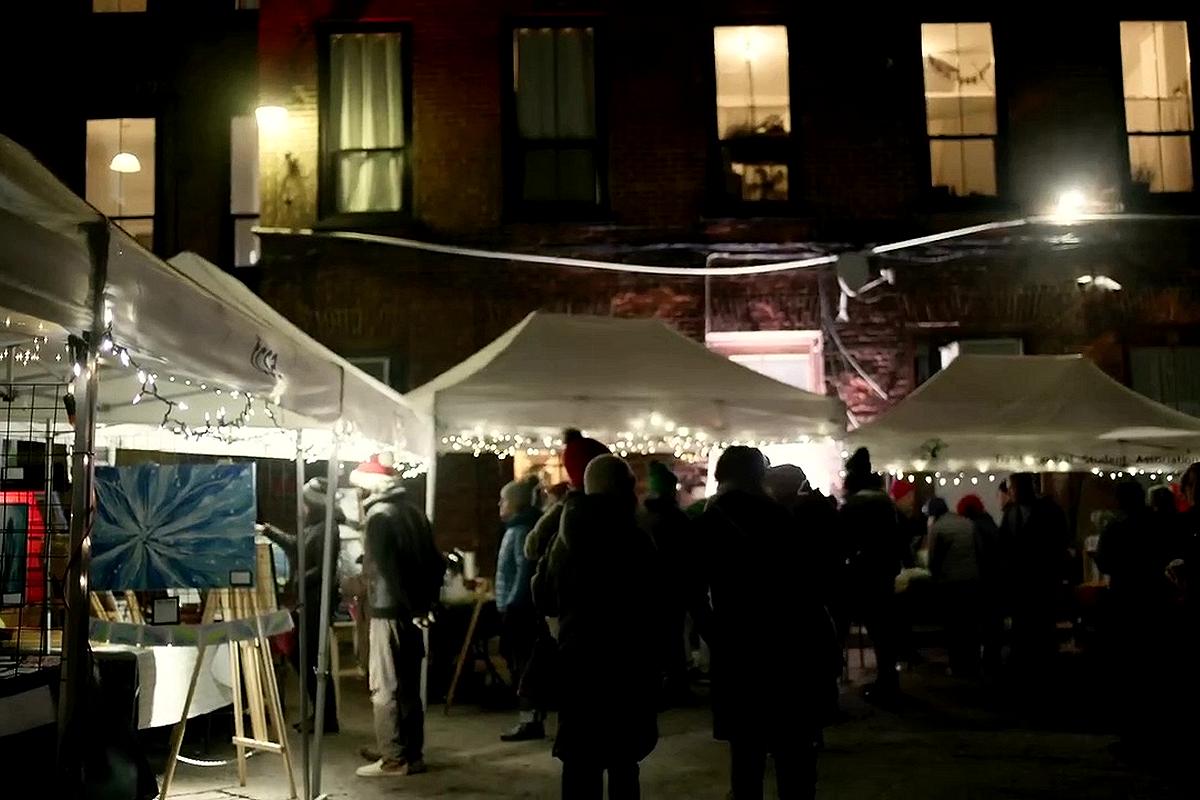
The Commerce Building Courtyard in downtown Peterborough will be transformed into a festive market on December 1, 2023 for the Neighbourhood Holiday Market organized by The Neighbourhood Vintage in partnership with First Friday Peterborough. The evening event during the First Friday art crawl features work from 20 local artists and artisans, live music performances, and food and drink. Pictured is the December 2022 market. (kawarthaNOW screenshot of First Friday Peterborough video)


December’s First Friday art crawl in downtown Peterborough is celebrating local creatives with a special outdoor holiday market.

Organized by The Neighbourhood Vintage in partnership with First Friday Peterborough, the Neighbourhood Holiday Market takes place in the Commerce Building Courtyard at 383 Water Street from 5 to 9 p.m. on December 1.

The family-friendly and accessible market will feature works from 20 local artist and artisan vendors, live music performances by local musicians Benj Rowland, Brooklyn Doran, and Caitlin O’Connor, and food and drink offered by local eateries Kit Coffee, La Hacienda, and St. Veronus and two local breweries.

Advertisement – content continues below


Tweet this quote

The first winter outdoor market in the Commerce Building Courtyard took place during last December’s First Friday art crawl, followed by a spring outdoor market during June’s event.

“The markets have been such a wonderful way for our community to come together,” says Jacquelyn Craft, owner of The Neighbourhood Vintage at 391 Water Street who organizes the markets, in a media release. “I love being able to create community events that showcase the vibrant creative talent here in Peterborough. From artists to makers, musicians to restaurants, there are so many talented members in our community and this has been a really great way for the public to discover them.”

The vendors participating in the Neighbourhood Holiday Market include Burn Island, Marrs Brand, Meowlinda, Olive Cedar Studio, Habitual Moon, 8th Troupe, City House Country House, Steaped Slow Ceramics, Keetarella, Take Cover Books, Whimsy & Wonder, Open Sky Stories, Away Designs, Miguel’s Art, The Artful Apricot, Ella Mollie, Well Grounded, TSC Studio/Gallery (Marcia Watt), Cheesecrafts, and Knitsbymich.

VIDEO: First Friday Peterborough December 2022 Outdoor Market

Advertisement – content continues below


Tweet this quote

The Neighbourhood Holiday Market is a great opportunity to find unique holiday gifts produced by local creatives while supporting both the arts community and the local economy.

“We get really excited about our outdoor events for First Friday since they always feel extra special,” says First Friday Peterborough marketing and events coordinator Melissa Wilson. “There’s music and food, and the energy and atmosphere is always so positive. It’s always so gratifying to see our hard work pay off when the community gets together to enjoy and celebrate the arts before the holiday season.”

Run by volunteers, First Friday Peterborough is a monthly art crawl event showcasing local artists at downtown galleries, studios, shops, and cafes. Admission to all locations is free. For more information and to keep up to date on future art crawls and markets, visit First Friday Peterborough on Facebook and Instagram.

Organized by The Neighbourhood Vintage in partnership with First Friday Peterborough, the Neighbourhood Holiday Market in the Commerce Building Courtyard in downtown Peterborough on December 1, 2023 is a great opportunity to find unique holiday gifts produced by local creatives while supporting both the arts community and the local economy. (kawarthaNOW screenshot of First Friday Peterborough video)


Low wages leave US arts workers with few prospects

Low wages leave US arts workers with few prospects

Passion does not pay the rent. Entry- and mid-level workers at US art institutions often earn wages below the cost of living. A pay equity project in the Berkshires is attempting to change that pay to a living wage.

A region where tourism is largely fuelled by the arts, drawing millions of visitors annually, the creative corridor involved in the pay equity project stretches from Berkshire County in western Massachusetts, to Columbia County in eastern New York state’s Hudson Valley. Only 39% of entry- and mid-level workers can imagine a future employed by an art or culture institution in the region, according to the recent Berkshire/Columbia Counties Pay Equity Project Report.

“We’re seeing this conversation across the country,” says Janis Martinson, the executive director of the Mahaiwe Performing Arts Center in Great Barrington, Massachusetts. “Non-profit organisations are contributing to the [gross domestic product] far ahead of its compensation to its employees. It’s on the organisations to do better for the employees who work so hard and with such dedication.”

Aron Goldman presents findings of the report, which canvassed more than 900 staff
Leigh Davis

Attracting and retaining talent to keep a creative economy afloat requires a “narrative shift” away from viewing arts and culture workers as luxuries and instead as essential workers, says Aron Goldman, the report’s author. “As long as working in the arts is considered a privilege, only the privileged will work in this field.”

Among the 38 organisations that submitted data for the report—institutions with annual operating budgets ranging from $4,000 to $19m, including Art Omi arts centre in Columbia County, New York State and the Berkshire Art Center in Stockbridge, Massachusetts, and collectively employing almost 1,000 people—nearly one third (29.5%) of employees are full-time but earn less than $50,000 annually. This is well below the average annual salary in Massachusetts this year of $76,600 and, in New York, $74,870, according to Forbes data.

All sacrifice, few benefits

Only about half of respondents reported that their pay completely covered their housing, transportation, food, healthcare, utilities and recreation costs. Between 25% and 48% of entry- and mid-level workers lack even the most common types of benefit, such as health insurance, retirement plans, dental insurance and paid time off. As a result, most entry- and mid-level workers have multiple jobs—not by choice, but out of necessity.

A significant portion of the 67-page report is devoted to anonymous employee responses to open-ended questions. Respondents across the board expressed a sense of conflict between their love of the arts and the financial realities of trying to survive on pay that comes in below a living wage.

“Paying someone so little puts them in a perpetual state of worry, unease and hopelessness,” one respondent said. Another said the ratio of “rent to income is becoming more impossible… Owning a house seems impossible.” Another said: “I love working for the arts, but as I get older, I need to be saving more money, and it’s very hard to do with my salary.”

“We must start the work to get to more than just a liveable wage, more than just the bare minimum for survival”

Martinson says she expected comments about employees having trouble making ends meet, but did not expect “to hear about the physical and mental health effects and relationship stress” caused by this economic precarity. “Those are very real symptoms of something we need to fix. It calls on our conscience to fix that.”

“We can’t just say, ‘Oh, it’s too hard to do it’,” says Jeremy Adams, the co-executive director of Art Omi. “We have to hold our feet to the fire to say, ‘This is going to happen.’ We know we’re not going to be able to flick a switch to get salaries where we want them to be, but [we must] start the work to get to more than just a liveable wage, more than just the bare minimum for survival.”

Rich culture, poor reward

At Jacob’s Pillow, a performing arts centre, residency programme and school in Becket, Massachusetts, the administration’s focus for the next three years will be on creating a structure of salary grades matching the market equivalent. “Our business models need to be adjusted,” says the organisation’s deputy director A. J. Pietrantone. “It’s not a one-fix thing, but a long-term evolution we need to take on.”

A pay equity summit to track what changes the region’s arts organisations have made is in the works for 2024. “Organisations can share their stories over the past year—wins, challenges and where they crashed and burned,” says Kristen van Ginhoven, the co-founder and artistic director of WAM Theatre in Lenox, Massachusetts. She and Aron Goldman are taking the report on the road and are already scheduled to make presentations on board meeting agendas at the invitation of regional arts and culture institutions. “Because we’re getting regional momentum and speaking as a group, we can apply for grants and advocate as a cohort for financial aid for each organisation,” says Van Ginhoven.

For Martinson, the report has underlined the discrepancy between the region’s rich cultural offerings and the poor compensation received by many of the people making it possible. “It’s important for people to know that the arts they are enjoying are being created in a way that is respectful of the people working to create it,” she says.“I genuinely believe that is the expectation of people consuming the art and if we don’t tell the story, they won’t know any difference.”

Arizona State Parks and Trails photo contest begins today

Arizona State Parks and Trails photo contest begins today
image

PHOENIX, Ariz. (KVOA) — Arizona State Parks and Trails is hosting a photo contest for photographers of all levels.

Starting Friday, Nov. 24, participants may submit their photos for the Opt Outside Photo Contest. The contest will run through Jan. 15, 2024. The contest is open to both amateur and professional photographers who are 18 years of age or older.

All photos must be taken within one of the more than 30 Arizona state parks, with awards to be presented in five categories:

  • Living creatures, spotlighting Arizona plants, animals, and insects
  • Friendly faces, featuring visitors enjoying the parks
  • Outdoor activities, showcasing the many recreational activities available in the parks, such as kayaking, fishing, hiking, camping, etc.
  • Landscapes, exhibiting the dramatic views from within the state parks
  • Arizona history, illustrating our state’s rich cultural resources and storied past

The photo contest is an opportunity for photographers to showcase their talent and the beauty and diversity of Arizona’s state parks. This contest will celebrate the creativity of photographers but also highlight the importance of preserving and protecting our state’s natural, cultural, and recreational resources.

Each category will boast a first-, second- and third-place winner. A grand prize winner will be selected for the contest overall and will receive a two-night stay in a Pin Drop micro-camper at Dead Horse Ranch State Park, a cave tour for two at Kartchner Caverns State Park, an Arizona State Parks annual pass, an REI gift card for $15, and an AppreciateAZ gift box.

First-place winners will each receive an Arizona State Parks annual pass. Second-place winners will receive two day-use passes, and third-place winners will receive one day-use pass. All winners will also receive a limited-edition Arizona State Parks and Trails sticker and AppreciateAZ water bottle. Honorable mention may also be given to photos of particular merit.

Entries will be judged on creativity, uniqueness, clarity/composition and effectiveness in conveying a story within a state park.

Photos must be submitted by midnight Jan. 15. Each contestant may submit up to five entries and may be entered in multiple categories. Winners will be announced in February 2024.

For more information, including a full list of state parks and a detailed list of submission requirements and contest rules, please visit AZStateParks.com/photo-contest.

The Pebble Flow Is a 100% Electric RV Designed to Remain Off-Grid for a Week

The Pebble Flow Is a 100% Electric RV Designed to Remain Off-Grid for a Week

“So many people will never embark on an RV trip simply because they are intimidated by how to do it,” notes Stefan Solyom, Pebble CTO, a new electric recreational vehicle venture developed by a roster of former Apple, Tesla, Volvo, and Lucid employees. Despite those hurdles, countless vacationers set out onto the road during the pandemic to vacation in trailers and RVs. The trend in turn sparked the development of a new generation of tech-laden recreational vehicles, both large and small, each more Tesla in nature than the clunky Winnebagos you might remember parked in our grandparent’s driveway.

With a large 45 kWh LFP battery, the Pebble Flow is designed to operate without the need for recharging for spans up to a week (using the integrated 1kW solar panels system), and can also be plugged in for AC/DC charging at public charging stations or at home, with regenerative charging adding to capacity while en route to your next destination.

The 100% electric Pebble Flow rolls in representing the more lavish end of the trailer lifestyle, and certainly delivers several magnitudes more comforts than traditional car camping. With a starting price of $98,500 and stretching 25′ long, 7’6″ wide, and surprisingly tall at 8’8″ in height, the Flow measures well against the comparably modern and more aerodynamic Lightship L1’s 27′ long, 8’6″ wide and 7’6″ tall dimensions. For additional comparison against the standard bearer of trailer design, the Flow’s price lands in the same ballpark as an Airstream Flying Cloud.

Detached white Pebble Flow RV trailer parked in front of large contemporary home with glass paned style garage door. Sunset skies loom in the background.

One perk of owning a Pebble Flow – and many future EVs – is the option to tap into V2H (vehicle to home) charging, turning the trailer into one sizable backup battery when parked at home.

Like the aforementioned Lightship L1, Pebble Flow’s designers recognize hauling a battery-laden trailer is a literally heavy task, and have thus outfitted the Flow with a dual-motor Active Propulsion Assist System to mitigate range anxiety.

The Flow’s designers also identified hitching a tow vehicle to a trailer can be a daunting task for the uninitiated, so they engineered the trailer to handle the task itself through an array of sensors, automatically aligning trailer to tow vehicle.

Woman with long black hair and in green turtleneck sweater dicing vegetables on a cutting board inside the galley kitchen of the Pebble Flow RV trailer.

Campsite meals are made considerably easier to prepare using the Flow’s fully stocked kitchen that includes a removable induction cooktop, a 4-in-1 convection microwave, and a full-size fridge. There’s even a flip-up service window in times when al fresco is the way to go.

Woman and daughter seated at the back of the Pebble Flow RV trailer's dining and seating area, working on color books while both smiling.

The Pebble Flow’s Murphy bed retracts into a desk to transition from relaxation to work mode in seconds.

Man in gray sweater and beanie seated at a narrow floating desk working from his laptop inside the Pebble Flow RV.

Wraparound windows give occupants an immersive view of their surroundings, while also inviting ample natural light to emphasize the spaciousness within.

Pebble CEO and founder Bingrui Yang’s 9-year tenure at Apple leading iPhone development is reflected in Pebble’s lofty goal of making a large recreational vehicle as intuitive to use as that centerpiece of many modern lives. The Pebble app is thus the centerpiece of the vehicle’s design, controlling lights, door locks, temperature control systems, and vehicle monitoring. “We are automating the hardest parts of the RV experience with the same technologies that power the most advanced automotive innovations,” says Yang, “If you know how to use an iPhone, you’ll be comfortable using our product.”

White Pebble Flow RV trailer unhitched and parked near a pond overlooked by large looming forest covered mountains.

The Pebble Flow’s Remote Control mode allows owners to maneuver and park the trailer from outside the vehicle once unhitched, simplifying the oftentimes nerve-racking task for RV newbies, both while out adventuring or upon returning home.

Those interested in glamping in comfort and pre-ordering the Pebble Flow can learn more at pebblelife.com. And if by chance you’re planning to attend this year’s LA Auto Show going on now, you can see the Pebble Flow firsthand at its debut through November 26th.

Gregory Han is a Senior Editor at Design Milk. A Los Angeles native with a profound love and curiosity for design, hiking, tide pools, and road trips, a selection of his adventures and musings can be found at gregoryhan.com.

Makeup Artist Christa Kaimimoku-Wong Started Her Wicked Journey as an Offstage ‘Swing’

Makeup Artist Christa Kaimimoku-Wong Started Her Wicked Journey as an Offstage ‘Swing’

If you need to know how to get the perfect shade of Elphaba green, call Christa Kaimimoku-Wong. She is the makeup supervisor, a.k.a. the official greenifier, for the long-running Broadway production of Wicked, which recently celebrated its 20th anniversary at the Gershwin Theatre. 

Hawaiian native Kaimimoku-Wong, who was also part of the recent Wicked panel at New York Comic Con at the Javits Center, studied illustration and painting but discovered her
passion for makeup after participating in the performing arts. Following her move to Manhattan, the makeup artist has worked in TV and film, at Fashion Week, and on Broadway, where she joined the Wicked team in 2015.

In the interview below for the Playbill series How Did I Get Here—spotlighting not only actors, but directors, designers, musicians, and others who work on and off the stage to create the magic that is live theatre—Kaimimoku-Wong shares her journey from painter to Wicked makeup supervisor and how the show saved her life.

image

Christa Kaimimoku-Wong and Alyssa Fox


What drew you to makeup design/supervision?
Christa Kaimimoku-Wong:
 To be honest, there wasn’t one thing in particular that drew me to a makeup design/supervisor role. I’ve always had a passion for character-based makeup and the art of telling a story. In 2014, I was asked to design the makeup for The Illusionists on Broadway,
and it was exciting. I would love to design more in the future if the
right opportunity presents itself. 

In 2015, I had the privilege of being
asked by the current supervisor at the time, Craig Jessup, to swing at Wicked and eventually take over the makeup supervisor position in 2021. As a swing, I was able to learn the ins and outs of what the job requirements are, so it was a smooth transition.

Where did you train/study?
I’ve been drawing and painting my whole life, which I believe plays an essential role in the art of makeup application. Through fine art, I was able to learn color theory, blending, and lighting. I tell every aspiring makeup artist to take art classes over spending thousands of dollars on makeup school.

When I was 15, I started working at a glamour shots studio at my local mall. That is where I learned the proper application of makeup for photo shoots. At the same time, I was active in the performing arts in school, so that is how I developed my theatrical makeup skills. I also think it’s helpful that I was able to experience theatrical makeup while performing so when actors have concerns, I can relate and help them easily.

I also worked at MAC Cosmetics for 11 years. During this time, I was able to work with and meet some of the best makeup
artists in the world. I was able to study and watch their technique,
and even sometimes having them critique my work. MAC also taught me how
to be a presenter, verbally and visually, in telling the story of makeup. I am grateful for my time with MAC and all of the people I met along the way.

Was there a teacher/instructor who was particularly impactful/helpful? What made this person stand out?
This
is a hard question because I’ve had the privilege of working with the
best artists in this industry. Every artist I’ve ever worked with has
been impactful or helpful at some point in my career. But to name a
few, all of my MAC retail artist family, the MAC Senior Artists, Craig
Jessup, Kabuki, and Joe Dulude.

image

Christa Kaimimoku-Wong and Talia Suskauer


Can you detail the nightly duties of a makeup supervisor? Do you work on other actors in the show or only Elphaba?
Depending on the show time, I need to be at the theatre an hour-and-a-half before to begin my show prep. During this time, I am delivering animal masks, prepping facial hair with Topstick, and painting/repairing masks as needed. At half-hour is when I head up to the principal hallway to begin greening Elphaba.

Are you able to be creative with the makeup or is it standard for the production?
Out of respect to the makeup designer, Joe Dulude, I do not make creative changes. Respecting
his vision is crucial in honoring the designer’s expertise and vision
for the show. The beauty of being in a show that has been on this long
is we’re constantly getting new faces to work with. This is when Joe is
able to get creative because not every actress has the same features or
skin color.

image

Christa Kaimimoku-Wong, Mary Kate Morrissey, and Mary Kay Yezerski
Heather Gershonowitz

Tell me about a time you almost gave up but didn’t.
When I moved to New York in 2011, I hit the pavement dropping off my resume to every MAC Cosmetics location in the city. I
must’ve dropped off 20 resumes, and after a month of no callbacks, I
only had a couple hundred dollars in savings left and on the brink of
giving up. It was hard to accept that I may have to move back home and
give up this dream. 

By some miracle, the next day I had two callbacks
at the same time, and the rest is history.

What do you consider your big break?
I would consider getting the makeup swing position at Wicked
my big break. When I started swinging, it was a blessing because I was
in a very dark place mentally due to my day job. I was questioning my
purpose and place in this industry. The supervisor at the time, Craig
Jessup, saved me, and I owe so much to him. He saw something in me and
took a chance. This is the biggest production I have been a part of so
far, and it has definitely helped to get my name and work exposed to a
larger audience.

image

Christa Kaimimoku-Wong and Jennifer DiNoia


What advice would you give your younger self or anyone starting out?
I would tell anyone starting out to stay focused on your craft, speak up for yourself, and be humble. I
don’t have a huge social media following, and I don’t care because the
majority of the work I book has come from word of mouth. People will
always remember experiences and feelings, good and bad, so make sure you
are authentic and stand out respectfully. I am living proof talent and
kindness will take you far.

What is your proudest achievement as a makeup supervisor?
My proudest achievement was doing the Macy’s Thanksgiving Day Parade with Wicked in 2021. I was supposed to have an assistant, but due to circumstances beyond my control, it fell through. I only found out a few hours before my 5 AM call time. I
remember giving myself a pep talk prior, mentally preparing that I
needed to look over the entire ensemble while doing Glinda and Elphaba’s
makeup.

I was running around 34th Street like a crazy woman making sure everyone looked good. After
the performance, I was exhausted mentally and spiritually, and our
former company manager Susan Sampliner came up to me and said, “You
should be extremely proud of yourself—you did good.” That meant
everything to me. So, whenever I am having a hard day on the job, I look back at that time and tell myself, “You got this.”

0
of

Check Out Production Photos of the 20th Anniversary Cast of Wicked

The last places on Earth to see truly dark starry nights

The last places on Earth to see truly dark starry nights

By Jordi BusquéFeatures correspondent

Jordi Busqué (Credit: Jordi Busqué)Jordi Busqué
(Credit: Jordi Busqué)

Astrophysicist and documentary photographer Jordi Busqué shares 11 photos of the night’s sky that transcend the boundaries of science and venture into the realm of pure wonder.

Before the beginning of the 19th Century, when Paris became the first city in Europe to use gas lighting to illuminate its streets, the sight of the Milky Way was as commonplace as the sight of the Moon. But in recent decades, light pollution has become so intense that many people rarely get to admire a starry night.

I’ve been always fascinated by astronomy. As a child I spent a week each summer in my grandmother’s village, a tiny place called Peñarroyas in the province of Teruel, Spain, that had just four permanent inhabitants. The night skies there were unbelievable, with so many stars I couldn’t even make out the main constellations. It felt as impressive as jumping on a rocket and going to space.

A few years later, I took my first pictures of the centre of the Milky Way rising behind the hills that surround the village. I eventually became an astrophysicist, which makes the experience of being out there, under the stars, even more meaningful to me. Now, I travel the world as a documentary photographer and science communicator in search of the last places on Earth where you still can see truly dark, starry nights.

From Morocco to Patagonia, these 11 photos reveal some of the world’s last dark-sky sanctuaries and offer a glimpse into the majesty that once enveloped humanity.

Jordi Busqué (Credit: Jordi Busqué)Jordi Busqué
(Credit: Jordi Busqué)

Taken in northern Chile’s Atacama Desert at an altitude of nearly 4,000m, this panoramic view of the Milky Way showcases its path across the sky. The Atacama Desert is one of the driest parts in the world and it offers one of the highest rates of sunny days. This means no clouds at night, which is essential if you want to photograph the stars. On the left-hand side of the photo, you can see the centre of the Milky Way, which is the brightest part of the galaxy.

Jordi Busqué (Credit: Jordi Busqué)Jordi Busqué
(Credit: Jordi Busqué)

I captured this photo in a long-abandoned village in northern Chile where the nights had once again become dark. In the sky, you can see the part of the constellation of the Great Bear that is popularly known as The Big Dipper. This is one of the constellations that is visible both from the northern and the southern hemispheres. But here it is upside down compared to how it would be seen at that moment from the north. Thankfully the pool of water on the ground reflects the Big Dipper back into the upright position.

Jordi Busqué (Credit: Jordi Busqué)Jordi Busqué
(Credit: Jordi Busqué)

Thanks to its brightness, the centre of the Milky Way is relatively easy to observe. From the northern hemisphere, it is best seen during the summer when looking south, as shown in this picture taken from Spain’s Canary Islands. Our solar system orbits the centre of the Milky Way every 250 million years. Given that our planet is about 4.5 billion years old, this means it has completed around 20 orbits around the galaxy’s centre.

Jordi Busqué (Credit: Jordi Busqué)Jordi Busqué
(Credit: Jordi Busqué)

One of the most challenging quality tests for a night sky is the visibility of the zodiacal light, which is much fainter than the Milky Way. The zodiacal light results from the Sun’s light reflecting off the dust particles floating within our solar system and appears as a faint, narrow and somewhat triangular-shaped glow in the night sky, stretching upwards from the horizon.

In springtime, you can see the zodiacal light about one hour after sunset, and in autumn about one hour before dawn. The time of the year is also very important. It’s only in spring and autumn that it stretches vertically upwards from the horizon. During summer and winter, the glow forms a smaller angle with the horizon and it doesn’t go as high in the sky. In Muslim tradition, the zodiacal light is referred to as the “false dawn” because in the dark desert nights it can be mistaken for the actual dawn. This picture was captured in the salt deserts of the Bolivian highlands, at an altitude of approximately 3,700m.

Jordi Busqué (Credit: Jordi Busqué)Jordi Busqué
(Credit: Jordi Busqué)

When you are in truly dark places, you can see galaxies with the naked eye. The white, cloud-like shape in the centre of the photo is called the Large Magellanic Cloud. It is a dwarf galaxy and a satellite of our Milky Way. Antonio Pigafetta, who accompanied Ferdinand Magellan’s circumnavigation of the world from 1519-1522, first reported its sight to Europeans, who were unaware of its existence, since it is visible only from the southern hemisphere. This photograph was taken in a field of giant cacti in Bolivia.

Jordi Busqué (Credit: Jordi Busqué)Jordi Busqué
(Credit: Jordi Busqué)

In some places, it almost feels like you can touch the stars. That was the sensation I wanted to convey with this image of stars reflected in a tidal pool on the Argentinian coast of Tierra del Fuego. The region is known for its strong winds, so I monitored the wind forecast for many days to maximise my chances of achieving stable water conditions and thus a clear reflection.

Jordi Busqué (Credit: Jordi Busqué)Jordi Busqué
(Credit: Jordi Busqué)

It took me three visits to capture this shot of Cerro Torre, the legendary peak of the Patagonian Andes in Argentina, as the peak is often shrouded in clouds. Here you can see the varying colours of the stars, which provide insight into their surface temperature and, to some extent, the stage in their life cycles. Stars that appear redder are cooler and usually older than their bluer counterparts.

Jordi Busqué (Credit: Jordi Busqué)Jordi Busqué
(Credit: Jordi Busqué)

To find places with clear night skies, you need to go where the population density is low. For that reason, deserts tend to be good places to admire starry nights. This photograph was taken in an oasis in the Sahara Desert; here you can see cloud-like shapes that are visible to the naked eye. But the shapes hold a secret that is only revealed when using a telescope or binoculars. Galileo Galilei was the first person to do that (with his small home-made telescope) in 1610 and discovered that the clouds of light are actually dense swarms of millions of individual stars.

Jordi Busqué (Credit: Jordi Busqué)Jordi Busqué
(Credit: Jordi Busqué)

Here, on the Atlantic coast of Morocco, you can see the very soft glow produced by the light of the stars, which is stronger facing the sea than facing the land. Baby sea turtles use this light to move towards the sea right after hatching. Unfortunately, light pollution makes the land glow stronger than the sea’s, causing them to get confused and walk in the opposite direction. Light pollution annoys astronomers, but also other creatures of the night like baby sea turtles, moths and fireflies.

Jordi Busqué (Credit: Jordi Busqué)Jordi Busqué
(Credit: Jordi Busqué)

In Europe, it is increasingly difficult to find places with no light pollution. The best we can hope for is to find a place where at least part of the sky remains dark. Such places still exist in some mountainous rural areas, such as the Pyrenees, where I took this picture in a cemetery to convey the sense of eternity that you often get from looking at the stars.

Jordi Busqué (Credit: Jordi Busqué)Jordi Busqué
(Credit: Jordi Busqué)

I took this self-portrait at the salt flat of Uyuni in Bolivia. When you lie down and look up in a place with no trees or other high objects, your visual field only contains stars and it’s very easy to imagine you are just floating in space or on the surface of the Moon.

I’d like to encourage people to try it out. Gazing up into a starry night offers a perspective shift, urging us to reassess our priorities. When we marvel at the immensity of the night sky, it reminds us that our planet is an exceptional place. Amid the brevity of our lives compared to celestial bodies, we need to be mindful of our journey on Earth.

BBC Travel’s In Pictures is a series that highlights stunning images from around the globe.

Sign up to the Future Earth newsletter to get essential climate news and hopeful developments in your inbox every Tuesday from Carl Nasman. This email is currently available to non-UK readers. In the UK? Sign up for newsletters here.


Copyright 2023 BBC. All rights reserved.  The BBC is not responsible for the content of external sites. Read about our approach to external linking.

Beta Terms By using the Beta Site, you agree that such use is at your own risk and you know that the Beta Site may include known or unknown bugs or errors, that we have no obligation to make this Beta Site available with or without charge for any period of time, nor to make it available at all, and that nothing in these Beta Terms or your use of the Beta Site creates any employment relationship between you and us. The Beta Site is provided on an “as is” and “as available” basis and we make no warranty to you of any kind, express or implied.

In case of conflict between these Beta Terms and the BBC Terms of Use these Beta Terms shall prevail.