About

Posts by :

Van Life and Photography is Not an Easy Mix

Van Life and Photography is Not an Easy Mix

Between my partner blaming me for never being around, getting older and less excited about jet lag from long flights, I have been transitioning towards wedding photography. Covid most certainly strengthened my resolve as there was not much traveling going on anyway. Life is getting back to normal. I admit that I still make a small part of my income with travel photography, so I was thinking about a way to make the best of both worlds. Why not shoot weddings primarily and travel during the off-season? It would not be more than three months a year while staying close to home. This was when the idea of van life kicked in.

We hate banner ads too. Download our app for iOS, iPad, and Android and get no banner ads for $24.99/year.

I wanted to travel at a slower pace, and the idea of sleeping next to my shooting locations was appealing. I shoot a lot of early mornings. Waking up at 5am is hard enough; I don’t need to account for one extra hour of commuting from my hotel. The more I thought about it, the more a van made sense. Until I actually started experiencing the road.

I took the road last month for a week-long trip. I was excited to check whether this was doable. Being an outdoor person, being on my own and out in the wild is something I enjoy quite a bit. The van itself and the outdoor experience are not for everybody. Some people need the hustle and bustle of city life and the afternoon drinks with colleagues. But if you are more into the peaceful and quiet nature of remote places, it is lovely. The bottleneck for me was making my photography work with it.
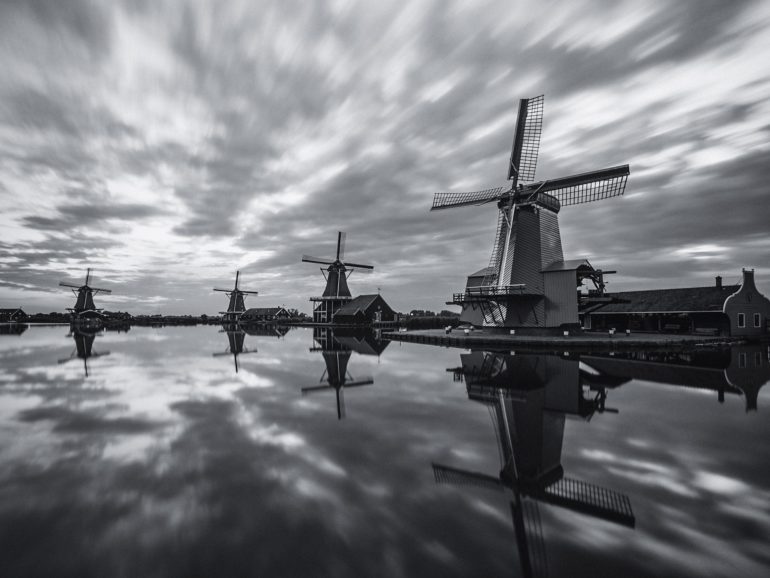
The act of taking pictures accounts for probably 20% of my time. The rest is shared between editing, writing, marketing, and other administrative duties I wish I can delegate at some point soon. Multitasking has become a thing. I write on my notepad when I am out with friends; I edit most of my shots on Lightroom mobile while riding the metro, and I can deliver an entire wedding album if I am stuck on a plane long enough. I think we all do that one way or another. For those of us who freelance, we breathe our photography, and it becomes an integral part of our daily routine, even without a camera in our hand.

I drove a total of 15 hours on that trip. 15 hours may not sound like much for an entire week, but driving is the one thing you cannot squeeze into a multitasking routine. There is no writing when you are driving! There is no culling, editing, or answering customers’ inquiries. Suddenly, I realized 15 hours was a luxury I could not afford with my current workload. I can zombie walk to a shooting location at 5am with minimum sleep and nothing but my grit. Crossing the country at 70 mph in that shape is something I am not willing to try.
I wish my troubles stopped there, but the lack of decent wifi came to be another nail in my coffin. Once again, I rely on a lot of editing and emailing. The bandwidth required for the 200MB GFX files is massive. Do not get me wrong, you can find phone service and wifi in many places. Free ones tend to be weak and strong ones get really expensive really quick.

A lot of people are making it work. Some can focus for a few days at a time on the experience and be completely cut off from the world. I think it just requires a different organization and workflow and, in my case, mixing it with a high-volume and communication-heavy wedding business is certainly not helping. I have a little too much commitment packed in a single day. Working from the road means it will never be the absolute freedom one can imagine as you will always need to set up somewhere with a decent network service. I also understand a little more why most people I meet on the road are couples who can split responsibilities. It is a different world out there, and it requires a different organization.

Despite those two points being huge hurdles, the one thing that hurt my photography the most was the reduced social encounters. Public transportation and hotels are the best way to meet locals or fellow travelers. Out of those encounters will rise ideas, stories you are willing to tell, or recommendations of must-see locations in the area. This is, for me, what travel photography is about, not jumping from one Instagram location to the next. It is about the people.
The one benefit of spending a fortune on a van is that you do not need to pay for a hotel room, therefore, those encounters will pass you by. Besides, there are so many limitations on where you can park that you will always find yourself a little more isolated.

My dreams of van life are not dead, I will just need to look at it harder and figure out the proper workarounds for me, and when I do, you can bet I will make a blog post about it.

5 Photography Cheat Sheets for Shooting Portraits You’ll Love

5 Photography Cheat Sheets for Shooting Portraits You’ll Love

There are tons of tutorials out there for shooting portraits. But many don’t get into the specifics that help you truly love the portraits you shoot. So we dove into our archive of original cheat sheets and infographics to find exactly this sort of stuff. How many of you use the three-color portrait method? Alternatively, what do you know about placing a nose in a portrait? Or lighting?

View this article with minimal banner ads in our app for iOS, iPad, and Android. Get no banner ads for $24.99/year.

Well, guess what! Over the years, we produced all these photography cheat sheets ourselves. And we’re helping you find exactly what you want by assembling a select few. We hope you get all you need for shooting portraits right here.

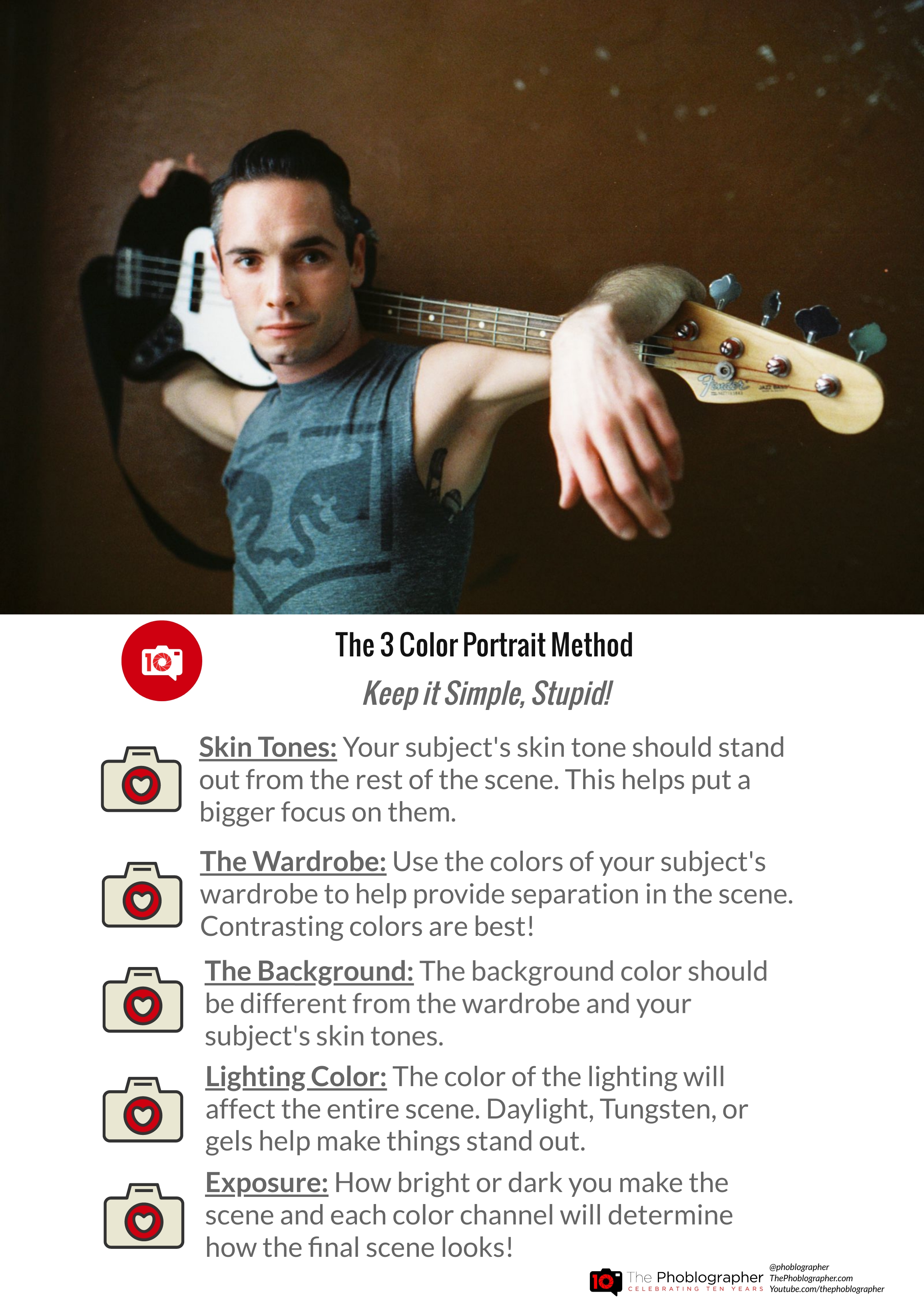
The Three Color Portrait Method

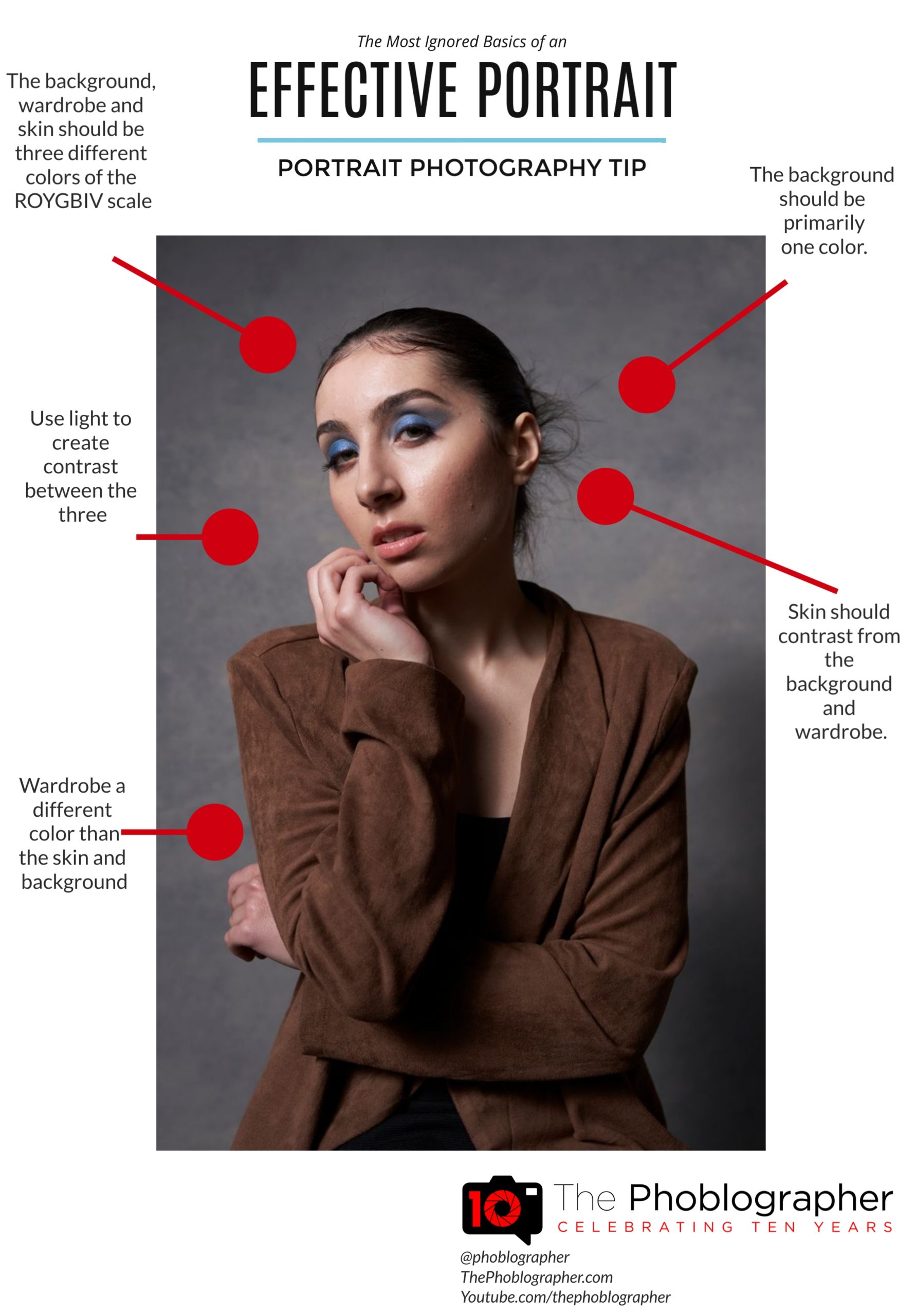
“The approach for many portrait photographers is arguably lazy. Instead of genuinely creating, many rely on the model to do something. But besides giving them instruction, try giving wardrobe input. Using the Behance platform to develop storyboards and mood boards helps a lot. It can dictate things like lighting and more. Plan to go above and beyond by using the three color portrait method. Add props into the scene to give the model something to do. Try flowers or candles. Create a story. Don’t just sit there capturing a model vibing in front of a camera. Those photographers tend to do nothing else but copy the work of others. If you’re looking to create work to feed the Instagram algorithm, stop. Put the camera down, thumb through a few photo books, and get inspired.”

Check out more in our blog post!

Shooting Portraits with an f1.2 Lens

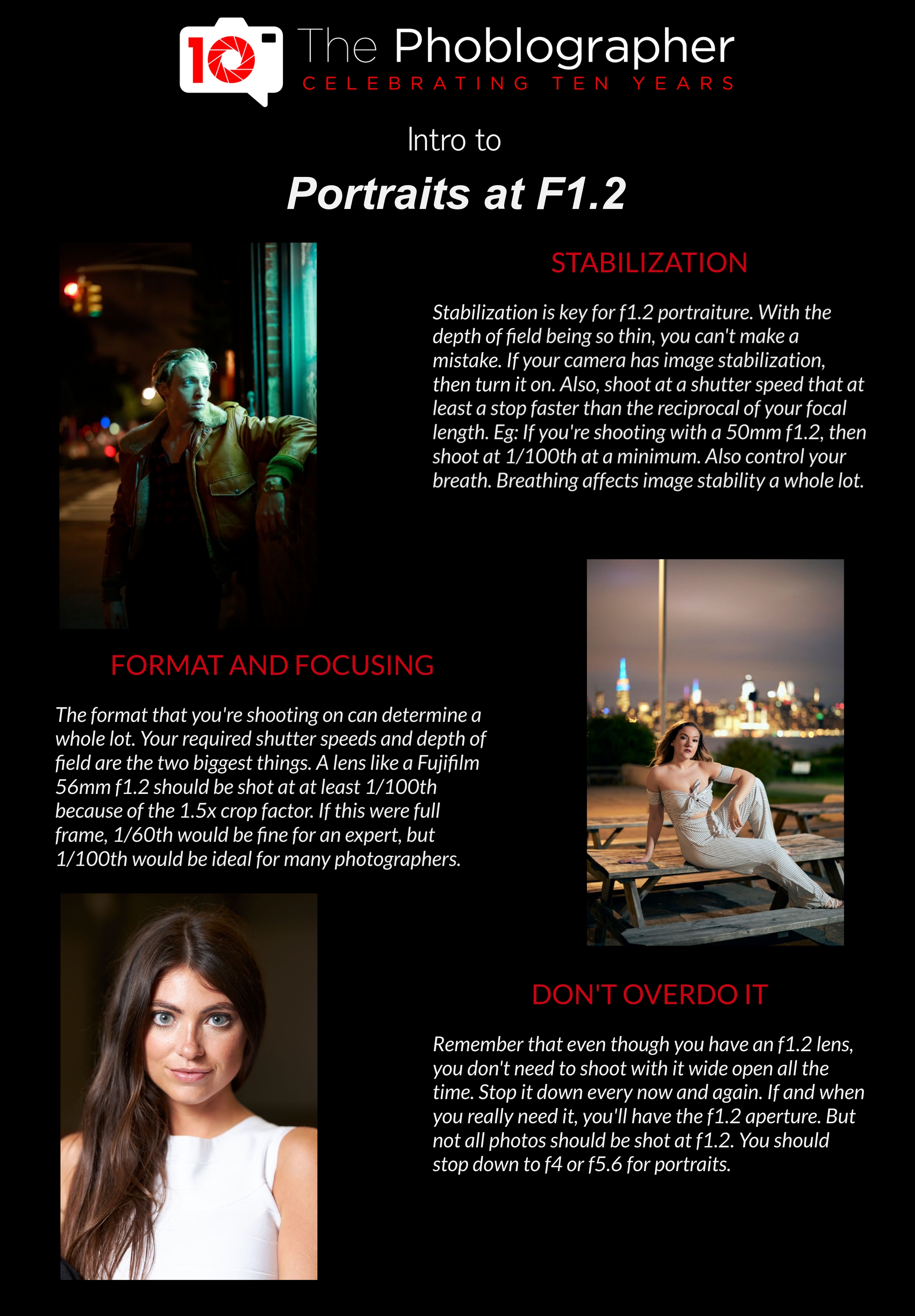
“When shooting wide open with an f1.2 lens, you’ll get a sharp yet soft look. This soft look makes everyone appear lovely and it’s very addicting. But you can deliver more sharpness by just stopping down a tad. We already talked about this, but the ultimate point is to find the balance. Personally, I like the softer look with a Polarizing filter on the the lens, which enhances the colors and contrast more. It’s a similar tactic to what many f1.2 lenses have with their APD variants. With these variants, there is an extra element that brings even smoother bokeh to the photos. Give it a shot!”

Check out more in our blog post.

Positioning the Nose While Shooting Portraits

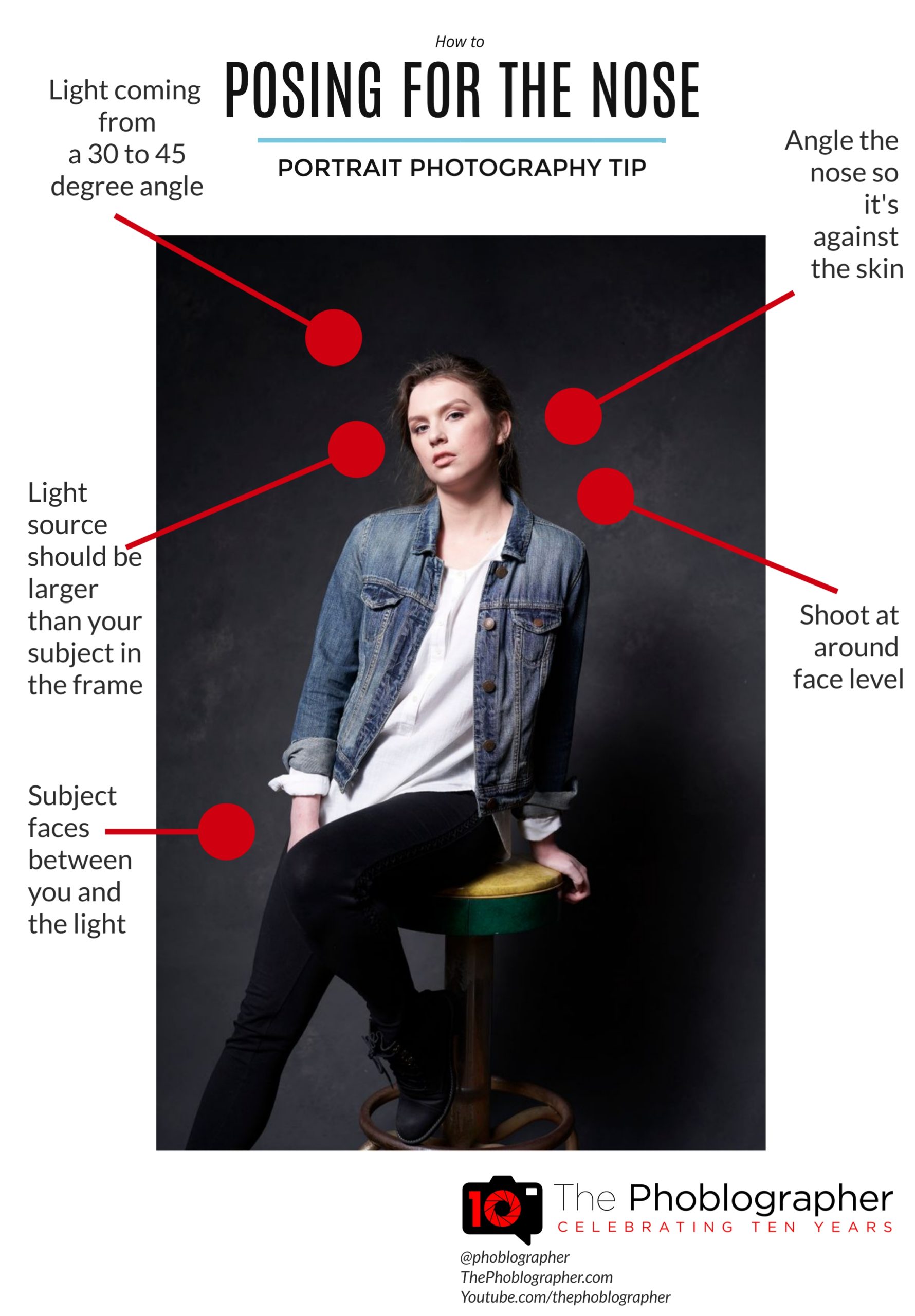
“In addition to this, give the nose a background. By that, we mean to place it against the skin. Notice how, in the image above and our lead image, the nose is against the cheek? That’s what you need to do. This makes the nose pop out less and makes it look more flattering. From here, you’ve got a variety of techniques and poses you can use. You can fold their arms, put their arms down, etc., but our focus here is the face, and it’s best to adjust this last. Don’t worry, that still means you’ve got a whole lot of posing options. Your subject’s face just needs to be posed a specific way.”

Read more in our blog post.

Backlit Portraits

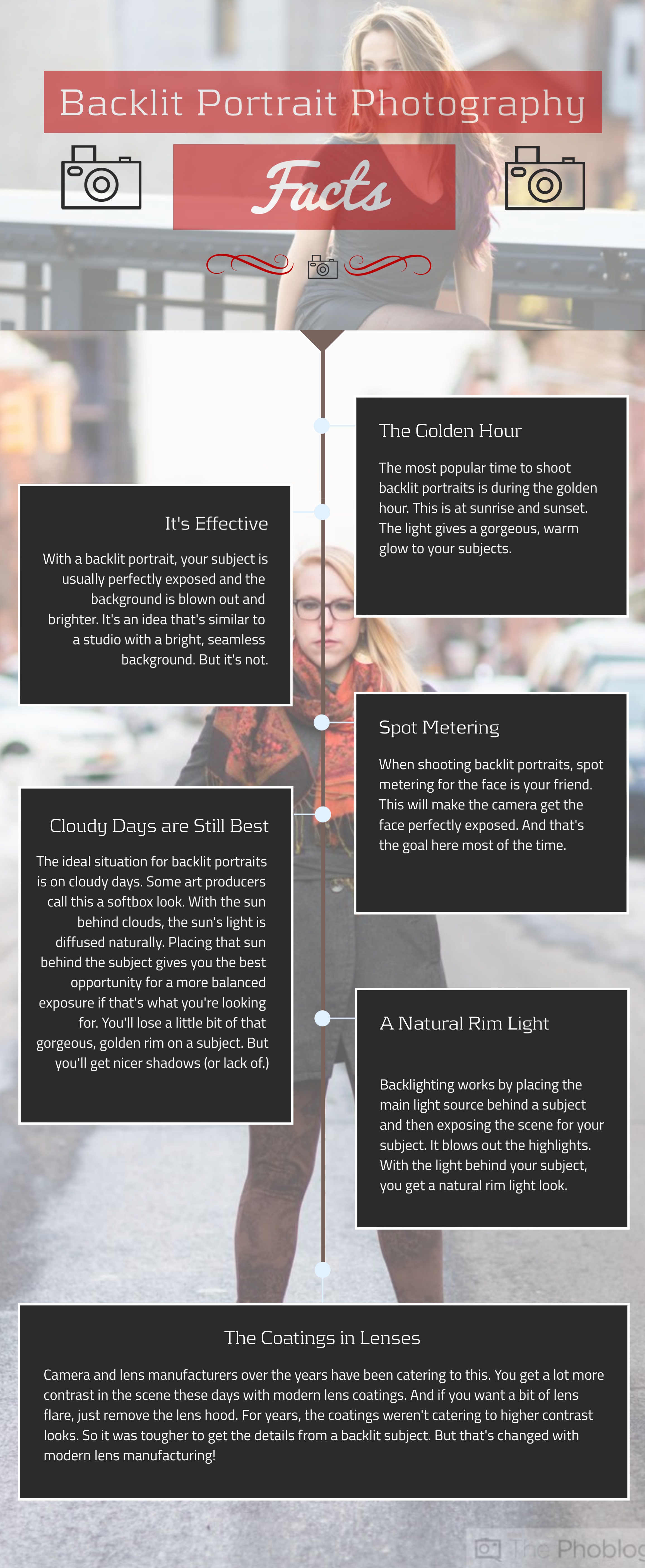
“One of the most important elements in creating a great backlit portrait is to make sure your subject is properly exposed. The default metering mode for most cameras will meter the entire frame rather than focus on your subject. For the best results, set your camera to spot metering and meter for your subject’s face to ensure it’s properly exposed.”

Read more in our blog post.

Important Elements of Portrait Photography

“In my experience of shooting folks of every race, everyone is rendered by cameras in the orange and red channels. Those are typically associated with the skin. You need to find a color that contrasts with the skin. You’ve got five other colors or so to pick from. Once you’ve gotten that, figure out the background. A person shot against a red brick background will inevitably be affected by the red light reflecting off the background. If it’s your intention to get that effect, cool, move forward, but chances are it’s not. Lastly, you need to separate the person from the background. That’s typically done using lighting, wardrobe, and depth of field.”

Read more in our blog post!

A groundbreaking exhibition on the National Mall shows monuments aren’t set in stone

A groundbreaking exhibition on the National Mall shows monuments aren’t set in stone

Children activating the installation America’s Playground: DC by artist Derrick Adams in Constitution Gardens on the National Mall.

A.J. Mitchell/Monument Lab

A.J. Mitchell/Monument Lab

Kids are running all over a temporary playground in the middle of the National Mall. It’s part of Beyond Granite: Pulling Together, the Mall’s first-ever official outdoor show. The idea is to commemorate American stories missing from the Mall and question how history has been enshrined in stone.

These new monuments look very different from the familiar imposing white monoliths or bronze presidents in thoughtful repose. Six acclaimed artists representing a cross-section of Americans – Black, Latino, Asian and Native – from all over the country were chosen by the Philadelphia-based group Monument Lab to participate.

Artist Derrick Adams, who grew up in Baltimore, designed a working playground divided by a billboard-sized archival photograph from 1954. It shows a previously all-white park a few days after it was desegregated by court order. Joyful Black and white children are seen sliding, swinging and climbing together. Visitors are invited to use the space as it was intended.

“What does it mean to have a monument on the Mall that you can play on?” asks Salamishah Tillet. “For children to feel like it’s their space, their Mall, a site of joy and happiness, is a pretty radical intervention.”

Tillett co-curated this exhibition; she’s also a professor at Rutgers University, where she directs the New Arts Justice initiative. This monument, she says, commemorates the fight for American children to have equal access to the right to play.

Paul Farber, the director of Monument Lab, with co-curator Salamishah Tillet at Beyond Granite: Pulling Together on the National Mall.

A.J. Mitchell Photography/Monument Lab

A.J. Mitchell Photography/Monument Lab

“I appreciate the fact that it’s acknowledging both the difficulties of the past, the celebration of civil rights and ushering us into another present as well,” she says.

Beyond Granite: Pulling Together was inspired by Marian Anderson’s legendary public performance in 1939 after white supremacists banned her from singing at Constitution Hall. The Black opera star’s rendition of “My Country ‘Tis of Thee” on the steps of the Lincoln Memorial became a cultural touchstone.

YouTube

Sculptor Paul Ramírez Jonas‘ bronze bell tower plays “My Country ‘Tis of Thee.” But the bells stop tolling right before the end. Visitors must pull a lever to play the final note.

“The piece is simply saying, America is not America without you as an active citizen,” Ramírez Jonas says. “It needs you in some way.”

National identity is partly defined by what we publicly mourn, observes Monument Lab Director Paul Farber. “I think about how in this country, we’re bursting at the seams with grief, with loss,” he says. “We don’t always have a place to put it.”

Artist Paul Ramírez Jonas installing the 600-pound bronze bell that visitors are invited to activate as part of his work, Let Freedom Ring.

A.J. Mitchell /Monument Lab

A.J. Mitchell /Monument Lab

Putting memorials on the National Mall makes them matter, he says. Think of the AIDS quilt. Or a memorial in the show called Homegoing.

Ashon T. Crawley‘s maze of bright blue platforms lies in the shadow of the Washington Monument. It mourns queer musicians who directed Black church choirs, sang in their services, and died, closeted, of AIDS-related complications. Crawley, who grew up Pentecostal, honors the loss of these elders with original music playing softly from speakers. “We are your family,” a choir sings. “We love and we care and sing for you.”

Some visitors to the Mall may not think of these deaths as a defining national tragedy that pulls us together as Americans. This monument asks: Why not? Crowley, a professor of religion, illuminates how Black gospel music and the blues can be traced to the Muslim prayers of ancestors taken from Africa. “If you did not have that sonic practice of prayer, you wouldn’t have the blues,” he says. “And you wouldn’t have gospel music.”

From above, the monument spells out the Arabic word “amin,” which means ‘let this prayer be accepted,'” Crawley says. When visitors enter the maze, they join the word and the prayer by following the path.

Ashon T. Crawley’s monument Homegoing, as seen from above, lies on the south grounds of the Washington Monument.

A.J. Mitchell /Monument Lab

A.J. Mitchell /Monument Lab

Finding meaning, belonging and a balance between trauma and triumph is the heart of this project, says Monument Lab’s Paul Farber. Artists, as artists do, are finding solutions amidst all the recent handwringing about the relevance of monuments. “We’re actually looking for history to come to life,” Farber says.

“You know, I think a lot of monuments commemorate dead people,” notes artist Tiffany Chung. Her monument, For The Living, lies near the Vietnam Veterans Memorial. “I think it’s difficult to live, and when you think about war and conflict, the consequences also fall on the shoulders of the living.”

Chung was a refugee when she came from Vietnam with her family to the U.S. as a child. Her monument is a map, low on the ground, made out of thick black landscaping rubber. It shows the flight paths of migrants from Southeast Asia around the world.

Artist Tiffany Chung’s For the Living lies close to the Vietnam Veterans Memorial on the National Mall.

A.J. Mitchell /Monument Lab

A.J. Mitchell /Monument Lab

“For me, instead of erecting something to really hit the sky, I want to spread it out on the earth,” she continues. “Because this is us. This is where we will go back to after we leave the world. And this is beautiful. The grass will grow. The sun will wash the things away, maybe including the material that created this map. But that’s the brevity of life!”

The monuments of Beyond Granite: Pulling Together aspire to heal legacies of harm. But they are not permanent. Due to various regulations, they can only be displayed until the middle of September.

Gorman Museum ready to put on a show

Gorman Museum ready to put on a show

The C.N. Gorman Museum of Native American Art will unveil a new, much larger home on the UC Davis campus on Friday, Sept. 22, and Saturday, Sept. 23, coinciding with the museum’s 50th anniversary.

Converted from the old UC Davis Faculty Club, the new museum will be able to hold 2,500 pieces of contemporary art by Native American and Indigenous artists, have administration space for staff and student employees, state-of-the-art lighting for the art collection, a small gift shop, a conference room that will serve as a special collections library, public visibility into collection preservationists working and outdoor event areas that will encase the building and cascade down into the arboretum.


enit

Wendy Red Star, “enit,” 2010. Lithograph 10/101. 


rack-augW.jpg

The C.N. Gorman Museum has a collection of 2,250 artworks, most created since 1980, including paintings, photography, ceramics, textiles and original prints.


London woman trades banking career for dog photography

London woman trades banking career for dog photography
Emma Slade with her cockapooEmma Slade

A woman says she gave up a 16-year career in banking to become a dog photographer because her puppy gave her “a new perspective on life”.

Emma Slade, from Canning Town, east London, left her role at Goldman Sachs in 2019 after she got her cockapoo.

The 43-year-old said: “I realised I wasn’t as happy as I had been… there was more to life than money.”

She has now raised more than £1,600 for a north London dog charity by photographing dogs it has helped.

Ms Slade is planning to publish a book in November featuring 36 dogs she has photographed that were rescued by All Dogs Matter, which is based in Haringey.

“Some of them have had horrible starts to life,” she said.

Ms Slade explained her interest in photography had been limited to taking holiday snaps until she got her puppy Schlappohr, who she named after the German word for “floppy ears”.

She said the arrival of the “little puppy” in her life had given her a “new perspective” on work.

Byron, one of the dogs adopted from All Dogs Matter

Emma Slade

Ira Moss, founder of All Dogs Matter, said the money raised would be used to fund the vet bills for one or two dogs at the centre.

“A lot of dogs coming in have medical issues,” she said. “People are spending £2,000 to buy them, but when they get ill, they don’t want to spend money at the vet.”

Ms Moss added that dog abandonment is at the highest rate she has ever seen after the pandemic-led rise in ownership.

Presentational grey line

Follow BBC London on Facebook, Twitter and Instagram. Send your story ideas to hellobbclondon@bbc.co.uk

Related Topics

Related Internet Links

The BBC is not responsible for the content of external sites.

The artist’s in studio: Karla Diaz

The artist’s in studio: Karla Diaz

Karla Diaz is a professional comic artist and illustrator from Chile, who has been drawing since childhood. She specialises in character design, comics and writing, and currently works for Sandstorm comics. Below she takes us through her studio setup.

“I live in Santiago, the capital of my country, Chile, and moved into this apartment with my partner a year ago. I work as a freelancer, so my studio is set up at home. It’s divided into two sections: one for traditional drawing, sketching and painting, and the other for all my digital work.

“My digital work setup consists of a 2019 iMac, and the main software I use for my illustrations and comics are Clip Studio Paint and Photoshop. I also use Evernote for writing my scripts, and always have Spotify playing K-pop music. Yes, I’m a K-pop fan!

My current favourite tools are my Copic Sketch Markers.

Karla Diaz

“An old Wacom Cintiq tablet from 2012 helps with my graphic work, and it still does a great job. I don’t use the original iMac keyboard. Instead, I environment, along with some toys and mementos that I’ve collected. However, I don’t like accumulating too many things because they tend to gather dust, which stresses me out. The Ikea panel you can see serves more as decoration and a place to hang my headphones!

“The other part of my studio is the table where I keep all my traditional drawing tools and my iPad. I use the iPad here to view references, watch videos, listen to music, and so on. I also use it for illustrating in Procreate, among other things.

“My current favourite tools are my Copic Sketch Markers. I have two sets: the 72-colour E set, and the set of 24 colours Copic gave me to promote their manga drawing contest. I also have a small set of 12 cool grey Copic Sketch Markers that were given as a gift from my partner.

“Next to my desk, I have a small bookshelf for art and comic books. I plan to replace it with a larger one because it’s getting too small! I have Loish’s artbook collection, lots of French comics, and artbooks from various Japanese artists.

I always try to learn new things, especially drawing and painting techniques. I’m what they call an eternal learner. I love taking courses on digital illustration, art, marketing, social media, and so on.”

Find Karla Diaz at her official website, for commissions and new art.

Artist in residence: Karla Diaz

Karla Diaz; a white and pink artist studio

(Image credit: Karla Diaz)

Karla’s studio setup, clockwise from top left. “This is my LED lamp. I bought it ages ago, and it still works perfectly. I don’t use it much anymore because I prefer to do my drawing using natural light. (Read our list of the best craft lights.)

“My iPad Pro is one of my most cherished tools; like having a mini computer that accompanies me. When I work in cafes, I take it with me to draw or write, as well as when I travel. (Read our guide to the best iPad for drawing.)

“I have two favourite books. The first is Mika Pikazo’s artbook. Her compositions are inspiring and I love her vibrant colours. The second is Anatomy for Artists by Tom Fox.

“I bought this miniature vacuum cleaner mainly because of its adorable cat paw shape, although in truth it doesn’t actually pick up a great deal of dirt.

“This sketchbook has been with me for almost two years, and I only have a few pages left. The size has been a challenge since I’m used to smaller sizes like Moleskine’s sketchbooks.

“This is my collection of compulsively purchased sketchbooks that, in my mind, I’ll eventually manage to fill up. No, really, my plan is to complete them all!”

Artist studio; Karla Diaz

(Image credit: Karla Diaz)

Karla’s studio setup, clockwise from top left. “This is my panel where I organise my week by hand, which works best for me. Below there’s a cork board where I put important information.

“A new raindrop plant that I bought exclusively for this article, as my first plant died and looked very depressing. Now I have a care kit and fertilisers to prevent that from happening again.

“This is my Ikea panel. I love the design and how practical it is. Here, I have some postcards that I bought from SHEIN, pencils, and my Bach Flower Remedies that I use occasionally when I’m anxious.

“I have an Epson L4260 printer for occasional needs, such as paperwork or printing photos. (Read our guide to the best art printers.)

“This Wacom Cintiq 24HD is truly a relic! I bought it around 2011 when I made the jump from a used Intuos tablet to this one with a screen. It’s been one of the best investments I’ve made for my work. It has survived several moves and still works flawlessly, and has never had a dead pixel.”

Artist studio; Karla Diaz

(Image credit: Karla Diaz)

“This illustration was made with Copic markers as a collaboration with an art supplies store. The idea was to create an image using traditional techniques with the theme related to drawing. It was a pleasure for me since this store is one of my favourites.”

Artist studio; Karla Diaz, a bright pink computer keyboard

(Image credit: Karla Diaz)

“I bought this Logitech POP Keys keyboard solely for its design and beautiful colours, but when I started using it, I realised how satisfying it actually is to type on as well. It’s very comfortable, and the battery lasts for a long time too.”

Artist studio; Karla Diaz, cat sat on a stack of books

(Image credit: Karla Diaz)

“Lately, I’ve been using a Sakura Papel Blanco Crema sketchbook, which is 21 x 30cm with 80 sheets. The paper isn’t heavy, but it’s sufficient for using Ecoline paint and Copic markers.

“My cat Koko is already a year old, very cuddly, and always demanding attention. He’s also a rescue cat, and was quite ugly when he was little. My other kitten is Luli (right), who has been with us for two months. She arrived infested with fleas and dirt, but now she’s beautiful!”

Artist studio; Karla Diaz, a mix of coloured pens on a desk

(Image credit: Karla Diaz)

“My first encounter with Copic markers was through a gift from my partner. They gave me a set of 12 cool grey tones, and I fell in love with them as soon as I tried them out. As soon as I could, I bought a large set, and now I can’t stop using them.”

Artist Studio; Karla Diaz, a book shelf with art books

(Image credit: Karla Diaz)

“I’m not a fan of Funko Pops, but I had to have this one of Mr. T, my childhood hero. I bought it without its box at an antique market here, and it was very cheap!

“One of my newer pieces of furniture. I bought it from Ikea when I moved into this apartment. Too bad I underestimated the power of my compulsive purchases, and now I can’t fit any more books in it.”

Artist studio; Karla Diaz, Ecoline paint pots on a shelf

(Image credit: Karla Diaz)

“My partner gave me these Ecoline paints. I first used them at university and always wanted to try them again, so this gift made me happy! They are similar to watercolours and require thick paper.”

Artist studio; Karla Diaz, a sketchbook filled with cartoon characters

(Image credit: Karla Diaz)

“I use my sketchbook to explore different themes and techniques. It’s still challenging for me to draw with ease. I think I’m very self-critical, but I’m working on it.”

Artist Studio; Karla Diaz, coloured pens and headphones on a hook

(Image credit: Karla Diaz)

“These are my Apple AirPods Max headphones. They are incredibly comfortable, and the noise cancellation allows me to concentrate a lot.

“This is a selection of my favourite pencils, which include some Tombow graphites and well-worn Faber-Castell pencils.” (Read our guide to the best pencils for artists.)

Get more Procreate tutorials in ImagineFX

This content originally appeared in ImagineFX magazine, the world’s leading digital art and fantasy art magazine. ImagineFX is on sale in the UK, Europe, United States, Canada, Australia and more. Limited numbers of ImagineFX print editions are available for delivery from our online store (the shipping costs are included in all prices) 

Alternatively, you can access us instantly through our digital options:

• Apple app (for iPad or iPhone)

• Pocket mags (multi-platform app, great for Android users)

• Zinio (multi-platform app for desktop or smartphone)

• Amazon Kindle

The big picture: ​praise dancers ​in Edna, Texas

The big picture: ​praise dancers ​in Edna, Texas
image

Praise dancing, a response to the biblical injunction to “Praise him with dancing and tambourines!”, is deep-rooted in Baptist and Pentecostal churches in the American south. Rahim Fortune took this picture of praise dancers in the town of Edna, Texas in 2020. It was part of a series focusing on the family of a young creative director, Chasidy Chevonne, for a book project in which Chevonne reflected on Black womanhood and the lives of the women she grew up among. The photographs were originally released to mark Juneteenth – the federal US holiday commemorating the end of slavery – a month after the murder of George Floyd in May that year; they were intended “as a form of visual healing”. Texas had been the last state to hear the Emancipation Proclamation, in 1865.

Rahim Fortune has been photographing in the southern states for the past six years; his work, including this picture, will feature in the inaugural PhotoFairs exhibition in New York next month. His pictures often examine different elements of his own heritage – his father was an African American living in Austin, Texas and his mother part of the Chickasaw Nation in Oklahoma. He thinks of his photographs as “a love letter to the place I grew up in” and a series that speaks to the “mythic quality of culture” in the American south-east. As well as his praise dancers, Fortune’s work celebrates blues musicians and rodeo queens, tracing the contributions of Black and Native American traditions to contemporary Americana and folklore. His ambition, he says, is to produce a body of work that can “ascend [beyond] any narrative around rural Black identity in America as one of simply servitude or oppression. Rather, I intend to highlight the boundless creativity and possibilities of the music and people who still contribute to this culture.”

Justus Fine Art Gallery hosts ‘Seeing’ photography exhibit

Justus Fine Art Gallery hosts ‘Seeing’ photography exhibit

em {
display: contents !important;
}
label em {
display: none !important;
}
.photo {
width: 100%;
max-width: 50rem
}
a.fr-file {
color: #0274b7 !important;
}

Justus Fine Art Gallery will host “Seeing: a Photography Exhibition” in September.

The exhibit will feature work by artists including Beverly Buys, Robbie Brindley, George Chambers, Don House, Carey Roberson, Andie Roberts and Eli Vega.

“Along with the individuality of artistic styles, a range of photographic processes will also be displayed. In conjunction with the photography show, a Haiku poetry competition, inspired by the works on display, will be held throughout the month,” a news release said.

The opening reception will be held from 5-9 p.m. Friday as part of the monthly Gallery Walk in downtown Hot Springs. The exhibit will be on display through Sept. 30.

Selections from Roberson’s “Morning Stroll Surprise” series will be featured in the exhibit.

“‘Morning Stroll Surprise’ is an iPhone-based side-project, that began while on a trip to New York in 2015, and was originally intended only as a creative exercise to get out of an artistic rut, and to lose some weight while taking morning walks (but that is a whole other issue),” Roberson said in the release.

Eight years later, “it has developed into part of my creative practice and is a major influence in all of my other work. The premise of the project is to study the unnoticed through a process of subtraction, framing, and questioning. Poetic connections are created through little shifts in perspective. Hidden arrangements wait to be subtracted by the camera’s frame and brought into a new life. Disparate forms and objects generate into new contexts and meanings, and framed assortments of circumstances give significance to the often unremarkable. Unfortunately, the weight loss part hasn’t gone as well as the project,” Roberson said.

Roberson earned a BFA in Studio Art from Henderson University in Arkadelphia and a MFA in photography from Louisiana Tech University. He is an associate professor of Art at Ouachita Baptist University in Arkadelphia, where he is the gallery director for the Rosemary Adams Department of Art & Design Galleries, and teaches art foundations, photography, sculpture, printmaking, and other studio art courses. He previously served as an associate professor of Art at the University of Arkansas at Little Rock from 2002 to 2018, where he headed the Photography Program, along with serving as the BFA coordinator and interim chair of the Department of Art & Design.

“Roberson’s artwork integrates traditional studio media with new digital technologies and methods to create quiet personal narratives,” the release said.

Roberson has exhibited in over 70 competitive, invitational, and solo exhibitions. His work has been exhibited at the University of North Texas, Ithaca College, Huntsville Museum of Art, Mobile Museum of Art, the Arkansas Museum of Fine Art, and numerous other university and private galleries around the nation. He is a winner of the Arkansas Arts Council Individual Fellowship Award and has works in a number of collections, including the Mobile Museum of Art in Mobile, Alabama. Roberson’s artwork has also been featured in the national publications of New American Paintings and CMYK Magazine.

“Using a film camera and an enlarger, nothing is digital in Buys’ process of creating cyanotype prints. Each print is one-of-a-kind — no two prints from the same negative are ever the same,” the release said.

“Cyanotype prints are made when sensitized paper is exposed to ultraviolet light. It is simple and direct in execution,” Buys said in the release.

“I strive for perfection at the beginning and embrace, even encourage, the imperfections that the process brings. The photographs are grid-like in that I enlarge each negative on six separate pieces of film that I have pieced together kind of like tile on a floor. The resulting negatives are placed on cotton rag paper that I have coated with the simple cyanotype chemistry. On sunny summer days, I make the prints by exposing this sandwich of sensitized paper, negative and a heavy sheet of glass to hold all in place under the sun. The prints are developed and washed in a large tray in my backyard using a garden hose. The simple tools and processes that I use to make the photographs reflect back on the type of ingenuity that I appreciate in the subjects of my Delta imagery,” Buys said.

Buys’ cyanotypes have been showcased in solo exhibits at Arkansas State University in Beebe; the Delta Cultural Center in Helena; the Russell Fine Arts Gallery at Henderson State University; and the University of Memphis Art Gallery in Memphis. Buys’ work has also been included in group exhibitions including the annual “Delta Exhibition” at the Arkansas Museum of Fine Art in Little Rock; “artSpark 2013” in Raleigh, North Carolina; the “2011 Winthrop Rockefeller Institute Legacy Art Exhibition” at Petit Jean; and “Selections From the University of Arkansas at Little Rock Permanent Collections” at the University of Arkansas in Little Rock.

Buys earned a BSE in Art Education from Henderson State University, an MA in Photography from the University of Arkansas at Little Rock, and an MFA in Photography/Printmaking from the University of Memphis. Buys served as a professor of photography at the Ellis College of Arts and Sciences at Henderson State University prior to retiring in 2014.

Chambers’ photographs focus on the landscape in an attempt to “look beneath the symbolic language we overlay the world with and glimpse what’s there” will be included in the exhibit, the release said.

“Place a tiny human face somewhere in the landscape and the eye will find it immediately. Any text in the scene and the eye wants to read it,” Chambers says in the release.

“Avoiding these symbols, I try to create a blank slate that is still visually dynamic, leading the eye into ever deeper levels of textures and detail. If the viewer connects with the image, they project their own feelings and meanings onto the piece.”

Chambers earned a BA in Commercial Photography from the Brooks Institute of Photography in California and currently maintains an active studio in Little Rock. His work has been included in a range of group and solo exhibitions, including “Beyond Symbol” solo exhibit at the Baum Gallery of the University of Central Arkansas in Conway in 1999; “Small Works on Paper,” 2003, 2002, 2000 and 1998; “Visual Anthropology: Welcome to our Neighborhoods” group show at the Laman Public Library in North Little Rock, 2016; two-person show, Anna Eaton Stout Gallery, Brescia College, Owensboro, Kentucky in 1996; “Trappings Exhibition,” Hot Springs Arts Center, Hot Springs, 1991; “Lightwriters,” Kresge Art Center, Michigan State University, East Lansing, Michigan, 1984; and “Prints, Drawings, Crafts Exhibition,” Arkansas Museum of Fine Art, Little Rock, 1991, 1984 and 1983. Collections include Arkansas Fine Art Museum, Henderson State University, University of Arkansas Medical Center, Kimberly Clarke Corporation, and LSI (GMAC Financing).

House “is respected for his dramatic black-and-white portraiture and rural scenes, along with his altered Polaroid prints. His work has been included in numerous solo and group exhibitions throughout the U.S., along with a wide range of publications. His photography has been featured in The Wall Street Journal, American Forests, Boy’s Life, Persimmon Hill, First Freedom, Free Hunters, Outdoor Oklahoma, Wood, Traditional Bowhunter, Backpacker Magazine, and Woman’s World, along with a variety of university textbooks, and covers for fiction and nonfiction books. Two collections of his work, “Buffalo Creek Chronicles” and “Not a Good Sign,” have been published by Phoenix International Press.

Selections of Brindley’s spare landscapes will also be included in the exhibit. “He only shoots with film using a Mamiya RB67, which requires a tripod and careful attention when composing his photos,” the release said.

“My work is a slow process. Sometimes driving all day over many miles of back roads and dirt paths, passing small towns and empty fields … to take one picture,” Brindley said in the release.

“Roberts has been photographing since she was a child and more seriously for the past 15 years. Her images reflect her interest in finding beauty in the abandoned. She doesn’t manipulate the imagery she finds, but creates engaging compositions from what she sees. This exhibit will be the first time Roberts has shared her work publicly,” the release said.

Vega was first exposed to art while attending Texas Tech University “where he gained a foundation in color theory, design, and composition. It wasn’t until 20 years later that he first began to explore photography,” it said. He currently teaches private and group photography workshops, along with writing. His books include “Renditions of Famous Paintings,” “Right Brain Photography (Be an Artist First),” and “I Always Wanted to Be Somebody (But, I Settled for Much More: Me).”

Owned by artist Dolores Justus, Justus Fine Art Gallery, 827-A Central Ave., is open from 10 a.m. to 5 p.m. Wednesday through Saturday. Call 501-321-2335 or visit http://www.justusfineart.com for more information.


photo


“My Garden,” by Beverly Buys. – Submitted photo


photo


“Morning stroll surprise in red rock, black asphalt, and white reflective plastic,” by Carey Roberson. – Submitted photo