
One part of “Playmates,” a pair of giant puzzle pieces on Colby Avenue, was reported missing Thursday.
Puzzling case: 5-foot jigsaw sculpture missing from downtown Everett


The enchanting allure of golden hues, vibrant skies, and serene landscapes make both sunrise and sunset photography captivating endeavours. While sunrise photography has its undeniable charm, there are distinct qualities that make sunset photography equally mesmerising, if not more.
In this article, we delve into five reasons why sunset photography shines brighter than its early morning counterpart. Now besides the obvious reason that you don’t have to wake at a ridiculous hour, take the journey in darkness and all the while not sure of the impending conditions there are a few more which set sunset up as one of the favorites of many photographers.
Sunset photography offers a canvas of awe-inspiring and ever-changing skies. As the day comes to a close, the atmosphere becomes infused with vibrant colours, ranging from warm oranges and pinks to fiery reds and purples. The interplay of clouds, hues, and textures creates a visually striking backdrop that adds drama and depth to your images. The dynamic nature of the evening sky presents opportunities for creating captivating compositions and narratives. At the end of the day you have the opportunity to survey the sky well before the golden hour approaches to help you determine your location, compositions, and assess the potential for the fiery sunset to come.

Sunsets are renowned for their intense and saturated colors that can set the sky ablaze. The warm tones and fiery palette can create a sense of warmth, romance, and emotion in your photographs. The golden hour during sunset bathes the landscape in a soft, warm glow, casting captivating shadows and emphasizing textures. The richness of colors at sunset allows for bold and vibrant imagery that evokes a powerful visual impact. Watching these grow in intensity during the last hour of the day helps you determine where you should be and if you need to readjust your position to maximize the composition you have chosen for that shoot. This can be done with ambient light all around you, unlike sunrise which invariably is in the dark.

The timing of sunset photography provides numerous advantages for outdoor shoots. The late afternoon and early evening hours offer more flexibility in planning and preparation, allowing photographers to scout locations, set up equipment, and make necessary adjustments before the golden hour commences. Additionally, the comfortable temperature during the evening enhances the overall experience and enables photographers to focus on capturing stunning images without worrying about extreme weather conditions. The challenge this presents is the higher possibility for others to be at the same location due to the hospitable timing, this can be other photographers of course, or even other tourists or visitors to the area who all have the potential to enhance or distract from your photographic goal.

The low angle of the sun during sunset creates captivating silhouettes and mesmerizing backlighting opportunities. Subjects positioned against the vibrant sky can be transformed into striking silhouettes, adding a sense of mystery and intrigue to your photographs. The warm and diffused light also adds a touch of magic, illuminating objects and creating a soft halo effect. These ethereal qualities of sunset lighting allow for creative and poetic compositions. The important part here is to experiment and play around with different subjects and shutter speeds, and while you do have time on your side to do this, it is always worth bearing in mind that the light is fading with every second that passes, reducing your opportunity to fine-tune a composition each time.

Sunset photography offers a tranquil and reflective atmosphere, perfect for introspection and capturing moments of serenity. As the day winds down, nature and the surrounding environment often adopt a calm and peaceful ambience. This tranquil setting creates a serene backdrop for your photographs, evoking a sense of harmony and allowing viewers to connect with the tranquil beauty of the scene. As the sun sets you will often find yourself alone or at worst in a small group of other photographers who like you are there to enjoy not only the photography but the feeling and sense of connection with nature that sunset can provide.

While sunrise photography holds its unique charm, sunset photography undeniably steals the show with its dramatic skies, rich colors, ideal timing for outdoor shoots, dreamy silhouettes, and peaceful atmosphere. The intense colors, vibrant palette, and mesmerizing lighting of the sunset create an enchanting backdrop for capturing memorable and emotionally evocative images. Embrace the twilight hours, harness the magic of sunsets, and allow their qualities to inspire your photography, showcasing the beauty of the world as the day bids farewell.
Remember the best colors can happen long after the sun has gone below the horizon, so don’t feel like you need to rush away moments after the sun has set, stick around and watch the sky’s color pallet change before it fades away for the absolute end of the day. You now also have the advantage at your feet of the potential for some astrophotography, so always worth keeping that idea in your bag should you have the time to wait around until darkness has fallen.
What are your thoughts on this topic? Let’s continue the conversation in the comments below.


CC standing, and Castro seated, each wearing traditional dress of their culture. Photo courtesy of the interviewees.
This article was written by Tatiana Suarez Patiño for Muy Waso, and is republished on Global Voices under a media partnership agreement.
Love is in the details, and no one can convince me otherwise. That is why I am fascinated by art, because it is full of details that reflect the artist’s total and boundless dedication.
If we talk about plastic arts, those details can be in the minimal point of light inside the pupil of an eye that transforms it into an observing subject, or in the delicate way in which yellow paint can become the mid-afternoon sun.
I have spent years of my life looking for these signs that reveal love, and without being arrogant, I can consider myself an expert in finding them. I not only see them, but also feel them.
That’s why the first time I saw Castro and CC together I recognized that love that comes from the details, and because of that magic, I was compelled to ask them for an interview to write the story that I share with you below.

Castro (left) and CC (right). Photo courtesy of the interviewees.
I was in Phoenix, Arizona, in the U.S. when I met them. They live there and that’s where they carry out their resistance. I met them at Cahokia, a venture led by Native American women, which works to generate sustainable economies through the development of artistic projects that promote creativity, the recovery of ancestral memory and the strengthening of Indigenous entrepreneurship.
Castro is Stephanie Guillermina’s last name and nickname; she is 32 years old, born in Queens, New York. Her parents are from Colombia and Chile and she is of Muisca and Mapuche descent. She identifies as Queer, and is a multidisciplinary artist, event planner, and doula.
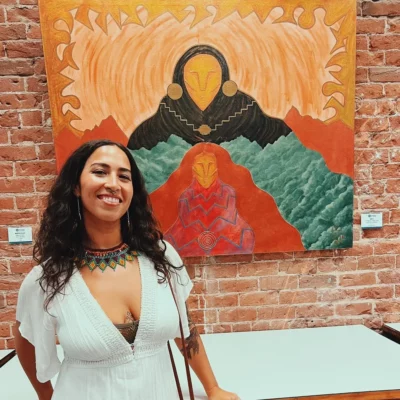
Stephanie Guillermina Castro posing with her work. Photo courtesy of the interviewees.
Carrie Sage Curley, better known as CC, born on the sacred lands of San Carlos Apache in Arizona 34 years ago, is a lesbian, multidisciplinary artist, community organizer, and cultural keeper.

Carrie Sage Curley posing next to her work. Photo courtesy of the interviewees.
In 2020, the two met during devotions at the Apache Stronghold ceremonial center at Oak Flat, a mountain sacred to the Apache. In 2022, after participating in an event, Women of the Desert, in Phoenix, they felt their paths were not two, but one, and they have been walking hand in hand ever since in the same direction.
That direction is everything. They do not have a relationship, they have a healing purpose: to make Indigenous women visible and recover their wisdom through art. Recovering their image taken away by centuries of colonization is not a minor struggle, and that is one of their goals — to build their image away from the visual clichés imposed by the dominant white ideologies, and they do it by painting one mural at a time. Their artwork can be found in the streets of Phoenix, in galleries, in social spaces, and in private collections, portraying strong, free, and autonomous Indigenous women, with their lights and shadows.
In this regard, Castro says:
I hope to capture an authentic representation of my ancestors through the lens of the spirits that guide me and my brush. I hope to provoke a connection to the Andes for those who have been displaced through migration. I hope that my relatives and those who experience my art will feel the power and light that traveled through me. And that they see the beauty and deeper meaning of intergenerational wisdom and love.

CC and Castro during a peaceful protest for the rights of sacred Indigenous lands. Photo courtesy of the interviewees.
For CC, her art is a connection to herself and to her roots through culture. It is interrogating her existence. She says:
I use my art as a weapon for the people. I love to paint my people, especially the women. It is an honor to be Apache. Whoever comes across my work I want them to feel loved by theirself and proud.
There is an ancestral voice that guides them and connects the past and the present to build a future, and those voices are materialized in art pieces, as CC explains:
We are our great-grandmothers, grandmothers, mothers. The clan is passed down from generation to generation. Our connection to the land is through our clan. I paint the strong women of the past and present. My mother is a local seamstress who continues to keep the spirit of dress alive. I photograph her work with my family and the women of the community, and that is why I am like this, I find my strength in my culture and the land.

CC painting a mural on the streets of Phoenix, Arizona, U.S. Photo courtesy of the interviewees.
The story that both are building is deeply inspiring, for it is the story of liberation. The liberation of our bodies and our image, as Castro says:
I feel that colonization has robbed us of our sensuality and connection to our divine sexual power and energy. I work diligently to regain this sensual awareness and connection to my body and my sexual power. The freer we are as individuals, the freer we are as a people. Returning to our ways in which we followed spirit and nature. Because our sexuality is divine nature — as plants and trees pollinate, so do we.
The sexual revolution is a pending issue in Latin America, and in Indigenous communities even more so; however, this story of transformation and light shows us that another reality is possible, where traditions, spirituality, and creativity are not at odds with sexual diversity, but rather complement each other and become one.
In this regard, CC shares the following reflection for all those people who have an internal debate between their sexuality and their traditions:
You should know that there is nothing wrong with you. Our creator gave you the spirit you carry. I know it can be scary to think what others say when they think of you but show them kindness and love because that is who you are. You need prayers, the earth, and people to be supported healthily.

CC and Castro fused in a loving embrace. Photo courtesy of the interviewees.
I thank them for the moments I was able to enjoy their company and I thank them for allowing me to tell their story. I feel it is a duty to share the life of these powerful souls, so that the force that brought them together can be amplified, and their experience can inspire others to live a freer life, far from the shackles of puritanical glances that condemn the healing love between Indigenous women.
As I finish writing this text, and my memory returns to the first day I met them. Castro looked at CC and smiled at her, and a whole universe opened up in the room. Planets, languages, silences, and ecosystems lived there that no one else could understand but them. And so I reassert my stance: love is in the smallest details.

Guillén Apezteguía is a photographer who loves to shoot film. He lives in San Diego and his work can be seen at cgaphotography.com and on Instagram, @cgaphotographs.
My personal journey with film photography began in college in the early 1990s. My dad gave me his Olympus OM-1 35mm film camera, and I enrolled in photography classes at Southwestern College in Chula Vista. One of our first assignments was to photograph something familiar, something relatable to our everyday lives. I loaded the camera with some Kodak Tri-X film and crossed the border into Tijuana. My dad ran his business down there, so it was familiar territory for me. I began to document everyday street life on both sides of the border. I loved shooting portraits, and I started to work with a magazine based in Tijuana, covering the local music scene. I remember the excitement of developing my film and printing in the darkroom. It was really magical, seeing those images appear on the paper in the chemical bath with the amber glow of the safelight overhead. I was hooked! Over the next several years, I kept shooting, and I transferred to UC San Diego to finish my degree in visual arts.
As technology continued to advance at a rapid pace, the rise and dominance of digital photography was inevitable. Slowly but surely, photographers including myself began to ditch film in favor of digital cameras. The quality of digital imaging improved tremendously over the years, allowing photographers to capture stunning high-resolution images on a chip the size of a postage stamp. Incredible! We no longer had to lug around rolls of film and reload the camera every 12 to 36 shots. We could literally shoot hundreds or even thousands of images and store them with ease on our memory cards, and transfer them electronically to our laptops or to the news desk in a matter of seconds. Who in their right mind would want to go back to shooting film? One would expect film to become obsolete at this point.

(Carlos Guillén Apezteguía)
As it turns out, a lot of artists and photographers these days are embracing analog film photography, and it’s making a comeback. In 2017, I decided to pick up a film camera again, and my romance with analog photography was rekindled in big way. I set up a makeshift darkroom in my bathroom and began to process black and white film. I scanned my negatives and the resulting images had a gorgeous look with subtle nuances in tone, texture and grain. The visual language of film was making its way back into my art and I loved it.
To my surprise and delight, I found a large community of fellow analog photography enthusiasts on Instagram, as well as right here in San Diego, through groups like Beers and Cameras (@beersandcameras), I’m Still Developing (@imstill.developing) and SD Walkabouts (@sdwalkabouts). A lot of young photographers out there are making some amazing work with film, and it’s very exciting.

(Carlos Guillén Apezteguía)
Aside from the aesthetic appeal that is unique to film, I think members of the younger generation who grew up with digital photography are embracing analog photography for multiple reasons. First off, shooting film requires a more mindful approach: It forces the photographer to slow down, and approach each shot with greater consideration. I think that this slower approach cultivates a deeper connection between the photographer and the subject, resulting in more meaningful pictures. The tangibility of analog photography is also very appealing to many people. Rather than digital files stored away on a hard drive, you get to see and hold and contemplate your slides and negatives. During the early days of the COVID-19 pandemic, I went back into my archive and scanned loads of my old negatives, and in a sense, rediscovered a lot of my early work. I can’t think of a single file from any hard drive I had 30 years ago that still exists. But my 30-year-old negatives are still in almost perfect condition.
I think the biggest reason for the resurgence of analog photography is that shooting film is fun! There’s always an element of anticipation and surprise that you just don’t get with digital. Loading your camera with a roll of fresh film and going out into the world to make pictures is exciting and rewarding.
The younger generation understands this and is embracing it. A lot of us who started shooting film before the advent of digital photography can also appreciate the enduring appeal of film. I would advise anyone who has an interest in photography and has not yet shot film to give it a try. Grab an old camera and have fun with it. If you’re not sure that you have it in you to develop your own film, take it to a local lab such as Safelight Labs, and it will develop and scan your film for you. So don’t wait, get out there and shoot some film! And most of all, have fun.

Man Ray, the American artist and photographer who all but defined the early 20th-century Paris art scene, is associated with many things. He’s associated with Surrealism and Dada, and the likes of Marcel Duchamp and André Breton. He’s also associated with Lee Miller and Kiki de Montparnasse, as well as the couturiers Elsa Schiaparelli and Coco Chanel, for whom he took photographs beginning in the interbellum years, after moving from New York to Paris in 1921. As such, the celebrated shape-shifter bridged the worlds of art and fashion like no other.
Some of Man Ray’s best-known photographs include Noire et Blanche (1926), Lune sur le Visage (1930), and Le Violon d’Ingres (1924), the last of which nearly tripled the record for most expensive photo sold at auction when it netted $12.4 million at Christie’s in 2022.
Not only have Ray’s ingenious photographic techniques—stark shadowing, solarization, rayographs—been endlessly reproduced over the years, he’s also become a font of inspiration for fashion designers. His enigmatic style and humor have been reflected through the collections of Yves Saint Laurent, Martin Margiela, Dries van Noten, Celine, Lanvin, and Madeleine Vionnet, to name just a few. Many of them are Belgian names, which may not come as a surprise given the country’s history of avant-gardism.
In “Man Ray and Fashion” (through August 13) at MoMu, the fashion museum of Antwerp, the artist’s photographs are presented alongside fashion pieces they inspired, highlighting the pivotal influence of his work on contemporary fashion. Here’s a selection of images showcasing Man Ray’s inimitable style and enduring dialogue with the world of fashion.
 Le Violon d’Ingres (1924) in the background. Photo: Stany Dederen. Courtesy of MoMu.” width=”1000″ height=”659″ srcset=”https://www.mecreates.com/story/news/wp-content/uploads/2023/06/3-Man-Ray-and-Fashion-MoMu-22-April-13-August-2023-_-c-MoMu-Antwerp-Image-credit-Stany-Dederen24.jpg 1000w, https://news.artnet.com/app/news-upload/2023/06/3-Man-Ray-and-Fashion-MoMu-22-April-13-August-2023-_-c-MoMu-Antwerp-Image-credit-Stany-Dederen24-300×198.jpg 300w, https://news.artnet.com/app/news-upload/2023/06/3-Man-Ray-and-Fashion-MoMu-22-April-13-August-2023-_-c-MoMu-Antwerp-Image-credit-Stany-Dederen24-50×33.jpg 50w” sizes=”(max-width: 1000px) 100vw, 1000px”>
Items from Yves Saint Laurent’s collection of 1965 with Man Ray’s photograph Le Violon d’Ingres (1924) in the background. Photo: Stany Dederen. Courtesy of MoMu.

Left: Celine, Spring–Summer 2012. Right: Man Ray, Lee Miller (1930). Photo: Stany Dederen. Courtesy of MoMu.
 La Chevelure (1927). Courtesy of Fondazione Marconi, Milan © Man Ray 2015 Trust / Sabam Belgium 2023.” width=”1000″ height=”707″ srcset=”https://www.mecreates.com/story/news/wp-content/uploads/2023/06/Man-Ray-and-Fashion-Image-6-_-c-Man-Ray-2015-Trust-Sabam-Belgium-2023.jpg 1000w, https://news.artnet.com/app/news-upload/2023/06/Man-Ray-and-Fashion-Image-6-_-c-Man-Ray-2015-Trust-Sabam-Belgium-2023-300×212.jpg 300w, https://news.artnet.com/app/news-upload/2023/06/Man-Ray-and-Fashion-Image-6-_-c-Man-Ray-2015-Trust-Sabam-Belgium-2023-50×35.jpg 50w” sizes=”(max-width: 1000px) 100vw, 1000px”>
Left: Olivier Theyskens, Spring-Summer 1999 © MoMu. Photo: Julien Claessens & Thomas Deschamps. Right: Man Ray, La Chevelure (1927). Courtesy of Fondazione Marconi, Milan © Man Ray 2015 Trust / Sabam Belgium 2023.
 Rayographie “Kiki” (1922). © Man Ray 2015 Trust / Adagp, Paris, 2023 – Photo : Telimage / Adagp Images. Right: Dirk Van Saene, Autumn-Winter, 2008-09 © MoMu. Photo: Hugo Maertens.” width=”1000″ height=”707″ srcset=”https://www.mecreates.com/story/news/wp-content/uploads/2023/06/Man-Ray-and-Fashion-Image-4-_-c-Man-Ray-2015-Trust-Sabam-Belgium-2023.jpg 1000w, https://news.artnet.com/app/news-upload/2023/06/Man-Ray-and-Fashion-Image-4-_-c-Man-Ray-2015-Trust-Sabam-Belgium-2023-300×212.jpg 300w, https://news.artnet.com/app/news-upload/2023/06/Man-Ray-and-Fashion-Image-4-_-c-Man-Ray-2015-Trust-Sabam-Belgium-2023-50×35.jpg 50w” sizes=”(max-width: 1000px) 100vw, 1000px”>
Left: Man Ray, Rayographie “Kiki” (1922). © Man Ray 2015 Trust / Adagp, Paris, 2023 – Photo: Telimage / Adagp Images. Right: Dirk Van Saene, Autumn-Winter, 2008-09 © MoMu. Photo: Hugo Maertens.

Maison Martin Margiela collections from 1996 to 2009. Photo: Stany Dederen. Courtesy of MoMu.
 Madame Toulgouat (ca. 1930) Librairie Diktats © Man Ray 2015 Trust / Sabam Belgium 2023.” width=”1000″ height=”733″ srcset=”https://www.mecreates.com/story/news/wp-content/uploads/2023/06/Man-Ray-and-Fashion-Image-3-_-c-Man-Ray-2015-Trust-Sabam-Belgium-2023.jpg 1000w, https://news.artnet.com/app/news-upload/2023/06/Man-Ray-and-Fashion-Image-3-_-c-Man-Ray-2015-Trust-Sabam-Belgium-2023-300×220.jpg 300w, https://news.artnet.com/app/news-upload/2023/06/Man-Ray-and-Fashion-Image-3-_-c-Man-Ray-2015-Trust-Sabam-Belgium-2023-50×37.jpg 50w, https://news.artnet.com/app/news-upload/2023/06/Man-Ray-and-Fashion-Image-3-_-c-Man-Ray-2015-Trust-Sabam-Belgium-2023-750×550.jpg 750w” sizes=”(max-width: 1000px) 100vw, 1000px”>
Left: Maison Martin Margiela, Spring-Summer 1990 © MoMu. Photo: Stany Dederen. Right: Man Ray, Madame Toulgouat (ca. 1930). Librairie Diktats © Man Ray 2015 Trust / Sabam Belgium 2023.

From left: Garments by Dirk Van Saene, Jean-Charles de Castelbajac, Quinten Mestdagh, and Bernhard Willhelm. Photo: Stany Dederen. Courtesy of MoMu.

Left: Man Ray, Juliet (1945). Right: Jonathan Anderson for Loewe, Autumn–Winter 2022–23. Photo: Stany Dederen. Courtesy of MoMu.
 Nancy Cunard (1926). © Centre Pompidou, MNAM-CCI, dist. Rmn-Grand Palais / Man Ray 2015 Trust / Sabam Belgium 2023. Right: Dries Van Noten, Autumn-Winter 2008-09 © MoMu. Photo: Stany Dederen.” width=”1000″ height=”707″ srcset=”https://www.mecreates.com/story/news/wp-content/uploads/2023/06/Man-Ray-and-Fashion-Image-7-_-c-Man-Ray-2015-Trust-Sabam-Belgium-2023.jpg 1000w, https://news.artnet.com/app/news-upload/2023/06/Man-Ray-and-Fashion-Image-7-_-c-Man-Ray-2015-Trust-Sabam-Belgium-2023-300×212.jpg 300w, https://news.artnet.com/app/news-upload/2023/06/Man-Ray-and-Fashion-Image-7-_-c-Man-Ray-2015-Trust-Sabam-Belgium-2023-50×35.jpg 50w” sizes=”(max-width: 1000px) 100vw, 1000px”>
Left: Man Ray, Nancy Cunard (1926). © Centre Pompidou, MNAM-CCI, dist. Rmn-Grand Palais / Man Ray 2015 Trust / Sabam Belgium 2023. Right: Dries van Noten, Autumn-Winter 2008-09 © MoMu. Photo: Stany Dederen.
Follow Artnet News on Facebook:
Want to stay ahead of the art world? Subscribe to our newsletter to get the breaking news, eye-opening interviews, and incisive critical takes that drive the conversation forward.

EDMONTON – Sabrina Williams is grateful to both her grandmothers, whom she affectionately calls Kokum (Cree for grandmother). They not only taught her the beadwork and sewing that gives her a meaningful vocation, they instilled a love of tradition she passes along to her daughter today.
But the knowledge the Edmonton artisan learned didn’t come without a dark side, as her parents were residential school survivors who became disconnected from their people’s ways.
“My parents lost most of their Indigenous identities and traditions. They are now coming back to the red road of healing and reconnecting,” said Williams, whose roots are Cree, Tahltan and Tlingit. “I was so thankful they let me make such a beautiful connection with my kokums, who taught me what my parents lost.”
Sabrina and her daughter Shelby, 12, are members of the Indigenous Arts Market Collective (I.A.M. Collective), an Edmonton organization of First Nations, Métis and Inuit artists. Members not only offer locally made Indigenous art and handcrafted items, they embody a spirit of entrepreneurship while sharing their culture with the world.
“We started in 2018, to break down barriers that were preventing Indigenous artists from participating in Edmonton’s local markets,” said Lorrie Lawrence, I.A.M. executive director and a founding member.
“We want to get as many youths to work in these traditional arts as possible. The elders who carry on with these traditions, it’s important for us to make sure they’re heard by the youth.”
Williams was taught skills such as quilt making and ribbon skirts by her kokum at Muskeg Lake Cree Nation, and learned beadwork, sweetgrass weaving and traditional medicine from her kokum in northern Saskatchewan.
“She taught me since I was six. Thirty-three years later I’m still embracing my matriarchs, my kokums’ sacred knowledge. And I am proud I am able to teach my daughter,” said Williams about daughter Shelby, who got an eye for acrylic painting and drawing after learning beadwork at age eight.
“She created the design for our orange shirt which was inspired by her grandparents, who attended residential schools. She also created MMIW (Missing and Murdered Indigenous Women) artwork, which was unfortunately inspired by the murder of my younger sister.”
Williams and Shelby now make a range of items, from quilts and handbags to Cree regalia and cedar hats, along with soaps, lotions and medicine oils using sage, sweetgrass and red cedar.
Frances Whitford, a Métis artisan and I.A.M. director, learned to work with moosehide and fur watching her Métis grandmother in Anzac, south of Fort McMurray. She recalls her grandfather’s trapline as a source of materials that were turned into mukluks and jackets.
“In our culture, you’re mainly taught by watching. All the things my grandmother would do, tanning hides, beadwork, the trapline; was part of my everyday life,” said Whitford.
Her brother and cousin have now stepped into their grandfather’s shoes, supplying furs and hide for her Beadwork & Bannock business, which was inspired by the family’s desire to preserve their Métis heritage.
“I didn’t realize I was taught something very special to my culture. It wasn’t until my grandmother passed away, that I realized it would be lost,” said Whitford.
A member of the Tataskweyak Cree Nation of northern Manitoba, I.A.M. director James Fox recalls wanting to connect to his Cree heritage, so in 2017, he joined Indigenous craft classes at the Edmonton library. From there it was beading lessons at the Native Friendship Centre, and his current Cree-ations now range from rawhide rattles and fish scale art to caribou hair tufting and leather crafts.
“When I started doing beadwork I wanted to keep the traditions, but I always add a modern twist,” said Fox.
Creations by members of the collective are available at the Downtown Farmers Market in Edmonton, and at Fort Edmonton Park in the summer.
“It’s very important to us, promoting authentic Indigenous arts,” Whitford said. “The number of beautiful artists is amazing.”
For more, visit https://iamcollective.ca/

Sellers of fine artworks by European Old Masters have spent the past several years trying to enliven the genre for a new audience. Have their efforts begun to pay off? And how have those efforts correlated with developments in the market for Contemporary artwork, especially for Contemporary artwork that engages with styles, themes, and motifs in classical European art?
We set out to contextualize auction data with strategic trends concerning Old Master works and Old Master-influenced artwork amid commercial galleries, art fairs, auction houses, and museums. Specifically, we investigated:
While the data and the anecdotal evidence cannot offer firm conclusions, we outline their complex relationships for readers to assess for themselves the layered interplay between the markets for European Old Masters and their successors from the mid-20th century to the present.
(Methodology – Morgan Stanley collaborated with Artnet News using the Artnet Price Database to survey the state of the global fine art auction market for European Old Masters since 2018, as illustrated in the charts herein. All price data is drawn from the Artnet Price Database and includes the buyer’s premium unless otherwise expressly noted. Artnet defines the “European Old Master” genre as follows: fine artworks created by European artists born between 1250 and 1820. Lots with an identified artist must carry a minimum estimate of $500, and lots with a modifier—such as “school of,” “circle of,” “follower of”—must carry a minimum estimate of $2,000. We then examined auction data for a selection of artists in the Contemporary (defined as artists born from 1945 through 1974) and Ultra-Contemporary (defined as artists born in 1975 or later) genres whose practices are visibly influenced by classical European art.)
Art fairs juxtapose Contemporary and Old Master art
Long regarded as the premier commercial fair for Old Master works, antiquities, and furniture, The European Fine Art Fair (TEFAF) has been working for years to expand its reach by deepening its focus on Modern and Contemporary artworks.1 In 2015, TEFAF experimented by staging a focused exhibition of eight Contemporary artworks amid its traditionally focused fair in Maastricht.2 The fair’s organizers returned to the concept in 2016, hosting a show of seven living artists exploring the theme of pain.3 TEFAF has since gone on to open a second annual fair in New York that leans heavily into mixing the classical mandate of its flagship fair in Maastricht with dozens of galleries focused on artists who lived and worked from the 19th century to the present.4 Before the announcement of its permanent closure in early 2023, the most recent editions of the Masterpiece London fair had moved in a similar direction, blending everything from dinosaur fossils and rare minerals to classical and Contemporary art.5
Major commercial galleries have been making the classic-to-Contemporary connection, too
In the fall of 2018, David Zwirner worked with Old Master dealer Nicholas Hall to stage “Endless Enigma: Eight Centuries of Fantastic Art,” a show that curated more than 90 works by artists spanning eras and genres; featured artists ranged from Hieronymous Bosch, Francisco de Goya, and Gustave Moreau to Francis Alÿs, Michaël Borremans, and Lisa Yuskavage, among others.6 In December 2022, as a part of Master Drawings New York, Sprüth Magers dedicated its Upper East Side space to exhibiting the work of living artist Karen Kilimnik alongside Renaissance paintings, works on paper, and sculptures dating from the 17th to 19th centuries.7
European Old Master Paintings in auction houses’ Impressionist, Modern and Postwar & Contemporary evening sales
It is noteworthy that, shortly after TEFAF began curating recent artwork into its classical mandate, the most expensive artwork ever sold at auction was not only an Old Master painting but rather an Old Master painting sold as a part of a Christie’s New York evening sale of Postwar and Contemporary art: Leonardo da Vinci’s Salvator Mundi, acquired for more than $450 million in November 2017.8 Intrigue around the whereabouts of the painting, which has not been seen in public since the Christie’s sale, has become a source of gossip in the art industry in succeeding years, sparking numerous news articles, books, and documentaries.
We found that the momentum to collapse genres has continued in recent and upcoming auctions. Similar to Christie’s placement of Salvator Mundi in a Postwar and Contemporary auction, Sotheby’s included Peter Paul Rubens’s Portrait of a Man as Mars in its May 16, 2023 Modern evening sale in New York, where the painting sold for a hammer price of $22.5 million against an estimate of $20 million to $30 million.9
Earlier, in November 2019, Sotheby’s also engineered a collaboration between Italian Old Master dealer Fabrizio Moretti (of Galleria Moretti) and drummer Fabrizio Moretti of the Strokes, pairing the two for a three-day installation of Old Master works titled “Fabrizio Moretti x Fabrizio Moretti: In Passing.”10 The concept saw the art-dealing Moretti selecting 20 paintings and sculptures of the era displayed in a labyrinthine setup at Sotheby’s New York headquarters in advance of a live auction in December 2019. At Christie’s, recently refreshed marketing tactics have also included robust international pre-sale tours and no-reserve auctions to appeal to both established and emerging collectors alike, as in the case of the white glove sale of European Old Masters from the collection of J.E. Safra on January 25, 2023.11
A spotlight on European Old Master women artists at auction
We found that in other instances, linking artists across eras has taken a more socially conscious direction by bringing attention to European Old Master artists who also happened to be women. The May 3, 2023 Old Master sale at the Vienna, Austria, headquarters of Dorotheum auction house included a grouping of works marketed as “Daughters of Art: Women Artists in the Era of Old Masters.”12 It included Fede Galizia, Artemisia Gentileschi, and Orsola Maddalena Caccia. The Galizia painting, titled Judith with the head of Holofernes (ca. 1610–15) and estimated at €200,000 to €300,000, more than doubled its estimate after fees, selling for a premium-inclusive €624,000.13
Christie’s led its Old Masters Paintings and Sculptures auction in Paris on June 15 with La Nature
morte au vase d’albâtre (1783) by the late 18th-to-early-19th century French artist Anne Vallayer-Coster. It fetched a record-setting €2.58 million ($2.8 million) before fees after being estimated to sell for between €600,000 and €1,000,000. Also featured in the sale were four works by Enlightenment-era painter Angelica Kauffman. In our view, it is difficult to imagine a major auction house touting these long-overlooked women artists in an Old Master sale a decade ago, but the decision looks much less surprising within the context of the way that art sellers, collectors, institutions, and scholars have shifted their focus over the last several years.
European Old Masters find new life in museums
We found that works by artists from historically unheralded demographics also excited bidders without extra fanfare. Consider Juan de Pareja, the mixed-race, enslaved assistant to Diego Velázquez. In 2019, a work by Pareja, titled Dog With a Candle and Lilies (early 1660s), carried a high estimate of just $9,000 at Pandolfini Casa d’Aste in Florence but sold for more than 30 times that—selling for almost $271,000. In 2020, the painting was acquired by the Indianapolis Museum of Art at Newfields using part of a $20 million fund devoted to strengthening the institution’s holdings of work by BIPOC artists, an initiative begun in response to allegations by museum staff of a toxic, discriminatory work culture.
Institutions, particularly in the U.S., have intensified their efforts to champion works by artists of color across eras since the inception of the Black Lives Matter movement and the protests following the 2020 death of George Floyd.14 Old Master dealer Robert Simon defined this as “a broad movement” of which “American museums are at the forefront.”15
The trend has continued into the present at the Metropolitan Museum of Art in New York. In April of 2023, the Met opened “Juan de Pareja, Afro-Hispanic Painter,” an exhibition linking Pareja’s practice to the 20th century Black American artists who launched the Harlem Renaissance.16
Just how effective have these attempts to reframe and reinvigorate the European Old Master genre been in recent years? We begin below by considering full-year auction results.

Source: Artnet Price Database and Artnet Analytics
2022 represented a five-year high in total sales in the genre, reaching $691.8 million worldwide, a 5.8 percent year-over-year increase in value.
Compared to the other four most recent full years on record, however, auctions of European Old Masters in 2022 did not constitute a peak in lots sold, lots offered, or sell-through rate. All three metrics peaked in 2021, and 2022’s results in each were only slightly above their counterparts in 2019. Evidence suggests that the 2021 surge in these statistics resulted from a surplus of works held back from auction during the pandemic-restricted 2020 sales slate finally coming to market in the first full year of recovery. (Lots sold, lots offered, and sell-through rate also peaked in 2021 in the Impressionist and Modern and Postwar and Contemporary genres, according to the Artnet Price Database and Artnet Analytics.)

Source: Artnet Price Database and Artnet Analytics
The biggest difference in 2022 came in the top price bracket: $229.2 million worth of European Old Master works sold for more than $10 million each. That total was nearly $100 million more than the previous high in 2021, when buyers paid $129.8 million for such trophy lots.
The top three lots by sale price in the genre were all by Sandro Botticelli, together totaling more than $186 million. The leader was Portrait of a Young Man Holding a Roundel, which brought in nearly $92.2 million at Sotheby’s Master Paintings and Sculptures Part I evening sale in January. Following it were the artist’s Madonna of the Magnificat, sold for about $48.5 million in the evening auction of the late Microsoft cofounder Paul G. Allen, and Man of Sorrows, sold for $45.4 million in the same Sotheby’s auction as the top lot.

Source: Artnet Price Database and Artnet Analytics
From the perspective of regional markets, the U.S. led the global auction trade in European Old Master sales in 2022. American houses brought $296.1 million worth of sales in the genre, the highest total achieved by any regional market since 2018. The U.K., the U.S.’s only competition for the top-selling regional market over the past five years, brought less than half that amount in 2022 ($141.9 million). One major determining factor was the regional split on top-selling lots. Of the 15 priciest European Old Master works sold at auction in 2022, seven were offered in the U.S. (including the top four), versus six in the U.K., none of which were higher than seventh by value—the priciest was a Rembrandt self-portrait from 1632 that brought £14.5 million.
The other major regional market story of last year was France, which generated $139.7 million worth of European Old Master sales, up nearly 82 percent by value year over year. Powering the surge were the fifth- and sixth-highest-priced lots in the genre in 2022: a Chardin still life of strawberries that fetched €24.4 million in an auction of Old Master and 19th Century works at Artcurial, and a rediscovered Michelangelo drawing, dubbed A nude man (after Masaccio) and two figures behind him, that was offered in a rare single-lot evening sale at Christie’s Paris and was bought for almost €23.2 million.
With the full-year auction results as a reference point, it is worth asking whether focusing on only the most recent quarter in the auction market (relative to the equivalent period in previous years) creates a different sense of the European Old Master market.

Source: Artnet Price Database and Artnet Analytics
Overall, we see a similar pattern in first quarter auction results for European Old Masters since 2018 as in full-year results for European Old Masters since 2018. The number of lots sold and lots offered, as well as the sell-through rate, all stayed roughly within the same historical bounds during the first quarter of each of the past six years, yet total sales peaked in the most recent period on record.
Total sales in Q1 of 2023 reached $211.3 million, an increase of more than $21 million (roughly 11 percent by value) from the previous pinnacle in the first quarter of 2021. However, it’s worth noting that from 2016 to 2022 Christie’s held only drawings sales of Old Masters in New York during Q1, shifting auctions of Old Master paintings to its more broadly themed ‘Classic Week’ during the second quarters of this period, and only returning to a schedule aligned with Sotheby’s January European Old Masters sales in Q1 of 2023. Comparative analysis on a quarterly basis may therefore not tell the whole or most nuanced tale.
Is the uptick in total sales, then, a new trend reflecting a renewed interest in European Old Masters, or is the intergenerational wealth transfer uncovering trophy works of art not seen or available in decades?
Contemporary artists earn fame for their Contemporary takes on the European Old Masters in the mid-2000s
British artist Glenn Brown received his first solo gallery exhibition in 1995, at Karsten Schubert in London, but he began exhibiting with Gagosian in 2004, the same year that he was the subject of a solo exhibition at London’s Serpentine Gallery.17 His work first appeared at auction in 2000, yet it was not until 2005 when his auction lots collectively generated more than $1 million in a single year. (The actual sales total was roughly $1.8 million.) He has brought more than $1 million in annual auction sales 13 times since 2005, including an apex of nearly $15.9 million in 2013. In the fall of 2022, Brown also opened a private museum in London that curates his own works alongside those of some of his favorite historical artists.18
American artist John Currin charted a similar path. He was the subject of a steady string of solo exhibitions in galleries starting in 1989, and also joined Gagosian, in 2006.19 His works were already an auction fixture by 2000, but bidders pushed his lots into the seven figures for the first time in 2004, when his work brought more than $2.5 million under the hammer. He too has achieved more than $1 million at auction in 12 more of the succeeding years, with his auction market peaking by value at $14.4 million in 2013.
Neither Brown nor Currin was the first Contemporary artist to reinterpret the European Old Masters, but we found that even one of their forebears needed to wait until the 21st century to incite high-level demand at auction. Total annual auction sales of works by Black American artist Barkley L. Hendricks (1945–2017) took until 2017 to cross into the seven figures; lots by the artist brought nearly $2.6 million that year, and even more in each of the three following years, including a peak of almost $9.4 million in 2020. A single portrait by Hendricks of his fellow artist Stanley Whitney sold for $6.1 million against estimates of $5 million to $7 million in Christie’s evening auction of works from the estate of Gerald Fineberg on May 17, 2023, setting a new artist auction record.
Ultra-Contemporary artists in dialogue with European Old Masters
We found that, coincidentally or not, the market has also gravitated toward a younger generations of artists putting their own visual spin on European Old Masters in more recent years. Kehinde Wiley was selected by President Barack Obama in October 2017 to paint his official portrait for the National Portrait Gallery, a commission that brought Wiley’s use of Old Master motifs to depict Black subjects to a new level of public awareness; attendance at the National Portrait Gallery increased by more than 300 percent when the work went on view in 2018 (along with Contemporary artist Amy Sherald’s portrait of First Lady Michelle Obama).20 While Wiley’s work first appeared at auction in 2005, it took until 2018—the same year that the Obama portrait was unveiled—for the artist to surpass $1 million in annual auction sales. However, he has done so in every full year since.
Even fresher to the market is Salman Toor (b. 1983), who received stellar reviews for his first institutional solo exhibition at the Whitney Museum of American Art from November 2020 through April 2021. New York Times critic Roberta Smith saw references to François Boucher, Jean-Honoré Fragonard, and Jean-Antoine Watteau.21 Toor’s auction debut was in 2020, and his works have never brought less than $2 million at auction in any year since; five lots by Toor made more than $1.4 million in just the first quarter of 2023.
Old vs. Neo Female Masters
Canadian-born artist Anna Weyant has had a meteoric rise: from a solo show at downtown New York gallery 56 Henry in fall 2019, to a solo show at the Los Angeles headquarters of blue-chip international allery Blum and Poe in spring 2021, to becoming the youngest artist then on the roster of Gagosian prior to her solo exhibition at one of the mega-gallery’s Chelsea spaces in the fall of 2022.22 Nineteen auction lots by Weyant together made almost $9.7 million in 2022, after the first two of her works to reach the auction block sold for a combined $65,220 the previous year.
Pretty Little Thing, a 2019 painting by 31-year-old Flora Yukhnovich (and only her third work to ever come to auction), rocketed 14 times over its $80,000 high estimate to sell for $1.2 million at a Phillips Contemporary art day sale in June 2021.23 Her abstracted, Rococo-inspired style has been described as looking “a bit like if Fragonard and Soutine had a child (and then sent that child to the Museum of Ice Cream or Disney World).”24 In January 2021, she joined London’s Victoria Miro gallery, one of the most highly regarded international dealerships.25 Through the first quarter of 2023, 36 of her works had collectively generated more than $24.8 million at auction since 2021.
Ewa Juszkiewicz “confronts the stereotypical perception of a woman’s beauty in classical European painting,” according to the artist’s website.26 Although she has yet to be the subject of a solo exhibition by a U.S., British, or western European gallery as of May 2023, her work has been included in group shows at blue-chip international dealers including Almine Rech and Gagosian (both in 2019), as well as at major international art fairs such as Frieze New York (2017 and 2018) and regional fairs such as Milan’s Artissima (2018) and Spain’s Arco Madrid (2019).27 Juszkiewicz’s auction sales totaled nearly $3.2 million in 2021, the year her work debuted under the hammer—then nearly doubled that volume the following year, achieving more than $6.3 million from the auction of 21 works in 2022.
Below we compare these results to the auction performance of actual European women artists from the Old Master era. Do the results bear out an interest in gender equity, and does the market reflect a recalibration of the art historical canon?

Source: Artnet Price Database and Artnet Analytics
For works by European Old Master women, there does seem to have been a post-Covid bump in lots sold when comparing first quarter auction results from the past six years (from 11 each in 2018 and 2019, to between 14 and 17 each in 2021–2023), keeping in mind the shifting auction schedule, but also an uptick in sell-through rate (from under 60 percent each in 2018 and 2019, to between 75 percent and 82 percent in 2021–2023).
However, little substantial growth has emerged in either the number of lots offered from such women artists or their total auction sales in the first quarter over this period. The 24 lots offered in Q1 of 2022 and the 22 lots offered in Q1 of 2023 are only slightly more than the 21 lots offered in Q1 of 2018. Total auction sales of works by European Old Master women in the first quarter peaked in 2019, at nearly $11.8 million. Only the $9.4 million worth of such sales in Q1 of 2022 approached that figure recently, while the first quarter totals in 2023 (less than $2.2 million) and 2021 (less than $2.4 million) both underperformed the equivalent total in 2018 ($2.6 million).

Source: Artnet Price Database and Artnet Analytics
Q1 of 2023 did not represent an apex in any price bracket for works by European Old Master women, which is not surprising based on the total sales figures, the first quarter auction schedule at Christie’s in New York notwithstanding. No works at all sold for between $1 million and $10 million during the first three months of this year—only the second time, along with 2020, that this has happened in the past six years. The first quarter of 2019 marked the high point in the sample for both total sales of works priced between $1 million and $10 million ($9.6 million in aggregate) and of works priced between $100,000 and $1 million ($2.1 million in aggregate).
Perhaps surprising is that only six European Old Master women have sold more than $1 million worth of artwork in aggregate at auction during the first quarters of the past six years. The leader by value is Elisabeth Louise Vigée Le Brun, who totaled more than $8.1 million through the sale of 14 works during the sample period. Artemisia Gentileschi ranks second, having brought more than $6.9 million through the sale of five lots. Italian artist Fede Galizia rounds out the top three after selling just two works for a grand total of almost $4.5 million. The other three women to cross the seven-figure mark from the Old Master genre are France’s Anne Vallayer-Coster ($3.1 million), the Dutch artist Rachel Ruysch (nearly $2.6 million), and Louise Moillon ($1.8 million).

Source: Artnet Price Database and Artnet Analytics
The U.S. has far and away been the leader in sales of works by European Old Master women over the first quarter in the past six years, notably, despite the absence of Old Master painting sales being held Q1 2018-2022 at Christie’s in New York. American auction houses have sold between $1.2 million and $11.5 million worth of such works in the first quarter of every year since 2018. The only other regional market to sell more than $295,000 worth of such lots in the first quarter of any of the last six years is France, which posted just under $2.4 million in 2022. Only six other regional markets sold any lots at all by European Old Master women during the sample period.
Of the 15 most expensive works by such artists to sell at auction in the first quarter of any year since 2018, 14 were sold in New York. The lone exception is Louise Moillon’s Nature morte à la coupe de fraises, panier de cerises, branche de groseilles à maquereaux (1631), which brought nearly €1.7 million at French auction house Aguttes in March 2022.
And yet, several living female artists under age 40 who incorporate Old Master themes already outsold most actual European Old Master women in the first quarter of 2023. Juszkiewicz ($1.8 million) and Yukhnovich ($1.7 million) outperformed all but the top six European Old Master women in the first three months of this year. Weyant ($767,000) outsold all but the top seven such historical artists.
It is possible the narrow supply of works by female Old Masters is partly responsible for this disparity in a genre largely reliant on re/discovery or re/attribution. But are collectors bidding up works by young women artists influenced by their classical forebears to fill a void left by historical circumstance, or is the energy around these Ultra-Contemporary artists being funneled back onto the few examples of works by women in the Old Master era? Based on our analysis, the path is uncertain. Data and anecdote provide no definitive answers to date but do offer plenty of food for thought.
Artnet Price Database: Artnet Price Database: From Michelangelo drawings to Warhol paintings, Le Corbusier chairs to Banksy prints, you will find over 14 million color-illustrated art auction records dating back to 1985. Artnet covers more than 1,800 auction houses and 385,000 artists, and every lot is vetted by Artnet’s team of multilingual specialists. Whether you are appraising a collection, researching an artist’s market history, or pricing an artwork for sale, the Price Database provides assistance to determine the value of art.
Disclosures: This material was published June 2023 and has been prepared for informational purposes only. Charts and graphs were published by ArtNet News in the Artnet Intelligence Report Spring 2022. The information and data in the material has been obtained from sources outside of Morgan Stanley Smith Barney LLC (“Morgan Stanley”). Morgan Stanley makes no representations or guarantees as to the accuracy or completeness of the information or data from sources outside of Morgan Stanley.
This material is not investment advice, nor does it constitute a recommendation, offer or advice regarding the purchase and/or sale of any artwork. It has been prepared without regard to the individual financial circumstances and objectives of persons who receive it. It is not a recommendation to purchase or sell artwork nor is it to be used to value any artwork. Investors must independently evaluate particular artwork, artwork investments and strategies, and should seek the advice of an appropriate third-party advisor for assistance in that regard as Morgan Stanley Smith Barney LLC, its affiliates, employees and Morgan Stanley Financial Advisors and Private Wealth Advisors (“Morgan Stanley”) do not provide advice on artwork nor provide tax or legal advice. Tax laws are complex and subject to change. Investors should consult their tax advisor for matters involving taxation and tax planning and their attorney for matters involving trusts and estate planning, charitable giving, philanthropic planning and other legal matters. Morgan Stanley does not assist with buying or selling art in any way and merely provides information to investors interested in learning more about the different types of art markets at a high level. Any investor interested in buying or selling art should consult with their own independent art advisor. This material may contain forward-looking statements and there can be no guarantee that they will come to pass.
Past performance is not a guarantee or indicative of future results.
Because of their narrow focus, sector investments tend to be more volatile than investments that diversify across many sectors and companies. Diversification does not guarantee a profit or protect against loss in a declining financial market.
By providing links to third party websites or online publication(s) or article(s), Morgan Stanley Smith Barney LLC (“Morgan Stanley” or “we”) is not implying an affiliation, sponsorship, endorsement, approval, investigation, verification with the third parties or that any monitoring is being done by Morgan Stanley of any information contained within the articles or websites. Morgan Stanley is not responsible for the information contained on the third party websites or your use of or inability to use such site, nor do we guarantee their accuracy and completeness. The terms, conditions, and privacy policy of any third party website may be different from those applicable to your use of any Morgan Stanley website. The information and data provided by the third party websites or publications are as of the date when they were written and subject to change without notice.
This material may provide the addresses of, or contain hyperlinks to, websites. Except to the extent to which the material refers to website material of Morgan Stanley Wealth Management, the firm has not reviewed the linked site. Equally, except to the extent to which the material refers to website material of Morgan Stanley Wealth Management, the firm takes no responsibility for, and makes no representations or warranties whatsoever as to, the data and information contained therein. Such address or hyperlink (including addresses or hyperlinks to website material of Morgan Stanley Wealth Management) is provided solely for your convenience and information and the content of the linked site does not in any way form part of this document. Accessing such website or following such link through the material or the website of the firm shall be at your own risk and we shall have no liability arising out of, or in connection with, any such referenced website. Morgan Stanley Wealth Management is a business of Morgan Stanley Smith Barney LLC.
© 2023 Morgan Stanley Smith Barney LLC. Member SIPC. CRC 5758559 06/2023
Follow Artnet News on Facebook:
Want to stay ahead of the art world? Subscribe to our newsletter to get the breaking news, eye-opening interviews, and incisive critical takes that drive the conversation forward.

JACKSON, Tenn. — A local photographers’ work is honored in the Hub City.

Retired combat photographer Larry Atherton showcased his photography at Tennessee Industrial Printing during their business hours on Friday.
Atherthon served three years in the Marine Corp as a combat photographer capturing his surroundings during the Vietnam War.

TIPS was able to hand out printed copies of the Declaration of Independence, Constitution of the United States, and printed copies of the eagle poster to guests who visited the exhibition.
“I learned my photography by listening to other people, watching other people, getting photography magazines, Life Magazine, looking at their work [and] trying to learn what I was looking for,” Atherton said.

He says he also won a few awards along the way.
TIPS was honored to help showcase Atherton’s photos and to view the unique history of that time period.
For more news in the Jackson area, click here.





