About

Posts by :

A guide to finding your photography style: Part one

A guide to finding your photography style: Part one

In the vast world of photography, there are numerous genres to explore, each with its unique characteristics and appeal. Whether you’re an aspiring photographer or a seasoned professional looking to refine your style, discovering your niche within the diverse range of photography genres is an exciting journey. This post aims to guide you in finding your own photographic niche (or style) by exploring different genres and understanding their essence.

finding your niche, Landscape Photography - Mungo Homestead, NSW
Landscape Photography — Mungo Homestead, NSW

Landscape photography

Landscape photography is all about capturing the awe-inspiring beauty of the natural world. From majestic mountains to serene seascapes, this genre allows photographers to immerse themselves in its grandeur. Maybe you find solace and inspiration in wide-open spaces, breathtaking vistas and the play of light on the land. Or perhaps you love hiking, exploring and spending time out in nature. In this case, landscape photography might be your calling.

finding your niche, Portrait Photography - Capturing personalities and memories
Portrait Photography — Capturing personalities and memories

Portrait photography

Portrait photography is a genre that focuses on capturing the essence and personality of individuals. It involves telling stories through faces by building a connection with your subject, understanding their emotions and translating their stories through your lens. If you enjoy working with people, exploring their emotions and creating visually compelling narratives, portrait photography could be the genre for you.

finding your niche, Wildlife photography - You don't have to go on safari to capture Wildlife
Wildlife photography — You don’t have to go on safari to capture Wildlife

Wildlife photography

For those fascinated by the animal kingdom and its untamed beauty, wildlife photography provides an incredible opportunity to capture stunning images of creatures in their natural habitats. It requires patience, observation skills, and an understanding of animal behavior. If you have the patience and drive and if you are willing to embark on thrilling adventures and have a passion for conservation, wildlife photography might be your niche.

finding your niche, Street photography - Capture the heartbeat of urban life
Street photography — Capture the heartbeat of urban life

Street photography

Street photography is the art of capturing candid moments in public spaces. It allows photographers to document the essence of urban life, portraying the interactions, emotions and stories unfolding on the streets. If you are drawn to the hustle and bustle of city life, find beauty in the ordinary and have a keen eye for decisive moments, street photography can be a genre that could resonate with you.

Conceptual photography - Tell stories, convey concepts
Conceptual photography — Tell stories, convey concepts

Conceptual photography

Conceptual photography transcends traditional boundaries and focuses on creating visual narratives that convey ideas, emotions or stories. It involves using symbolism, surrealism, and creative compositions to evoke a particular response from viewers. This genre may be your niche if you have a vivid imagination, enjoy crafting thought-provoking imagery and wish to communicate deeper meanings through your work.

Fashion photography - Work with models, designers and creatives
Fashion photography — Work with models, designers and creatives

Fashion photography

Fashion photography is all about capturing the beauty of fashion, clothing and style. It involves collaborating with models, stylists and designers to create visually striking images that showcase clothing and accessories. If you have a passion for fashion, enjoy working with a team and have an eye for aesthetics, fashion photography might be the genre to explore. It can be editorial or creative and does not always mean High Fashion either.

Final thoughts

Exploring different photography genres is a crucial step in finding your niche and developing your unique photographic style. Each genre offers a distinct opportunity to express your creativity, tell stories and connect with your audience. Remember, this is just the beginning of your journey, and there are many other genres and subgenres to discover. And that’s just the tip of the iceberg. There’s also aerial photography, drone photography, product photography and so much more for you to discover.

Take the time to experiment, reflect on your preferences and inspirations, and let your creative vision guide you toward the genre that resonates with you the most. Research and find imagery that resonates with you, be inspired. Connect with other photographers and photography groups. Embrace the diversity of photography, and most importantly, enjoy the process of finding your niche. Happy shooting!

Mizetto’s Summer Collection Tests Design’s Boundaries

Mizetto’s Summer Collection Tests Design’s Boundaries

Creative and fun, Mizetto’s Summer 2023 Collection lives somewhere between work and play. The brand has pushed its own capabilities, exploring new materials, production methods, and functionality. Made in Sweden, the latest release includes a wood chair, a versatile table with attachments, a leaning piece, modular planters, and a trash/recycling bin. All share the qualities of clean lines and curves and leave you wanting to experience each for yourself. Known for its color combinations, Mizetto has also added five new “Nordic noir” hues: rusty burgundy, cloudy latte, forest green, latte, and dusty blue.

Lumber by Addi Photo: Jonas Lindstrom

Perhaps the most curious addition is Lumber by Addi, a piece meant for leaning, lingering, and loitering. The soft beam’s release marks the first upholstered product introduced by the brand. It’s a great answer to adding seating to small spaces, and we can’t help but note its resemblance to a dynamic piece of gymnastics equipment. A quick place to stop on the go for a coffee or email check, Lumber’s small tray-like table adds further functionality to a piece with no obvious front or back. It can even be hung on a wall for maximum space saving. Lumber’s upholstery is flameproof wool, with a cover that’s fully removable, repairable, and exchangeable. The legs are powder coated metal.

long black leaning bench with small attached round table mounted to a wall

Lumber by Addi Photo: Jonas Lindstrom

long dark maroon leaning bench with small attached round table and small version mounted to the wall

Lumber by Addi Photo: Jonas Lindstrom

two long black leaning benches with small attached round table mounted to the wall

Lumber by Addi Photo: Jonas Lindstrom

monochromatic styled blue space with three chairs

Embrace Chair by Sami Kallio Photo: Jonas Lindstrom

A wooden chair is new territory for Mizetto, so they turned to an expert for help – Finish-Swedish furniture designer and woodworker Sami Kallio. The Embrace armchair was a result of the brand lacking seating in their own spaces, and shortly after, Kallio walked in with a fully functioning prototype.

“A few alterations later, Embrace was born; a chair that seemingly hugs its user. I love how it can be hung on a tabletop and stacked, but still provide us with all the beauty and comfort we seek in a piece of furniture,” said Rickard Muskala, founder, and chief of product development.

Kallio is also behind the multi-purpose table in the Embrace series.

styled space with two dining chairs

Embrace Chair + Embrace Table by Sami Kallio Photo: Jonas Lindstrom

styled space with arm pushing a blue dining chair under a wood dining table

Embrace Chair + Embrace Table by Sami Kallio Photo: Jonas Lindstrom

detail of wood dining chair

Embrace Chair by Sami Kallio Photo: Jonas Lindstrom

modular beige planter with greenery against a beige background

Plant Here by addi Photo: Jonas Lindstrom

Playful, fun, and modular, Addi’s Plant Here gives our green friends a pedestal fitting of their mood-enhancing ways. The planter pays attention to the various needs of different varietals through its accessible design, whether you’re a balcony or office gardener. Features include a generous depth, transparent inner pot for easy planting, different heights, shapes, sizes, and colors. Combine two or more to form endlessly possible installations.

modular dark maroon and beige planters with greenery against a beige background

Plant Here by addi Photo: Jonas Lindstrom

three tall cylindrical garbage cans

Pelican by Studio Nooi

Trash and recycling bins are a necessity, but that doesn’t mean they have to look like one. Pelican by Studio Nooi turns them into minimal decorative objects with touchless interaction. Their semicircular shape allows for modular design, creating an oval when placed back to back. Pelican’s design is suitable for residential as well as commercial spaces, and comes in two sizes and a variety of colors.

living space with a staircase, side table, and two tall cylindrical garbage cans

Pelican by Studio Nooi

two tall black cylindrical garbage cans against a black wall

Pelican by Studio Nooi Photo: Jonas Lindstrom

tall beige cylindrical garbage can against a beige wall

Pelican by Studio Nooi Photo: Jonas Lindstrom

seven tall cylindrical garbage cans in various muted tones

Pelican by Studio Nooi

To learn more about Mizetto’s Summer 2023 collection, visit mizetto.se.

Kelly Beall is senior editor at Design Milk. The Pittsburgh-based graphic designer and writer has had a deep love of art and design for as long as she can remember, and enjoys sharing her finds with others. When undistracted by great art and design, she can be found making a mess in the kitchen, consuming as much information as possible, or on the couch with her three pets. Find her @designcrush on social.

Angel wings sculpture to become permanent public art in Sandy Springs

Angel wings sculpture to become permanent public art in Sandy Springs
Art Sandy Springs (ASS) made a purchase recommendation to the Sandy Springs City Council this month for a sculpture entered in the ArtSS in the Open competition. Cheri Morris, chair of Art Sandy Springs, said a sculpture called “Inspire” by Jim Weitzel of Forest City, NC was selected during the competition.The cost of the copper […]

Ron Haviv and the ‘power of photography’

Ron Haviv and the ‘power of photography’

In the time it takes to read this article, around 10 million photographs will be taken. Most will come from the smartphones of users who are compelled to constantly document their lives.

By contrast, award-wining American photojournalist Ron Haviv has mostly taken photos to document conflict. He has photographed more than 25 wars, from the US-led invasion of Iraq to conflicts in Afghanistan, Panama, Haiti, and most lately Ukraine

Born in 1965, he is co-founder of the photo agency VII and works with UNICEF, Doctors Without Borders and the International Red Cross, in addition to numerous publications. 

While his thought-provoking images have become a way to raise awareness abour the horrors of war and violence, this was not initially by design.

“I wouldn’t say that I chose it ,” he told DW at the Global Media Forum in Bonn in June. “My first foreign assignment was in Central America covering elections in Panama that turned violent.”

Then everything changed.

“I took a photograph that became very famous. Seven months after I took the photograph, the United States invaded Panama. And the president of the United States spoke about the photograph as one of the justifications for the invasion,” he explained.

young children sit down and watch a story being read to them as thez shelter underground
Children in a Kiev subway station shelter from Russian missile attacks. From Ron Haviv’s “I once had a home” series, it was runner up in UNICEF’s Photo of the Year, 2022.Image: Ron Haviv, USA, VII for 1843/Economist/picture alliance

‘Raising awareness and education’

Haviv soon gained “an understanding at that moment that the photography that I could do, especially around conflict, could play a very serious role in conversation, in raising awareness and education.”

This sparked an interest in documenting historical events with his lens, including the 1989 fall of the Berlin Wall or Nelson Mandela’s release from prison in 1990.

But it wasn’t long before Haviv was dragged back into conflict zones, including the never-ending war in Iraq.

It was a steep learning curve for Haviv, and not just in terms of photography technique. He also had to discover that “it was imperative that there were people telling these stories to hold people accountable, not only for their action, but for their inaction,” he explained.

Amanda Meltzer of New York looks at a photo of a Bosnian prisoner that is part of a photo exhibit on the war in the former Yugoslavia
Haviv’s image of a desperate Bosnian prisoner during the war in Yugoslavia featured at the United Nations in New York in 1993Image: Kevin Larkin/AP Photo/picture alliance

Photography ‘becomes evidence’

“In my career I have documented three genocides – Rwanda, Bosnia and Darfur.”

Within some of the cruelest of human acts, taking photos becomes ever more important.

“The photography moves past this idea of just being journalism, it becomes evidence. Photography can’t stop a war. Photography can’t start a war, but it can play a very important role in the dissemination of information and the way that decisions are made.”

In 2015, Turkish journalist Nilüfer Demir took an image that was to prompt responses from European leaders regarding a “human catastrophe.” The image of Alan Kurdi, the two-year old Syrian refugee who drowned in the Mediterranean Sea en route to Europe, lying face down in the sand, led many to ask the question of where the moral line should be drawn when photographers take such images.

‘The power of photography’

Haviv is in little doubt just how important these photos are. “I believe in the power of photography,” he said.

“I’m of the belief that the greater good overrides, that the story is important enough to be seen. Even if somebody’s crying or suffering, the photograph needs to be taken to show the world what’s happening.”

But what about the sensitivities, the intrusion? Haviv is unequivocal. “Having done this for more than 30 years,” he said, “I have never gone to a funeral of somebody that’s died through politics, war, famine, and been told, ‘No, don’t take any photographs.'”

People have instead demanded that he document the plight of their loved ones. “I have been physically dragged by a family member and said, ‘Photograph my son, photograph my child, show the world.'”

President of Turkey Recep Tayyip Erdogan holds up a photo of Alan Kurdi, a young Syrian refugee who drowned in the Mediterranean Sea while he and his family tried to reach Europe amid the European refugee crisis, while speaking the United Nations General Assembly at UN headquarters on September 24, 2019 in New York City
At the time, some observers thought the image of Alan Kurdi would bring about policy change, but little has since changed Image: Drew Angerer/Getty Images

Fending off the threat of AI

But is the whole photography craft under threat from transformational technologies such as artificial intelligence (AI)?

“What you should be expecting from people like myself is authorship of an idea,” he said in response to th threat of AI. “This is a story that I’m telling in depth, especially now. There is integrity, that this is not an AI production: This is reality.”

He continued: “I’m showing you a true representation of the way that I saw things. And you have to trust me because I am a valued person or I’m doing it with The Economist and you trust The Economist and therefore you believe what you’re seeing.”

With AI able to easily manipulate images, “we are moving more and more into this place where it will be very difficult to believe what you’re seeing,” Haviv said.

But there is a chance that such dystopian misrepresentations can be avoided.

“There is no place for AI in my world,” the photographer continued. “The goal is to keep AI out and it has to be done in partnership with the publications, in partnership with the camera companies, and most importantly, in partnership with the audience.”

He descibes a new initiative led by Adobe called Content Authenticity Initiative, whereby photo files will be given a blue check to confirm they have not been manipulated.

Haviv has been in the photojournalism business for over 30 years. Though many things have remained the same, technology now threatens the authenticity of the craft, meaning the way we see the world needs to be questioned more than ever.

Interview conducted by Manasi Gopalakrishnan

Planning Board Critiques Ambitious Public Art Master Plan

Planning Board Critiques Ambitious Public Art Master Plan

On June 26, City Community Development staff presented a draft of the Public Art Master Plan to the Planning Board for review. Once finalized, the Plan will guide the City’s efforts to support public art, aiming to ensure that it is meaningfully integrated into the community. The presentation focused on the Plan’s recommendations, five-year work plan, and public art location opportunities.

Calimar,” bronze sculpture by Rossella Scapini. Photo Maurice Ramirez for City of Alameda.

Public Art Master Plan recommendations

The Plan is developing during a time when Public Art Commission (PAC) members are interested in amplifying their work, local creatives seek opportunities, and the community wants to see more public art. City staff are eager to provide opportunities but are constrained by variable contributions to the Public Art Fund. The Fund is only financed when developers choose to contribute to it to meet their public art obligations instead of installing project-site artwork.

Draft recommendations include developing the following:

  1. Opportunities for Alameda artists, culture bearers, and creatives to professionally connect.
  2. Opportunities for locals to develop skills and be involved in creating public art.
  3. A list of prioritized sites for public art.
  4. Opportunities for the community to be involved in and invest in public art.
  5. A mix of artworks in theme, form, and interactivity, ensuring that public art is accessible to people of all abilities.
  6. An action plan for cultural equity, diversity, and inclusion in public art.

These recommendations align with the PAC’s mission and establish priorities.

Alameda Post - two tall columns in a park that lead to a large circular gathering area
“Gateway to California,” mosaic columns by Norman Moore. Photo Maurice Ramirez for City of Alameda.

Five-year plan

Draft recommendations for the next five years are as follows:

  • Year One: Build resources to assist artists, developers, community members, City staff, and the PAC. Examples include developing procedures for artists to pitch public art ideas, professional development opportunities to help local artists build public art skills, and a resource toolkit for developers and PAC members.
  • Year Two: Develop a grant program, including applications to create cultural arts, arts programming, and physical artworks, and explore ways to create consistency in grant opportunities year over year.
  • Year Three: Prioritize sites for physical artworks based upon upcoming public and private development projects, available public locations, and areas where public art does not yet exist.
  • Year Four: Develop advocacy, marketing, and visibility of the public art program by continuing to build on the City’s public art website and developing a plan to sustain public engagement.
  • Year Five: Develop a deaccessioning policy and process.
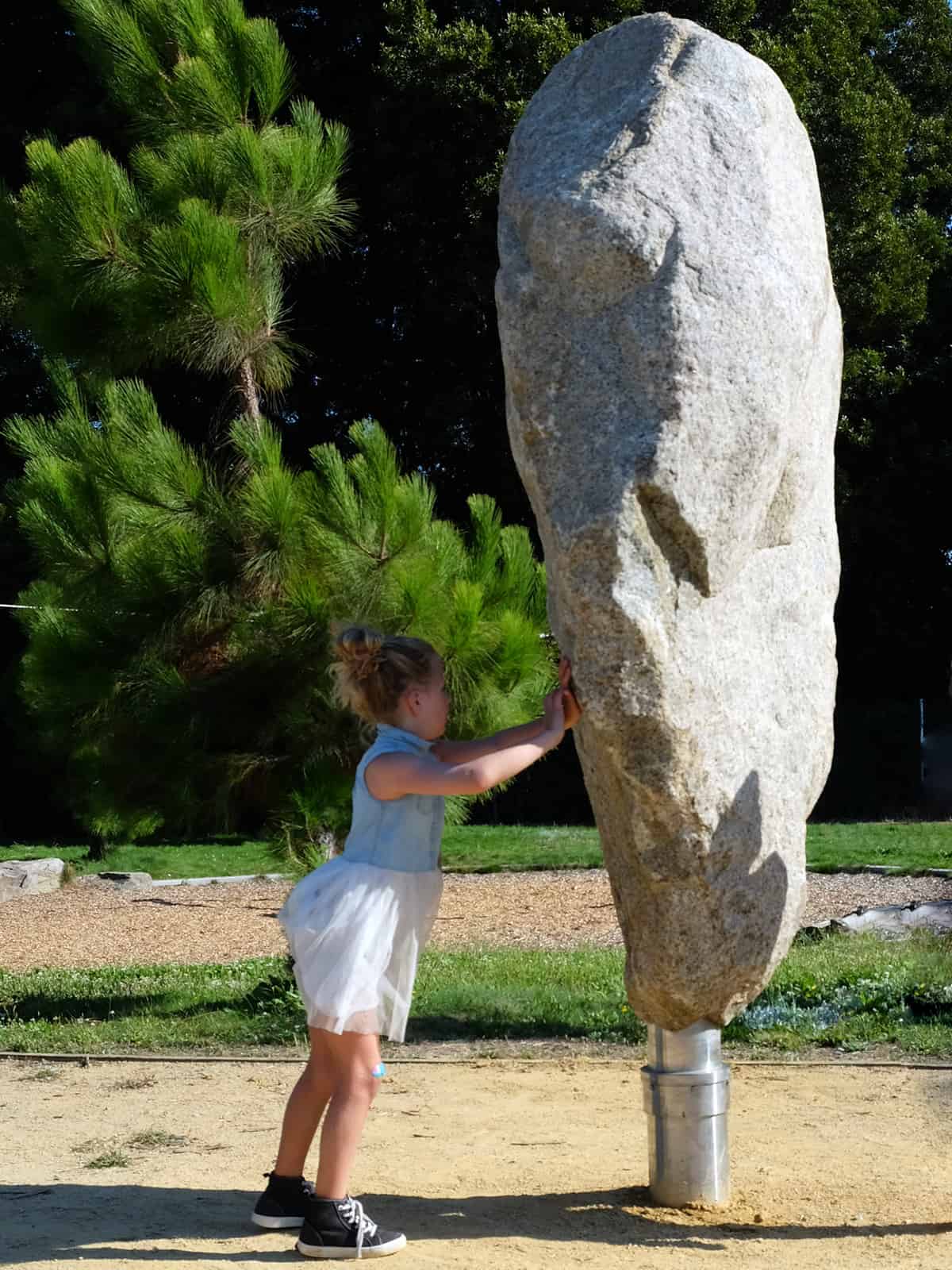
Alameda Post - McKenna Noonan, 7, student at Love Elementary, pushes one of Zachary Coffin's Rockspinners at Jean Sweeney Open Space Park
McKenna Noonan, 7, student at Love Elementary, pushes one of Zachary Coffin’s Rockspinners at Jean Sweeney Open Space Park on the day of its installation in 2022. Photo Adam Gillitt.

Locations for public art

The draft plan suggests two methods for discerning sites for artworks. The first is identifying municipal development projects, such as the planned roundabout at Clement Avenue/Tilden Way. The second is to partner with the Alameda Recreation and Parks Department (ARPD) to identify park sites. For instance, “Gateway to California” was installed in Jean Sweeney Open Space Park, and “Beken” was installed in the Seaplane Lagoon Promenade.

Board comments

Planning Board member Ronald Curtis asked what the PAC expected the public to take away from the art being presented. Looking at the City’s current art, he said he couldn’t figure out the cultural significance, goal, or intended audience. Development Manager Walker Toma answered that the intention is for the art to be applicable to all groups and not focused on a specific demographic.

Similarly, Vice President Hanson Hom opined that art can educate about history or local culture, and he would like to see more of this type of art that serves more than one purpose. City Planner Allen Tai responded that there used to be an ordinance requiring Alameda public art to have historical or maritime themes. However, the City removed this language to allow for a greater variety of art.

Board member Xiomara Cisneros said she would like the site selection process to be better articulated, particularly in terms of how art will be distributed throughout the community. Board member Asheshh Saheba said he would like clarification on when ARPD can independently approve art in its parks and when the PAC needs to get involved.

Alameda Post - A tall sculpture tower with a hazy sun in the background
Beken,” sculpture by DeWitt Godfrey. Photo Maurice Ramirez for City of Alameda.

Next steps

Based on the comments received, Staff will now revise and present the Public Art Master Plan to the Recreation and Park Commission before bringing the final plan back to the PAC for approval in July. If approved, staff will bring the Plan before City Council for final approval in September 2023.

Contributing writer Karin K. Jensen covers boards and commissions for the Alameda Post. Contact her via [email protected]. Her writing is collected at https://linktr.ee/karinkjensen and https://alamedapost.com/Karin-K-Jensen.

Caselli 11-12 curates a dialogue between furniture and sculpture with ‘Makers 2’

Caselli 11-12 curates a dialogue between furniture and sculpture with ‘Makers 2’
What is furniture, if not an ergonomic exploration of materiality, a carefully crafted augmentation of the user, an eloquent sculpture rendered with functionality, or perhaps, all of that in tandem? Deemed as a derivative of function and pragmatism, furniture designs often, or at least in common perceptions, tend to gravitate towards simple and clean forms catering to a predefined purpose. However, contemporary makers are increasingly approaching furniture inquisitively. As opposed to retracing traditional processes and materialities, they question— Is there a window for artistic commentary in the utilitarian? Through experimentation in silhouettes and materials, product and furniture designers reinterpret the semantics of furniture—reiterating how the ever-expanding sphere has unfathomable possibilities to offer.

In 2022, an old toll house in Milan, Italy, that flanked a monumental city gate, was transformed into an exhibition space for design gallery Caselli 11-12—its name corresponding to the numbering of the buildings. The historic spaces of the gallery have harboured research and experimentation through a carefully curated programme of partnerships and exhibitions. December 2022 marked the inception of a discourse surrounding the materials and techniques that forge contemporary design: Makers 1. The series advances in its second episode, Makers 2, taking the stage in the gallery’s majestic interiors. Restating the same hands-on, three-dimensional approach to design that defines the series, Makers 2 delves into a territory that unites furniture and sculpture-making. The show will remain on display from May 10 – June 30, 2023.

Caselli 11-12 specialises in contemporary design through the curation of cross-disciplinary projects. The gallery has hosted collaborations with national and international design studios, fostering emerging and established practices alike through a program of alliances and research-based exhibitions. For Makers 2, 39 international designers, artists, and architects present unique takes on the concept of creation or ‘making,’ and cultivate a repertoire that kindles ties between traditional and non-traditional materialities. The furniture design, lighting design and objects focus on historical materials such as ceramics, glass, stone and metal. These classic ingredients are then juxtaposed with hybrid and unconventional materials including milk, eggs, paper, cement, and wax. What ensues is a repository of functional assemblies that resonate much more with sculptural art than with industrial product design.

The thematic exhibition unfolds as an investigation of fragility and strength in furniture and sculpture—making realism and abstractions set dialogue under the same roof. Several designs fool the viewers into believing their deceptive appearances, perceiving an object to be soft when it is in fact, rigid, and vice versa. Dutch designers Tejo Remy and René Veenhuizen present Flexible Formwork, a series that encompasses designs that appear inflated but are cast entirely in concrete. Coffee tables and stool designs by Berlin-based designer Illya Goldman Gubin are a blend of paper, fibreglass and resin. The table designs that emulate crumpled paper surprise the onlooker with their solidity and sturdiness. The pastel pink wax silhouettes by Robert Wallace sit in harmonious contrast with the metallic coldness of the ‘Foil Mirror Cabinet’ by Brussels and Antwerp-based design studio destroyers/ builders. Decorative objects such as ‘Double Lines’ by Maria Bang Espersen, ‘Sketch of a Vase’ by Danny Cremers and ‘Candelabra With Ornament’ by Alexander Kirkeby push the limits of their materiality through their eccentric forms. As the viewer meanders through the diverse spaces, they encounter a range of lighting designs donned in different expressions illuminating the way.

Makers 2 injects both curiosity and doubt into visitors’ minds. When they witness mundane materials used in disguise and with a trompe l’oeil effect, the perceptive memory of familiar objects and matter, is questioned—and altered. What one expects to be brittle unpredictably displays strength, and what one assumes is soft, is rigid. The anthology of approaches that unravels in the show at Caselli 11-12 transcends preconceived boundaries of each medium, inviting onlookers to reconsider their notions of furniture and sculpture—and if they are different at all.

‘Makers 2’ will remain on display from May 10 – June 30, 2023, at Caselli 11-12 in Milan, Italy.

Piqua Arts Council hires new program director

Piqua Arts Council hires new program director

PIQUA — There’s no doubt that the Piqua Arts Council has experienced significant growth over the past few years, despite some of the challenges that businesses, non-profits and organizations have faced due to the coronavirus pandemic. Beginning as an organization of an executive director, a Board of Trustees and a handful of event committees and volunteers, PAC has been due for a personnel increase. In 2021, the staff expanded with the addition of Marketing Director Lily Stewart and on June 5 of this year, MiMi Ryan joined the PAC team as their new Program Director.

With over 15 years of event planning experience, Ryan came to the Arts Council as a professional wedding planner. One of her joys has been her unique opportunity in planning weddings and other events from the tops of the Rocky Mountains to the sandy beaches of the Atlantic Coast. Ryan has a special love for events and art, having planned over 425 live events from weddings to live music events, fundraisers, art shows, corporate events, tea parties and more. Her passion, attention to detail and drive for excellence has already been apparent in the short time that she has been with the Arts Council.

Ryan is responsible for the coordination and execution of PAC’s community events and programming. Currently, the Arts Council offers 12 annual programs that will produce 22 events for 2023. MiMi had a hand in this year’s Rock Piqua last Saturday, June 17, which was one of the most successful yet.

“MiMi’s personality and enthusiasm will be an incredible asset to PAC,” said Piqua Arts Council Executive Director Jordan Knepper. “With her background we expect great things out of her and look forward to her putting her own touches on our events.”

Ryan’s focus has shifted to the Arts Council’s first ever Pastel Workshop with Jill Stefani Wagner in July, along with the new event: Art 4 Everyone | 4 KIDS. More information about these events can be found here: www.PiquaArtsCouncil.org.

The Big Picture 2023 Photography Awards: 47 Winning Images And Finalists Capturing The Rich Diversity Of Life On Earth

The Big Picture 2023 Photography Awards: 47 Winning Images And Finalists Capturing The Rich Diversity Of Life On Earth

Every year, the famous ‘The Big Picture’ photography contest, organized by the California Academy of Sciences and Biographic, brings us closer to the work of some of the best nature photographers in the world. The 10th-year contest winners and finalists have been selected, and we are more than happy to share the amazing nature shots with you that made the cut.

Overall, there were 7 categories: Art of Nature, Aquatic Life, Winged Life, Landscapes, Waterscapes, and Flora, Terrestrial Wildlife, Human/Nature, and Photo Story: A Matter Of Time. The Grand Prize was won by Corey Arnold, a commercial fisherman and photographer from Washington, United States, with a photograph of a bear in a backyard called “Backyard Friend”.

So without further ado, we invite you to immerse yourselves in these beautiful photographs, and for last year’s awards, see the post on Bored Panda here.

More info: bigpicturecompetition.org | Facebook | twitter.com | Instagram

Skjverøy, Norway.

“This photograph is a perfect demonstration of evolution and ecology: carousel feeding by Norwegian orcas. A behavior first coined with respect to bottlenose dolphins, carousel feeding is a hunting tactic wherein a pod of marine mammals work together to herd prey into a tight ball, or, as it appears in this photo, a donut-like shape. As the ball is herded tightly by one or more individuals, the rest of the pod will whip their tails into the school in order to stun, and then feed on, the fish within.”

bigpicturecompetition Report

Isle Royale National Park, Michigan, United States.

“An intimate portrait five years in the making: A majestic moose (Alces alces) reveling in the water where it spends most of its time during the summer months. The moose population in this area has grown sharply in the last few years due to a decline in gray wolves—their only predator. This single-prey, single-predator relationship in Isle Royale National Park has been closely studied by scientists for over 50 years.”

bigpicturecompetition Report

Shiqu, Sichuan Province, China.

“A difficult scene shows a snow leopard (Panthera uncia) and a Pallas’s cat (Otocolobus manul) both engaged in a struggle for survival—one to feed and the other to stay alive. It is remarkable to see them together at all but especially in this light, as they are typically not active during the daytime. Unfortunately for this Pallas’s cat, she picked an inopportune time to go hunting for pikas for her kittens, and even more unfortunate, these squat felids cannot outrun a leopard due to their stocky bodies. This photographer, with help from forest rangers and permission from the local government, fed her orphaned kittens with road-killed pikas from the area until the cats were able to fend for themselves.”

bigpicturecompetition Report

Zin Desert, Israel.

“As there are less than 5,000 of them left in the world, finding any Nubian ibex (Capra nubiana) is a challenge—let alone battling adult males. This photographer has witnessed numerous juveniles bumping heads as practice, but before this moment had never seen adult males battling at full power for the right to breed.”

bigpicturecompetition Report

Borgarfjörður Eystri, Iceland.

“As this surreal photo demonstrates, Atlantic puffins (Fratercula arctica) are well known for being some of the most photogenic birds on the planet. They’re also highly social and mate for life, and while their primary mating ritual is a behavior called ‘billing,’ where they rub their beaks together, puffins also give gifts to their partners, such as a choice feather as seen here.”

bigpicturecompetition Report

Asheville, North Carolina, United States.

“With a wildlife corridor passing through their property, a retired couple living on the outskirts of Asheville, North Carolina frequently find four-legged visitors at their back porch, including this beautiful American black bear (Ursus americanus). In fact, residents of Asheville are known for their close relationship with wild black bears in the area. This photographer theorizes that through this coexistence, these bears may be growing more intelligent and increasingly bold—resulting in close contact like that featured here.”

bigpicturecompetition Report

Maui, Hawaii, United States.

“An astonishing image: four green sea turtles (Chelonia mydas) serenely swim through the waters of Maui. While it’s not unusual to see them in Hawaiian waters, where they thrive thanks to strict protections, it is extraordinarily rare to spot more than two swimming together. Green sea turtles are primarily solitary creatures once they reach adulthood, coupling only briefly for courtship and to breed.”

bigpicturecompetition Report

Tossa De Mar, Spain.

“Miquel Angel Artús Illana is a photographer from and trained in Barcelona, currently residing in Tossa De Mar. He has always been fascinated by landscapes, traveling weekly since he was very young to the native forests and mountains of his home.”

bigpicturecompetition Report

San Francisco, California, United States.

“A gaze of raccoons perk up as a car peels by in Golden Gate Park—where you might catch at least twenty of these critters on any given night. It’s not uncommon to observe this many together in the wild, but it used to be unusual to see this many at once in a city—no doubt a direct result of the large amounts of unsecured garbage available in urban areas.”

bigpicturecompetition Report

Moreai Rurutu, French Polynesia.

“Here, even in rough waters, a humpback whale (Megaptera novaeangliae) calf playfully rolls while its mother sleeps just out of frame. While this is an extremely rare sight—and even more remarkable photo capture—not much is known about why humpbacks roll. This photographer notes that he’s spent hundreds of hours documenting these beautiful creatures, yet had never seen this behavior demonstrated before.”

bigpicturecompetition Report

Rangiroa, French Polynesia.

“A serene moment of paddletail snappers (Lutjanus gibbus) swimming in the largest atoll in the Tuamotu Islands, this masterful image captures the many layers of a healthy, thriving ecosystem—above and below the surface—in a single frame. Not only is this photo a testament to the beauty of the ocean, but it’s also a powerful example of what it looks like when our watery world is protected.”

bigpicturecompetition Report

Kosi Bay Lake, South Africa.

“An image years in the making: Seemingly coy hippopotamuses (Hippopotamus amphibius) sit below the surface of the water, eyes fixed on the camera. After extensively researching this specific family, including taking underwater drone footage of their behavior, this photographer eventually felt comfortable enough to jump in and take this image. Why all the preparation? These hefty creatures kill more people per year than sharks, making an underwater image of them as spectacular an endeavor as it is dangerous.”

bigpicturecompetition Report

Osaki-shi Miyagi-ken, Japan.

“Even up close, it’s clear to see why Japanese hoverflies (Monocromia pleuralis) are often mistaken for honey bees or wasps; however, as their name suggests, they are members of the fly family. It’s hypothesized that they have evolved to resemble bees and wasps as a form of protection, but they do share a similarity with their lookalikes: they’re exceptional pollinators, making them an integral part of their local ecosystems.”

bigpicturecompetition Report

British Columbia, Canada.

“What they lack in size they make up for in feistiness! Rufous hummingbirds (Selasphorus rufus) are notorious for their relentless attacks on both flowers and other hummingbirds, but here we get to see a moment of pause during flight. This unusual perspective allows us to see a softer side of this finger-lengthed, yet mighty, species.”

bigpicturecompetition Report

Anilao, Philippines.

“So named for the transparent webbing that connects to the female’s arms, the blanket octopus (Tremoctopus violaceus) is a curious cephalopod. They exhibit one of the most extreme displays of sexual size dimorphism in nature, with females, like the one pictured here, reaching up to nearly 6 feet in length—while the males only grow to a paltry inch.”

bigpicturecompetition Report

Reynivellir, Iceland.

“Naturally, this photographer had high hopes of seeing the Northern Lights while in Iceland. Unfortunately, due to gray skies and the low intensity of the lights, he wasn’t able to capture them in the sky; however, he later found a surprise in the sand of Iceland’s volcanic black beaches—a shock of green that closely resembled the iconic Arctic phenomenon.”

bigpicturecompetition Report

Besigheim, Baden-Württemberg, Germany.

“Impossible to see with the naked eye, this microscopic view of a lesser stag beetle (Dorcus parallelipipedus) shows what it looks like from head to chest. While these beautiful bugs look deceptively smooth on the surface, a closer look reveals a symphony of scales and textures.”

bigpicturecompetition Report

White Mountains, Arizona, United States.

“This year’s Art of Nature winner serves as a photographic Rorschach test! The photographer mentions a range of reactions and theories as to what the mesmerizing lines might be part of. A coastal scene with waves crashing on the cliff or sand rippled with waves in the deep desert? We’ll keep you in suspense no longer: It’s the underside of a mushroom, likely a member of the Lactarius family. The photographer notes that he was drawn back to the unusually vibrant colors displayed on the gills, the blue color in particular, which might indicate the presence of psilocybin or psilocin. Trippy indeed!”

bigpicturecompetition Report

Carmel Bay, United States.

“Urchins are often vilified in media coverage of changing kelp forests—they’re the most visible cause of kelp forest loss, devouring algae and replacing lush forests with spine-studded barrens. But in this remarkable photo, we see how urchins belong to kelp forests as much as the kelp itself does; more importantly, they play a crucial role as detritivores—eating dead algae and feeding marine life higher up the food chain. Ultimately, urchins are trying to survive in changing seas just like kelp; the loss of their kelp forest homes is a consequence of climate change from which they also suffer.”

bigpicturecompetition Report

Bwindi Impenetrable National Park, Uganda, Africa.

“Capturing an image of a week-old mountain gorilla (Gorilla beringei beringei) is no easy feat, as the mothers are understandably protective of their offspring and the number of such gorillas in general has shrunk. After surveilling this gorilla family at a distance for many days, the opportunity to snap a shot of the newborn presented itself, resulting in a solemn reminder of both the beauty and fragility of nature.”

bigpicturecompetition Report

Lake Clark National Park, Alaska, United States.

“Looking for a change in scenery while traveling for the first time since the pandemic began, this photographer wasn’t disappointed by Alaska or this Alaskan Peninsula brown bear (Ursus arctos gyas). However, she did have to practice patience, as most days were dominated by cloudy conditions. Finally, the sky gradually started to change color, making the ground appear as though this majestic animal was walking on clouds and allowing the photographer to capture this breathtaking, ethereal image.”

bigpicturecompetition Report

Sabah, Malaysia.

“Exhibiting a behavior that’s all-too human, a proboscis monkey (Nasalis larvatus) hugs another after preventing it from falling out of a tree. Endemic to the jungles of Borneo, these highly social animals are on the brink of extinction, making their embrace all the more heart-wrenching.”

bigpicturecompetition Report

Tromsø, Norway.

“An Arctic moth perches on a leaf in the night, theoretically on the lookout for a mate. Thanks to the freezing temperatures, and flanked by the ethereal tendrils of the Northern Lights, it moved very slowly, allowing the photographer to capture it. If only we could all be afforded such a view while looking for a date!”

bigpicturecompetition Report

See Also on Bored Panda

Gulf of Mannar, Sri Lanka.

“From a bird’s eye view, this is an artful, geometric perspective of greater crested terns (Thalasseus bergii), but it reveals a tragic scene. Upon closer inspection, one sees the terns in a frenzied flight to save their hundreds of eggs—laid on the sparse sand patches—from being washed away into the sea.”

bigpicturecompetition Report

Región de Atacama, Copiapó, Chile.

“Even the driest non polar desert in the world is teeming with life if you look closely enough. After various trips to the area, this photographer camped out for three days in order to capture this breathtaking image that shows how the mist and fog roll over the seemingly barren desert of Atacama.”

bigpicturecompetition Report

Lake Matheson, Fox Glacier, Westland National Park, New Zealand.

“A mesmerizing, yet deadly, spore scene. This beautiful, mushroom-forming fungus (Armillaria novae-zelandiae) is a member of the Physalacriaceae family—one of three Armillaria species native to New Zealand. This highly invasive species is often found on decaying wood and capable of causing root rot in plants with which it comes into contact.”

bigpicturecompetition Report

Nehalem Bay State Park, Oregon, United States.

“Reminders that we are all made of stardust can be found in the most unlikely of places: Including this Pacific sea nettle, (Chrysaora fuscescens) that has washed up on the beach. As the sun glints and radiates against its beautiful body, a galaxy shines through.”

bigpicturecompetition Report

Lwiro Primate Sanctuary, Kahuzi-Biega National Park, Congo, Africa.

“A Congolese care worker swaddles two rescued chimpanzees (Pan troglodytes) as she might her own children. This photographer spent several weeks working in and around Kahuzi-Biega National Park, including at the associated Lwiro Primate Sanctuary, where over 100 rescued chimpanzees have been given a second chance at life. The result of this time is a remarkable photo that not only tugs at the heartstrings, but reminds us that we are more alike than different.”

bigpicturecompetition Report

Amatitlán Lake, Guatemala.

“We’ve been conditioned to think that when it comes to nature, green is good; unfortunately, in the case of Amatitlán Lake this couldn’t be further from the truth. Each year, enormous quantities of untreated sewage and sediment are carried into this lake from Guatemala City. The result is this disarmingly neon green and undoubtedly toxic lakefront view, visible from the air.”

bigpicturecompetition Report

Kalo Chorio (outside Nicosia), Cyprus.

“This photographer had always hoped to capture the inside and outside of an owl tree nest at the same time. With this exact photo in mind, he took years to construct an appropriate camera trap and bird box and wait for these Cyprus scops owls (Otus cyprius) to use it. And use it they did. The pictured owl alone returned to its offspring nearly twenty times a night with all manner of prey in tow, including this unlucky gecko.”

bigpicturecompetition Report

See Also on Bored Panda

Fagradalsfjall, Reykjanes, Iceland.

“A hypnotic scene as viewed from a neighboring mountain: New lava flow branches off to run its course, the pattern reminiscent of tree roots. The photographer muses that volcanoes are one of the few places where you can watch the land change and grow over the course of seconds, when typically geology takes thousands or millions of years, existing on a timescale far greater than that of humans.”

bigpicturecompetition Report

Anilao, Philippines.

“With camera settings focused on the goby she was chasing, this photographer stumbled upon a much more alluring subject: rainbow cynarina coral (Cynarina lacrymalis). These incredible single polyp corals are highly sought after by aquaculturists, and are also known as button or donut corals thanks to their circular shape with contrast-color center.”

bigpicturecompetition Report

London, United Kingdom.

“After spending weeks observing this young red fox as it learned optimal trash-picking time (before the weekly pick-up), this photographer was finally able to capture a photo of it opportunistically raiding the overflowing bin. Despite what this image might lead you to believe, Vulpes vulpes are not typically garbage eaters, but actually omnivores—meaning their diet ranges from fruits and grasses to smaller animals. Thanks to urban development, that diet has now expanded to include ‘fast food scraps.’”

bigpicturecompetition Report

North Carolina, United States.

“A brown bear (Ursus arctos) cub enthusiastically grips the edge of its cage, as though inviting the photographer forward for a photo. Though this initially may not seem gut-wrenching, this photographer notes that this cub’s parents live below in a concrete cell, where they can only hear one another, nothing more. She hopes that by seeing this photo, the viewer will ensure they do not patronize roadside or other unaccredited zoos.”

bigpicturecompetition Report

Sørfolda, Norway.

“When they coined the phrase ‘whale of a tale,’ they must have been thinking of Hvaldimir—a beluga whale (Delphinapterus leucas) with one incredible backstory. After surfacing off the coast of Norway in 2019 wearing a Russian harness and a camera mount, locals believed that Hvaldimir had been trained as a spy. Beyond this theory, not much else is known about him, but as this image suggests, he’s gotten into a fair amount of trouble with humans. As he’s no longer part of a pod due to his domestication, he seeks out human interaction, which can be quite dangerous.”

bigpicturecompetition Report

West Chicago, Illinois, United States.

“A female coyote crosses a freight train bridge. Urban coyotes in Chicago have distinct territories they claim as their own, often using railroad tracks to avoid crossing busy highways in order to travel between green spaces and abandoned lots where they hunt for rabbits, rodents, and other urban food sources.”

bigpicturecompetition Report

See Also on Bored Panda