About

Posts by :

Photography as Performance Art: Jeremy Cowart Creates a Totally New Kind of 10K NFT Collection

Photography as Performance Art: Jeremy Cowart Creates a Totally New Kind of 10K NFT Collection

Jeremy Cowart held the phone, on speaker, out for him and the rest of his production team to hear. 

“I don’t think I’ve ever heard of a problem like that ever happening,” the voice from the phone stated flatly. 

Cowart pursed his lips, but only slightly. In just over six hours, on the massive Nashville studio stage where he currently stood, the photographer would attempt to—before a live audience—create 10,000 unique photo-based self-portrait NFTs.

Each would feature three distinct layers of meticulously-chosen visuals, including prisms and lasers, all flashing rapidly in randomized combinations from multiple lighting sources including the massive, 130-foot LED volume wall looming behind him. 

All of the photos were to be edited instantaneously into eight different styles (each distributed at varying and pre-arranged frequencies) via an app custom-created for this single event by the man on the phone, who was either in Finland or a nearby country (Cowart wasn’t sure). And all of this was supposed to happen in about 20 minutes. 

Perhaps unsurprisingly, the MacBook Pro tasked with processing that all in real-time was having a hard time keeping up. 

But even that wasn’t the sole concern on Cowart’s mind Tuesday afternoon. The artist planned to be at center of all of these 10,000 photos, in a white bodysuit and mask emblematic of a blank canvas. Every single movement he made during the 20 minutes that those thousands of photos were being taken would impact their appearance and rarity. 

“I have to make sure I stay centered, because even if I’m barely off-center, it doesn’t work,” Cowart told Decrypt in Nashville, hours before his “Auras” event was to take place. “Even if I turn my head or angle my head, those are rarity traits.”
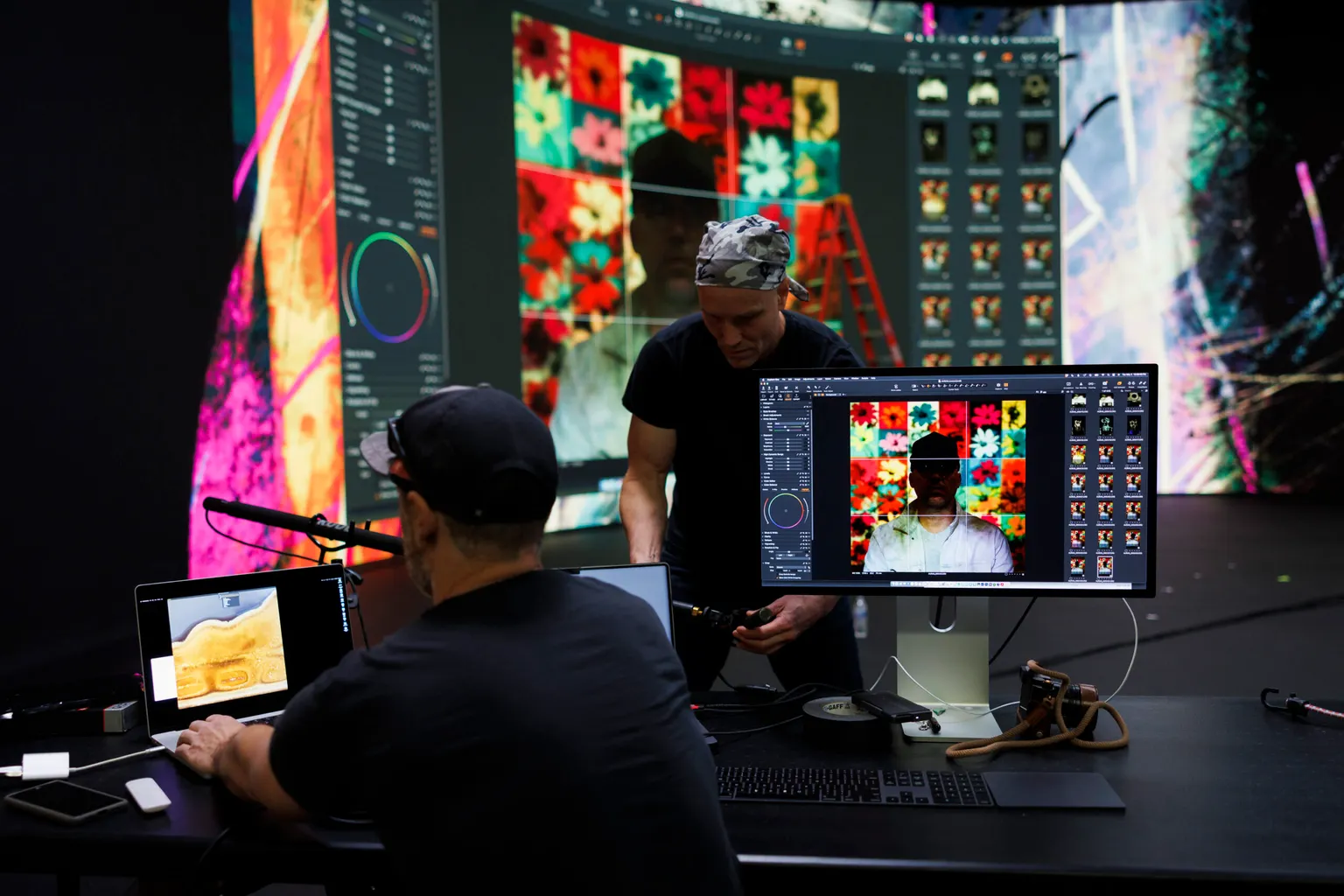
Cowart’s team preparing for “Auras” on Tuesday afternoon. Credit: Brett Carlsen for Decrypt

Why was Cowart putting these entirely self-created pressures and restraints on himself? There was no practical need for all of the photos to be taken in 20 minutes, nor for them all to be edited instantly—let alone for this entire, mostly untested process to unfold in front of a live audience in real time.

“I’m drawn to big, scary things, to things that are really hard,” Cowart said, shrugging, when asked why he was doing this. “And this has pushed me to my limits in all kinds of different ways. I don’t know. I don’t know if it will work. I think it will.”
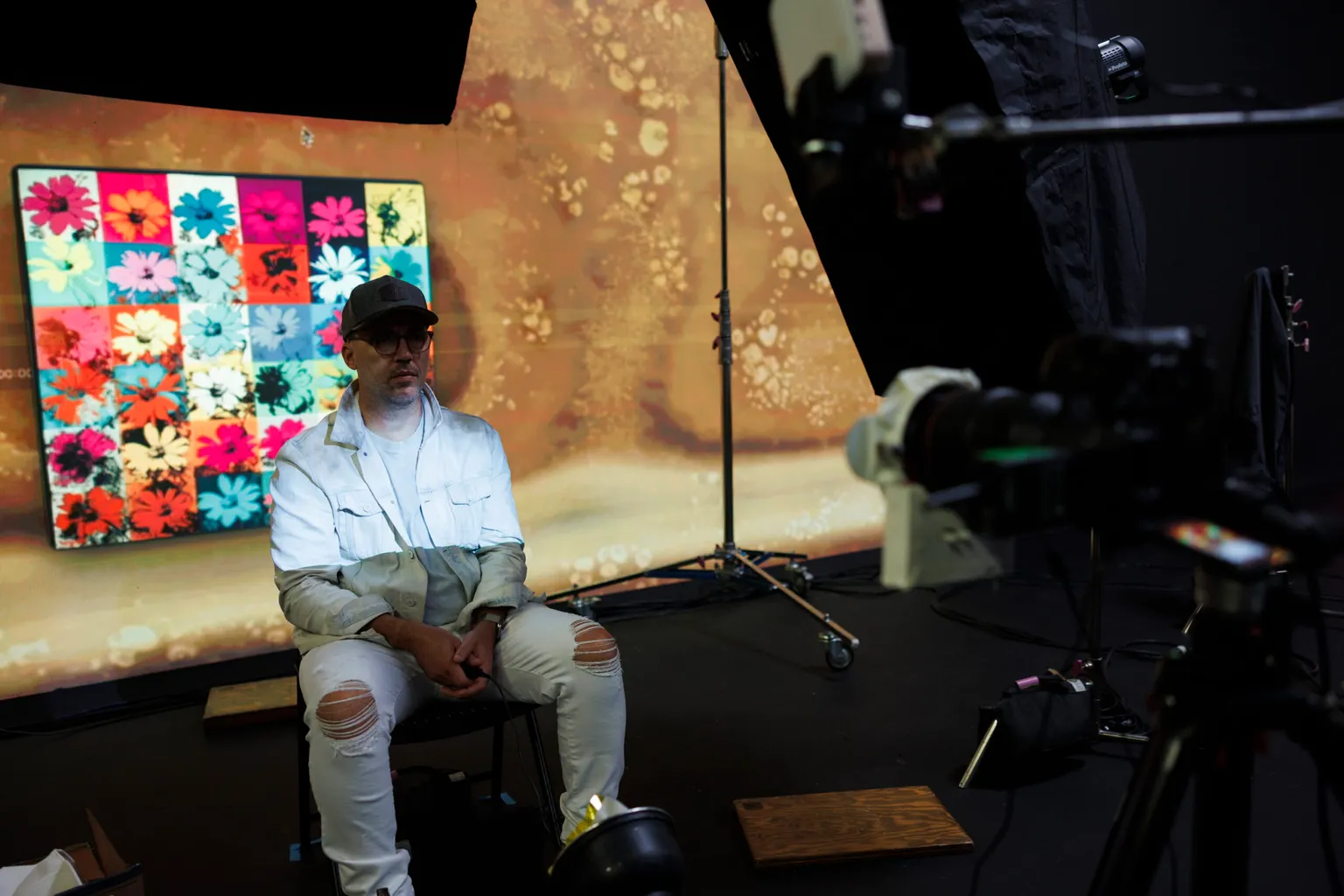
Cowart tests his lighting. Credit: Brett Carlsen for Decrypt

Cowart is used to being on a big stage, metaphorically. He has photographed subjects including Barack Obama, Taylor Swift, and the Kardashians, and his work has been regularly featured in Rolling Stone, The New York Times, and Time. Over the course of that career, he has privately experimented with and developed numerous novel photography techniques. “Auras” utilizes many of them, finally showcased to the world in concert.

“This is the culmination of about 10 years of pushing myself in the studio and trying new things,” Cowart said. “Tonight is me revealing all of that for the first time.”

By the late afternoon, the live photo-editing process was still having some problems. So Cowart relented, at least on that one point—the 10,000 photos could be edited in the five minutes following the capturing process, he decided. The audience would still get to see the whole creation process from start to finish, and all in less than 30 minutes. 

All of a sudden, it was time. A little over 150 guests—mostly from the Nashville area, but also from across the country—poured into the studio. 
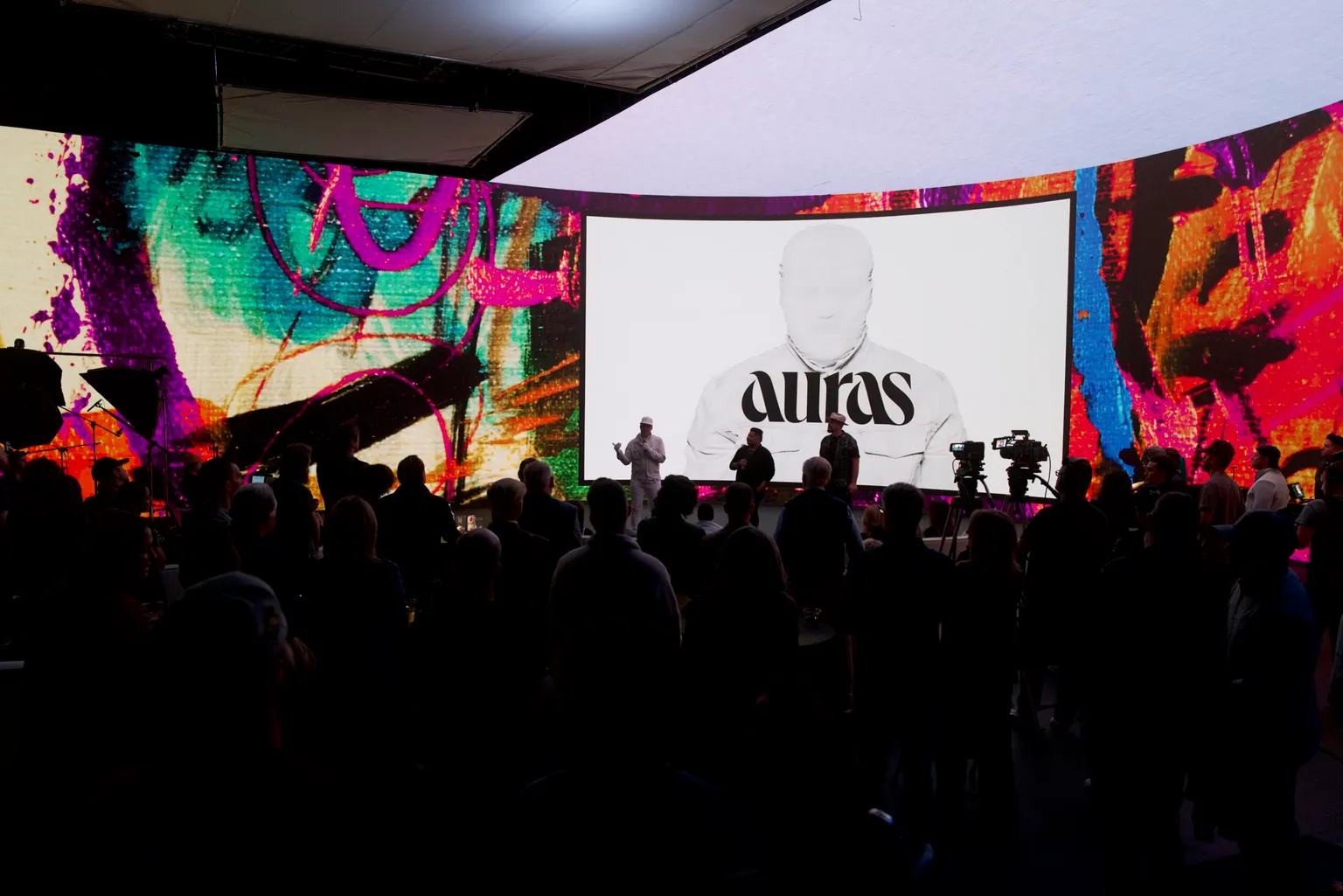
Cowart welcomes guests to the “Auras” event. Credit: Cole Plichta

After opening remarks, Cowart took the stage, his entire body and face covered in white. Brooding classical music boomed from the darkened ceiling as a cacophony of lights, designs, photos, and faces flashed across Cowart’s body to the cheers of the crowd. 

The photos were being taken too quickly for the eye to catch. But on the farther end of the studio’s massive LED wall, a colossal projection of Cowart’s desktop displayed the inflow of raw pictures, about eight per second, each painted with an entirely different combination of images, tones, and light. 
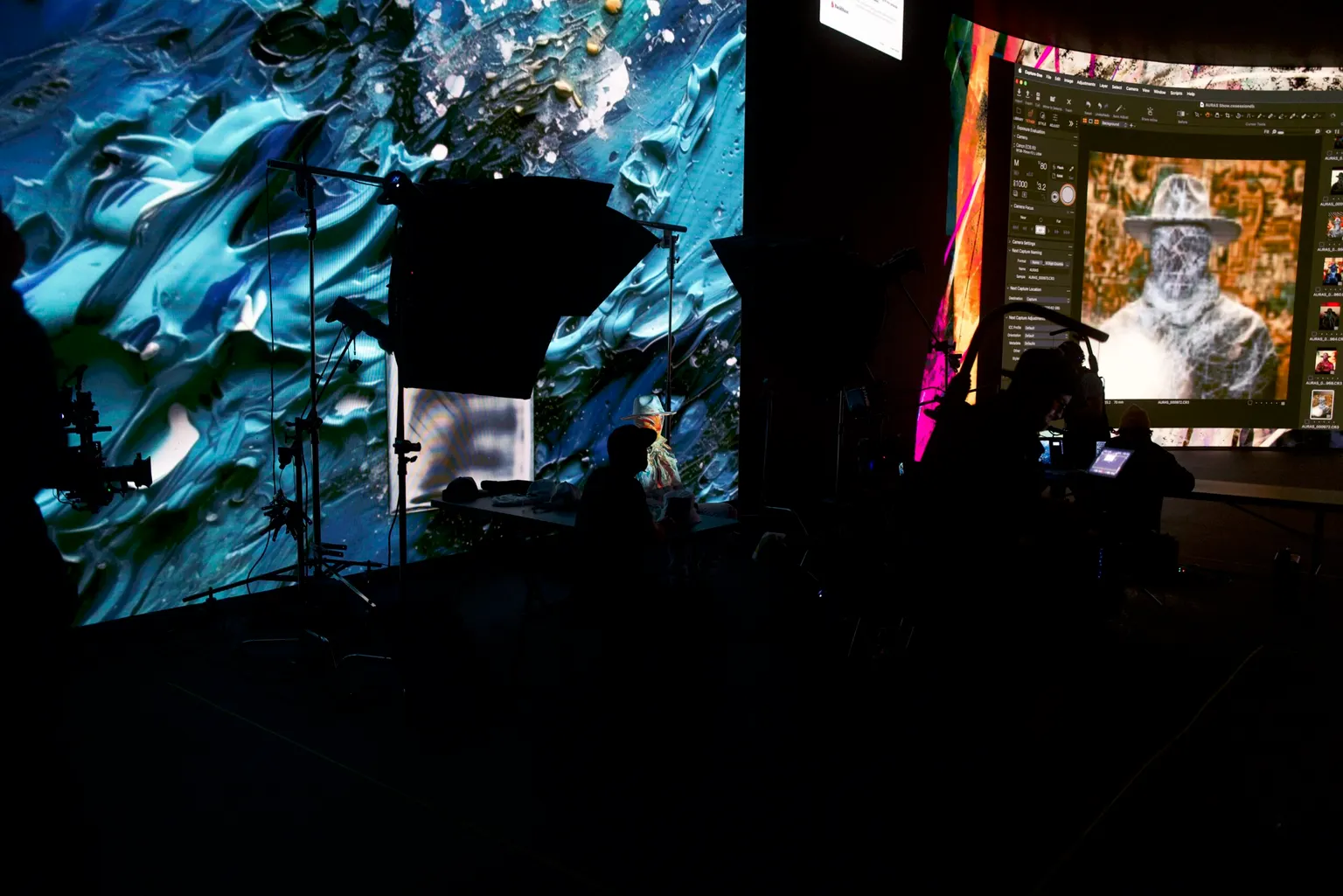
Cowart performing “Auras.” Credit: Cole Plichta

The cumulative resulting effect of the performance, which one attendee later described as unexpectedly emotional, was hypnotic, and—in spite of the extreme degree of overstimulation—soothing in its synchronicity. 

“The way that Jeremy’s art was flashing, sometimes the [music’s] tempo synced up perfectly,” Cristina Spinei, the composer whose work played over the process, told Decrypt. “I was watching it like ‘Oh my god, we couldn’t have planned this.’”
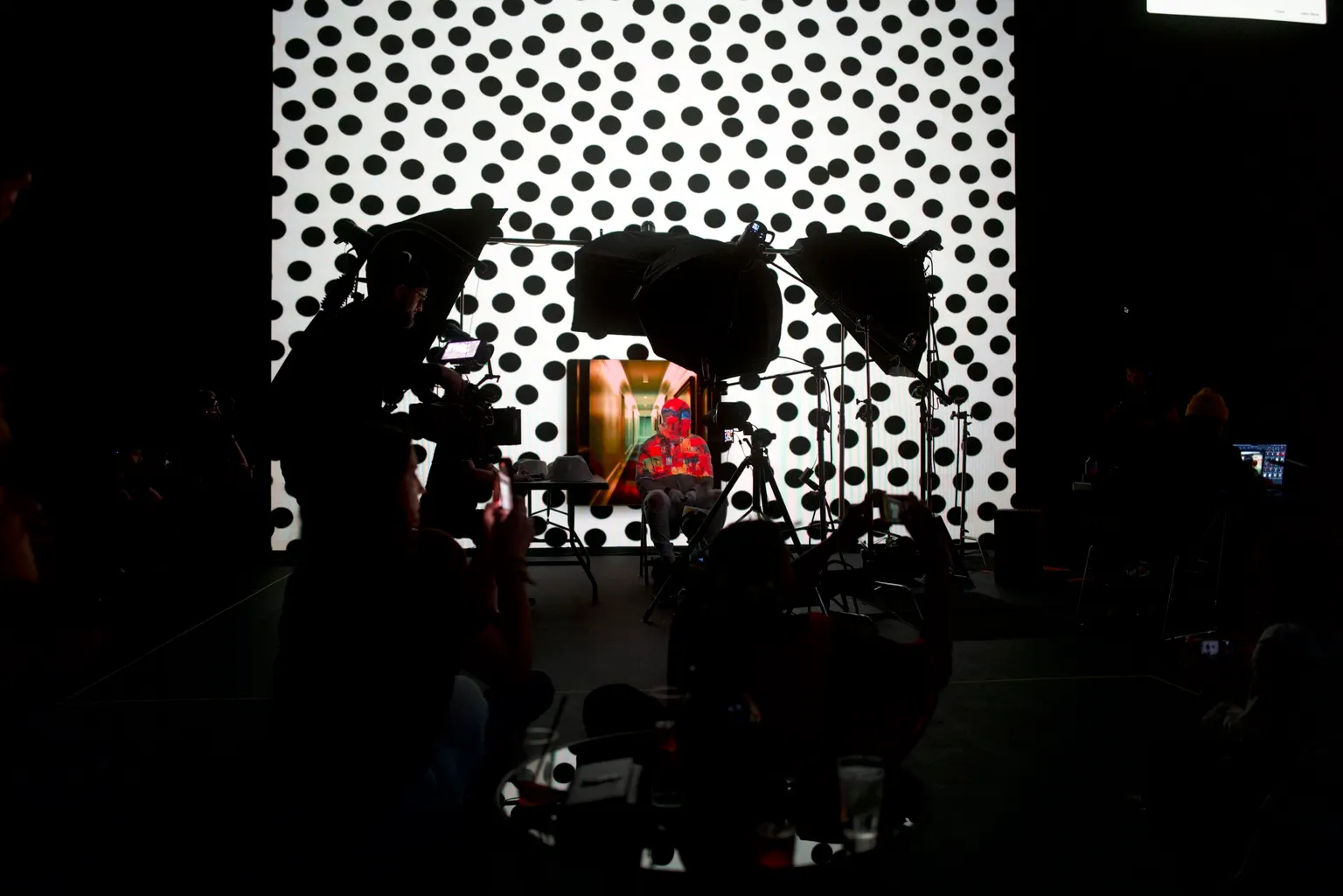
Cowart performing “Auras.” Credit: Cole Plichta

Spinei, whose music combines classical acoustics with electronic elements, also uses NFTs to release her works. At first, the technology seemed like a more efficient way to control her distribution process. But Spinei’s embrace of the blockchain also had some unexpected repercussions. 

“When I first got into Web3, I didn’t realize the capacity that it would have to change my music,” she said. “There’s this really freeing feeling of being released from a genre. That there’s no box an artist has to fit into.”
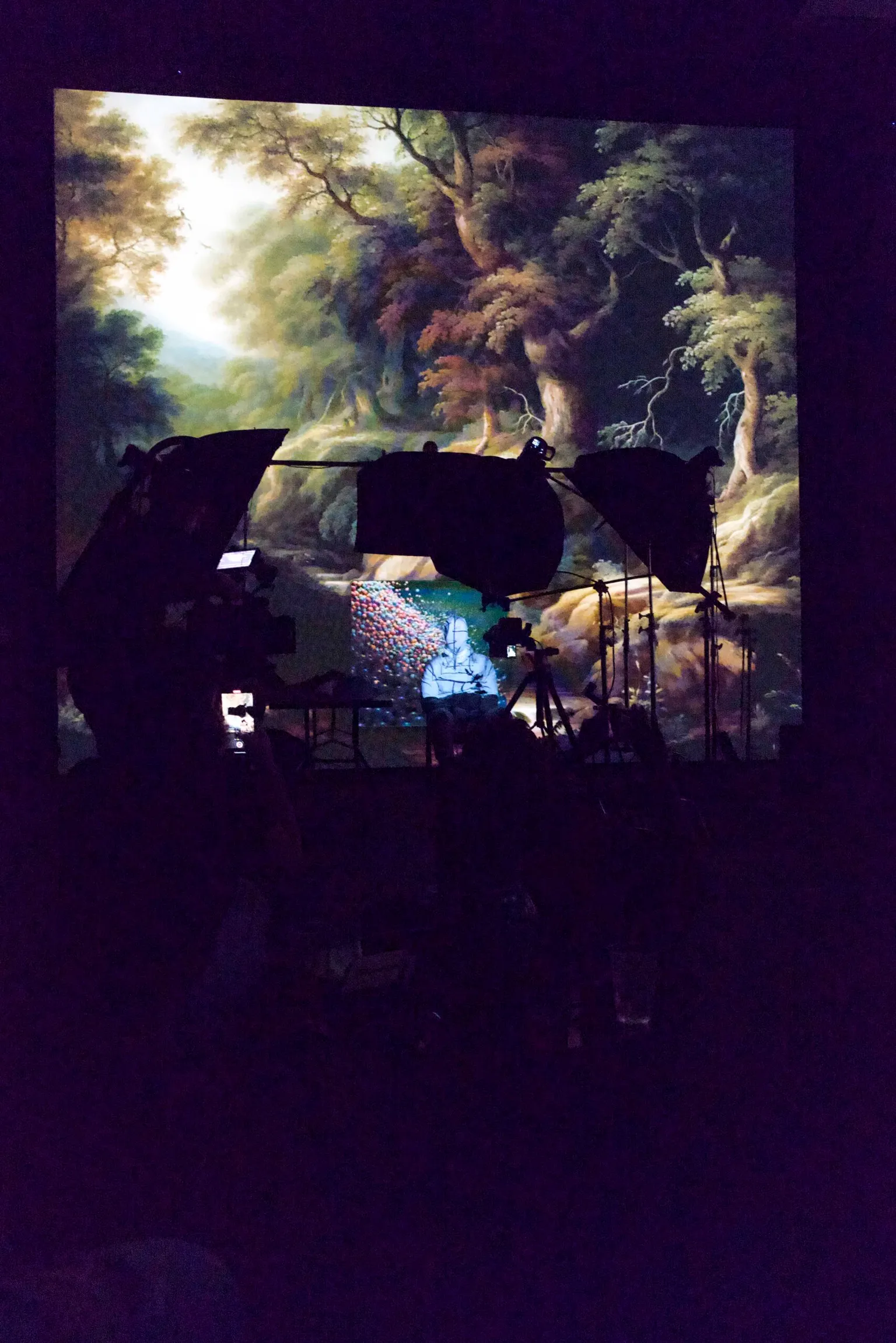
Cowart performing “Auras.” Credit: Cole Plichta

Watching Cowart bare it all on Tuesday night, the crowd cheering louder and louder as the photo tally steadily ticked towards 10,000, Spinei felt that same liberating spirit of Web3—one focused less on technology, and more on embracing the genuinely weird and new.

“Now there’s a proper place for this work, and an audience interested in something a little bit different,” Spinei said. “Ideas and projects that break down the barriers of what visual art is, of what music is.”

Just before 8pm in Nashville, Cowart achieved his dream: his series of 10,000 photos, all unique, had been flawlessly birthed before a crowd of witnesses. In the aftermath, they came up to congratulate him, to shake his hand, to hug him, to toast him—and, not to miss an opportunity, to get their photos taken by him on the “Auras” stage. 
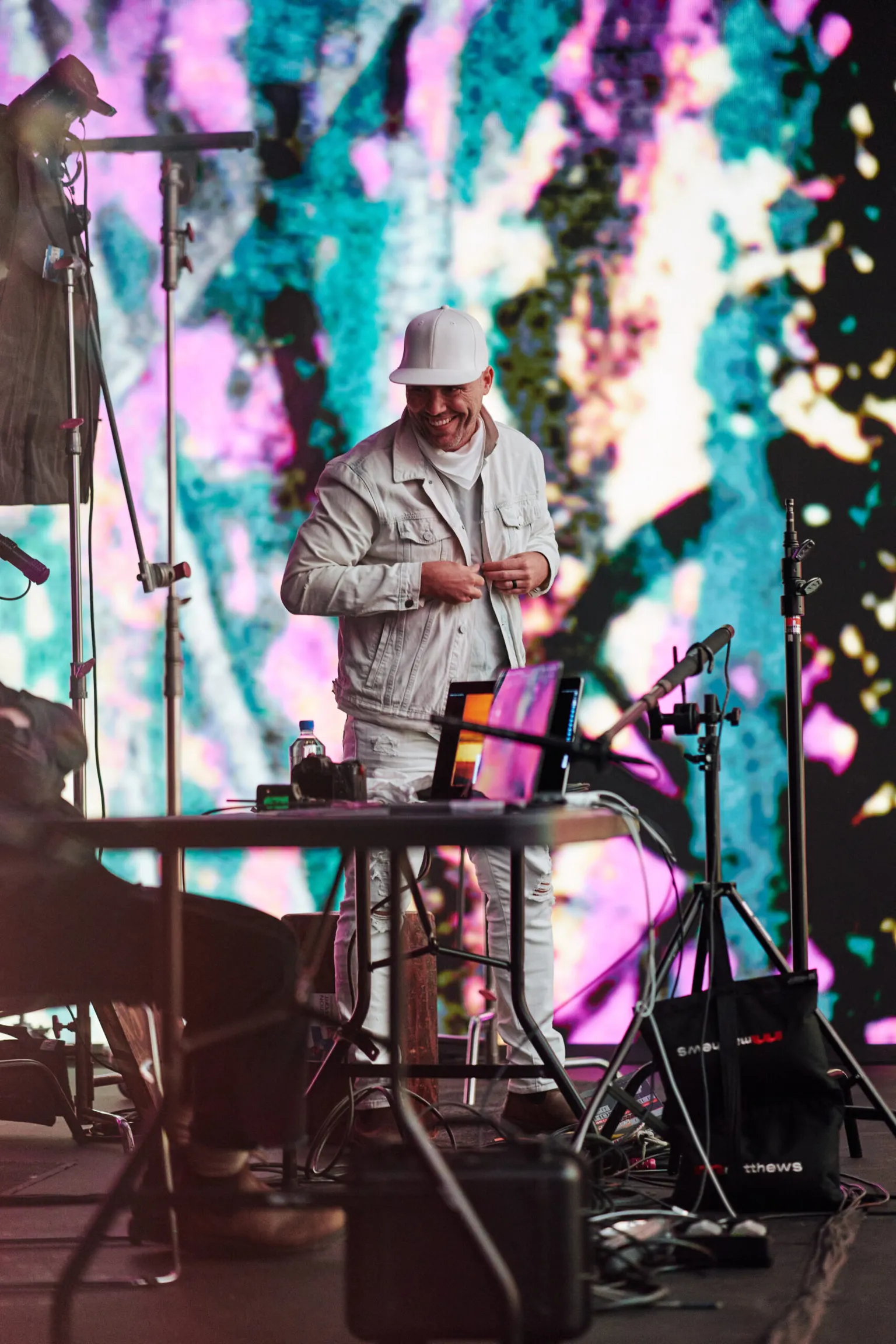
Cowart savors the completion of “Auras.” Credit: Cole Plichta

“Auras” will mint next week on May 9 on OpenSea, with the project created in partnership with the NFT marketplace and digital creator platform Transient Labs. Current holders of Cowart’s previous NFT project, Block Queens, will be given the opportunity to mint an “Auras” NFT for free.

Cowart envisioned “Auras” as a series of profile picture (PFP) NFTs, meaning those that holders typically display on social media to signal connection to a certain (often elite) online community. Some of the most prominent NFT collections to date, including Bored Ape Yacht Club and CryptoPunks, are also series of 10,000 tokenized PFPs.

Some attendees of Cowart’s event last night, however, pushed back against associating “Auras” with such collections.

“People are exploiting Web3 at the moment. It’s a money-printing machine for a lot of people,” Violetta Zironi, a Nashville-based musician who has minted several NFT collections based on her works, told Decrypt. “When [a series] comes from a businessperson who hires artists to slap together some monkey pictures, that’s speculation. That’s not art.”

To Zironi, proof of a project’s artistic merit lies not in the method in which it is distributed, but in the origin of its creation. 

“When there is an artist behind a project, and the idea comes from an artist, and you can see that. That is art,” she said. “This came from Jeremy. This is art.”

Stay on top of crypto news, get daily updates in your inbox.

A Word or Two on Art and Technology

A Word or Two on Art and Technology

The words we bring to art intend, at best, to translate the perceptual realm into the linguistic, anchoring sensation through definition. But, as we all know, that often doesn’t occur. The well known essay, “International Art English” by Alix Rule and David Levine skewers that premise, as does Tom Wolfe’s The Painted Word (1975) nearly forty years earlier, and a decade before that Susan Sontag’s “Against Interpretation” resisted language’s simulacrum of art. So on, down the line. And yet, words also serve to support, promote, highlight, associate, and adore the art they describe.

Words appear for new practices, movements, and styles to expand appreciation and awareness. They necessarily limit in order to focus attention on specific elements and criteria. Adopted, they take on a life of their own. For well over two thousand years, the word “beauty” has been used and confused. It points at something, though no one, not even Plato or Kant (or should I say, no thanks to Plato or Kant), can confirm how or where beauty appears. When even the word “art” confounds, what are we to do? We hoist our attempts into the next sentence.

When art encounters technology, the language gets brackish as disciplines and histories converge. Just as some people sneer at art’s lingo, misunderstanding its unfamiliarity as obscurantism instead of observing an effort at specificity (let’s presume), so do many art audiences shrink from the terminologies associated with digital art. Or, should I say media art, or new media, or computer art, or virtual art, or art and technology…?

With so many emerging technologies, language proliferates. It gets co-opted by headlines and marketing efforts. To resist the inflections now attached to those terms, new words appear, or old ones revived. Curators, critics and scholars study the roots and contexts of these words to make sense of how they might be refreshed or why they should be abandoned.

I thought of this Critics Page as a symposium on the language of art and technology, inviting curators and scholars from around the world to contribute their perspectives by selecting a word they would like to never hear again or one they think important for this moment. It is a smattering of keywords with many more possible as our interests and concerns evolve.

There are definitely some words many of us despise, and Margaret Wertheim’s text about “the metaverse” aptly articulates the problem with the way the word was co-opted by corporate interests. There are no “neutral” practices, explains the longtime director of Postmasters Gallery, Magda Sawon. The legal trio of Yayoi Shionoiri, Sarah Conley Odenkirk, and Megan Noh ask about the emphasis on human touch that has percolated around issues of AI; this seems particularly relevant as we look back at the history of conceptual art, which often denied the necessity of the artist’s own hand in the process of making the work.

Such concerns naturally lead us to debate the aesthetic values we bring to art, which art historian and curator at the Buffalo AKG Tina Rivers Ryan considers in musing on her affective response to works of art. Just as Pop art responded to the visual culture of comic books, advertising, mass media, and consumer product design, we are challenged now to consider the influence of gaming, computer graphics, screen culture, social media, and the widespread access to and use of digital tools. We may want a space free of that bombardment, but its influence and critique is being expressed in art across all forms of media.

When and where are we looking at digital art? On our mobile device while in transit or standing in relation to a geolocated work? Passing by a shop or gallery window? Seated on a bench? Guided with instructions or figuring it out on our own? In a gallery, museum, fair? Display is the concern of Nxt Museum Director Merel van Helsdingen, as the curation of digital art continues to get negotiated as new practices demand new infrastructure or positioning. And yet, all this talk of new and different leads curators and theorists Ruth Catlow and Penny Rafferty to enter into a dialogue on the problems with innovation as the celebrated concept in the discourse. Mashinka Firunts Hakopian offers the word “ancestral” to shift just this kind of thinking.

Thinking historically leads professor Sarah Cook to converse with her PhD student Bilyana Palankasova on the shifts in the word “incubator” over the last couple centuries. The words we use produce contexts for thinking just as datasets establish worlds of knowledge and reference. Writer and curator Clara Peh examines the popular term “worldbuilding” and reminds us to consider what tools and whose data enable the world being designed. When audiences introduce expectations for greater specificity, we all have the chance to demand more equitable designs. That is the major concern of the anonymous collective Kanon, articulated through their essay on “community,” available in the online edition of this Critics Page.

So many words might have been added that could not fit in this limited context, though they often appear as a subtext to these essays: binary, code, decentralized, equity, and ethics, through to software, transparency, user, virtual, and so forth. The choice to invite curators and scholars stemmed from my own curiosity about how these people, who often anguish about how to express their research and intent, find the current conversation. Theirs is not the only perspective, so the Art and Technology column this month asked artists in media ranging from AR to sculpture to share words they have used or experienced in relation to their practice; confusion about art making is there, as is support. In the spirit of broadening the conversation, I hope readers will join us for the New Social Environment on this Critics Page and share the word that troubles or excites their engagement in art and technology.

The words we use matter, and so I close with the importance of the poetry of language, which appears in the haikus provided by independent curator Doreen A. Ríos. The haiku is a Japanese form of poetry with a strict requirement of five syllables for the first line, followed by seven in the second and returning to five in the last line. That discipline, however, is meant as a provocation beyond the terse language. A Zen practitioner years ago described it to me as kin to the koan. Both provide the opportunity for audiences to find themselves present. Certainly we need to be present to the developments and influences arising, fading, and fluctuating in art, technology, and the world around us.

Kelynn Holenstein named grand-prizewinner of poster art contest for Taste of Buffalo presented By Tops

Kelynn Holenstein named grand-prizewinner of poster art contest for Taste of Buffalo presented By Tops

Kelynn Holenstein's poster art.

Kelynn Holenstein’s poster art.

Thu, May 4th 2023 10:45 am

Submitted by Tops Friendly Markets

Tops Friendly Markets and the Taste of Buffalo announced Kelynn Holenstein, a talented artist from North Tonawanda, is the grand-prizewinner of the 2023 Taste of Buffalo Tops poster art contest.

Kelynn was the winner for artists in the 18-year-old-plus age group. Her artwork will be featured on the festival poster and in the event’s marketing materials. In addition, Kelynn will receive a $1,000 prize.

Samantha Nadeau, a resident of West Seneca, is the winner in the 13-17-year-old age group, and will be presented with $500. The prizes are courtesy of Tops Friendly Markets and The Taste of Buffalo.

“Congratulations to our winners and thank you to everyone who took the time to submit artwork celebrating the Taste of Buffalo’s 40th birthday,” said Elizabeth Mamot, 2023 Taste of Buffalo chair. “Kelynn’s artwork is festive, fun and flavorful, and I loved the use of the bright colors. Samantha’s drawing reminded me of my favorite childhood book, ‘Cloudy with a Chance of Meatballs!’ ”

Samantha Nadeau’s poster art.

••••••••

This year’s festival, which celebrates its 40th birthday in 2023, is taking place July 8-9 in Niagara Square and on a portion of Delaware Avenue.

Organizers said, “We’re looking forward to hosting extraordinary chefs from Buffalo once again on the live culinary stage sponsored by Tops. Presale food ticket vouchers will also be available for purchase at Tops Markets locations beginning in June.”

Based in Williamsville, Tops Markets currently operates 149 grocery stores in New York, Pennsylvania and Vermont, including five that are run by franchisees. For more information, visit www.topsmarkets.com.

The Taste of Buffalo presented by Tops is the nation’s largest two-day food festival. Named one of “10 food and wine festivals you can feel good about attending,” by USA Today, the Taste is a not-for-profit organization with more than 1,000 volunteers helping to put on the annual event. More than $573,000 has been raised at the festival for local charities, in addition to scholarships awarded annually to local high school seniors pursuing a culinary or hospitality- related degree. For more information, visit tasteofbuffalo.com.

The Best Photography Festivals Opening This May

Scotiabank CONTACT Photography Festival, Photo London, Boutographies and Riga Photomonth are some of the photography festivals we selected for this month.

Scotiabank CONTACT Photography Festival / Toronto, Canada / 28 April – 11 June

© Jake Kimble

Toronto’s CONTACT photography festival presents a vast array of exhibitions and activities showcasing work by Canadian and international lens-based artists, which collectively come to critically frame the social, cultural, and political events of our times, and the way photography can reflect upon them, and intersect with them.

More than 180 projects will make CONTACT’s exhibitions program, featuring artists such as Wolfgang Tillmans, Persijn Broersen and Margit Lukács, Jake Kimble, African agency Sunday school, Jorian Charlton, John Delante & Ananna Rafa, and many more. Documentary approaches intersect the fictional, the personal and the political, video narratives present speculative reflections on today’s reality as well as intimate and personal perspectives, archival work and collages integrate in and ampliate the festival’s visual reach. Located in several sites around the city, both outdoors and indoors, exhibitions are activated by a rich program of talks, screenings, and workshops.

Discover more about the exhibited artists and the offered activities of the festival’s website.

Photo London / London, UK / 11–14 May

image
© Fatimazohra Serri

A UK landmark of photography’s dissemination, the Photo London fair is back this year with over 110 galleries presenting work from around the world.

Publishing houses such as Blow Up Press, Atelier EXB, Dewi Lewis Publishing and Overlapse, galleries such as Podbielski Contemporary, New Dimension, and O Gallery are just a few among the many names collectively representing the international photographic industry, and bringing compelling work crossing different formats and approaches. A public program of talks will foster the conversation between artists and curators on the themes and urgencies of contemporary photography, enriched by book launches, prizes presentations, and much more.

Explore the Fair’s program on their website.

Boutographies / Montpellier, France / 6–28 May

image
© Flavio Montrone

With three weeks of exhibitions and activities offered every May, Boutographies has been the photographic highlight of Montpellier, France, for twenty years.

Issued from an Open Call process, the selection of works that makes Boutographie’s exhibition program is presenting the voices of young European talents among whom Daniel SzalaÏ, Camilla de Maffei, Aurélien Goubau, Ekaterina Balaban, Andrea Gjestvang, Tamara Eckhardt, Pauline Vanden Neste, Flavio Montrone and Fatoumata Diabaté. Digital surveillance, salt mines and artificial suns, childhood and the struggles of entering adulthood are just some of the themes that cross this selection of mature, yet refreshing photographic creation, picturing a collective contemporary portrait of Europe.

Find out information about the festival program on Boutographies’ website.

Riga Photomonth / Riga, Latvia / 1-31 May

image
© Deep AI

Since 2014, Riga Photomonth tries to respond to current events, while exploring new ways to expand the photographic conversation.

Under the curation of Arnis Balčus, Riga’s photographic festival is back this year with a program entirely composed of AI work, announcing the initiative as the first AI photo festival. Artificial intelligence is going to be employed as a tool to reflect on Latvian identity, and on the ideas, stereotypes, prejudices, and ideologies defining any outcome AI generators DALL-E, DeepAI, and Stable Diffusion might produce. Thirty-one different subjects will be addressed, building a portrait of Latvia and of contemporary technologies and their biases at a time.

Find out more on Riga Photomonth’s website.

————–

ALSO OPEN THIS MONTH:

Fotografia Europea / Reggio Emilia, Italy / 28 April – 11 June

Since 2006, Fotografia Europea is one of the main international yearly appointments for contemporary photography in Italy, displaying historical as well as emerging work to the city of Reggio Emilia. With Luce Lebart joining Walter Guadagnini and Tim Clark’s artistic direction, this year’s edition titled explores the European countries’ sense of collective belonging, and the way it is shaped by myths and memory. Explore the festival’s program on their website.

Festival Circulation(s)/ Paris, France / 25 March – 21 May

Circulation(s) is bringing young, talented European photographers to Paris for the 13th time, searching for ways to explore today’s pressing questions through various conceptual and aesthetic approaches that blur the boundaries between photography and contemporary art. Find out more on their website.

Kyotographie / Kyoto, Japan / 15 April – 14 May

This year’s edition of Kyotographie, themed “Border”, will question how lines can shape our existence, and explore the breaking of boundaries as an essential act for survival. Across the several venues in Kyoto, a complex visual discourse around political, urgent topics is articulated through a vast array of approaches. More information is to be found on their website.

Honor Native American Heritage At New Mexico’s Amazing Fire And Ice Art & Dance Gathering

Honor Native American Heritage At New Mexico’s Amazing Fire And Ice Art & Dance Gathering

El Malpais National Monument in the western part of New Mexico is home to a varied landscape that can be considered otherworldly. It’s known as the land of fire and ice for good reason: not only is it home to a large volcanic field but to caves that keep cold enough for ice to form. It’s a land of contrasts, a land of beauty, and a land of culture. In the areas surrounding this great national monument live Native American artists who will share their art and talents at the upcoming Fire and Ice Native American Art and Dance Gathering. Held May 20-21, 2023 at El Malpais National Monument, this is one event you won’t want to miss.

Will you attend the Fire and Ice Native American Art and Dance Gathering at El Malpais National Monument this May? For more information on this extraordinary cultural event, visit the National Park Service’s website.

Looking for a scenic drive? After visiting El Malpais National Monument, take a drive along the Grants to Quemado Scenic Drive — it’s truly breathtaking!

OnlyInYourState may earn compensation through affiliate links in this article.

Address: El Malpais National Monument Visitor Center, 1900 E Santa Fe Ave, Grants, NM 87020, USA

Shoot toy photography this Star Wars Day and create a mini cinematic scene

Shoot toy photography this Star Wars Day and create a mini cinematic scene

Interested in film stills photography, but don’t have access to detailed movie sets, ultra-realistic props and an army of actors? Toy photography might be a suitable way to scratch your movie-making itch – it’s a great way to create and shoot otherwise unattainable, cinematic sci-fi and fantasy-themed worlds from the comfort of your own home. 

Our space blizzard scene – inspired by The Empire Strikes Back’s infamous Battle of Hoth – might look like a fairly involved process, but it was created using a few Lego models, rocks found in the back yard, a bag of flour and Adobe Photoshop CC. You don’t need to be a master model maker to create a convincing scene, since you only have to worry about what the camera sees. 

• Here’s how to create a jump to lightspeed effect in Photoshop (opens in new tab)

Add a few in-camera special effects – including a specialist Adaptalux light – a shallow depth of field and a couple of editing tricks, and you can disguise anything rough around the edges. Just make sure you use a weatherproof camera, an old camera or a rain cover for protection, because it’s going to get messy…

01 Keep it constant

(Image credit: Future)

(opens in new tab)

Flash can often prove too powerful when shooting close-ups, so we recommend using continuous lighting. We directed an LED panel onto our diorama from the right. This created defined, cinematic shadows, so we opted not to fill them by placing another panel on the left. A second light (a Lume Cube) was placed behind the scene – without encroaching into the frame – to create a soft backlight that would mimic the sun. Many LED lights enable you to alter the color temperature. We set our panel to 5600K, to roughly represent daylight.

02 Cover your camera!

(Image credit: Future)

(opens in new tab)

Even if your camera is weather-sealed, we wouldn’t recommend knowingly exposing it to sand, grit or anything else with small particles that could potentially work its way into the body, unless you absolutely have to. Our scene involved using flour as snow, which gets everywhere, whether you protect your camera or not, so we used a makeshift camera and lens cover (using a freezer bag) to protect our setup from the bulk of the cooking ingredient. If you’re lucky enough to have an old camera or lenses, this would be the ideal time to use them. 

03 Camera settings

(Image credit: Future)

(opens in new tab)

We used an aperture of f/6.3 to provide a shallow depth of field that would effectively hide any inconsistencies within the scenery, and a shutter speed of both 1/100 sec and 1/400 sec. This enabled us to blur the flying flour and freeze it still before blending multiple images together in Photoshop using layer masks. However, if you’re not confident using layer masks, you can also use multiple air blowers (you’ll need an assistant to fire the shutter or operate a blower) to capture a similar effect in-camera.

04 Flour power

(Image credit: Future)

(opens in new tab)

Set burst mode to continuous high and use a remote shutter release (if you have one) to fire the shutter. Fire off a burst of shots while sprinkling flour to create snowfall, or use an air blower to fire particles across the frame. We directed our flour explosions away from the Lego Millennium Falcon, so it looked like the thrusters were creating the plumes. We focused on the screaming figurine using manual focus but, if you use AF, switch to manual focus before shooting to prevent refocusing or hunting.

05 Add a little flare

(Image credit: Future)

(opens in new tab)

The lens flare and glow from the ship’s thrusters were created in Photoshop CC. The latter uses a similar technique to our Lightsaber tutorial, with motion blur added via Filter > Blur > Motion Blur. The flare is created by going to Filter > Render > Lens Flare and selecting ‘105mm Prime’. In both instances, you need to create the effects on a black layer before changing the blend mode to Screen.

What’s the Adaptalux Studio?

(Image credit: Future)

(opens in new tab)

Although the blue blast from the spaceship’s thrusters was added in post, we used blue LED lighting to create the cool glow that it would emit in-camera. You could do this by simply attaching a blue gel to an LED light. However, we had access to a specialist piece of equipment called the Adaptalux Studio. This modular LED lighting system can house up to six Lighting Arms, of which various colours are available. Each arm is flexible, so you can set them in a variety of positions. We attached the Control Pod to a hot shoe mount via its 1/4-inch thread and then onto our camera’s hot shoe. The blue Lighting Arm was then angled over the scene accordingly.

How to get Adobe Photoshop CC

Adobe offers three subscription-based Photography Plans, which you can click on below. We recommend either the regular Photography Plan, or the Photography Plan (1TB), which costs more but comes with 1TB of online storage.

For this tutorial and for anyone who likes to work on a single main computer, we recommend the regular Creative Cloud Photography Plan (opens in new tab). This is the cheapest way to get started AND it comes with Lightroom and Lightroom Classic too.

Showing 3 of 3 deals

Filters

Arrow
Adobe (opens in new tab)
(opens in new tab)

View Deal (opens in new tab)

Adobe (opens in new tab)
(opens in new tab)

View Deal (opens in new tab)

Adobe (opens in new tab)

Read more:

Make your own Lightsaber in Photoshop (opens in new tab)
Top techniques for photographing action figures
(opens in new tab)Bring your toys to life with forced perspective photography (opens in new tab)

BisMan photographers capture memories with bridge

BisMan photographers capture memories with bridge

BISMARCK, N.D. (KFYR) – When photographers in the area think of the perfect backdrops that represent Bismarck and Mandan, they find themselves shooting toward sites like the Capitol and Fort Abraham Lincoln. But one of their favorites is the historic rail bridge, and now they might have to find a new background.

Josh Kadrmas has pointed his lens at the historic rail bridge for many years, but soon, he will have to shift focus.

“I think anytime you are taking pictures in the Bismarck-Mandan area, that’s usually the go-to spot, is the bridge in the background,” said Kadrmas.

For many, the bridge is seen as an iconic landmark in the Bismarck-Mandan area. From family photos to even magazine covers, it is one of the most photographed places in the capital city.

“It’s the kind of thing people like around here. They are just like, ‘We would really like to have the bridge in our pictures,’” said photographer Deborah Kates.

Photographers say they like how the bridge creates a unique background for their photos.

“It would be fascinating to see just how many people have used just the bridge as either the focal point or just the backdrop for family pictures,” said Kadrmas.

The bridge held strong through the shift from film to digital photography, but likely won’t be here for the next step. This will leave photographers without a muse.

“I’d probably have to look for another spot, I just think it would be a real loss,” said Kates.

In the meantime, photographers will surely be capturing the bridge so it will forever be preserved in pictures.

Last week, BNSF gained the final two permits the company needed to tear down and build a new bridge. Friends of the Rail Bridge say they are challenging those permits by looking to get them appealed.

‘As I grow older, my memories, they dissipate’: Newborn photographer steps in to save the day

‘As I grow older, my memories, they dissipate’: Newborn photographer steps in to save the day

NASHVILLE, Tenn. (WTVF) — After a newborn photographer bailed while a mom was in labor, a stranger showed up to save the day.

First-time parents Alysa and David DeVille are in love with Evangeline Nadine DeVille. She was born at Vanderbilt University Medical Center on April 28th.

But it didn’t go as planned. Their newborn photographer flaked when she was in labor.

“She blocked me, and it broke my heart, which is why I made that post on Facebook,” DeVille said.

Moon Haven Studios photographer Alyssa Coppett responded on social media.

“I decided to take Alysa’s session because something felt right in my heart to do it, and it’s like from the moment I took that session, my life has started having these other synchronicities click, and it’s telling me I should not give up on what I’m trying to do for the community,” Coppett said.

Not only do they have the same name, but they’re both married to Fort Campbell soldiers.

“Being able to step into that, and see that it was fate that brought us together, was something that I think a lot of people can really relate to and connect with themselves,” Coppett said.

When she arrived at the hospital, Alyssa found out why the photographs might be the most important ones she’ll ever take.

“Alysa having a prior injury that impacts her memory, and knowing that she’s going to forget, makes me sympathize with her because of my own experience in motherhood,” Coppett said.

Alyssa said she was in a car crash involving a drunk driver as a child and was diagnosed with a brain injury.

One day, these moments might be her only recollection of birth. DeVille said, “As I grow older, my memories — they dissipate. I don’t have any memories from my childhood my teenage years. I don’t even remember marrying my husband.”

As a mother who suffered from postpartum depression, it’s something Alyssa understands all too well.

“There are pieces that are blank that I can’t remember, and that is one major impact of postpartum disorders,” Coppett said.

Now, these photos serve as a reminder of why her work is so important.

“Whenever you’re able to make connections that are personal, it reignites that creative passion in you,” Coppett said.

Evangeline

Moon Haven Studios
Evangeline

As far as the deposit she sent to her original photographer — Alysa said she’s chalking it up to a loss.

“My pregnancy was really hard. I had a lot of ups and downs, and I was really feeling like the world was just yucky with everything going on, having a baby and wondering what her life is going to be like. Alyssa really showed me that there are still good people,” DeVille said.


Get NewsChannel 5 Now, wherever, whenever, always free.

Watch the live stream below, and download our apps on Roku, Apple TV, Amazon Fire TV and more. Click here to learn more.