
The abiding philosophy in this family of artists has been unconditional acceptance, even when it “points you nowhere.”
Jamie Nares’s Message to Her Daughters Was Simple: ‘Go for It’


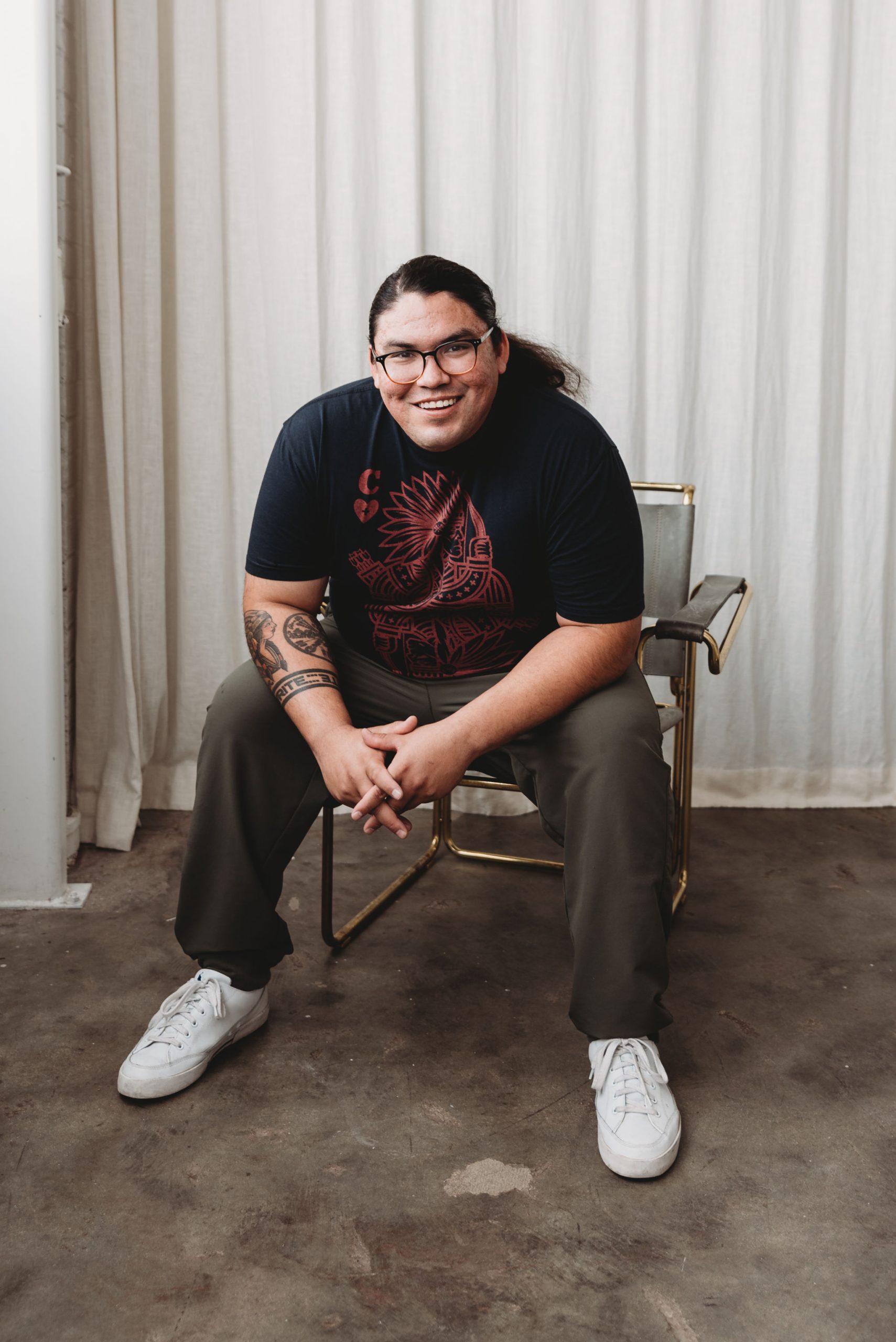
When Joshua Emerson’s mom died in the winter of 2019, he felt like a crucial part of himself had been severed. The Denver-based comedian, writer and actor was raised partly on the Navajo reservation in Arizona, and his mother’s passing sparked a difficult reckoning with his Native heritage.
“There’s a sense that I lost a little of my Indigenousness when she died, because she was the one that was Navajo, and was from the reservation, and she spoke Navajo,” says Emerson, whose dad is white. “I don’t speak Navajo. There’s a sense that I have to learn how to come back to that as an adult … I feel orphaned culturally, and because of that, it’s made me want to do Native projects and be around Native people.”
Now 31, Emerson is co-chair of the Denver American Indian Commission, and puts on one of the only Native comedy showcases in the United States. He also just became managing director of Creative Nations Collective, a permanent onsite gallery for Indigenous artists at the Dairy Arts Center in Boulder.
Emerson stays busy these days, performing comedy and helping various communities blossom — from the Colorado indie-comic circle to the world of local Indigenous artists. He’s also the co-founder of DeadRoom Comedy in Denver, a troupe and production company he started with friends Elliot Weber and Jacob Jonas after graduating from Fort Lewis College in Durango four years ago.
Hosting nearly 200 events since its inception, including the Colorado Native comedy showcase, DeadRoom has become the perfect vehicle to combine Emerson’s industrious ambition with his passion for Indigenous issues. He sees comedy as a vehicle for Native people of various tribal backgrounds to connect and learn from each other.
“Comedy is unique in that it’s able to give voice to minority communities,” he says. “It helps us talk about difficult things and then relieve it through a punchline that just makes everybody laugh and brings [them] into community. When you can talk about difficult things, you’re able to be more honest.”

With that uplift and honesty in mind, Emerson stresses that “Native Americans are not a monolith.” As the only Indigenous member of DeadRoom, which has expanded from its three founding members, he wants folks to know that understanding Native people takes more than catching up on the latest season of Reservation Dogs.
“When you’re talking to a Native you gotta ask, ‘So what tribe or community are you from?’ They [each] have their own history and backstory,” he says. “There’s a big difference between being Ojibwe and being Navajo — being Diné, which is what I am. But it’s cool; we have similar struggles; we see each other. There’s definitely, like, a head nod. There’s a community [that comes] from being Native.”
DeadRoom is now putting on roughly a dozen comedy events a month, according to Emerson, stretching across Colorado and into surrounding states. And as the collective’s footprint grows, Emerson waxes poignantly when asked whether there is any subject that shouldn’t be joked about.
“If you’re going to talk about something that’s going to bring up trauma in people, you gotta have an exit for it,” he explains. “Are you being irresponsible by making jokes that are gonna hurt people? And then there’s this other thing of, you don’t know what’s funny until you try it. So the attempt becomes sacred.”
When it comes to that “sacred” attempt, Emerson says there are few crowds tougher than those found here in Boulder.
“I’d say Boulder is one of the hardest places to talk about race … even [harder than] Colorado Springs or Fort Collins. When you’re talking about race in those communities, their racism is out in the open, and they’re OK laughing about it,” he says. “You come up to Boulder, I think there’s less racism but the racism that is here is very inside — very hidden — and it’s very hard to reach. When you do bring it up it makes people uncomfortable, because they’ve compartmentalized it. It’s hard for them to find the funny in it. I don’t know if it’s that they’re ashamed, or if they’re aware they even have it stored away.”
But as Emerson continues to push audiences into uncomfortable territory while working to ensure “a seat at the table” for Native people through various organizations and events, the self-described comedy “lifer” returns to a simple but profound goal.
“The best you can do is try to make it better, and hope that creates a lineage so that it’s easier for anyone that comes behind you.”
ON STAGE: Underground Comedy Showcase feat. Joshua Emerson and Ben Roy. 7:30 p.m. April 27-29, License No. 1, 2115 13th St., Boulder. Tickets here.


#inform-video-player-1 .inform-embed { margin-top: 10px; margin-bottom: 20px; }
#inform-video-player-2 .inform-embed { margin-top: 10px; margin-bottom: 20px; }
A film event, playwrights festival, concert and a workshop by the Idaho Circus Collective join the traditional artisan booths and food trucks for the 37th annual Art Under the Elms Friday through Sunday at Lewis-Clark State College in Lewiston.
Admission to the event, organized by the LCSC Center for Arts & History, is free. Hours are noon to 7 p.m. Friday, 10 a.m. to 7 p.m. Saturday and 10 a.m. to 4 p.m. Sunday.
#inform-video-player-3 .inform-embed { margin-top: 10px; margin-bottom: 20px; }


Lying in bed the other morning listening to the radio, I experienced a dark epiphany; I’ve never been much fun in the mornings. There had been problems in Jerusalem, and one side in the conflict had provided video footage supporting its claim that it had been wronged. For my whole life up to this point, I would have been minded to take a look at that video. But now I found myself thinking, why bother? How would I know it showed what it said it showed? How would I know it wasn’t a complete fake? Videos and photos used to mean something concrete, but now you can’t be sure.
I haven’t enough confidence in my human intelligence to formulate a firm view on the dangers or otherwise of artificial intelligence. What I do know is that before long, we won’t know anything for sure. As it stands, however good a fake might be, you can still just about tell it’s a fake. But only just. Sooner rather than later, the joins will disappear. We might even have already passed that point without knowing it. If the judges of the Sony world photography awards couldn’t spot the fake, what chance have the rest of us got?
Television drama is ahead of the curve on this. The Capture and The Undeclared War were both great and did the subject justice – both gave off an unsettling sense of the end of days. If the twist in every crime drama is some kind of deep fakery, it’s all going to get terribly boring. So, in the outside world, to paraphrase GK Chesterton, everything will go to pot as we’ll believe in nothing or, indeed, anything. And, back home, there won’t even be a decent box set to watch. What a time to be alive.


When Chef Sean Sherman reminisces about the progression of his career, he does not brag about prestigious culinary training or upper-echelon European inspirations. When asked about his motivations, the James Beard award-winning chef speaks of the centuries-long oppression of the Native American Community, colonization, and generations of unchecked cultural erasure.
Recently named one of Time’s 100 Most Influential People 2023, Chef Sean Sherman is a revolutionary of the culinary arts. Sherman is the founder and CEO of The Sioux Chef, a team of Native American artists organized around the common goal of decolonizing North American cuisine and reviving Native American culture through food. He is also the founder of The Sioux Chef initiative “NĀTIFS” — an acronym for “North American traditional indigenous food systems”— a nonprofit dedicated to promoting awareness of indigenous foodways and Native American food access.
The project that put Sherman on the map was his creation of the award-winning Minneapolis restaurant “Owamni,” a full-service indigenous restaurant that aims to promote accessibility to Native American cuisine and embody sustainable culinary practices.
Needless to say, Sherman is at the forefront of food-related activism and an innovative powerhouse of culinary excellence. But this was not without struggle — Sherman has fought tooth and nail to get to where he is today. In an interview with The Crimson, Chef Sherman spoke to the roots of his mission and the challenges his team has faced in implementing their vision within the modern restaurant industry.
“For me, from the very beginning, it was more about coming from a very poor area. There’s not a lot of family wealth to tap into for business ventures,” Sherman said. “It’s a lot of privilege to be able to raise enough funds to open up something like a restaurant. That was probably the biggest struggle is navigating through the system that’s set out against us.”
Sherman’s passion for the deconstruction of colonial culinary practices is where his expertise really shines through. In his work, he prioritizes “removing colonial ingredients like dairy, wheat flour, cane sugar, beef, pork, chicken”— redefining the American pantry.
Those unfamiliar with the mission of The Sioux Chef may be surprised by the classification of these ingredients as colonial. However, the overprocessed foods often credited with rising rates of obesity and diabetes in the United States are almost always characterized by their overdependence on ingredients purported by colonial foodways. Overprocessed wheat flour, unnaturally derived sugars (including the American favorite cane sugar), and refined oils are all examples of problematic culinary staples ingrained in American culture from the inception of colonial America.
“For almost all native tribes, losing access to the majority of their food and a lot of the culture and knowledge around their foods affected things a lot,” Sherman said. “We see a lot more health epidemics, things like type two diabetes, obesity, and heart disease.”
The heart of Sherman’s work lies in combating this institutionalized culinary oppression. “It’s a broken system that needs to change,” he said.
Advertisement
The Sioux Chef’s most recent endeavor is “Indigenous Food Lab”— a market space that features curated Native food products. “Our goal is to be a regional support center to help any entrepreneurs or tribal communities develop any kind of food production,” Sherman said.
According to NĀTIFS’s website, the Indigenous Food Lab is currently in its second phase of “creating regional and Indigenous food access.”
“We’re already planting seeds to operate food labs in Anchorage, Bozeman, and Rapid City, Sherman said. “The vision is to have these food labs all over North America and eventually beyond, into other countries.”
A key priority of the “Indigenous Food Lab” initiative is adapting to the native cuisines of diverse tribes. “Just in the US alone, there are 574 different tribes that are federally recognized and even more that have lost that status,” Sherman said.
Since Native culinary traditions rely heavily on the environment of their regions, it would be impossible to capture and represent the intricacies of indigenous cuisine in a single restaurant. That being said, the regional quality of this culinary culture, paired with the ever-deteriorating nature of environmental concerns, provides even more urgency for these acts of culinary preservation.
Sherman hopes to expand knowledge surrounding Native cuisine, whether through the outreach of NĀTIFS or the promotion of other region-centric restaurants like “Owamni.” Sherman mentioned restaurants owned by his friends such as Crystal Wahpepah’s Wahpepah’s Kitchen in Oakland, California, and Ben Jacobs’s Tocabe in Denver, Colorado, but highlighted that there are “not a lot” of Native-owned restaurants nationally. “That’s why we started the nonprofit, to help other people develop,” Sherman said.
The Sioux Chef remains steadfast in its mission as expansion moves underway. If readers wish to assist Sean Sherman’s advocacy, he urges them to keep an eye out, extend support towards indigenous food situations within their region, and/or provide directly to the NĀTIFS nonprofit.


La peinture, servante idéale de la photographie, pour détourner les mots de Charles Beaudelaire, résume ce dont il est question chez les trois artistes : Bertrand Delais, Stéphane Belzère et Virginie Isbell, réunis pour l’exposition “Lisières”. Aucun d’eux ne se considèrent comme photographe, mais tous utilisent la technique du médium, pour creuser les profondeurs de la matière photographique et offrir de nouvelles représentations du réel, plus picturales. Cernes, délinéations, teintes…

Todd Haimes, Artistic Director of Roundabout Theatre Company, Passes Away at 66
Mr. Haimes transformed Roundabout from a 150-seat Off-Broadway company into one of the largest not-for-profit theatres in the United States.

Todd Haimes, longtime artistic director and guiding light of Roundabout Theatre Company, passed away April 19 following complications of osteosarcoma. He was 66. The news was confirmed by Roundabout press representative Matt Polk.
Mr. Haimes, known widely for his tireless work transforming Roundabout from a 150-seat Off-Broadway company into one of the largest not-for-profit theatres in the United States, led the company for the last 39 years.
Born May 7, 1956 in New York City, Mr. Haimes joined Roundabout in 1983 when the company was operating in a Chelsea movie house. Initially the managing director, Mr. Haimes took out loans in his own name to keep the company afloat in his first weeks before the board of directors voted to shut down the enterprise. He fought back, and, at 26, was able to convince a board member to donate enough money to buy him the time to implement sweeping expenditure cuts, marketing improvements, and staff changes. Amongst his wide-reaching changes was an adjustment to curtain times to entice earlier theatre goers, discounts for children, and special events for different audience demographics. Remarkably, he turned the company around, growing it into one of the most powerful forces in the American theatre.
In 1989, Mr. Haimes became the producing director of Roundabout, rising to chief executive in 2015. In 1991, Mr. Haimes brought Roundabout to Broadway, where it soon became a bastion of revivals of classic work, as well as a home for new work. Currently, two new plays—Pictures From Home and Fat Ham—are utilizing Roundabout-owned theatres for their Broadway debuts, as well as the Broadway transfer of the Olivier-winning & Juliet. Under Mr. Haimes’ guidance, Roundabout has grown to encompass three Broadway theatres: Studio 54, the American Airlines, and theStephen Sondheim; and Off-Broadway’s Harold and Miriam Steinberg Center for Theatre.

In total, Mr. Haimes was involved in 141 Broadway productions, in addition to his countless contributions to the Off-Broadway theatre ecosystem. Roundabout is responsible for one of the most expansive theatre education program in the country, which reaches more than 4,000 students annually, alongside extensive technical training programs to help underprivileged students find careers in the backstage aspects of theatre. During the COVID-19 shutdown, Roundabout created remote learning programs for the NYC Department of Education, ensuring that arts education would continue throughout New York City.
During Mr. Haimes’ tenure, Roundabout won 34 Tony, 58 Drama Desk, 73 Outer Critics Circle, 21 Lucille Lortel, and 14 Obie Awards. In 2013, he received a Lifetime Achievement Award from the Lucille Lortel Awards, and in 2021 he received a portrait at Sardi’s Restaurant, an honor which he particularly valued.
Mr. Haimes was the former President of the Board of The Alliance of Resident Theatres/New York, and a member of the Tony Awards Administration Committee and the Broadway League Executive Committee. He has taught Theatre Administration in the graduate program at the Yale School of Drama and the Graduate Theatre Administration program at Brooklyn College. He holds a Bachelor’s Degree from the University of Pennsylvania and a Master’s Degree in Business Administration from the Yale School of Organization and Management.
Since 2002, he fought a private battle with osteosarcoma, a bone cancer. Despite the sickness, he continued to lead the company through the 2022-2023 season, including the currently running Primary Trust, and national tours of 1776 and A Soldier’s Play.
A plan had been established with the full support and commitment from the Roundabout Board of Directors to elevate Deputy Artistic Director Scott Ellis to Interim Artistic Director. Ellis, who has worked by Mr. Haimes’ side for more than 30 years, will work alongside Roundabout executive staff members Sydney Beers and Chris Nave until a permanent plan is executed.
He is survived by his wife, Jeanne-Marie; his children, Hilary and Andrew; his step-children, Julia and Kiki; his grandchildren, Corey, Josephine, Aiden, and Alexander; and the countless performers and audience members whose lives he impacted.
As a not-for-profit theatre company, Roundabout survives off of donations and funds raised from subscriptions to their annual season. In honor of Mr. Haimes, donations may be made to A.R.T. New York and the Todd Haimes Fund for Artistic Excellence at Roundabout Theatre Company.


On March 28, UWSP erected a mural painted by Christopher Sweet, an artist, and a member of the Ho-Chunk Nation and White Earth Ojibwe tribes, to commemorate the burial ground beneath the campus. It is titled “The Wake and The Healing.”
Sweet’s mural took about two months to complete, and he worked on the panels individually. The painting stands 24 feet tall by 32 feet across at the Communication Arts Center.
In 2016, Dr. Ray Reser, an alumnus, professor, and archaeologist at UWSP, was given an article about indigenous burials from the 1930s. Soon after, he requested and succeeded in asking the Wisconsin Historical Society to recognize the UWSP campus as an uncatalogued burial ground in 2018.

Reser said, “The first step to the mural was finding out there were Native American burials here on campus.” He contacted Tommy Thompson, the former UW System president, to fund the mural.
Thompson allocated $30,000 to support the endeavor.
“I had spoken to many indigenous tribes and individuals, and they all felt there needed to be some monument to remember their ancestors,” Reser said.
According to Reser, formal funerals for indigenous tribes take over a year by tradition, and after the bodies were buried in the stone quarry that is now on campus, their tribal members never got to perform the proper funeral services for them.
He said, “Around 80 [indigenous] people passed from Scarlet Fever in the Mid-1800s, and Native American bodies were likely put into the old stone quarry that ran from Old Main to the health center.”

The mural pictures four graduates of the tribes: Menomonee, Ojibwe, Ho-Chunk, and Potawatomi. It has corresponding Native American beading pictured for those tribes represented on each graduation cap.
During his process, Sweet burned sage throughout working on the mural and asked the ancestors to bless him. He hopes the mural will be an awakening for them.
“I want my mural to encourage and inspire indigenous students throughout their careers at UWSP,” Sweet said.
Denise “Dee” Sweet, Christopher Sweet’s cousin, and inspiration for his artwork, wrote a poem for the mural.
Dee’s poem titled “Earth Diver” reads:
“Through chards of pots
And musky tangled roots
We swim the crushed soil
And clumps of clay to wind
our way from the underground.
Our hands reach for the sunlight
Like shimmering arrowheads
Voices emerging, dust to dust.
Still breathing our names
Still singing our songs.”
Karen Ann Hoffman, an alumnus of UWSP, worked with Dr. Ray Reser after her late husband’s passing. Around 2018, she and Reser started advocating for the burial ground to be recognized. She is a beadwork artist of the Haudenosaunee tribe.

“Most of the artwork from this tribe has been erased, both intentionally and unintentionally. As an advocate for Native American art, that bothers me,” she said.
“I want to think about opportunities to uplift and bring to light other Native American artists.”
She pushed to have a call for art to the Native American artistic community to select a final piece of artwork for a commission to memorialize the burial ground
“[Sweet’s] paintbrush, his knowledge, and community are what inspired the mural. I hope that everyone, after seeing the mural, acknowledges daily [that] they walk over the grave of so many of our ancestors,” Hoffman said.
Following the debut of the mural, a traditional ghost feast took place on April 13 where the ancestors were brought food and drinks to give them a ceremony that they would have received if their burial was done properly. The formal unveiling of the mural is scheduled for May 5.
Delila Lyshik
News Reporter
dlysh541@uwsp.edu






