Native

Indigenous Creativity Shined at the 101st Santa Fe Indian Market

Indigenous Creativity Shined at the 101st Santa Fe Indian Market
image

More than a thousand Indigenous artists from more than 200 tribes gathered at the annual Santa Fe Indian Market in New Mexico this weekend. Now in its 101st year, it’s a longstanding tradition for artisans to showcase and sell their pottery, textiles, jewelry, and more. The two-day event—organized by SWAIA—delivered both a vibrant street style scene and an innovative runway show, featuring top Native designers such as Orlando Dugi, Lauren Good Day, and Jamie Okuma (who recently became the first Native designer ever to become a member of the CFDA).

Held in and around the historic Santa Fe Plaza, attendees got to peruse the assortments of craftwork from a diverse array of artists. One could spend many hours shopping the one-of-a-kind ribbon shirts from Penny Singer; printed hoodies and skirts from Elias Jade Not Afraid; elegant earrings and rings from jewelers such as Keri Ataumbi, Maria Samora, and Robin Waynee; and striking artwork by Wakeah Jhane and Penélope Joe. Even better? The street style scene was a sight to behold in itself, as many in attendance used the opportunity to display their cultural pride. Attendees and artists showed up in their finest ensembles for the occasion. 

Well-clad guests were seen rocking their finest Native-made pieces, such as floral-beaded earrings, colorful ribbon skirts, and turquoise squash-blossom necklaces worth a small fortune. If the Indigenous community has its version of the Met Gala, this would be it. Traditional items were paired with jeans or dresses for a cool, current feel. The annual Clothing Contest held on the plaza, meanwhile, displayed the best of time-honored regalia. Men, women, and young people were judged on their traditional Indigenous attire made with raw, organic, or natural materials. The ensembles ranged from striking jingle dresses to dentalium-shell capes.

Exhibition honors art, legacy of Oscar Howe

Exhibition honors art, legacy of Oscar Howe

Aug. 23, 2023

This paid piece is sponsored by the University of South Dakota.

The University of South Dakota honors Oscar Howe’s legacy as an artist and mentor through a traveling exhibition being seen nationwide.

“Howe’s legacy reminds us of the tremendous power of inspiration and perseverance,” said Bruce Kelley, dean of the College of Fine Arts. “As his own artistry evolved, Howe challenged the notion that he had to fit a certain mold. He spent most of his life in small communities in South Dakota and yet proved to be a global force. His legacy lives on in both his art and his teachings, which continue to impact generations of students and artists.”

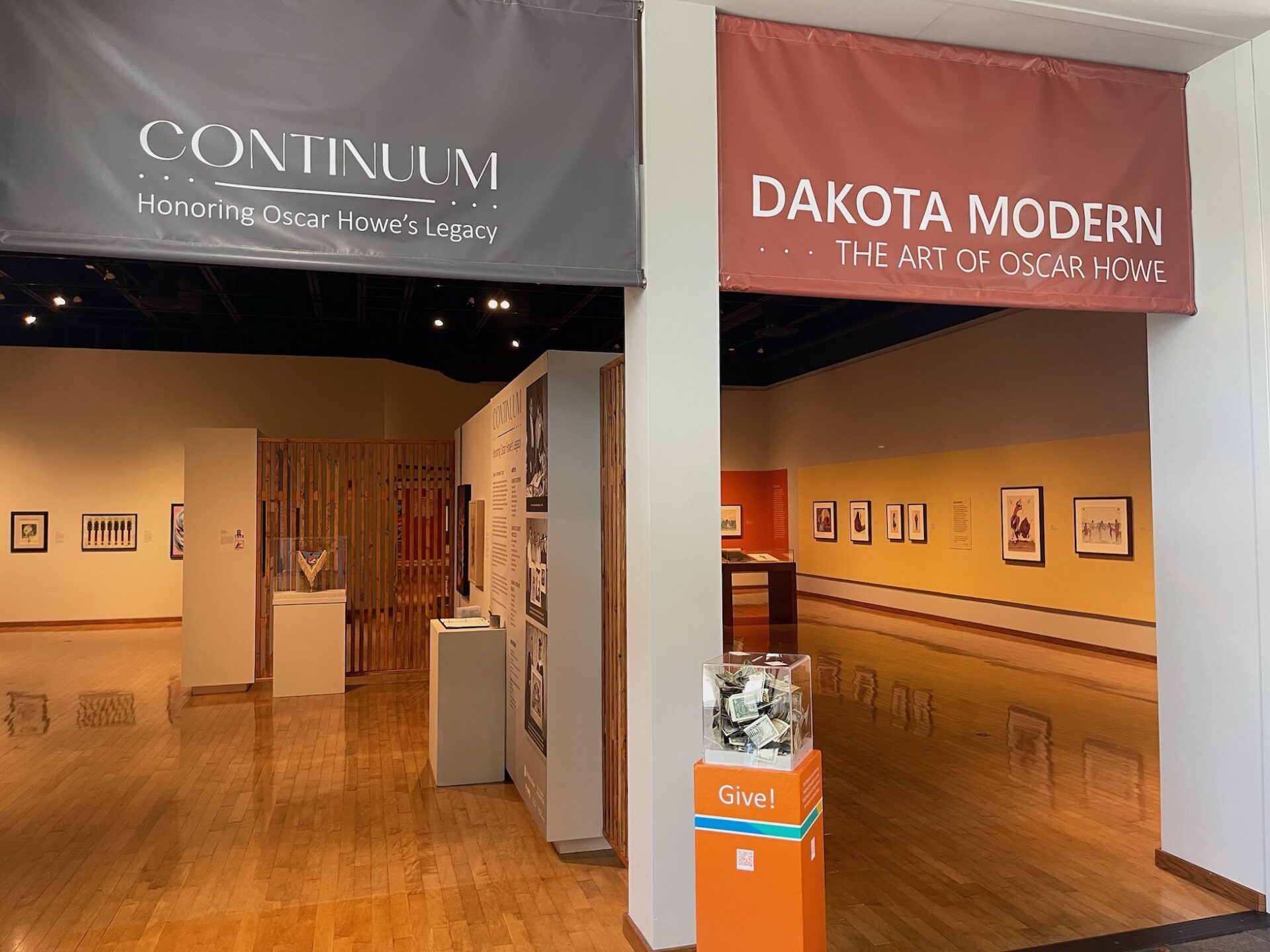
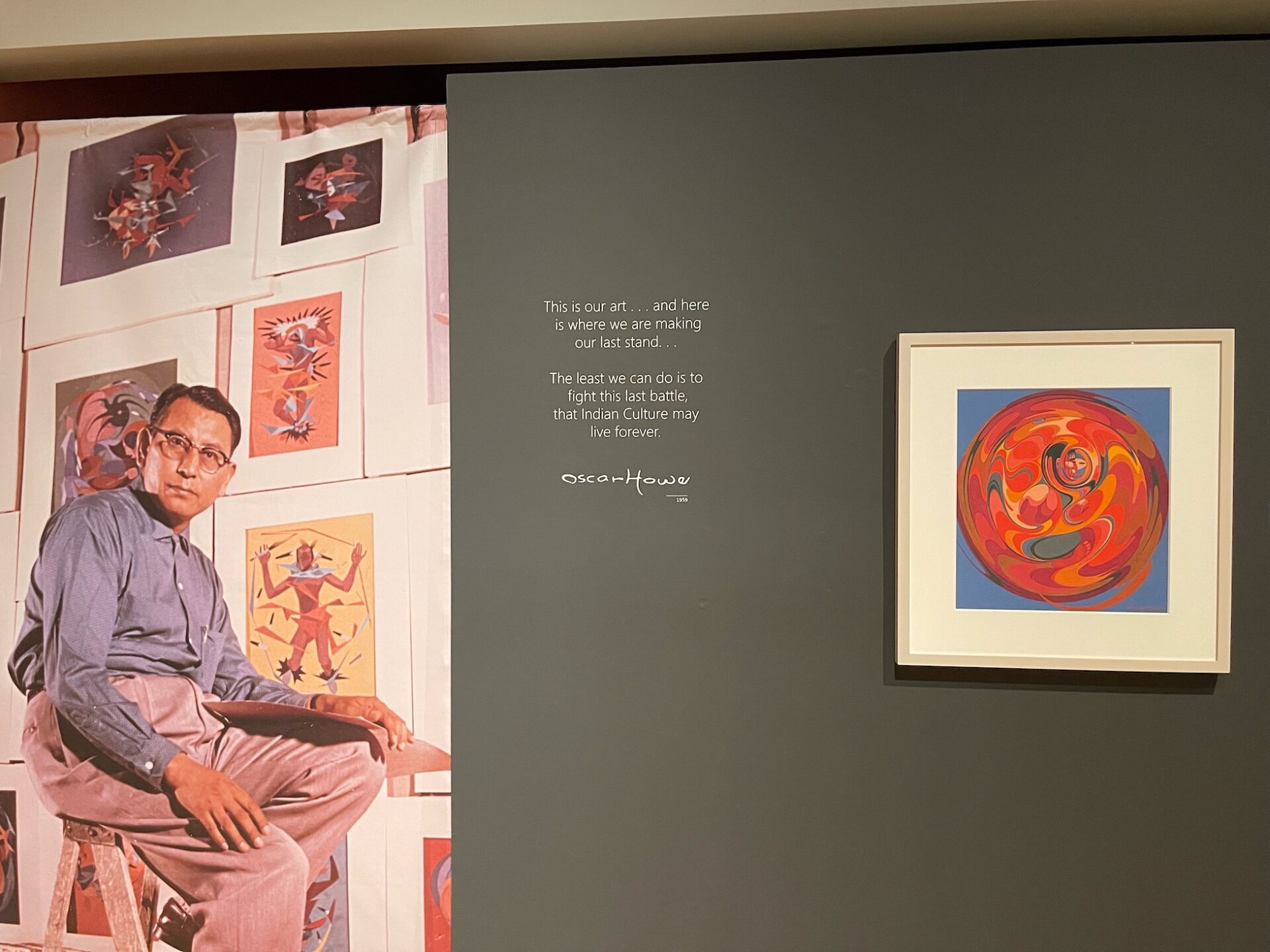
“Dakota Modern: The Art of Oscar Howe” takes viewers on a journey of more than 40 years of Oscar Howe’s career and development, from early conventional work he created while in high school in the 1930s through the emergence of Howe’s innovative and abstract approach to painting in the 1950s and 1960s.

This exhibition, developed in collaboration with the Portland Art Museum and curated by Kathleen Ash-Milby, curator of Native American art at PAM, introduces new generations to Howe, who is considered to be one of the 20th century’s most innovative Native American painters.

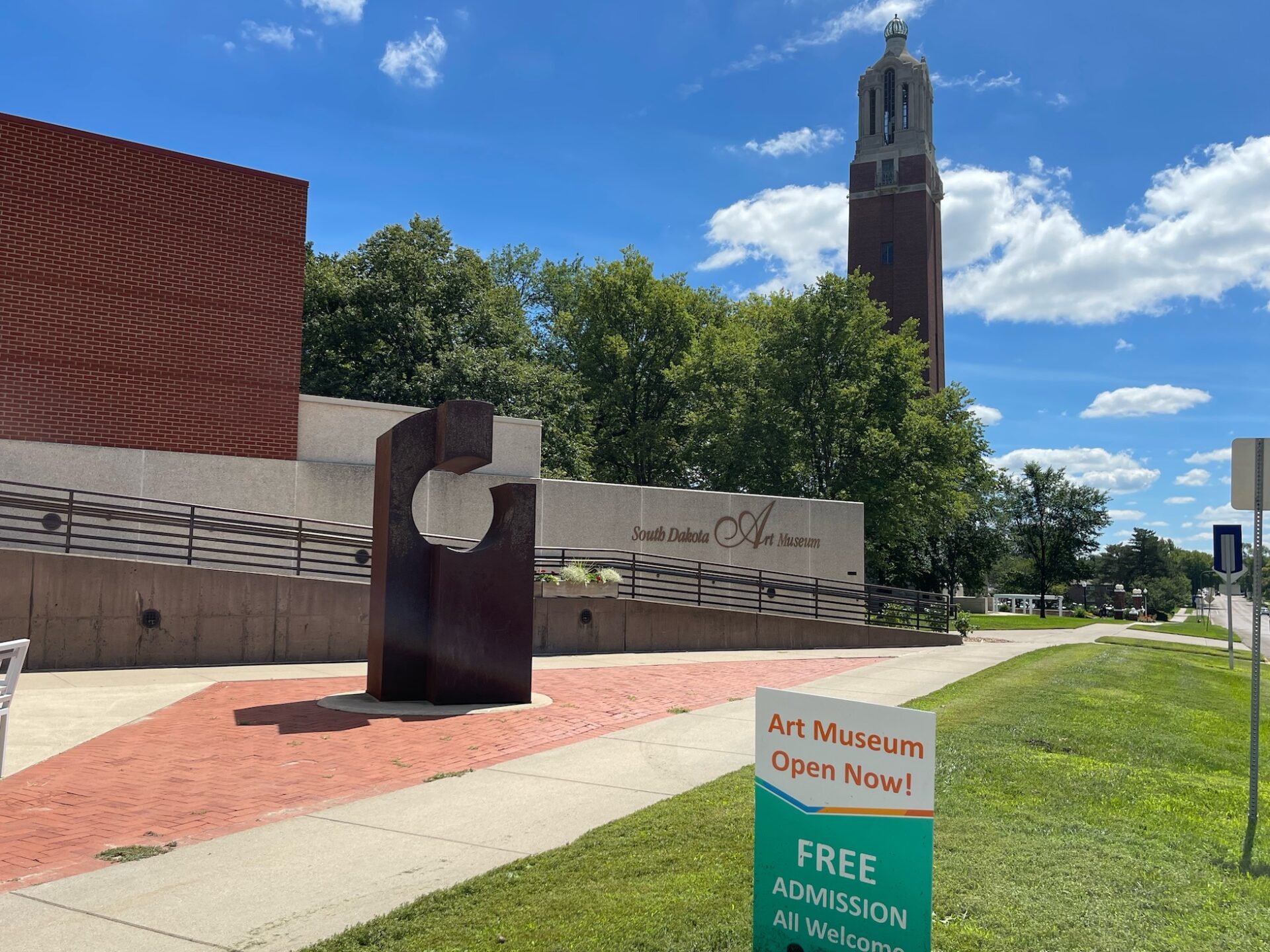
“Dakota Modern: The Art of Oscar Howe” has been on display across the country – from Portland to the Smithsonian’s National Museum of the American Indian in the nation’s capital. Now, it has traveled to Howe’s home state of South Dakota and is on display at the South Dakota Art Museum in Brookings through Sept. 17.

To truly understand and appreciate the craft of a man who catalyzed a movement among Native artists to express their individuality rather than conforming to an established style, it is important to appreciate the culture and tradition of the artist who wielded the brush.

The history

Born in 1915 at Joe Creek on the Crow Creek Reservation, Howe would come to be a renowned artist whose work would be seen around the globe by the time he turned 18.

Howe attended the Pierre Indian School before returning home to learn from his grandmother Shell Face. While there, he spent hours drawing and painting, using anything he could get his hands on as tools for his craft. His grandmother would share the history of their people, telling stories and legends of the generations before them.

In 1933, Howe left the Plains for New Mexico and attended the Santa Fe Indian School, where he joined the art program established by Dorothy Dunn. Though he could have taken his talents anywhere, Howe chose to return to his roots in South Dakota upon graduating in 1938.

Around this time, he joined the South Dakota Works Progress Administration and completed mural projects in Mitchell and Mobridge.

In 1942, Howe was drafted into the Army and would return from his time abroad with his wife, Adelheid Hample. The couple had one child, Inge Dawn.

Howe earned his bachelor’s degree from Dakota Wesleyan University and later received his MFA from the University of Oklahoma. In 1957, after teaching at Pierre High School for three years, he became an artist-in-residence and professor of art at the University of South Dakota.

Howe dedicated 23 years of his career to USD. He retired as emeritus professor of art in 1980, leaving behind a legacy that would influence generations of students for decades to come.

The artist exhibited works in New York, London and Paris while he was a student in the 1930s and later was represented by more than 50 solo shows. He was named artist laureate of the Middle Border in 1954 and artist laureate of South Dakota in 1960. He was also the first recipient of the South Dakota Governor’s Award for Creative Achievement in 1973.

Rituals rooted in family

When Inge Dawn Howe Maresh was a child, she thought everyone’s dad painted at night after they watched the news.

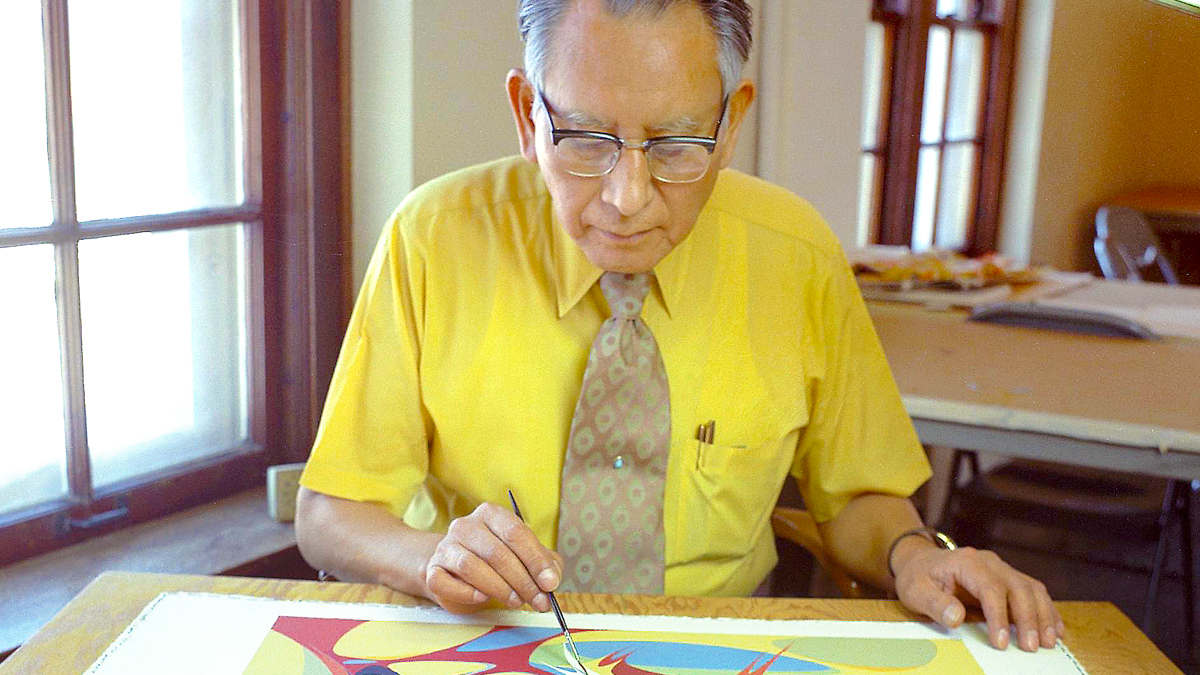
She grew up watching her father set up an art studio in each home they lived in. Sometimes it was a dedicated corner of a room; other times he and his wife sacrificed a bedroom as a studio and slept in the living room — all so he could have space to create.

“My father was a wonderful father,” Howe Maresh said. “He was gentle and kind; he taught by example. He loved his family very much.”

According to Howe Maresh, the family’s routine was comfortable and well structured. Her father would come home promptly at 5 p.m. when her mother had dinner prepared and on the table. They would eat together as a family, sharing stories about their days before her father would move to the living room to watch the news. After the news, it was time to paint.

“In preparation for his next piece, my father would draw a sketch of the story he wanted to tell with his painting,” Howe Maresh reflected. “He would study his paper before establishing three ‘esthetic points’ (beauty points) and connect them with lines (symbols of truth). This process is called ‘owa’ and means writing with a point-to-point movement.”

Howe incorporated Native American symbols into his works, and every element of his pieces was layered with deep meaning and intentionality that paid homage to his Dakota heritage.

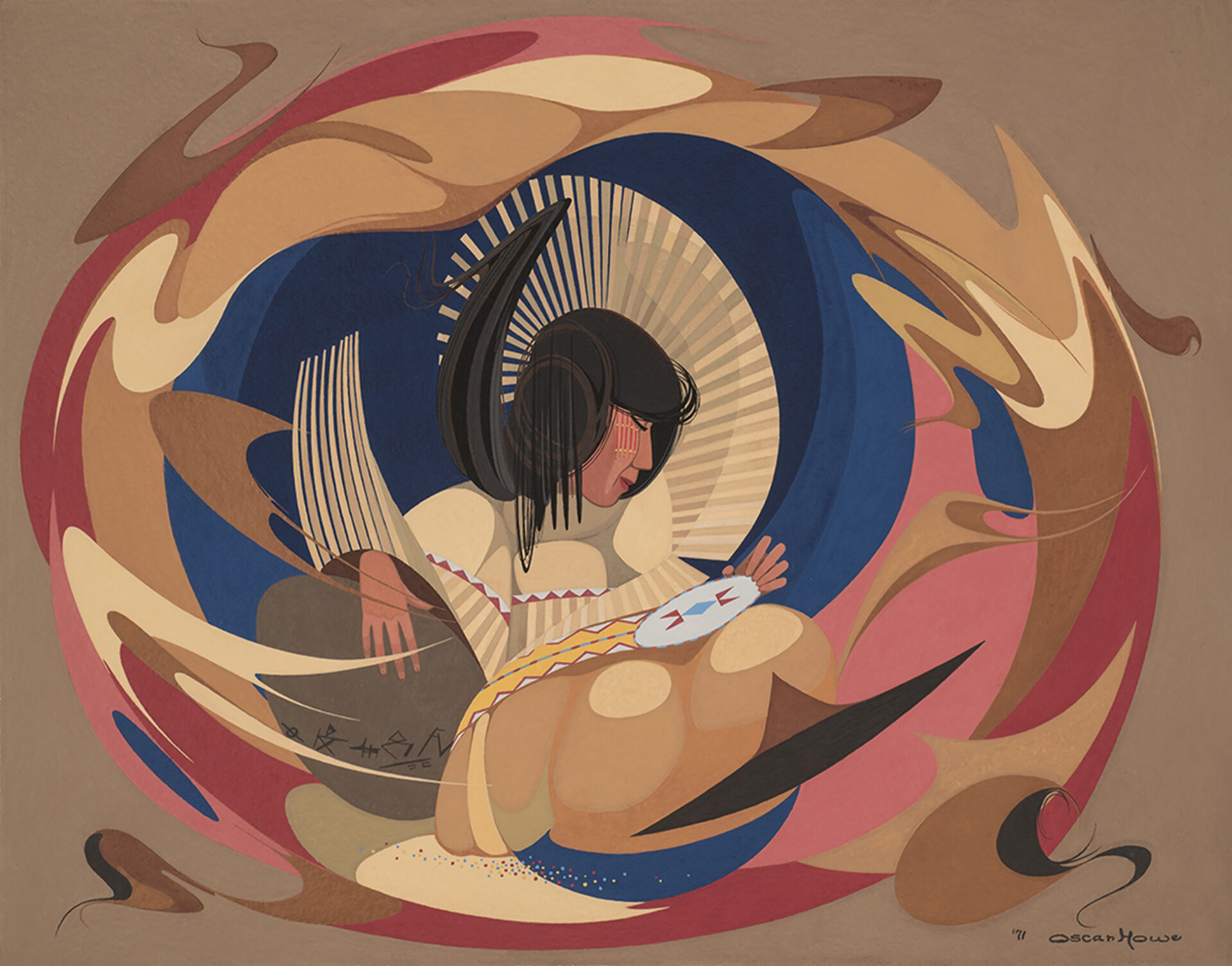
“Dance of Double Woman,” 1971, Oscar Howe, © Howe LLC

Howe Maresh described the care he took into each color he mixed by hand and remembered a bathtub full of Fabriano paper that she would help him soak in preparation for his next piece. Howe emulated the process of painting on skins and visually represented the oral history of his people.

“He wished to stay close to traditional Dakota Indian painting (on skins) called the painting of the truth,” Howe Maresh said. “I think his art fulfilled his hope to represent the best of Dakota culture, and he was able to capture the spirituality of his people in very powerful ways and introduce it to modern cultures.”

“Kaska” (Trial by Riding a Wild Horse), Oscar Howe, © Howe LLC

One summer, Howe Maresh took a workshop from her father and witnessed his teachings firsthand.

“I think he touched all his students with inspiration for setting goals in your life and feeding your creative spirit,” she said. “He certainly respected individuality and positivity in life. He believed it was everyone’s responsibility to make the world a better place by connecting with and respecting your own culture so you can expand your horizons to value and appreciate other cultures.”

Paving the way for Native artists

Howe paved a path for Native artists, giving them expressive permission to own their talents, embrace their history and break down barriers that fought to keep them contained.

As a teacher, father, husband and artist, Howe’s approach was calm and unapologetic. He never underestimated the power of community or the value of integrity.

“I try to faithfully and truthfully bring out the true meaning of the fine and good things of the past Sioux culture,” Howe said in his 1958 letter to the Philbrook Art Center. “It is my greatest hope that my paintings may serve to bring the best of Indian culture to the modern way of life.”

Howe created paintings that could be appreciated for their basic aesthetic appeal, but he challenged viewers to consider something far more meaningful — to feel the movement of a ceremonial sun dance, watch dancers transcend a traditional powwow and witness traditions that are honored to this day.

Howe wove deeply rooted tradition and ceremony into the sharp lines of modernism. He intentionally used both the positive and negative space on the page, creating magic in noncontextual landscapes. This timeless appeal to his art invites viewers to think beyond the image of a reservation on the plains of South Dakota and see Native people, culture and tradition across all timelines in all corners of the world.

Howe’s influence in artistry expanded far beyond the legacy of his paintings. In addition to teaching on USD’s campus and serving as a faculty adviser for the Wapaha Club – the USD Native Student Club founded in 1957 – Howe began to offer summer art classes to high school students in 1960.

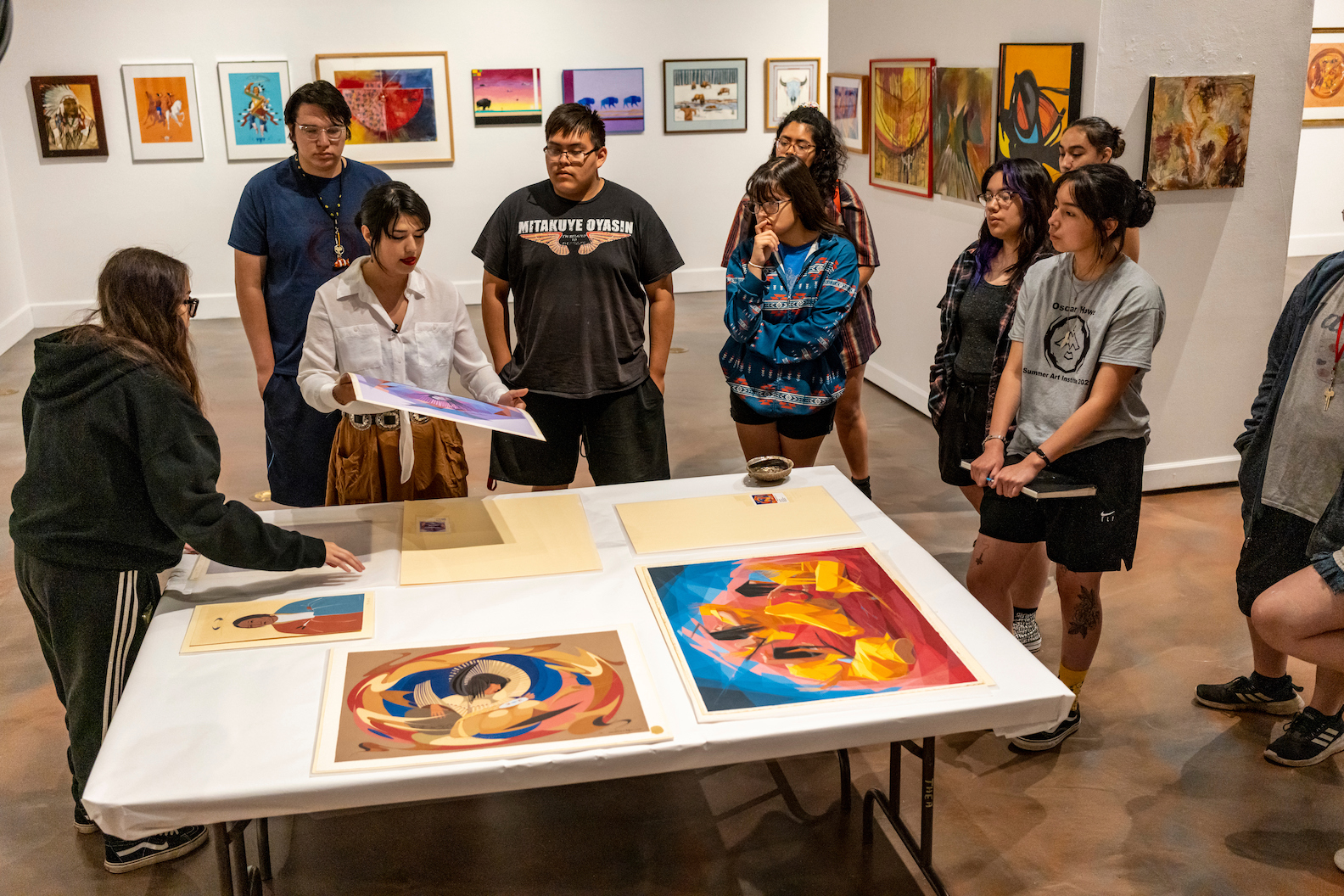
Primarily dedicated to Native Americans, the classes offered by Howe created an opportunity for students to visit a college campus, learn from a successful Native artist and be exposed to an educational experience they otherwise might not have received. The students were provided with a sense of community and connection that expanded beyond the borders of where they grew up.

Through the stroke of a brush, Howe brought their history to life — teaching about the past while honoring the present. He introduced students to a new opportunity, encouraging them to pave their own path in the world.

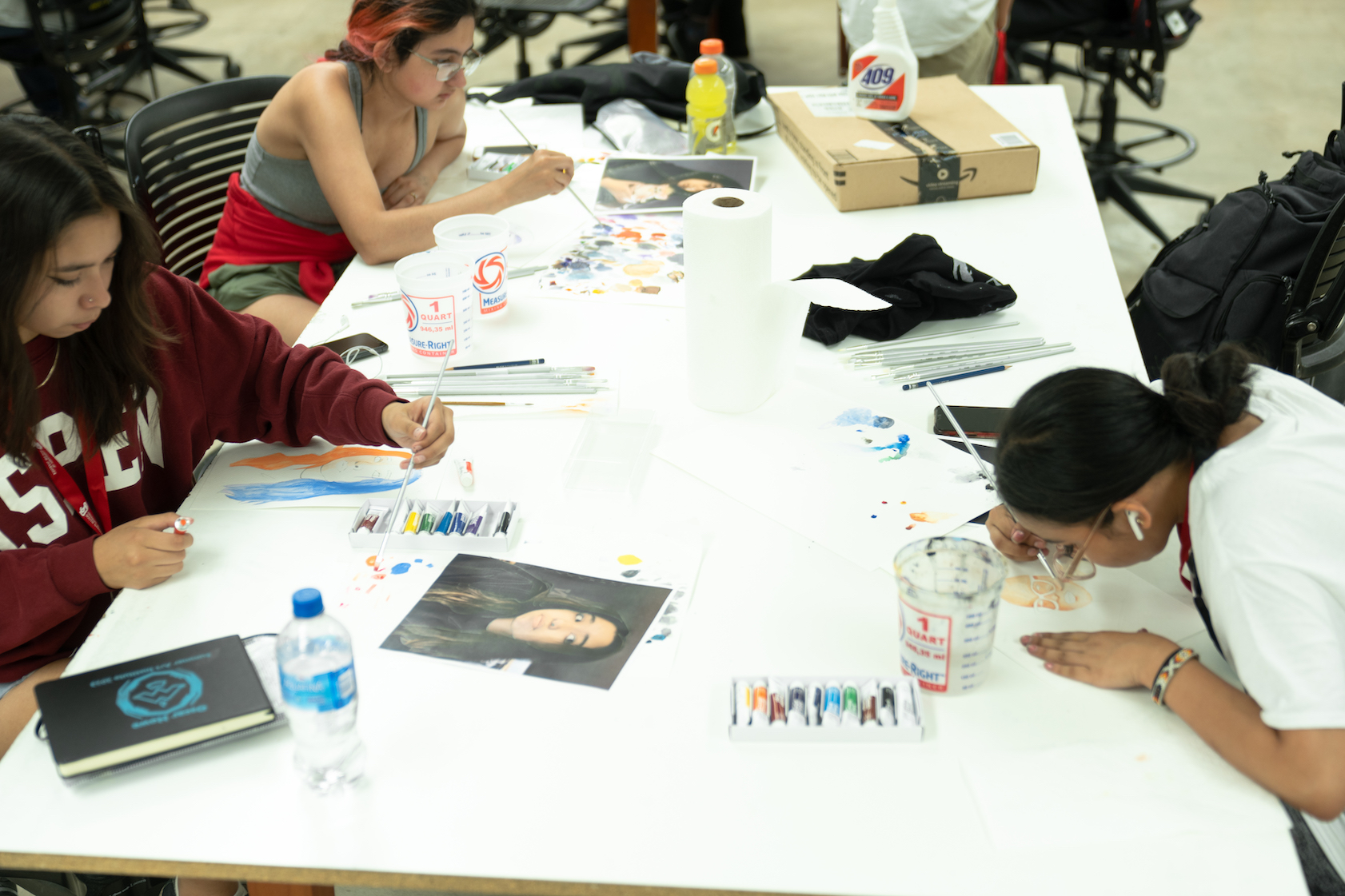
Decades later, students who had the benefit of being taught by Howe would carry on this tradition through the Oscar Howe Summer Art Institute, or OHSAI.

Leaving a legacy

“For all of our pride in Oscar Howe as a South Dakotan, we must acknowledge that he belongs to the world.” – John A. Day

While his paintings have graced the walls of museums around the globe, Howe was not driven by fame; rather, the humble, generous artist was motivated to encourage and support the generations that would follow.

In 1991, Robert Penn, a former student of Howe’s who experienced firsthand a life-changing education from Howe, joined forces with John A. Day to restart the OHSAI in honor of the late artist.

In the early years of the institute, funding was scarce, and at times, the faculty who led the programming weren’t paid. Later, with the help of transformative grant dollars, the institute was able to not only attract incredibly talented artists as teachers and lecturers but also welcome students from beyond the region.

Like Penn, many students who have attended the institute have found success and fame as artists and have come back years later to pay it forward, acting as student counselors, teachers and lecturers.

“The importance of Oscar Howe’s influence on Native American artists and arts programing cannot be understated,” said Cory Knedler, chair of the UDS art department and director of the OHSAI.

“Without Howe’s influence on Bobby Penn, there would be no Oscar Howe Summer Art Institute. Penn was Howe’s protege and understood the importance of a strong mentor and providing transference of knowledge from one generation to the next. Without the institute, there would be countless artists that would not have had the opportunity to meet the mentors that changed their lives and encouraged them to pursue an art career. We continue to see this today as students who went through the early OHSAI are now back as instructors, continuing to transfer what they learned to the next generation of young artists.”

To learn more about the traveling exhibition, click here.

Japanese Artist Tetsuya Ishida Dreamed of Having a Solo Show in New York Before His Untimely Death. Two Decades Later, Gagosian Is Honoring His Wish

Japanese Artist Tetsuya Ishida Dreamed of Having a Solo Show in New York Before His Untimely Death. Two Decades Later, Gagosian Is Honoring His Wish

More than two decades ago, when Tetsuya Ishida was still a young emerging artist in Japan, he was already dreaming big. He had his eyes set on New York, wishing that he would one day have his solo exhibition in the center of the contemporary art world. He was preparing himself, saving money from a part-time job and learning English when he was not painting.

Ishida’s dream, however, did not materialize prior to his untimely death in 2005 at the age of 31 due to a train accident. But that was not the end of his story: This fall, the late Japanese artist’s wish will come true next month when Gagosian opens “Tetsuya Ishida: My Anxious Self” at its 555 West 24th Street space in New York on September 12.

Featuring more than 80 works, the exhibition, curated by Cecilia Alemani, is set to be the artist’s largest show outside of his native Japan. The gallery is also now representing Ishida globally in association with the artist’s estate, Artnet News can exclusively reveal.

Tetsuya Ishida

Tetsuya Ishida, Exercise Equipment (1997). © Tetsuya Ishida Estate. Photo: Rob McKeever. Courtesy Gagosian.

“In getting to know the family over the past several years, we learned that an exhibition in New York was Tetsuya’s greatest artistic ambition, and we are incredibly honored to present his paintings in New York on the 50th anniversary of his birth,” Nick Simunovic, senior director of Gagosian in Asia, told Artnet News.

Born in Yaizu, Japan, in 1973, Ishida grew up as part of the country’s “lost generation,” a term referring to those who graduated during the 1990s and 2000s in a period of recession. During his short-lived artist career, Ishida created about 200 works. The sentiment of loss and despair experienced among this generation during a decade marred by high unemployment and high suicide rates can be felt in Ishida’s poignant paintings and graphic works.

Often meticulously detailed, Ishida’s paintings depict expressionless or sad faces of young men, their human bodies merged with objects surrounding them, including plastic bags, airplanes, buildings, broken satellites, machine parts, and animals like crabs and seahorses. At times, his human figures appear nearly lifeless in his paintings, lying on a conveyor belt or arriving as packaged goods.

Critics in Japan relate Ishida’s work with the country’s dominating manga and anime culture, but at the same time, this “convergence” with objects can also be understood as a visualization of the psychological survival mechanism needed during a repressive time.

“At first, it was a self-portrait. I tried to make myself—my weak self, my pitiful self, my anxious self—into a joke or something funny that could be laughed at… It was sometimes seen as a parody or satire referring to contemporary people. As I continued to think about this, I expanded it to include consumers, city-dwellers, workers, and the Japanese people,” the artist was quoted in a statement.

Ishida’s works were exhibited and collected in some parts of Asia but they did not get to travel beyond the region until November 2013, when Gagosian held a solo exhibition of the artist at its Hong Kong space, the artist’s first outside of Japan.

Tetsuya Ishida

Tetsuya Ishida c. 1995 © Tetsuya Ishida Estate. Courtesy the artist and Gagosian

Recalling the organization of the exhibition, Simunovic, who was leading the gallery’s Hong Kong operation at the time, was first introduced to the artist’s enigmatic paintings through a Hong Kong collector more than 12 years ago. “I was immediately taken with the work and showed it to Larry [Gagosian], who was equally captivated,” Simunovic said. “We both agreed that it would be interesting to present an exhibition and, as we didn’t know the family at the time, we began making plans to mount a show of work from the secondary market. We secured great loans from collectors across Asia.”

The 2013 Hong Kong exhibition became a turning point for Ishida’s art. Jessica Morgan, a curator at the Tate at the time, saw the show and subsequently included the artist in the 2014 edition of Gwangju Biennale, when she served as its artistic director. “Okwui Enwezor, who was on the Gwangju jury at the time, was fascinated by Ishida and the power of his work, and, in turn, featured the artist in his exhibition for the 56th Venice Biennale in 2015,” Simunovic noted. And then, Reina Sofia’s curatorial team saw the Venice show and subsequently offered Ishida’s family a solo show at the museum in Madrid in 2019.

In between, the artist’s relatives became aware of the growing reputation of his work and reached out to Simunovic. “We slowly began building a relationship and we were given works for sale, which we placed in esteemed collections around the world,” he said.

Tetsuya Ishida

Tetsuya Ishida, Refuel Meal (1996) © Tetsuya Ishida Estate. Courtesy the artist, Shizuoka Prefectural Museum of Art, and Gagosian.

The gallery and the artist’s family were initially working on a show in New York, which was stalled due to the Covid-19 lockdowns. “We believe in his work and feel it’s extremely important that it be seen and understood in the West,” Simunovic said. The 80 works to be featured in the New York show represent nearly half of Ishida’s entire body of work. Some of them are on loan from the collection of the Shizuoka Prefectural Museum of Art, which is located in the artist’s home town in Japan, as well as other private collections. Others are from the estate and will be available for sale, but Simunovic declined to reveal exactly how many works and the price range.

Simunovic is confident the show will resonate with an audience in the West. Ishida’s art, which addresses the themes of disconnection, alienation, and despair, are universal and highly relevant to the current times, he added.

“We live in a pluralistic art world where there are countless western collectors who enjoy collecting Asian contemporary art, just as there are countless Asian collectors who are avidly collecting western contemporary art,” he said.

More Trending Stories:  

An 1837 Portrait of an Enslaved Child, Obscured by Overpainting for a Century, Has Been Restored and Acquired by the Met 

Rising Artist Ronan Day-Lewis’s ‘Punk Romanticism’ Imbues Desolate American Landscapes With an Eerie, Cinematic Aura 

Why Did Yoko Ono’s Arboretum Art Installation in New York Shut Down Early? ‘Unfortunately, Trees Died’ 

LGDR Gallery Splits Up After Less than Two Years as Founding Partner Jeanne Greenberg Rohatyn Departs 

Photographers Recreate Old Master Paintings in Witty and Profound Ways in a New Show at a Princeton University Art Gallery 

Blue-Chip Artworks Seized From Top Portuguese Collector Will Be Featured in New Art Museum in Lisbon 

Once Celebrated and Then Forgotten, the French Artist Marie Laurencin Is About to Step Into the Limelight Again, Three Decades After Her Death 

Follow Artnet News on Facebook:
Want to stay ahead of the art world? Subscribe to our newsletter to get the breaking news, eye-opening interviews, and incisive critical takes that drive the conversation forward.

Collective Momentum: How Chicago Tool Library and Center for Native Futures are Making Impact with Design

Collective Momentum: How Chicago Tool Library and Center for Native Futures are Making Impact with Design

Photo: Courtesy the Chicago Tool Library

The spirit of Chicago design showed itself in a lively discussion with this year’s outstanding Design Impact Grant recipients—Tessa Vierk, executive director and co-founder of Chicago Tool Library (CTL) and Monica Rickert-Bolter, co-founder and director of operations at the Center for Native Futures (CfNF), moderated by grantee alum, Quilen Blackwell, president and co-founder of Chicago Eco House—during this year’s NeoConBoth organizations’ future focus to broaden Chicago’s accessibility to art and design culture and design-build resources have something in common. The community framework they are cultivating considers the impact of historical influence, socioeconomics, environmental, political and other challenges that create barriers. Says Vierk, ”It really isn’t just a space, it is an ethos about sharing and collective wealth that we all should be benefiting from.”

Just four years old and newly relocated to West Garfield Park, CTL is a lending library with an impressive inventory of tools and items with an affordable pay-what-you-can membership structure. Their service to individual DIY types covers all seventy-seven neighborhoods with a mission to “create new and equitable opportunities for Chicagoans to build, repair and learn.” With their relocation, CTL acquired nearly 5,000 new tools that have upgraded their ability to scale outreach to other nonprofits, community gardens, block clubs and small businesses. When asked about the future of design in Chicago, Vierk answers with a light-hearted laugh, referencing the organization’s grant project “power tools to the people” concept. She continues with calming determination: “Our perspective is about democratizing design and access to concepts and tools to build design capacity on a neighborhood level,” she says, ready to dive into the needs of diverse community groups to be better partners and “blow up” the neighborhood impact.

Photo courtesy the Center for Native Futures

In a similar direction, physical space is a game-changer for the Center for Native Futures, functionally and symbolically, as they take on a storefront location in the Marquette Building, incorporating gallery and artist-in-residence studio space “to perpetuate Native presence in the city of Zhegagoynak (Chicago) and foster Native artists and curators.” The organization is at the epicenter of Indigenous Futurism(s), “an ongoing principle we have adapted to intertwine past, present and future, particularly through the advancement of art,” says Rickert-Bolter. To clarify the concept, she poses the question, “How are artists using traditional practices to showcase art and stories in a new way—and making it accessible to a broader audience to secure Indigenous future?”

In the case of the iconic Marquette Building, the bronze reliefs depicting the journey of Jacques Marquette are historically problematic and CfNF is leading the effort to reframe the Native narrative in an exhibit. Juxtaposed with that, visitors will experience the continuum of vibrant Native culture in nearby CfNF galleries that display contemporary visual arts. Building on this serendipitous moment where Indigenous Futurism(s) collide, the organization is thrilled to expand its Native curatorial vision. “We don’t always see Natives who are in charge of curation in museums and galleries in the Great Lakes Region,” says Rickert-Bolter. “Our grant will allow us to initiate a mentorship program for a Native professional with curatorial experience to work with an emerging artist. At the end of the program, there will be a curatorial show. Our goal is to attract local Native art and culture professionals and encourage them to stay in the region.” 

Designing a Better Chicago at NeoCon

Both awardees’ enthusiasm to create the broadest possible benefits for communities was unbridled. Constructing collective design capacity in neighborhoods is a novel approach to removing barriers while building resilience and motivating new storytelling. After all, challenging the traditional winner-takes-all-perspective can yield a healthier, more inclusive and more innovative community culture.

Yetta Starr, IIDA, is the founding principal of Starr Design Associates, Inc., a commercial interior design practice specializing in showroom, workplace, education, scientific and civic interiors as well as exhibits and visual communication projects.  Starr has a passion for engaging with community-based initiatives supporting cultural identity and economic development.  She is a contributing writer to print and online publications, reporting on industry trends and design’s impact on the human experience.

Contact: ystarr@starrdesign.net Website: starrdesign.net

Native heritage and the West explored in painting exhibition

Native heritage and the West explored in painting exhibition

CHEYENNE – An exhibition of paintings exploring complex themes with astounding visuals is coming to Laramie County Community College as part of the Ed & Caren Murray Art Series.

Born on the Wind River Reservation in central Wyoming, artist Robert Martinez’s diverse heritage — including Spanish, Mexican, Scotch-Irish, French Canadian and Northern Arapaho roots — infuses his artwork with a rich tapestry of cultures and influences.

Let the news come to you

Get any of our free email newsletters — news headlines, sports, arts & entertainment, state legislature, CFD news, and more.

Explore newsletters

Black Artists Of Oregon: Episode 1

Black Artists Of Oregon: Episode 1
Black Artists of Oregon

Black Artists of Oregon

Black Artists Of Oregon: Episode 1


image


00:00
/

This is Art Unbound, a joint production of PAM and the Numberz FM. Episode 1 is featuring Intisar Abioto, the guest curator for the exhibition Black Artists of Oregon on view September 9, 2023 through March 17, 2024.

This first episode is hosted by DJ Ambush, the executive director at 96.7 The Numberz FM.

Produced by: The Numberz Podcast Network
Music by: King E.D.O.

5 Star Story: Kong Wee Pang’s Memphis art

5 Star Story: Kong Wee Pang’s Memphis art

MEMPHIS, Tenn. (WMC) – Memphis and the Mid-South are full of talented people with a solid musical legacy. But this area is also full of incredible fine artists who make this city even more beautiful.

In this week’s 5 Star Story, in our continuing quest to highlight the things that make us proud, meet an artist who traveled thousands of miles to make Memphis her home and whose public art is already well known to many.

From the “I Love Memphis” mural in the Crosstown neighborhood to the glittering “Love Doves” in Overton Square, Kong Wee Pang is putting her mark on Memphis. Kong Wee, whose native language is Malay, says the glitter is a touch of New Orleans, where her husband is from originally.

Kong Wee Pang's art is on display all around Memphis.
Kong Wee Pang’s art is on display all around Memphis.(Action News 5)

“Sequin is perfect for the space to (make the whole environment more vibrant).”

The “Love Doves” mural was the first public art piece in Memphis that Kong Wee and her husband, artist Jay Crum, created under the pseudonym Taro Pop Studio.

“Because of that piece, we’ve been getting invited to so many different places to install some kind of same material art,” she said.

Those “different places” include installations in Denver, Auburn, Austin and Nashville.

Kong Wee Pang's art is on display all around Memphis.
Kong Wee Pang’s art is on display all around Memphis.(Action News 5)

Since moving to the Bluff City 23 years ago to attend the Memphis College of Art, the Malaysian transplant has transformed mundane city surfaces into things of beauty, like the glittery mural under the Interstate-40 overpass on Main Street.

“So hopefully, this mural that is gonna help connect these two bridges together, the South Main and North Main, and revitalize that North Main area‚” Kong Wee explained.

Just steps away from that mural inside the Renasant Convention Center is another Taro Pop masterpiece representing what Kong Wee called Memphis’ endless growth and music history.

“Then we still want to capture the music. […] So we’re using the Memphis Mississippi River bridge to form the reflection, to form the blue guitars,” she described.

Kong Wee Pang's art is on display all around Memphis.
Kong Wee Pang’s art is on display all around Memphis.(Action News 5)

Kong Wee also created the 2022 River Arts Fest poster and just this year, she was invited to showcase not only her talent, but also her country of origin for the 2023 Memphis in May poster.

She explained what that painting represents: “Malaysia is a rainforest, so every morning you wake up, you will see the rainforest, the water drop, drop on the ground. So that kind of reflects my past. So when you squint your eyes you start to see that the city of the twin towers, famous Malaysia from the west. So the east side is more like a rainforest, very natural, so the hummingbird is part of… the element. Our national flower is hibiscus.”

In addition to public art, Kong Wee is a fine artist whose work has been shown in galleries around the world. Her current medium of choice is watercolor, a sort of metaphor for life.

“And so the watercolor that I use and also is part of the, kinda like Chinese idiom (speaks Chinese) means that remember where is original, the water that you drink, where you come from. So, that watercolor is kind of like opening up the abstract-like thinking; sometimes you don’t know who you are but you’re thinking you know. Water is kind of the medium that you want to control, you always want to control, but (you can’t). So what is in between that control and not control?” she theorized.

“Sometimes, I don’t even know that one stroke will form something, but there might be too much water. That means I have too much thought behind the painting.”

Kong Wee is also a design artist for companies like Planned Parenthood, St. Jude Children’s Research Hospital and FedEx, to name just a few.

Sometimes she immerses the technology from that aspect of her work to create fine and public art. The Summer Arts Garden in front of the Memphis Brooks Museum of Art, on display until October, is a great example.

“I spent so many times in Overton Park so I wanted to do my best to create this art garden piece. So when I create this piece, I also inject some AR (Augmented Reality) you can scan so the creature comes out from the umbrella,” she explained.

Kong Wee Pang's art is on display all around Memphis.
Kong Wee Pang’s art is on display all around Memphis.(Action News 5)

But whether her art is digital, three-dimensional or on canvas, Kong Wee’s Memphis masterpieces inspire us all to open our hearts and imagination, like a painting she created that, on first look, appears to be a large flower.

“So for the piece, the bird is hidden, the hidden bird in the flower but you see the first thing is like, ‘Oh, there’s a flower.’ But, if you’re using your heart to see something, you will see even more the hidden message,” she said.

Kong Wee Pang makes us proud she’s made Memphis home.

To learn more about Kong Wee Pang’s art, click here.

Click here to sign up for our newsletter!

Click here to report a spelling or grammar error. Please include the headline.

Mundelein artist makes College of Lake County temporary ‘Home’

Mundelein artist makes College of Lake County temporary ‘Home’

College of Lake County (CLC) is expanding its approach to the arts with its first artist-in-residence, Mundelein-native Cristina Chopalli. She is one of four artists showing works at “Home,” the upcoming fall art exhibition Aug. 25 to Sept. 21 in the Robert T. Wright Gallery of Art at the college’s Grayslake Campus.

Chopalli always knew she’d create art. After getting her master’s in fine arts degree in creative writing, her method was originally supposed to be through words. After graduating, she began writing a memoir and traumatic parts became difficult for her to write. So, she paused the project and turned to painting.

With no formal training, Chopalli soon entered her paintings for gallery exhibitions and made it her full-time career. Her paintings feature layers of brightly colored acrylic paints, overlapping together to form familiar shapes and figures with bold lines. She says she’s always surprised by what she finds in the paint.

“The sprawling canvas fills with colors, movement and joy,” Chopalli says about her latest painting. “After a couple of hours, the colors and shapes enter into a meditative flow and combinations blossom.”

Chopalli describes her work as intuitive. She starts by painting what she feels without overthinking it. Many of her works come to her during meditation or in a dream.

As an artist-in-residence, Chopalli set up her art studio at CLC’s Grayslake Campus. She has a number of works in the exhibition, but the one she’s creating during her residency at CLC is wider than she is tall, bursting with colors and organic shapes. Along with the opportunity to showcase her work, Chopalli has enjoyed her time at CLC because she has the chance to speak to interested students about her work and their career goals.


“I enjoy exchanging thoughts on all types of art with college students and faculty who stop by while I work,” Chopalli said. “I’m hopeful to have a good variety of my work together because it really has a collective narrative. When people see my work, for me, what’s important is that they find whatever it is that they’re looking for. There is not just one message or right or wrong.”

The opening reception is Friday, Aug. 25 from 5:30-7 p.m. Artists Taehoon Kim, Michael Litewski and Ilse Miller will also share their personal visions of home.

“The “Home’ exhibition offers a diverse group of artists with unique takes on the metaphorical idea of home,” said Art Gallery Curator Ann Rintz. “It features non-objective, abstract and realistic art by four artists of various backgrounds and at different stages of their creative careers. I find that diversity creates a more dynamic exhibition.”

Gallery hours are Monday-Thursday 8 a.m. to 9 p.m., Friday 8 a.m. to 6 p.m. and Saturday 9 a.m. to 3 p.m.

About College of Lake County

College of Lake County is a comprehensive community college committed to equitable high-quality education, cultural enrichment and partnerships to advance the diverse communities it serves in northeastern Illinois. Offered at three campuses in Grayslake, Vernon Hills and Waukegan or online, college classes are affordable and accessible to help each student achieve academic, career and personal goals. More than 70,000 students graduated with degrees and certificates since the college opened in 1969. College of Lake County is the only higher-education institution ranked among the top 15 best places to work in Illinois by Forbes in 2019 and is a national leader in many areas, including campus internationalization, sustainability and conservation.

EDA Leadership Meets With Native Community Development Coalition Members in South Dakota

EDA Leadership Meets With Native Community Development Coalition Members in South Dakota
image

This spring, Dennis Alvord, EDA’s Deputy Assistant Secretary (DAS) for Economic Development and Chief Operating Officer, visited Rapid City, South Dakota. He met with members of the Mountain Plains Regional Native CDFI Coalition (Mountain Plains), led by the Four Bands Community Fund. In 2022, Mountain Plains received a $45 million EDA award as part of the Build Back Better Regional Challenge (BBBRC).

EDA leadership is committed to furthering the agency’s relationship with its Tribal partners and stakeholders. This event provided the opportunity to spotlight how one of our grantees is maximizing its BBBRC funding to improve economic opportunities within its community, a core EDA investment priority.

Equity & Economic Growth

Mountain Plains is comprised of nine Native Community Development Financial Institutions (CDFIs), serving Montana, North Dakota, South Dakota and Wyoming. These four states are some of the most sparsely populated in the nation while having the highest concentrations of Native Americans. They contain twenty Indian reservations and urban populations totaling more than 208,000 people. The coalition works to dismantle long-standing barriers to capital which led to disproportionate rates of poverty, unemployment, and income. Together, they create locally-led financing infrastructure to support Indigenous business growth and economic stability in this region.

The EDA investment enables the coalition to do just that by expanding economic opportunities in Tribal communities through a Regional Revolving Loan Fund (RLF), providing $21 million in loan capital to deploy. It was designed to provide local Native entrepreneurs with the resources they need to build and grow their businesses. Through this program, EDA and the coalition seek to reverse decades of historical disinvestment and institutionalized inequities for Native communities.

Community Impact

Coalition members began the proceedings by providing DAS Alvord with an update on their work since the grant was awarded last fall. After robust conversations and a couple of panel discussions, the group visited several Native-owned businesses in downtown Rapid City, many of which have received funding through the RLF program. These visits were designed to underscore the real-world impact of the grants and the BBBRC program.

DAS Dennis Alvord tours the Tusweca Gallery, an Indigenous art gallery in Rapid City, South Dakota. The gallery received an RLF loan made possible through EDA’s Build Back Better Regional Challenge.

The tour included a stop at the Tusweca Gallery, which features a series of exhibits by Indigenous artists. With an emphasis on Lakota history, these pieces help to promote the creative talents of the nearby Pine Ridge Indian Reservation.

The day’s events concluded with a meal catered by Chef Braveheart, an Indigenous private chef, motivational speaker and female entrepreneur. Guests were also treated to a traditional dance ceremony performed by members of the Oglala Lakota Nation.

The following day, DAS Alvord gave keynote remarks congratulating the coalition for their BBBRC successes and inspiring them to keep leveraging their forward momentum. He highlighted additional opportunities available through the EDA and the broader Department of Commerce coalition of agencies.

For more information on resources available to Tribal communities, please visit eda.gov (PDF).

Native artist and fisherman Gary Stevens dies at 53

Native artist and fisherman Gary Stevens dies at 53

Gary Albert Stevens, 53, passed away in June in his Las Vegas home of natural causes. His memorial service will be at 5 p.m. on Thursday, Aug. 31, at Chief Shakes House on Shakes Island in Wrangell, followed by a reception and potluck at the American Legion Hall.

He was born to Gary James and Susan Georgina Stevens on March 28, 1970, in Wrangell. He was Tlingit and Haida of the Naanyaa.iee clan. His Tlingit names were Gush Tlein, Ts’eil and “Eagle Looking Out on the Ocean.” He was the first grandchild born to the Feller and Stevens family in Wrangell.

He graduated from Wrangell High School in 1989, and at the age of 20 moved to Ketchikan to learn Tlingit formline art.

He later went on to get an associate of arts degree at the Institute of American Indian Arts in Sante Fe, New Mexico, in 2001 and a bachelor of arts in English in 2003. He was given the Truman Capote Short Story Writer Award in 1999 and graduated Phi Beta Kappa.

Gary owned Down the Mountain prints in Seattle from 2003 to 2012, and with his talent provided the designs for Alaska Wolf and Raven Silkscreens and Apparel owned by his mother and all the art prints for Naanyaa.iee kooexs from 2008 to 2013, and the design to celebrate the Shakes Island restoration in 2014.

When he was 23, he conceived a canoe project. He got community members involved and saw the result of their work at a ceremony for “The Dedication of the Wrangell Canoe” to the Wrangell Cooperative Association in April 1998. It now sits in front of the screen at the Shakes House.

His first commercial fishing trip was when he was a few weeks old, when he trolled on the Fairweather Grounds. He commercial fished with his dad and younger brother on the Miss Susan.

He was preceded in death by his father, Gary Stevens; grandmothers Carol Feller Brady, Patricia Youens Ewing and Edith Ann Stevens; grandfathers John Paul Feller Sr. and James Stevens; uncles Chuck Jenkins Sr., Albert Feller Sr., Otto Feller, Thomas Feller Sr., Carl Bean, Walter Stevens, John Fowler II, Christopher Feller, John Feller Jr., James Shirai, Chester, Ben and George Miyasato Sr .; aunts Sandra Moore, Patricia Ann Stevens and Rachel Shirai Peterson.

He is survived by his mother Susan Georgina Stevens; brother Mark Christopher Stevens; grandfather Brookner Scott Brady; Linnea Brooks, the long-time companion of his dad; uncles Carl Stevens, Earl Kloster, Jerry Knapp; aunts Helen Feller, Luella Knapp, Rhonda Lynn Smith, Harriet Beleal; and numerous cousins, nieces and nephews.