Native

Jeffrey Gibson’s ‘sexy’ new book showcases the complexity of Indigenous art

Jeffrey Gibson’s ‘sexy’ new book showcases the complexity of Indigenous art
An inside look at Jeffrey Gibson’s An Indigenous Present, which is a collection of more than 60 Indigenous contemporary creatives across various mediums. Photo provided by publisherAn inside look at Jeffrey Gibson’s An Indigenous Present, which is a collection of more than 60 Indigenous contemporary creatives across various mediums. Photo provided by publisher
An inside look at Jeffrey Gibson’s An Indigenous Present, which is a collection of more than 60 Indigenous contemporary artists across various mediums. Photo provided by publisher

What started as a dream to build an Indigenous community that challenges ideas of contemporary art and colonial categorization has resulted in a catalogue featuring more than 60 Indigenous artists. The book explores what it means to combine different identities and methods of making art across the globe. 

Nearly 20 years ago, Jeffrey Gibson, of Mississippi Choctaw and Cherokee descent, began dreaming of an anthology that showcased contemporary Indigenous creatives across various mediums while moving beyond the page, offering a counterexample to earlier publications he had seen. 

According to Gibson, within the art world’s institutions, there is a history of pervasive racism, which has led to an industry that often tries to confine artists into one specific box or label their work according to identity, traditions, or their traumas.

He noted that the industry is often attached to diversity initiatives, causing many Indigenous artists to question whether their participation hinged on who they were instead of what they made.

“The culture that I’ve grown up with surrounding Indigenous people felt like the boundaries were drawn so tightly as to what we’re allowed to do, who we’re supposed to be, and what we’re supposed to look like. I’ve never fit that model myself, and I have always been drawn to other Native people who also don’t fit that model,” says Gibson.

“So much of the 20th-century writing around Native artists is almost about justifying their work and relationship to western art history, and explaining why it’s Native, and often trying to draw a direct line to precedents and beadwork, or precedents and materials or in painting.”

He added that this approach is often restrictived an limits the freedom of artists to express themselves and showcase what their Indigeneity means to them instead.

“I wanted to make a book that did that,” he said.

Headdress–Jeneen by Dana Claxton, featured in Jeffrey Gibson’s An Indigenous Present. Photo provided by the artistHeaddress–Jeneen by Dana Claxton, featured in Jeffrey Gibson’s An Indigenous Present. Photo provided by the artist
Headdress–Jeneen by Dana Claxton, featured in Jeffrey Gibson’s An Indigenous Present. Photo provided by the artist

Gibson and his team spent two and a half years reaching out to an ever-evolving group of Indigenous creatives to be a part of this project.

They then worked to present their art in a large-format book with beautiful images that includes thoughts from curators, poets and writers – all while infusing the cultural and distinctly different identities of communities.

And now, Gibson’s dream is coming to life with the release of An Indigenous Present, published by DelMonico Books and Big NDN Press, on Aug. 22, 2023. 

This collection gathers more than 60 Indigenous contemporary artists, including many Indigenous artists from “Canada,” such as Dana Claxton, Laakkuluk Williamson Bathory, Rebecca Belmore, Beau Dick, Wally Dion, Korina Emmerich, Brian Jungen, Meryl McMaster, Caroline Monnet, Audie Murray, Arielle Twist, and Zoon a.k.a. Daniel Glen Monkman. 

“An Indigenous Present has emerged as much out of my dissatisfaction with the circumstances I have navigated during my own career as it has from witnessing artists who proudly identify as Indigenous carve out their own creative spaces and, collectively, manifest both local and international contexts for their artworks,” Gibson writes in the introduction. 

He spoke to IndigiNews by phone from his office, a turn-of-the-century schoolhouse in the Hamlet of Claverack, just outside of Hudson, New York, where the original classrooms have been converted into sewing rooms, painting rooms, woodshops, a kitchen, and more. 

There, Gibson created a shared studio space with other artists in the surrounding area. This type of environment is exactly the sort of energy Gibson was looking for with An Indigenous Present, as sharing and reciprocity have always been an ethos within Indigenous culture.  

High heel boots covered in beadwork depicting an elk.High heel boots covered in beadwork depicting an elk.
Elkboots by Jamie Okuma. Photo provided by artist

“I wanted this collection to be about people whose work I’m excited by that I’ve casually come across over the last 25 years, but it’s not really that casual because Native art is always a destination. It’s the world I’ve paid attention to and the people I have been inspired by,” says Gibson. 

“I wished for a different kind of art system, one that looked at and related to artworks from the cultural perspective of their Indigenous makers. I knew I wasn’t alone in wanting these things,” he says in the intro of the book. 

Look at any curated collection of Indigenous artists from the past, and what you’ll mostly see is the influence of traditional design or academic essays illustrated with artwork by Indigenous makers.

What the creators in An Indigenous Present are making moves past those distilled perspectives, allowing for the pieces to be in conversation with one another rather than an addition to the curator’s thoughts. 

And it is this that Gibson hopes to interrogate, stating that “other Indigenous artists were contributing to – and authoring – new conversations that challenged the outdated perceptions of who we are and what we make” already. 

He said that the underlying message is that being Indigenous is instilled within the creator, and within these intersections of different identities, this collection aims to “create a visual experience that foregrounds diverse approaches to concept, form and medium as well as connection, influence, conversation and collaboration.”

“We are spread far and wide, and we are all very different. So you’re going to talk to one person who is Inuit, and they’re going to talk to you about materials and intention in one way. And then you’re going to talk to a Pueblo person, and they’re going to share something completely different,” he shares. 

Tout est possible 01 by Caroline Monnet, featured in Jeffrey Gibson’s An Indigenous Present. Photo provided by the artistTout est possible 01 by Caroline Monnet, featured in Jeffrey Gibson’s An Indigenous Present. Photo provided by the artist
Tout est possible 01 by Caroline Monnet, featured in Jeffrey Gibson’s An Indigenous Present. Photo provided by the artist

With a history of displacement, banning cultural practices, and a global industry of fake Indigenous art, these artists are working hard to reimagine a new space that binds the past, present, and future. And since the lifting of the potlatch ban in 1951, Indigenous creators have, in fact, been revitalizing and redefining their presence in the art world while expressing creative and cultural sovereignty. 

Working alongside many curators over the years, Gibson spent a lot of time thinking about how Indigenous artists have been presented historically. They often showcased it based on the region or generation of the artist, or whether it was traditional or contemporary, but with this collection, he wanted to consider the contents of the artwork he was looking at.

“I really want this book to help contextualize, even if there’s an artist who isn’t in the book, this book could serve to give context to their work,” he explains. 

Gibson and his team made over 60 virtual studio visits with Indigenous artists before sitting down to organize the content in a way that didn’t have to section artists into areas such as “textiles,” “painting,” or “weaving.” 

Working with managing editor Jenelle Porter and the graphic design studio OTAMI-is based in Tiohtià:ke (Montréal), they had many conversations about art, concepts, materials, community, the art scene, and more.

Never Forget by Nicholas Galanin, featured in Jeffrey Gibson’s An Indigenous Present. Photo provided by the artistNever Forget by Nicholas Galanin, featured in Jeffrey Gibson’s An Indigenous Present. Photo provided by the artist
Never Forget by Nicholas Galanin, featured in Jeffrey Gibson’s An Indigenous Present. Photo provided by the artist

“I wanted to make a lavish picture book (“sexy” was a word I used a lot to describe this project) that invites an audience to consider the creative and conceptual spaces artists need to think freely, disrupt the flow, take chances, make mistakes, and even fail in the process of creating something new,” Gibson shares in the introduction of the book. 

It was also crucial for Gibson to incorporate Indigenous humour into this collection because it is rooted within the culture and has always been a form of survival. 

“This book includes many artworks that make me laugh with their cleverness and sarcasm, made by artists like Rebecca Belmore, Lewis deSoto, James Luna, New Red Order, Wendy Red Star, and Hulleah J. Tsinhnahjinnie, among others,” Gibson writes in the intro. 

“These artworks operate in the realm of a knowing wink from someone who understands what it is like to be Indigenous in the 20th and 21st centuries.”

One important intention from the beginning was the creation of an equitable distribution plan, which asked each artist to share up to four addresses of places where they want to send the book free of charge, creating low-barrier access to the book within their communities and in places like independent, Indigenous run spaces and public libraries. He shares that the book has already gone into its second printing before its release. 

“An Indigenous Present is not meant to be the definitive account on the subject of Native and Indigenous art and artists. Not at all,” he wrote.

“There is so much work to be done, so many histories to recount and collect. And most importantly, there are so many emerging artists to nurture and support.”

Sordoni Art Gallery at Wilkes University Celebrates 50 Years with The One Rose: The Life and Legacy of Rose O’Neill

Sordoni Art Gallery at Wilkes University Celebrates 50 Years with The One Rose: The Life and Legacy of Rose O’Neill

In recognition of 50 years of arts, culture and community, the Sordoni Art Gallery at Wilkes University will open the 2023-24 season by featuring the life and work of Wilkes-Barre native Rose O’Neill. The One Rose: Celebrating The Life and Legacy of Rose O’Neill will be displayed from Aug. 25 to Oct. 8

About Rose O’Neill

O’Neill (1874–1944), an American illustrator of the early 20th century, was a woman of many accomplishments — published poet, novelist and activist for women’s suffrage. She is considered the first female comic artist and was the first woman illustrator for Puck magazine, the leading men’s magazine of the late-19th century, entertaining its readers with considerable satire and political commentary.

Kewpie dolls, based on comic strip characters O’Neill created, gained international popularity, served as the face of major advertising campaigns and appeared on a variety of household goods. O’Neill became the first woman to earn over a million dollars, and her $1.4 million fortune would be equivalent to more than $36 million today.

An accomplished artist and sculptor of Sweet Monsters, her work was featured in exhibitions in Paris and New York. O’Neill was inducted into the National Women’s Hall of Fame in 2019. The One Rose celebrates the life and career of this Wilkes-Barre artist who was born just streets away from where the gallery is today. 

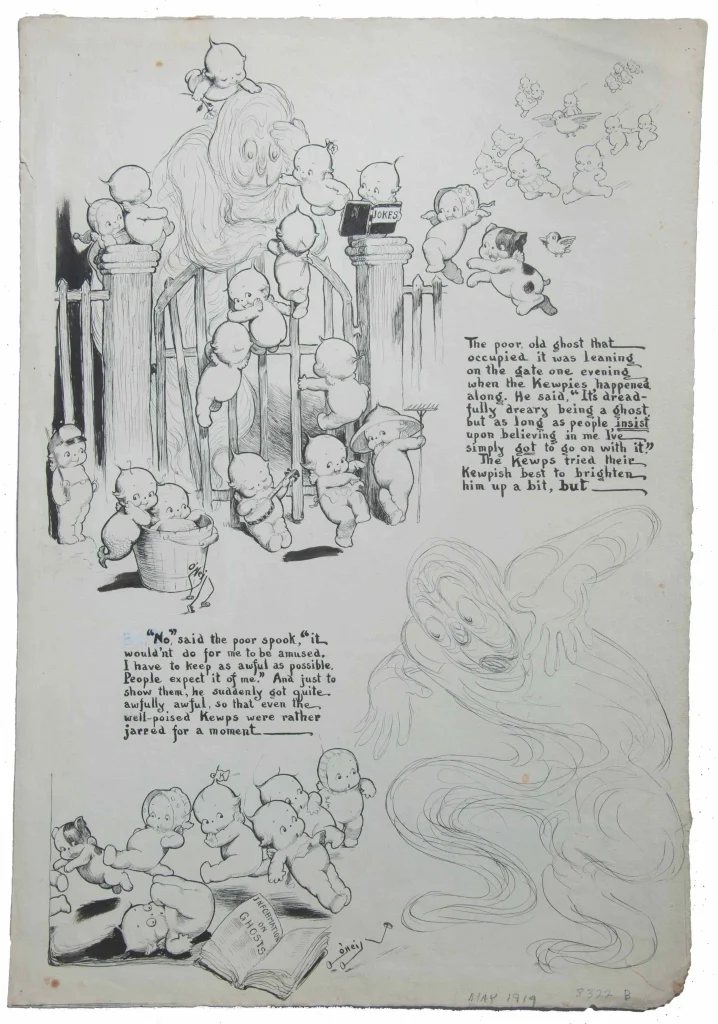
The Ghost-Kewps, 1919, pen and ink on paper, 22 1/2 × 17 1/4 inches, collection of the Ralph Foster Museum, College of the Ozarks

Exhibition and Anniversary Events

A celebratory cocktail party will kick off a series of anniversary and exhibition events.

Cocktails & Culture will be held from 5:30 to 7:30 p.m. on Thursday, Sept. 7. Attendees will enjoy an evening of live music, specialty cocktails, local cuisine and an inside look at the exhibition. This event is held in collaboration with Diamond City Partnership and tickets are $25. Advance registration is required.

For more information, visit wilkes.edu/sordoniartgallery.

Additional events include:

Second Saturday Family Hour, Noon to 2 p.m. on Sept. 9: Participants will create their own comic strip and suffragette rosette. Coloring sheets featuring downtown Wilkes-Barre landmarks will be provided by the Wilkes-Barre Riverfront Parks Committee. Storytime with the Osterhout Free Library begins at 1 p.m. This event is free and open to the public.

Cartooning Workshop with Kevin O’Neill, Noon to 3 p.m. on Sept. 23: This special Art in Your Hands: Kid’s Edition workshop is hosted by Kevin O’Neill, who will lead the creation of a dinosaur mural while teaching the basics of illustration. This workshop is for children ages seven to 10. Space is limited and registration is required by emailing melissa.carestia@wilkes.edu.

Art in Context Lecture: The O’Neills in Wilkes-Barre, 5 p.m. on Sept. 27: Learn about Wilkes-Barre history through the lens of the O’Neill Family. They lived on Meade Street in the Emerald Cottage dedicated to “friendship, love, truth, and liberty.” This discussion is led by Diane Wenger, Wilkes professor emeritus of history. This event is free and open to the public.

Rose O’Neill: Facts & Fancies at 5 p.m. on Wednesday, Oct. 4: A lecture featuring one of the foremost scholars on Rose O’Neill will close the exhibition. Sarah Buhr, curator of the Springfield Art Museum, will discuss the accomplishments of this singular woman. From her artwork to writing to becoming the first woman to make over a million dollars from her craft, Buhr will share the magnificent life and career of O’Neill. This event is free and open to the public.

50 Years of the Sordoni Art Gallery

The Sordoni Art Gallery has been a constant in the ever-changing landscape of downtown Wilkes-Barre. After the devastating flood that impacted the Wyoming Valley in June 1972, Margaret “Barney” Sordoni (1915-1989) and her son, Andrew J. Sordoni III, worked alongside Eugene Farley, the first president of Wilkes College, to create a unique resource for the college and community.

Since 1973, the Sordoni Art Gallery has continuously played an integral role in bringing high-caliber art and artists to the Wilkes campus and greater northeastern Pennsylvania region. The gallery opened its doors in Stark Learning Center on River Street with an exhibition featuring works by Wilkes-Barre native George Catlin. To unveil its current South Main Street home, shared with the Karambelas Media and Communication Center, in 2017, the gallery celebrated its new 7,000-square-foot space with a landmark exhibition featuring works by Andy Warhol.

“The Sordoni has always been more than just an art gallery to Wilkes University. A non-traditional classroom, the Sordoni Art Gallery encourages students to ask questions, test boundaries and think critically about the world around them,” says President Greg Cant. “For some Wilkes students — many of whom are the first in their families to attend a four-year college — the Sordoni Art Gallery offers the completely new experience of being immersed in the visual arts. This is a life-changing moment for these students, and we take great pride in having such a valuable resource on our campus.”

The gallery is open from 10 a.m. to 5 p.m., Tuesdays through Fridays and Noon to 5 p.m. on Saturdays. It follows the operating schedule of Wilkes and is closed on University holidays, breaks or due to inclement weather. For more information, visit wilkes.edu/sordoniartgallery.

Remembering Ron Slowinski (1942-2023)

Remembering Ron Slowinski (1942-2023)

Ronald Slowinski (legacy.com)

The widely exhibited artist and longtime Kansas City Art Institute professor balanced earthly delights with the mysterious and mystical

Born in Chicago, Ron Slowinski never lost the friendly, blustery and direct persona native to the Polish Catholic neighborhood where he grew up. Slowinski credited Chicago’s glories — its architecture, its diverse population, the museums and especially the Chicago Art Institute’s collection — for many of his aesthetic inspirations. His love for what he called “the almighty grid,” which underlies all his paintings, came from the Frank Lloyd Wright buildings he saw as a kid in Chicago. But the richness and mysteriousness of his art evolved as he moved, lived and drank in the cultures of New York, Japan, Kansas City and especially the Southwest.

Slowinski graduated from the School of the Art Institute of Chicago in 1954. He was then drafted into the army, where he was stationed at Fort Bliss, Texas, for two years as a guided missiles technician. He helped fire missiles in the Alamogordo region, and it was there that he encountered nearby New Mexico and hiked through what he called its “non-compromised nature.” He fell in love with the Indigenous cultures there and devoured books on the Hopi and Navajo, all of which later factored in his most prominent artworks.

In 1956 Slowinski returned to Chicago. In a 1979 essay he wrote: “The years 1956-59 I spent painting and ‘starving’ in Chicago were, in some ways, the most exciting . . . a group of artists started a co-op gallery — the Wells Street Gallery, where I had my first one-man show.” He was in numerous exhibits after that, along with other Chicago artists such as Robert Natkin, sculptor John Chamberlain, Richard Bogart and photographer Aaron Siskind. Slowinski wrote that we “were for the most part young, without reputation.” They were also all abstract artists. “The group saw itself as a kind of reaction-alternative to the Allen Frumkin Gallery (which showed only representational art), the dominant aesthetic force in Chicago at that time,” he stated.

In 1959, along with many of his artist friends, Slowinski moved to New York City and set up a loft/studio in what is now known as SoHo but was then called “Hell’s Hundred Acres.”

“The years I lived in New York City were exciting but difficult,” he wrote. “I married (Martha Crowe) and had two children (Joseph and Rachel) — not an easy or comfortable life raising children in a fifth-floor loft in a commercial neighborhood (Canal and Broadway).”

Slowinski had his first one-man show in New York at the prestigious Poindexter Gallery, run by one of New York’s few female directors, Nellie Poindexter. Along with Slowinski and other Chicago artists, Poindexter exhibited art by Richard Diebenkorn, Al Held, Nell Blaine, Robert DeNiro, Sr. and Jack Tworkov.

Because of his admiration for Frank Lloyd Wright — he visited Taliesin several times — Slowinski took a job as a preparator (a “basement rat,” he called himself) at the Guggenheim Museum, where his prankster humor occasionally took over. An expert copyist, Slowinski loved to tell the story about reproducing an important Kandinsky artwork from the Guggenheim’s collection and trotting it up to a curator’s office, where he proceeded to stomp on it while yelling, “Kandinsky, Kandinsky, Kandinsky! I’m sick of Kandinsky!” He also dumpster-dived into the Guggenheim’s trash bins to secure some of Wright’s painting materials. Eventually he was given part of Wright’s easel by the Guggenheim.

During his years in New York Slowinski largely created systematic and gridded paintings. The eminent designer Ivan Chermayoff commissioned him to paint an 11 x 22-foot geometric work for Westinghouse Electric’s corporate lobby in Pittsburgh, which was installed in 1971, among other commissioned works.
Slowinski took a job teaching art at the University of Indiana in Bloomington in 1965. The next year, he moved to Kansas City to teach at the Kansas City Art Institute, where for 39 years he taught painting and drawing. Slowinski cared about his students and was genuinely excited about their work. He regularly took them to his home and showed them his one-of-a-kind collection of Southwestern Indian art, and he kept in contact with them for years.

James Woodfill, chair and professor of KCAI’s painting department, was one of Slowinski’s students. In a recent interview he recalled that Slowinski “was so generous as a mentor, opening his studio and home for visits and spending long blocks of time in our studios talking not only about our work but about our lives as artists . . . The work in our senior studio was wide-ranging, experimental, and personal. Ron emphasized the development of our individual voices and helped us navigate our explorations in both traditional and multi-disciplinary dialogs.”

Slowinski also curated several exhibitions at the Kansas City Art Institute’s former Charlotte Crosby Kemper Gallery, including shows of Japanese prints, New Mexico Santos figures and American Indian art from the Larry Frank collection. Director Sherry Cromwell-Lacy remembers how carefully he dealt with art objects. “He made me promise,” she recalled in a recent interview, “that I would ‘feed’ (with cornmeal) the Hopi masks every day before going home.”

Ronald J. Slowinski, “La Baugh Woods”(1977), from the Pollen Series, acrylic on canvas, 50 x 56” (The Nelson-Atkins Museum of Art. Gift of Dr. and Mrs. John Arnold and Dr. and Mrs. Burnell Landers)

In 1974 Slowinski approached my husband, Douglas Drake, who had just opened the Douglas Drake Gallery in Kansas City, about exhibiting his art. Drake’s first exhibition at his gallery included a drawing by Henri Matisse. “Ron told me he wanted to be in my gallery,” Drake remembers, “because the Matisse I showed was a really good one. So I passed the test!“I was so surprised by the freshness and uniqueness of his work that I included him in a show of abstract art I had already planned that included canvases by Gottlieb, Motherwell, Stella, Olitski, Frankenthaler, Noland, and others.” Drake continued to represent Slowinski until his death.

At that point, Slowinski’s hard-edged geometric grids had morphed into more intuitive and flowing fields of atmospheric color. Two major lifestyle changes played into these changes. In 1968-69, after receiving a Fulbright Advanced Research Grant, he lived with his family in Kyoto, where he consumed the culture. “The gardens,” he once exclaimed. “I can still see those gardens!” He also began spending every summer in Taos, often with his family, attending the various Pueblo summer dances and studying the Indigenous art and religions with the intensity of a scholar.

The paintings and watercolors he exhibited at the Douglas Drake Gallery were titled the “Wyoming Series,” “Genji Series,” “Hopi Flower and Corn Dance” paintings and the “Pollen” pictures.

As minimalist and etheric as these paintings appeared, Slowinski still incorporated the grid. Drake recalls that he used hake brushes from Japan, first covering his canvases with gesso, leaving the surface intentionally uneven. He then carefully built up 10 layers of horizontal and vertical strokes with the thinnest of paint. These brushstrokes were administered “ritualistically,” Slowinski said, “with a kind of mantric sensibility, like saying the rosary.” He often sprinkled marble dust on the canvas before adding the final layer of paint, the combination of effects resulting in the specific luminosity of his paintings.

The wet-on-wet painting technique was meant to emulate the way a 19th-century Hopi woman potter might have worked, and in essence, Slowinski said, he wanted to embody the spirit of anonymous women potters from centuries past.

As diaphanous as his paintings look initially, due to the subtle layering, after just a few seconds the paintings seem to vibrate as if they are alive.

Gaylord Torrence, curator emeritus of American Indian art at The Nelson-Atkins Museum of Art, met Ron in 1977. In a statement he wrote, “Over the years, Ron assembled a collection of historical Native American art from the cultures of New Mexico and Arizona. In keeping with his interest in all Indigenous art, he was drawn most to those objects that embodied world view, philosophy, and mythology — works that reflected the heart of the cultures. I recall two old Hopi basketry trays hanging in his home that many collectors would have dismissed as unimportant, yet for Ron they reflected the ancient continuity of the Hopi people; they were a type made before EuroAmerican encounter and continue to be produced today.”

A 2004 exhibit of Slowinski’s paintings at the Canfield Gallery in Santa Fe was well reviewed in both ArtNews and Art in America.

As he became older Slowinski began making figurative work. He had always admired the mystics Thomas Merton and St. John of the Cross and had studied Tibetan Buddhism. In 2001 he had an exhibit at the Leedy-Voulkos Art Center called “God: Recent Works,” in which the deity was represented by various men and women, in what one reviewer labeled “a hermetic compendium of personal passions and concerns.”

But by 2013, for the exhibition “Unexpected Joy” at the John Molloy Gallery in New York City, Slowinski had found yet another way to invigorate his abstract artwork. The abrupt shifts of color bands in these works were derived from his longstanding study of Russian icons, where the titles of the narratives are often placed at the bottom of the picture plane. “Formally,” Slowinski said of these works, “the different sections have nothing to do with another, but I like the conceptual aspects of these works. It’s hellishly difficult to get the right proportions, and it’s self-defeating and an almost impossible goal to get it right.”

But as in all Slowinski’s best artworks, as he balanced structure with color and light, and earthly delights with the mysterious and mystical, he got it right.

Maui’s top recording artists, halau host concert for wildfire relief

Maui’s top recording artists, halau host concert for wildfire relief

WAILEA, Maui (HawaiiNewsNow) – Maui’s celebrated recording artists and halau shared the healing power of music in a livestream benefit concert from the Grand Wailea on Maui from 12:30 p.m. to 3:30 p.m on Saturday.

Kalehua Kahele, vocalist of award-winning island reggae trip Ekolu, and the group’s manager Dar Keala, joined HNN’s Sunrise Weekends to talk about the Wiwoʻole Benefit Concert. Watch a replay here.

“Wiwoʻole means to be strong, to be courageous, to be brave. That is really what we want to do as we present today, as we give back mele to help to strengthen our community through song and music” Kahele said.

Proceeds go towards the Native Hawaiian non-profit Aina Momona, which focuses on environmental resilience and social justice, and the Maui Strong Fund of the Hawaii Community Foundation.

Participating artists include Grammy and Na Hoku Hanohano Award Winners: Amy Hanaialii, Cody Pueo Pata, Ekolu, Kalani Peʻa, Kanekoa, Kamaka Kukona, Kimie Miner, Hoaka, Kuikawa, Pi’ilani Arias, Raiatea Helm, Waiolohia, Halau o ka Hanu Lehua, Halau Kekuaokalaʻauʻalaʻiliahi and Haunani Paredes, Halau Kekuaokalaʻauʻalaʻiliahi, and more.

For more information and to donate, visit kaainamomona.org.

‘sā Ladakh’ explores culture, climate and community in the Himalayan terrain

‘sā Ladakh’ explores culture, climate and community in the Himalayan terrain

Nestled in the Himalayas, sā Ladakh is a land art exhibition taking place in Disko Valley near Leh in Ladakh, India. translates to ‘soil’ in the native languages spoken in the mountain region, and through its usage here, serves the idea of a grounded, slow, community predicated, and sustainable way of life. The inaugural edition of the art exhibition has been founded by mountaineer Tenzing ‘Jammy’ Jamyang, contemporary artist Raki Nikahetiya, and designer Sagardeep Singh. The exhibition has been co-curated by Dr. Monisha Ahmed, co-founder of LAMO (Ladakhi Media and Arts Organisation).


For A Fifty Million Years, 2023, Mixed Media, Raki Nikahetiya| “sā” Ladakh | STIRworld
For A Fifty Million Years, 2023, Mixed Media, Raki Nikahetiya Image: © Raki Nikahetiya, Courtesy of sā Ladakh

Set on a mountain trail, the exhibition kindles engagement with the natural landscape and facilitates hope for climate change, through art installations that prompt the audience to think through community, culture and the natural environment. Art festival co-curator and co-founder, Nikahetiya shared a glimpse of their vision in the official release, stating: “Our primary focus will be on a 20-acre expanse of land, where we will delve into our interpretation of ‘climate optimism.’ Through the remarkable medium of land art, our aim is to foster an inclusive dialogue on climate-related issues, engaging and inspiring communities amidst the breathtaking yet delicate Himalayan landscape.” Even their art installation For A Fifty Million Years nudges the geological interpretation of the mountainscape, bringing together the assimilation of the natural environment. It is, above all, a reminder of the longevity and evolution of the mountain soil. Through layers of natural environs atop each other, and shaped by natural pressures and movements over a mega annum, the installation emulates essential geological processes. It is a time capsule archiving the origin of our terrain.


Untitled , 2023, Paper-mâché with old note books and card board, clay, Skarma Sonam Tashi | “sā” Ladakh | STIRworld
Untitled, 2023, Paper-mâché with old notebooks and cardboard, clay, Skarma Sonam Tashi Image: Courtesy of sā Ladakh

Ideas of the anthropological significance of the terrain are further explored by Indian artist Skarma Sonam Tashi’s art installation Untitled, which confronts the fragility of human existence and the configurations of the earth. Tashi’s work draws attention to environmental and climate challenges in the high-altitude regions and questions the significance that mountainous regions hold for the planet in the 21st century. Using the backdrop of a large rock face, onto which he creates glaciers and drawings of human settlements, the drawn glaciers gradually ebb as it approaches the drawn homes. Tashi’s experimentation with everyday recycling material and clay treats the transformational aspect of the landscape as a metaphor for fragility and malleability.


Untitled , 2023, Paper-mâché with old note books and card board, clay, Skarma Sonam Tashi | “sā” Ladakh | STIRworld
What if we prayed to the mountains?, 2023, Clay, metal wire, wood, jute rope, stones and rocks, Arunima Dazess Wangchuk Image: Courtesy of sā Ladakh

Local artist Anayat Ali and artist Arunima Dazess Wangchuk treat the mountain land as a liminal space. Ali’s Sacred Place depicts the connotations of the urban urgency for development and land as an imperative for the same. The uneven composure of naturally found stones, rocks, and soil are delicately balanced, and the lack of industrial materials is a reminder of how natural elements, particularly constructions of stones or bedrock, have been facilitating protection for human civilisations for centuries. Wangchuk’s artwork What if we prayed to the mountains? is made of clay, metal wire, wood, jute rope, stones, and rocks, and through these, evokes a devotion to nature. The work is concerned with climate crises and carbon footprint, reinforced by systems such as tourism and industrialisation, which sustain native livelihoods but simultaneously deplete the quality of natural resources. It further taints the relationship between local people and their environment of origin, malnourishing their sense of belonging. Wangchuk creates an altar as she proposes the rhetoric: “What if we prayed to the mountains, would the world then be a better place?”


Vanishing Footprints, 2023,basgo clay, plaster of Paris, and wood ash, Dorjay Churpon | “sā” Ladakh | STIRworld
Vanishing Footprints, 2023, basso clay, plaster of Paris, and wood ash, Dorjay Churpon Image: Courtesy of sā Ladakh

Artist Tundup Dorjay Churpon’s installation Vanishing Footprints also deciphers the native identity and its evolution tainted by the format of the developing world. Approaching topics of urban migration, the installation traces a forgotten interdependence on cattle, which was the source of many dietary staples. It is reminiscent of a cattle-dependent lifestyle; the hooves which are spread across are made of basso clay, plaster of Paris, and wood ash.


River of Sweat, 2023,Recycled Sarees,Anshu Singh | “sā” Ladakh | STIRworld
River of Sweat, 2023, Recycled Sarees, Anshu Singh Image: Courtesy of sā Ladakh

Urban ways of life are also explored in Vibha Galhotra’s textile installation You Don’t Own Me!, and the work by Anshu Singh, a contemporary artist practicing within the textile medium, who exhibited River of Sweat. These works of art review the harsh realities of capitalism and the exploitation of natural resources. Singh’s installation is made from repurposed sarees, demanding attention to the environmental impact of the fashion industry, which is the second most polluting industry in the world. Galhotra, too, uses discarded clothes, and her art installation reminds us that ownership and sovereignty do not apply to nature, thus encouraging a transcendence of our contemporary systems and structures, such that we come to revolve on the axis of collective responsibility.


You Don't Own Me!, 2023, Discarded fabric, Vibha Galhotra | “sā” Ladakh | STIRworld
You Don’t Own Me!, 2023, Discarded fabric, Vibha Galhotra Image: Courtesy of sā Ladakh

Other artists exhibiting at sa Ladakh include Birender Yadav, Jigmet Angmo, Gurmet Kungyam, Sagardeep Singh, and Tundup Gyatso. With light projections and video art, German artist Philipp Frank explores the dynamics between spirituality and the natural world.

Engaging with configurations of earth allows one to reignite hope against the pending climate crisis. Art has always been a lens that magnifies our relationship to nature. Contemporary art further deepens its interpretation of this dependence and occasionally facilitates alternative solutions to sustain this dependence. For example, this year Helsinki Biennal’s New Directions May Emerge inspired ideas of ecological revival. Similarly, artworks installed at the music festival Coachella Desert X were prompted to observe social and ecological concerns of our contemporary world. The art exhibition sā Ladakh transcends the idea of art as a medium for generating climate awareness, instead choosing to present outright climate optimism, with artists taking a constructive approach to remind us of the significance of grassroots and the restructuring of modern systems from the ground. This, in a sense, mimics the mountains themselves, and the natural landscape of the region compliments the emotional template of humility and resilience—calling for a compassionate revolution and fostering a dialogue to reimagine our symbiotic relationship with nature.

While the art installations are visible during the day, the video and light installations can be viewed during the night. sa ladakh is on view until August 23, and the closing ceremony will be accompanied by music, workshops, and live art. The event has been supported by Ladakh Media and Arts Organisation, the Austrian Cultural Forum, and the Embassies of Germany and Switzerland to India among others.

LIVE: Maui Ola: Musicians, artists come together at benefit concert for victims of Hawaii wildfires

LIVE: Maui Ola: Musicians, artists come together at benefit concert for victims of Hawaii wildfires

HONOLULU (Gray News) – A concert Sunday in Hawaii is being livestreamed to raise money for the Maui communities affected by the deadly wildfires.

WATCH LIVE HERE: The concert starts at 6 p.m. HT (12 a.m. ET).

“Maui Ola: A Benefit Concert for Maui” will showcase musicians, celebrities, community leaders, event producers and others to raise awareness and get financial support from local, national and international audiences.

Organizers said on the benefit’s website that another part of the mission is to use music as a part of the healing process. Artists and professionals involved are donating 100% of their efforts.

“So many ‘ohana have been tremendously impacted by the tragic wildfires,” said community leader Tiare Lawrence, who manages the popular social media account Kākoʻo Haleakalā. “Maui Ola is a beautiful way for their urgent needs to be met. We feel the aloha that has gone into this effort.”

Musicians scheduled to perform include Kolohe Kai, Hawaiian Style Band, Pure Heart, Jerry Santos, Raiatea Helm, Paula Fuga, Kimie Miner, Anuhea, Del Beazley and the Hawaiʻi Symphony Orchestra. Several other musicians and cultural practitioners with meaningful ties to Maui are also set to participate.

Organizers said all proceeds will go toward the communities through donation portals, including Maui United Way, Hawaiʻi Community Foundation, Hawaiʻi People’s Fund and the Council for Native Hawaiian Advancement.

For more information and to donate, visit mauiola.org.

“Everyone has an important and worthy contribution in our collective effort to bring comfort to our families on Maui,” said Zachary Lum, co-producer and executive director of Kāhuli Leo Leʻa. “In normal circumstances, the production and creative media industries are usually synonymous with entertainment. But in times of need, we have a very different contribution – we deliver urgent messages quickly and broadly.

“In the case of Maui Ola, our message is ‘support Maui,’ and we aim to deliver it worldwide.”

Hawaii News Now set up a special streaming page, where viewers can watch the concert, learn more about the fires’ impact and donate.

Maui Ola: Musicians, artists come together at benefit concert for victims of Hawaii wildfires

Maui Ola: Musicians, artists come together at benefit concert for victims of Hawaii wildfires

HONOLULU (Gray News) – A concert Sunday in Hawaii is being livestreamed to raise money for the Maui communities affected by the deadly wildfires.

“Maui Ola: A Benefit Concert for Maui” will showcase musicians, celebrities, community leaders, event producers and others to raise awareness and get financial support from local, national and international audiences.

Organizers said on the benefit’s website that another part of the mission is to use music as a part of the healing process. Artists and professionals involved are donating 100% of their efforts.

“So many ‘ohana have been tremendously impacted by the tragic wildfires,” said community leader Tiare Lawrence, who manages the popular social media account Kākoʻo Haleakalā. “Maui Ola is a beautiful way for their urgent needs to be met. We feel the aloha that has gone into this effort.”

Musicians scheduled to perform include Kolohe Kai, Hawaiian Style Band, Pure Heart, Jerry Santos, Raiatea Helm, Paula Fuga, Kimie Miner, Anuhea, Del Beazley and the Hawaiʻi Symphony Orchestra. Several other musicians and cultural practitioners with meaningful ties to Maui are also set to participate.

Organizers said all proceeds will go toward the communities through donation portals, including Maui United Way, Hawaiʻi Community Foundation, Hawaiʻi People’s Fund and the Council for Native Hawaiian Advancement.

For more information and to donate, visit mauiola.org.

“Everyone has an important and worthy contribution in our collective effort to bring comfort to our families on Maui,” said Zachary Lum, co-producer and executive director of Kāhuli Leo Leʻa. “In normal circumstances, the production and creative media industries are usually synonymous with entertainment. But in times of need, we have a very different contribution – we deliver urgent messages quickly and broadly.

“In the case of Maui Ola, our message is ‘support Maui,’ and we aim to deliver it worldwide.”

Hawaii News Now set up a special streaming page, where viewers can learn more about the fires’ impact and donate.

Robbie Robertson left inspirational stamp on local Indigenous musicians

Robbie Robertson left inspirational stamp on local Indigenous musicians

Among the musicians who inspired Prince George singer/songwriter Marcel Gagnon to pick up a guitar and play, none had a more profound effect than  Robbie Robertson.

Robertson, who died last week at age 80, drew on his Indigenous roots to shape an illustrious career that brought worldwide fame and fortune to the Canadian artist as a rock music icon.

Best known for his work as the guitarist for The Band, Bob Dylan’s backing band, and their star-studded sendoff concert, The Last Waltz, it was Robertson’s solo material and songs like Unbound, Sacrifice, Stomp Dance (Unity) and Peyote Healing, all shaped by the music of his ancestors, that showed Gagnon the way as an artist.

For Gagnon, nominated for a Juno Award in 2002 for Best Music of Aboriginal Canada his debut album Crazy Maker, the power of Robertson’s music touched his soul.

“His stuff with The Band, and  Bob Dylan was all wonderful, but I think throughout the whole thing he was really looking for who he truly was in music and I think he found it when he created the Underworld of Red Boy,” said Gagnon. “That’s the core of who Robbie Robertson was, in my view.

“That album meant so much to me, it influenced everything about my music when I started to write that Crazy Maker, album, it was Robbie Robertson’s influence. I never wrote his style or anything, it was just remembering the songs. His music is the type of music that slowly, over time, will take its place at the highest level of music throughout the world.“

Gagnon is a substance abuse counselor and, in his work with prison inmates as a Lheidli T’enneh elder who teaches spirituality, he uses Robertson’s music to set the mood for traditional ceremonies at the jail.

“I would plug in the Robbie Robertson CD when the guys were coming in to do a ceremony and they’d be talking and laughing and some of them ever swearing, but as soon as they got through that door and heard the music there was silence,” said Gagnon. “They would all walk in very quietly. I’m talking young guys who were supposed to be into heavy rap and hip-hop, and that’s what it did to them.

“He didn’t write from what he saw, he wrote from things that were inside him that affected him emotionally and he brought that emotion out so other people can relate to it. It was just incredible, to me, that album is the highlight of who he was.”

Robertson was the son of a Mohawk mother and was first inspired to pick up a guitar at age 10 after hearing his relatives play traditional music on the Six Nations reserve in southern Ontario. Combining electronica/techno hip-hop looping beats with native North American drumming and singing, he made traditional songs mainstream and brought them to a mass audience.

He made two albums in the 1990s with the Red Road Ensemble, a group of Indigenous musicians.

The first – Music For Native North Americans, came out in 1994 and followed on the heels of his wildly successful 1987 self-titled solo debut, which contained the hit Somewhere Down the Crazy River – and he released Underworld of Red Boy in 1998. Red Boy refers to the only derogatory term Robertson was ever called.

As one of the leaders of the UHNBC Traditional Drummers, Wesley Mitchell brings traditional songs with the Monday Night Drum Group to Prince George hospital to lift the spirits of staff and patients and pay  tribute to the healthcare system. They draw from the same influences as Robertson did with his songs Cherokee Morning Song, Coyote Dance and Makhk Jchi (Heartbeat Drum Song) from the Music For Native Americans album.

“It’s a sad day, but when a musician has lived 80 turns around the sun here on Planet Earth and has given his all to creative arts with the band and going solo, one thing that sticks out for me is he took care of his band members,” said Mitchell.

“Being Indigenous and keeping people on that red road, clean and sober, he did that for his members to the best of his ability and he wrote songs. All those songs, when you sit back at home listening, you just enjoy your surroundings and that’s what I get from his songs – the beauty of Mother Earth and the beauty of being a human being experiencing a spiritual life.

“He’s an icon and he led the way for songwriting and taking the lead in guitar. It’s just a way to express yourself and I can relate, for what the drum has done for me to express myself and find a voice and be part of the community. It brings joy and it brings happiness to express yourself through an instrument.”

Jake Worthington chases dreams, achieves timelessly authentic country music success

Jake Worthington chases dreams, achieves timelessly authentic country music success

Artist Jake Worthington’s grandfather — his most significant influence — spoke of country music moments from decades ago in reverential tones that the 27-year-old performer had no other choice but to pursue success in the genre.

“I’m fueled by hanging on to dreams,” Worthington, a Big Loud Records-signed native of LaPorte, Texas told The Tennessean before his July 21 Grand Ole Opry debut.

His rural-born grandfather, who died recently, was a religious man who loved fishing and dreamed of excelling as a songwriter as country music experienced its 70s and 80s global boom.

By 17, Terry Worthington’s grandson was a cherub-faced second-place finalist on The Voice’s sixth season whose performances of Keith Whitley’s soulful country ballad “Don’t Close Your Eyes” impressed both judges and fans.

Country music’s 15-year journey in the early 2000s into male artist-driven and beat-laden pop benefitted the financial status of the genre and elevated its place in the industry. However, for artists like Worthington — and others — wholly inspired by the genre’s heyday, it felt like they were gaining mastery in talents that mainstream was leaving behind.

In the era of country’s most recent mainstream boom, however, artists like Brooks and Dunn’s Ronnie Dunn, Vince Gill and Marty Stuart have proven timeless.

When asked about Worthington during Stuart’s recent Late Night Jam event at the Ryman Auditorium, all three, without fail, grin with an almost childlike curl and express the same sentiment.

Jake Worthington performs during Marty Stuart’s Late Night Jam Wednesday, June 7, 2023 at the Ryman.

“If I was betting on anybody in country music, I’d put all my chips on this guy,” said Stuart. “I love him and I believe in him, he’s the real deal.”

Before receiving a standing ovation for his Opry debut, Worthington finally smiled as broadly as that trio of country icons.

“You can’t put that feeling into a bottle, but I’m going to damn sure try to put it on some records,” he said.

Worthington’s tenor emerges from his broad chest and round belly like warm, slow-poured whiskey on a humid evening. It’s the type of instrument that, when layered over a steel guitar and accompanied by a waltz tempo, feels — in a manner deserving of praise by Dunn, Gill, Stuart and more — like music undaunted by time.

“Believing you can play and sing the stuff I play and sing requires much more than a belief in yourself,” offered Worthington.

Jake Worthington, April 2023.

Worthington’s self-titled album has been out since April. Champions of his work like fellow Big Loud-signed establishing stars ERNEST and HARDY have featured him on tracks including the latter’s 2021 “Hixtape” track “Jonesin'” and the former’s 2023-released “Flower Shops” deluxe album track “Heartache In My Hundred Proof.”

The number of talented artists thriving, but not mainstream aware, who use such homespun colloquialisms is why Big Loud co-founder and CEO Seth England told Texas Monthly that the label desired to dive into the “appealingly authentic” space between a boom in Americana’s rootsy stylings and mainstream country’s growing pop market.

Country Music:Inside Oliver Anthony’s ‘Rich Men North of Richmond’ and its path to Billboard’s Hot 100 chart

Women in Country:Here’s who’ll be honoring The Judds on their upcoming tribute compilation

A time has again arrived for country to create sounds that, as England notes, don’t “pussyfoot” with the genre’s timeless traditions.

“Frank Sinatra, George Jones and Muddy Waters weren’t autotuned. I’m not, either. We’re singing from our hearts and souls,” said Worthington flatly.

Portrait of Jake Worthington at the Grand Ole Opry backstage in Nashville, Tenn., Friday, July 21, 2023.

“Everyone worried about the production, though,” he said. “I was stressed, initially, because I hadn’t seen the proof from Joey that he could create my type of traditional country record. But he’s hyper-sensitive to learning how to smartly let the fiddles, steel guitars and vocals — especially when they’re being played by people like [Musicians Hall of Famer] Paul Franklin — shine and make the best music possible. We discovered a perfect marriage.”

“It’s time to go deeper into the vein,” says Worthington about what he has coming next.

“According to my grandfather, Frankie Miller’s (1959-released) ‘Blackland Farmer’ should be a number one hit today, tomorrow and forever. I might need to cut that in his memory. One day I’m gonna wrap my teeth around sitting down and recording, producing and getting that out there.”