Native

A Millennial Weaver Carries a Centuries-Old Craft Forward

A Millennial Weaver Carries a Centuries-Old Craft Forward

Spiders are weavers. The Navajo artist and weaver Melissa Cody knows this palpably. As she sits cross-legged on sheepskins at her loom, on one of the wooden platforms that boost her higher as her stack of monumental tapestries grows, the sacred knowledge of Spider Woman and Spider Man, who brought the gift of looms and weaving to the Diné, or Navajo, is right there in her studio with her.

It also infuses “Melissa Cody: Webbed Skies,” the first major solo exhibition of the artist’s work, which is on view at MoMA PS1 through Sept. 9. in a co-production with the São Paulo Museum of Art in Brazil (known as MASP).

The exhibition is part of the overdue recognition of Indigenous artists by museums and other institutions, from the recent retrospective of Jaune Quick-to-See-Smith’s work at the Whitney Museum of American Art to the expanding roster of artists at the Venice Biennale. Cody, 41, is a millennial at the forefront of an art form harking back millenniums — at once building on tradition and joyously venturing beyond it.

Her show’s title alludes to her 2021 work “Under Cover of Webbed Skies,” in which hourglass shapes resembling a spider’s underbelly stand in for the artist herself, passing Spider Woman’s wisdom on to future generations and a web of motherly protection from mountain to sky. (Selected works are also at the Garth Greenan Gallery from April 25 to June 15.)

The artist Melissa Cody, her long dark hair tied in a low ponytail and dressed in a gray T-shirt that exposes her artfully tattooed arms, weaves on her traditional loom. She is using a wooden comb to tap yarns for her textiles.
Melissa Cody, a fourth-generation Navajo weaver, at her loom in her studio in Long Beach, Calif. She is tapping yarns for her textiles with the same wood comb she started out with at age 5.Nia Macknight for The New York Times

Cody was weaned on weaving, tapping weft yarns for her nine-foot-tall textiles with the same wood comb she started out with at age 5. She grew up on the western edge of the Navajo Nation in Arizona, the fourth generation from a family of distinguished female weavers, most notably her award-winning mother, Lola S. Cody, who raises her own churro sheep for traditional patterns like “Two Grey Hills,” and her grandmother Martha Gorman Schultz, still pioneering in her 90s on her outdoor loom.

We are having trouble retrieving the article content.

Please enable JavaScript in your browser settings.


Thank you for your patience while we verify access. If you are in Reader mode please exit and log into your Times account, or subscribe for all of The Times.


Thank you for your patience while we verify access.

Already a subscriber? Log in.

Want all of The Times? Subscribe.

US pavilion features first Indigenous artist to have solo show

US pavilion features first Indigenous artist to have solo show

Jeffrey Gibson is representing the US at this year’s Venice Biennale, marking the first time the country has staged a solo exhibition by an Indigenous artist. Gibson, who is a member of the Mississippi Band of Choctaw Indians and is also of Cherokee descent, was born in Colorado and moved frequently growing up, living across the US as well as abroad, including in Germany and South Korea. This international upbringing influenced Gibson’s colourful work, which often incorporates Native American traditions with text, a variety of textiles and concepts like identity and globalism.

Jeffrey Gibson: “Words like ‘nationhood’ and ‘homeland’ become complicated when I’m representing the US.” Cara Romero

How are you approaching the idea of representing the US, given the country’s history of massacres, displacement and racism? How are you thinking about your presentation in relation to that history?

It was very daunting initially. My initial proposal was very different from what I ultimately decided to do. I went to Venice [in 2022] and I realised the kind of weight and pressure of representing the US, and I started thinking about what I felt was important for me to contribute, content-wise, to that.

Ultimately, it came down to looking at my practice and thinking about the things that have been the most impactful with audiences. Some of it is where people see themselves in the work, in particular Native people and Indigenous people. In Native communities, many people refer to their nations, like the Choctaw Nation. Words like “nationhood” and “homeland” become complicated when I’m representing the US. I also had to be really honest with myself that throughout my life growing up abroad, I have identified as American, and then talked about being Native American in places where some people were really unfamiliar with it. I felt like it was my responsibility to just tell my story.

They Come From Fire (2022) Courtesy of Portland Art Museum

The title of the pavilion is the space in which to place me. Can you share what drew you to this passage from Layli Long Soldier’s poem He Sápa?

I have followed Layli’s work for years now, and it speaks to me on a personal level. She is able to put into words and lay onto a page the internal thoughts I’ve had my whole life. When I was thinking about a title, I knew that I wanted to work with an Indigenous writer.

The text goes, “This is how you see me the space in which to place me/The space in me you see is this place/To see this space see how you place me in you”. That piece does what I try to accomplish with the way that I use text, which is always hoping that people can project themselves and their own stories into it in a way that becomes self-reflective. That’s one of the goals of the pavilion. Although I am Indigenous, I hope that we’re not just looked at as [having] a kind of separate experience, but more as individuals who have experiences that can overlap with people from many different nationalities and many different backgrounds.

Gibson’s sculpture The Sun Will Be Shining (2022) features glass and bone pipe beads Photo: Max Yawney, courtesy of Sikkema Jenkins & Co., Roberts Projects and Stephen Friedman Gallery

What kind of themes does the pavilion explore?

I wanted to start by reading the foundational documents of the US. I started with the Bill of Rights and the Declaration of Independence, and eventually that led me to things like amendments and proposals that have yet to be passed or may never be passed. You get into individuals who were parts of those movements and statements that they’ve made. There are a little over 20 works in the exhibition. It is a wonderful way for me to walk through history and think about my own family and my own tribes and where they’ve existed in the states of the US and in what periods of history.

What do you think are the hallmarks of a successful national pavilion? Have any in particular stuck with you?

Mike Nelson for the British Pavilion [I, Imposter in 2011]. It was like you were in a weird headspace. You just couldn’t make sense of it. I felt like it was a real, very immersive experience that I wanted to return to. I also remember seeing Félix González-Torres’s installation in the American pavilion [America in 2007]. I’m a huge fan, he’s been a huge influence on me.

American History (2015) is a woven and beaded work featuring the words of James Baldwin Photo: Pete Mauney, courtesy of Sikkema Jenkins & Co., Roberts Projects and Stephen Friedman Gallery

I think a strong pavilion for me is when the space is addressed, and it doesn’t feel like we’ve tried to recreate a white box institutional space, and the building itself is sculpturally important. For me, the American pavilion is a fully activated space. This is the building you inherit if you’re going to represent the US.

The American pavilion didn’t come into the Biennale until 1930, so I think it’s interesting that the architecture is very much marked by the period it was commissioned, and that was a very significant period for Native people as well. There are very few things that don’t carry a ton of content with them, including the building itself.

“Le Emátanhanpi”: Students Present Native Art Showcase

“Le Emátanhanpi”: Students Present Native Art Showcase

The Circle of Indigenous Students’ Alliance (CISA) presented its Native Art Showcase with live poetry, dancing, music and visual art presentations at an April 12 event. 

CISA, an organization that elevates the voices and culture of Indigenous students on campus, followed the theme Le Emátanhanpi, which in the Lakota language is interpreted as “We Belong Here.” The showcase featured seven performances and four artists and art groups on display, with the performances featuring four poetry readings, one song, one dance and an oratory.

Rachel Two Bulls (CAS ’24), a Lakota student who organized the event, said the thematic emphasis on the concept of belonging comes from the diversity of Indigenous culture and the idea of environmental belonging. 

“CISA and the theme of indigeneity on campus has been really difficult to harness just because of how diverse and spread out we are,” Two Bulls told The Hoya. “I think belonging to the land is something that is big in culture but not necessarily something that is talked about and let alone something that different groups can talk about together and still understand because we’re from different places, but I think once we establish ourselves as belonging to a community, it becomes easier to actually identify with Indigenous groups.”

Evie Steele/The Hoya | The Circle of Indigenous Students’Alliance (CISA), an organization that elevates the voices and culture of Indigenous students on campus, displayed its Native Art Showcase with the theme Le Emántanhanpi, which in the Lakota language is interpreted as “We Belong Here,” featuring live poetry, dancing, music and visual art presentations April 12.

“Capturing the big picture narrative is what we’re trying to do,” Two Bulls added. 

The showcase, also sponsored through Campus Ministry, ended with a raffle for three winners to receive select pieces of art from the showcase. 

Sophia Monsalvo (CAS ’26), a Colombian African American student who performed at the CISA showcase for the first time, sang “Saber Olvidar,” which in Spanish means “to know forgetting.” She said she chose to join the showcase because of the strong community she has found in CISA and among Indigenous people. 

“I chose to sing tonight in general because I just started getting involved with CISA last year and it was about a really big journey of reconnecting with my own Indigeneity and understanding what that means in the Latin American context,” Monsalvo told The Hoya. “CISA has really helped me find community in that and speak and be able to exist in that.”

“I really love any chance I can get to share my energy and space with people,” Monsalvo added. 

At the showcase, Simone Guité (CAS ’26), a member of the Chinook Nation, shared her oratory titled “Tonto Got His Indian Money” to draw attention to the fact that the Chinook Nation has not yet received permanent federal recognition.

Guité said she created the oratory after a research project in which she examined how her family’s history connects to United States history. 

“I looked at my tribe, so I came in kind of having a really strong foundation and knowing a lot of the nitty-gritty tribal legal cases and dates and events,” Guité told The Hoya. “And so then I thought what better way to share it rather than presenting a big whole paper than my own personal stories and family stories.”

Monsalvo said she chose her showcase song because of its resonances with an experience common among many Indigenous people — channeling hope by remembering the many different parts of their identity.

“I know a lot of that feels like remembering the ancestors and remembering the legacy and life that we still hold within ourselves as Indigenous people,” Monsalvo said. 

Two Bulls said that events like CISA’s showcase help capture the lives of Indigenous people and communities in their own words, something that many Georgetown students may not understand. 

“I think creating spaces like this to talk about something more than struggle, despite how difficult it is for us to splinter and then have to come back together as a group, to look at something about us rather than something about what we’re struggling with,” Two Bulls said. “It is also instilling in us that there is a place amongst others in Georgetown that is for you, in that identity as an Indigenous person.”

Guité said that events like the Native Art Showcase help her and other Indigenous students build community on campus, which she said is not always easily accessible. 

“I think a lot of times there’s obviously not a lot of spaces that are meant for Indigenous people to share their stories and their artwork,” Guité said. “So having this event is a great way for that to happen and a great space to create more community and come together and share our own experiences.”

Representing the U.S. and Critiquing It in a Psychedelic Rainbow

Representing the U.S. and Critiquing It in a Psychedelic Rainbow

People in Venice might hear the jingle dress dancers before they see them. On April 18, some 26 intertribal Native American dancers and singers from Oklahoma and Colorado will make their way through the winding streets and canals of the Italian city. Wearing brightly colored shawls, beaded yokes and dresses decorated with the metal cones that give the dance its distinctive cshh cshh rattling sound, they’ll make their way to the Giardini, one of the primary sites of the Venice Biennale. There, they’ll climb atop and surround a large red sculpture composed of pedestals of different heights and perform.

The jingle dress dance, which originated with the Ojibwe people of North America in the early 20th century, typically takes place at powwows. In Venice, it will inaugurate the exhibition in the United States Pavilion on April 20. Titled “the space in which to place me,” the show is a mini-survey of the rapturous art of the queer Choctaw and Cherokee artist Jeffrey Gibson. Flags, paintings, sculptures and a video envelop and fill the stately building with proliferating geometric patterns, intricate beadwork, evocative text, a psychedelic overdose of color and political references to Indigenous and broader American histories.

“How do I relate to the United States?” mused Gibson, 52, who in conversation slips effortlessly between earnestness and flashes of playful, dry wit. It was late December, and we were sitting in a room in his upstate New York studio whose nondescript furniture was dotted with evidence of ongoing work on Venice: a maquette here, paint samples there, a test flag folded loosely in a chair. The deadline for finishing nearly two dozen artworks was about a month away, but Gibson was calm — at least outwardly so — as he showed me images and the pieces in progress.

“I have a complicated relationship with the United States,” he said. His ancestors were among the Native Americans forcibly displaced by the federal government. Both his parents came from poverty and went to boarding schools, where Native children were frequently abused. As his studio manager zoomed in on a digital image of a painting, I could see a large block of text surrounded by angular, radiating lines. Gibson read the title: “The returned male student far too frequently goes back to the reservation and falls into the old custom of letting his hair grow long.”

The chilling line came from a 1902 letter written by the Commissioner of Indian Affairs to a school superintendent in California about the need to assimilate Native students returning home from boarding schools. Once he found it, Gibson decided that all three busts he was working on for the Biennale should have prominent hair: a beaded mullet; long, flowing locks made from ribbon; and an elaborately-styled shawl-fringe “do.” The choice represents one of his artistic strengths: taking a point of pain and turning it into a kind of celebration, without losing its critical edge.

Installation view of yellow walls inside the U.S. Pavilion showing Jeffrey Gibson’s “the space in which to place me,” at the Venice Biennale. Two brightly colored paintings and a sculpture on a pedestal.
Installation view of Gibson’s works at the U.S. Pavilion, from left: “The Returned Male Student Far Too Frequently Goes Back to the Reservation and Falls Into the Old Custom of Letting His Hair Grow Long,” which references a letter by the Commissioner of Indian Affairs; “I’m a Natural Man”: “Liberty, When It Begins to Take Root, Is a Plant of Rapid Growth,” which cites a letter from George Washington to James Madison.Brian Barlow

We are having trouble retrieving the article content.

Please enable JavaScript in your browser settings.


Thank you for your patience while we verify access. If you are in Reader mode please exit and log into your Times account, or subscribe for all of The Times.


Thank you for your patience while we verify access.

Already a subscriber? Log in.

Want all of The Times? Subscribe.

Indigenous Artists Are the Heart of the Venice Biennale

Indigenous Artists Are the Heart of the Venice Biennale
image

Here are highlights of the range of work produced by Native artists in the pavilions and a central exhibition that proudly calls itself “Foreigners Everywhere.”

Before visitors step into any gallery at the 2024 Venice Biennale, which opens April 20, Indigenous artists will have made their presence known.

A collective of painters from the Brazilian Amazon, MAHKU (Movimento dos Artistas Huni Kuin), will cover the facade of the central exhibition hall with an intricate mural. Inuuteq Storch, the first Greenlandic and Inuk artist to represent Denmark at the international art festival, will erect a sign reading “Kalaallit Nunaat,” or “Greenland” above the pavilion’s entrance. (Greenland has been a self-governing country within the Danish Realm since 1979. )

The Brazil Pavilion nearby has been renamed the Hãhãwpuá Pavilion — one of many terms that Indigenous people use to describe the territory that, after colonization, became Brazil. “There is a very political aspect to the Indigenous presence in an artistic space like the Venice Biennale,” said Denilson Baniwa, the Hãhãwpuá Pavilion’s co-curator. “Our aim is to rewrite history and add a new chapter to art history.”

Beyond the United States Pavilion, which features the art of Jeffrey Gibson, the Venice Biennale offers a taste of the wide range of work produced by Indigenous, First Nations and Native artists around the globe. Here are some highlights.

Mataaho Collective’s “Takapau” (2022), made of polyester tie-downs and stainless steel buckles. The first gallery at the Arsenale will host the monumental installation by a group of four Maori women known for making large fiber sculptures. Maarten Holl, via Te Papa

Indigenous artists are at the heart of “Foreigners Everywhere,” the Venice Biennale’s central exhibition. As the Brazilian curator Adriano Pedrosa, artistic director of this year’s Biennale, sees it, the Indigenous artist is “frequently treated as a foreigner in his or her own land.” The first gallery at the Arsenale, Venice’s former shipyard complex, will host a monumental installation by the Mataaho Collective, a group of four Maori women known for making large-scale fiber sculptures. The 331-artist lineup also includes the Native American artists Kay WalkingStick and Emmi Whitehorse; the Brazilian Yanomani artists Joseca Mokahesi and André Taniki; Indigenous Australian artists Marlene Gilson and Naminapu Maymuru-White; and Maori artists Sandy Adsett and Selwyn Wilson, considered one of the founders of Maori Modernism, who died in 2002.

We are having trouble retrieving the article content.

Please enable JavaScript in your browser settings.


Thank you for your patience while we verify access. If you are in Reader mode please exit and log into your Times account, or subscribe for all of The Times.


Thank you for your patience while we verify access.

Already a subscriber? Log in.

Want all of The Times? Subscribe.

Q&A: First Nations Artist Jay Soule on Blending Indigenous Themes with Pop Culture

Q&A: First Nations Artist Jay Soule on Blending Indigenous Themes with Pop Culture
First Nations multimedia artist Jay Soule, also known as CHIPPEWAR, will be among the 250 artists showcasing their skills in Toronto, ON, at the city’s premiere art fair, Artist Project.

Soule (Chippewas of the Thames First Nation) was a professional body piercer and tattoo artist for about 15 years, working in shops across the world. He now juggles various artistic endeavors, painting, sculpting, installations, music, and his clothing line, CHIPPEWAR

Never miss Indian Country’s biggest stories and breaking news. Sign up to get our reporting sent straight to your inbox every weekday morning. 


During the spring to fall seasons, you can catch him on the powwow trail, traveling to various powwows across the United States and Canada to sell his art, clothing, and other merchandise. 

Soule recently talked to Native News Online about his transition from tattooing and body piercing to multimedia work sparked by the Idle No More movement — an Indigenous-led social and environmental justice movement, his creative process, and what advice he would give to aspiring Native artists.  

What inspired you to become an artist?
I worked as a body piercer and tattoo artist for about 15 years before I shifted my focus to artwork around 2012. This change was influenced by the emergence of the Idle No More movement, which inspired me to contribute to sharing messages from the Indigenous community through my art. 

What are you looking forward to the most by having your art showcased alongside other local artists at the Artist Project?
For the Artist’s Project, I won’t be emphasizing sales pitches. It’ll simply showcase my paintings and the neon signs I create. I’ve taken on this space mainly to expose my work to potentially thousands of people. This isn’t my first time participating; it’s probably my third or fourth. Honestly, it’s never been financially rewarding—I usually end up losing money. However, I see it as a chance to promote and market my work rather than focusing on sales. My art, which blends Indigenous themes with pop culture, might not always find the right market here. Still, I attend to make connections, meet new people, and network with fellow artists. That’s what matters to me more than just selling my work. 

Can you tell us about any specific pieces or collections you’ll be showcasing at the Artist Project and what inspired them?
I’ll be displaying nine of my neon signs from a series I call ‘Max Versus.’ They’re inspired by the old Mad Magazine spoofs on products. For example, I’ve taken a product like Mr. Clean and changed it to ‘Mr. Genocide Magic Eraser,’ featuring Johnny McDonald. Another sign is a spoof on a Canadian Dry soda can, titled ‘Caniduh Lies,’ renamed ‘Ginger Tails.’ There’s also ‘Chief Rezardee,’ a play on Chef Boyardee, featuring a canned moose stew. In total, there are nine of these neon signs. Additionally, I’ll be showcasing a variety of skateboards and my movie poster works. For instance, ‘They Lie’ and ‘Indian Boy in the Temple of Doom’ highlight the residential school system and the Catholic Church’s impact on Indigenous children. The exhibition will include larger paintings, neon signs, and skateboard artwork.

Could you share some insights into the creative process behind your artwork and clothing designs? 
All of my work is based on pop culture references. Growing up in a non-Indigenous home, I spent my time watching TV and watching movies and listening to music. I didn’t know much about my culture or where I came from initially. As I started learning and reconnecting, I found a way to incorporate Indigenous themes into pop culture references. It became a means of Indigenizing what I knew about pop culture while also addressing the lack of Indigenous representation and the misrepresentation in film and television. I also grew up skateboarding, reading Mad Magazine, and watching various movies, so my work is a combination of all those influences.

Soule's neon sign series, 'Max Versus' imbues a recognizable products with a narrative twist. (photos/Instagram)Soule’s neon sign series, ‘Max Versus, ‘ imbues recognizable products with a narrative twist. (photos/Instagram)

What challenges have you faced as an Indigenous artist navigating the art world, and how have you overcome them?
The biggest challenge for any Indigenous artist is that we earn 30 to 40 percent less than non-Indigenous artists in Canada. The art market here tends to favor traditional Indigenous art, creating closed spaces for Indigenous artists. When opportunities do arise, they often expect traditional Indigenous art, which doesn’t align with my pop culture and pop art style. This has made it difficult for me to fit into their expectations. Curators, museums, and galleries struggle with defining what traditional Indigenous art looks like. It’s been a significant challenge. Most of my progress has come from my own initiative—about 90 percent of it involves me opening doors for myself or self-producing.

Can you share any upcoming projects or exhibitions you’re particularly excited about after the Artist Project?
I have two upcoming exhibitions. One begins later this month, towards the last week of April, at Museum London in London, Ontario. They’ll be displaying 14 of my movie poster paintings in the museum. Then, on June 14th, in Quebec City, my buffalo skulls exhibition returns. This time, it’ll be indoors, set up in the basement of a 200-year-old brick or stone building in Old Quebec City. It’ll be quite interesting to set up all those skulls and images in that space. It’s fun and exciting to see this exhibition in a different setting. I’ll be figuring it out as I go, as I’ve never even been in space until I set it up.

What advice would you give to aspiring Indigenous artists?
Just do it. Follow your instincts and create the artwork you’re drawn to. Be original with your ideas, put new spins on things, and just go for it. Don’t let anything hold you back from pursuing your art.

More Stories Like This

Here’s What’s Going in Indian Country, April 6 — April 11
‘Grounded by Our Roots,’ A New Indigenous Art Exhibition, Opens at the American Museum of Natural History
Native American Speed Skier Ross Anderson Inducted into Hall of Fame; Makes History
Olympian Billy Mills and Running Strong for American Indian Youth To Host Native American Arts Festival in Downtown Sacramento

Native Perspective.  Native Voices.  Native News. 

We launched Native News Online because the mainstream media often overlooks news that is important is Native people. We believe that everyone in Indian Country deserves equal access to news and commentary pertaining to them, their relatives and their communities. That’s why the story you’ve just finished was free — and we want to keep it that way, for all readers.  We hope you’ll consider making a donation to support our efforts so that we can continue publishing more stories that make a difference to Native people, whether they live on or off the reservation. Your donation will help us keep producing quality journalism and elevating Indigenous voices. Any contribution of any amount — big or small — gives us a better, stronger future and allows us to remain a force for change. Donate to Native News Online today and support independent Indigenous-centered journalism. Thank you.

About The Author
Kaili Berg
Author: Kaili BergEmail: This email address is being protected from spambots. You need JavaScript enabled to view it.
Staff Reporter
Kaili Berg (Aleut) is a member of the Alutiiq/Sugpiaq Nation, and a shareholder of Koniag, Inc. She is a staff reporter for Native News Online and Tribal Business News. Berg, who is based in Wisconsin, previously reported for the Ho-Chunk Nation newspaper, Hocak Worak. She went to school originally for nursing, but changed her major after finding her passion in communications at Western Technical College in Lacrosse, Wisconsin.


Indigenous Artifacts Should Be Returned to Indigenous People

Indigenous Artifacts Should Be Returned to Indigenous People
image

In January 2024, the American Museum of Natural History in New York closed its Hall of the Great Plains and Hall of Eastern Woodlands, and visitors to the Field Museum in Chicago and other museums across the country are seeing covered display cases and signs explaining that these exhibits “have been covered in consideration of ongoing legal and ethical reviews.” These closures are overdue corrections by museums that have long misrepresented and misused Indigenous history. But more than a subtraction, they are a sign of an important shift in where and how Americans learn Native American history.

It’s easy to see covered cases and closed exhibits as a loss, even if an understandable one. Most of the news coverage has explained the shift as an unavoidable sacrifice for Native rights and sensibilities, a zero-sum game in which museum-goers and school field trips are the necessary losers. Headlines proclaim closures and removals and show pictures of empty cases or the final rush of visitors before the items were taken from public view. Stories quote disappointed visitors who interpret the closures as keeping them from learning about Native Americans.

Yet this focus misses the fact that there has never been an easier time to learn about Native American histories and cultures and to see Native American art and artifacts. A field trip that may be diminished by the closures at the American Museum of Natural History can simply head to lower Manhattan to visit the NYC branch of the National Museum of the American Indian. It’s time to stop expecting Native history at museums of “natural history” and start learning it from museums and cultural centers that are run by any of the hundreds of Native nations in the United States or with their collaboration. And it’s time to start learning the quite different stories that they tell.

Until recently, exhibits about Native Americans were in museums of “natural history” because white Americans saw them as part of archaeology and anthropology rather than history. At its opening in the 1960s, the Smithsonian’s National Museum of American History had nothing about Native Americans, who instead were in the National Museum of Natural History alongside early primates and dinosaurs. The message was clear: Native Americans—perceived of as a monolithic culture—were primitive and destined for disappearance, fitting more with displays of animals than with the American History Museum’s message of technology and progress. In the early 20th century, the Yahi man known as Ishi was displayed as a living exhibit at the University of California Museum of Anthropology following the genocide of his people. In 1968, a group of Miwoks (Yosemites) visited the National Museum of Natural History and read in one of the exhibits that their tribe had gone “extinct” in the 19th century. And until the closures that happened in January, visitors at the American Museum of Natural History could see generic mannequins of Native men and women stoically conveying timeless primitiveness.

The latest changes are responding to new federal rules on the implementation of the Native American Graves Protection and Repatriation Act (NAGPRA) regarding the rights of Native nations over sacred and funerary objects of their ancestors. The National Museum of the American Indian (NMAI) in Washington, D.C., founded as part of implementing NAGPRA, was a way to responsibly deal with the large collection of Native American skeletal remains and sacred burial objects held by the Smithsonian. But the NMAI has become far more than that. Its Indigenous designers, curators, and administrators, in part with funding from Native nations, have built a public space with locations in D.C. and Manhattan where everyone can learn about Native peoples—in all their diversity—as continuing nations with living cultures, as real human beings in the past, present, and future.

The return of objects, funds from casinos and other tribal businesses, and an ongoing renaissance in tribal politics and culture have enabled Native nations across the country to build and renovate their own museums and cultural centers. In spite of their fraught histories with museums, some Native nations have embraced and changed museology. As Native scholar and founding director of the Chickasaw Cultural Center, Amanda Cobb-Greetham, explained to me, Native peoples have “turned an instrument of colonization and dispossession … into an instrument of self-definition and cultural continuance.” They portray their own specific peoples as a living history. Executive Director of the Museum of the Cherokee People Shana Bushyhead Condill explains of her museum, “We preserve and perpetuate the history, stories and enduring culture of the Cherokee people.”

There are hundreds of examples, including the Mashantucket Pequot Museum and Research Center in Mashantucket, Connecticut; the Osage Nation Museum in Pawhuska, Oklahoma; and the Himdag Ki: Tohono O’odham Nation Cultural Center and Museum in Sells, Arizona. These museums all teach the diverse histories of their peoples, from the distant past to the present, to Native and non-Native visitors. As Mohawk scholar Scott Manning Stevens puts it, in these Indigenous cultural centers, “living cultures are as much a part of the fabric of the institution as the artifacts still displayed in exhibits.” Many have research centers too, where tribal and non-tribal scholars can work on a more respectful and accurate study of the past.

Read More: Without Indigenous History, There Is No U.S. History

Beyond tribal museums, other museums are being built or creating exhibits with participation by Native Americans. Crystal Bridges Museum of American Art in Bentonville, Arkansas, has become a leader in incorporating Native artists and curators into its definition of “American Art.” The Penn Museum at the University of Pennsylvania does not need to cover artifacts in its “Native American Voices: The People — Here and Now” exhibit because tribal representatives helped to create it. At the First Americans Museum in Oklahoma City, funded by the Chickasaw Nation in addition to Oklahoma City and the state of Oklahoma, Native nations collaborated on the architectural design, the exhibits, and the programming. And wherever you are, you can access online exhibits and teaching resources created by hundreds of Native nations on their own past and present.

Some of the items that have now been taken out of view may come back once they have gone through the NAGPRA consultation process, but much more important is the shift away from anthropological museums being the place to see Native American historical artifacts. Native American histories are not being lost or papered over, but the location as well as the style of their presentation is shifting to a more human, forward-looking one. This is a gain for everyone. Ideally, the covered cases and closed halls will prompt visits to new places and spark new understandings of the long and continuing history—and future—of Native America.

6 most beautiful paintings by Indian artists | The Times of India

6 most beautiful paintings by Indian artists  | The Times of India

Jamini Roy, the man who is known for his efforts in combining folk art with modernism, showed his new, unique style through his paintings. In ‘The Three Pujarins’, Roy paints three women holding objects of puja in their hands, with a very serene expression on their face. The women are portrayed with elongated figures and simple features, which is a characteristic of Roy’s style influenced by Bengali folk art. The vibrant colours used by Roy, majorly the solid blue, yellow, and hints of red, with the women wearing nose rings has a sense of straight expression to them.

AV Indian Museum to Feature Native American Artists

AV Indian Museum to Feature Native American Artists
image

Antelope Valley Indian Museum State Historic Park will feature two guest artists, Cecelia Begay and Michael Chas Williams, in April to share their Native culture with museum visitors. The guest artists will have their art for sale.

Visitors will have the opportunity to meet Cecelia Begay (Diné Navajo) on April 13 and 14. Begay was born and raised in Castle Butte, Arizona, on the Navajo Reservation, but has lived in the Antelope Valley for over 30 years. She is known for jewelry she creates using beads, juniper seeds, pine nuts and shells.

On Saturday, April 20, the museum will showcase the art of Michael Chas Williams, a member of the Wichita Tribe of Anadarko, Oklahoma. Williams works with pastels, pencils, and pen and ink to create portraits of contemporary and historical Native American people. He also creates traditional Tribal necklaces with lapis, corals, turquoise, shells, and trade beads, in addition to leather work items and Plains dreamcatchers. Williams studied architecture and design at California Polytechnic State University, San Luis Obispo.

Event: Visiting Native American Artists

Time and Dates: 11 a.m. to 4 p.m., April 13, 14, and 20, 2024

Admission: $3 for adults. Children 12 and under are free.

Note: As a California State Parks Adventure Pass Park, 4th Graders and their families may enter for free!

Location: Antelope Valley Indian Museum SHP, 15701 East Avenue M, Lancaster, CA 93535

Directions: From State Route 14 in Lancaster, go east on Avenue K to 150th Street East. Turn right and go south for two miles to Avenue M. Turn left and go east on Avenue M for one mile to the museum.

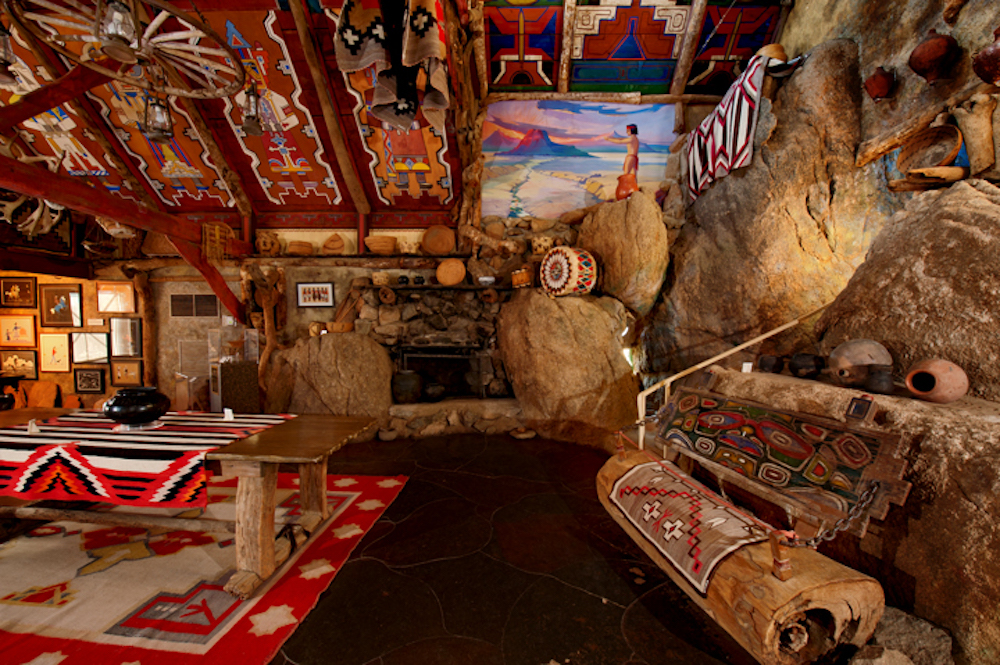
Antelope Valley Indian Museum SHP exhibits over 4,000 objects created by the Native American peoples of southern California, Arizona, and New Mexico. Visitors also enjoy the museum’s nature trail, gift shop, and picnic area.

Pets are not allowed. Service animals are welcome per California State Parks’ Service Animals Policy.

For more information, please call the museum at (661) 946-3055 (711 TTY relay service) or visit the museum’s website at avim.parks.ca.gov. Follow us on Facebook at facebook.com/AVIndianMuseum.

The California Department of Parks and Recreation, popularly known as State Parks, and the programs supported by its Office of Historic Preservation and divisions of Boating and Waterways and Off-Highway Motor Vehicle Recreation provides for the health, inspiration and education of the people of California by helping to preserve the state’s extraordinary biological diversity, protecting its most valued natural and cultural resources, and creating opportunities for high-quality outdoor recreation. Learn more at parks.ca.gov.