Native

Native American leaders pushing to strengthen protection for arts

Native American leaders pushing to strengthen protection for arts

WASHINGTON — Native American artists say they continue to struggle with the theft of their work, and tribal leaders are urging Congress to strengthen the Indian Arts and Crafts Act.

IACA was passed in 1990 to prohibit any advertisement and all sales of counterfeit Indian arts and crafts. Choctaw Nation artist D.G. Smalling says the IACA must adapt to the new ways of buying and selling art through online sales.

“We have just a very different kind of engagement with intellectual property now,” Smalling said. “This is why my principal attorney is an expert in intellectual property. It is to defend what I create and to defend what is mine.”

Cherokee Nation Chief Chuck Hoskin Jr. urged Congress to strengthen the IACA during the recent Cherokee Days in Washington D.C.

He is working with members of Congress on a proposed ARTIST Act of 2023 (Amendments to Respect Traditional Indigenous Skill and Talent).

“We haven’t engaged the delegation just yet,” Hoskin said. “We will be setting up some opportunities to visit with them. The Senate Committee on Indian Affairs is where this matter sits at the moment. The chair of that committee is Chairman (Brian) Schatz of Hawaii and he and ranking member Sen. (Lisa) Murkowski have asked for input on the ARTIST Act, so that is the particular forum through which we are channeling our advocacy.”

The proposed legislation would increase and expand protections on Indian arts and crafts, as well as enforce stricter punishments for those who are selling or making counterfeit goods which could lead to being arrested for the crimes. These counterfeit items are often recreated by non-Indian artists or printed off and seen on portraits, shirts, mugs, online shops and many other places throughout the world.

“The law must be changed in order to protect actual Cherokee artists, artisans, and craftspeople  – those who are citizens of one of the three federally-recognized Cherokee tribes – and ensure their arts and crafts are the only works permitted to be presented as Cherokee,” Hoskin wrote in a March 29 letter to the Indian Affairs Committee.

Smalling is supportive of Hoskin and other tribal leaders as they push for change.

“They are asking that the law and the act can be adapted for our time and we need to cover all things that are digital, all things that are traditional and analog and we need to have a much more robust set of laws that can then be used to act against those who are chronic violators who profit off of theft,” Smalling said.

“I stand 100% with Chief Hoskin and the other tribal leaders who are seeking to defend our right to our own identity on our own terms.”

Gaylord News is a reporting project of the University of Oklahoma Gaylord College of Journalism and Mass Communication.  For more stories by Gaylord News go to GaylordNews.net.

Oklahoma Native American artist Benjamin Harjo Jr. dies

Oklahoma Native American artist Benjamin Harjo Jr. dies
image
Internationally recognized Native American artist Benjamin Harjo Jr. passed away. He was 77.
Harjo is one of the nation’s preeminent American Indian artists, often referred to as the “Picasso of Native American art.”
Ben, who was Seminole and Absentee Shawnee, was an immensely talented and gifted artist with a style uniquely his own, the Seminole Nation Museum said in a social media post. 
Harjo studied at the Institute of American Indian Arts and Oklahoma State University, where he graduated with a Bachelor of Fine Arts in 1974. 
“The passing of Benjamin Harjo, Jr., a beloved member of the Cowboy Family and a renowned Native American artist, marks the loss of a significant treasure for our university and state,” said Oklahoma State University President Dr. Kayse Shurym. “Ben’s unique artistic skills, dedication to his beloved Native American heritage and service to our country have profoundly impacted our world, and his legacy will continue to inspire future generations.”
Services for Harjo have not yet been announced. 

Meet the virtual artists backed by some of the world’s biggest entertainment companies

Meet the virtual artists backed by some of the world’s biggest entertainment companies

Music companies are jumping into the virtual-artist space in a big way.

image

The three majors – Sony [1,753 articles]” href=”https://www.musicbusinessworldwide.com/companies/sony/”>Sony Music, Universal Music Group [3,124 articles]” href=”https://www.musicbusinessworldwide.com/companies/universal-music-group/”>Universal Music Group and Warner Music Group [2,429 articles]” href=”https://www.musicbusinessworldwide.com/companies/access-industries/warner-music-group/”>Warner Music Group – have all invested in virtual artist projects, but they are hardly the first.

The trend really began in Japan and Korea as far back as the 1990s, but back then, the technology was experimental, expensive and – maybe most importantly – audiences may not have been ready for virtual singers and bands, represented by cartoons or avatars and with no presence in the real world.

All that seems to be changing today, with social media sites often acting as incubators for a new generation of virtual artists.

Polar, created by TheSoul Publishing, boasts 1.9 million followers on TikTok. Lil Miquela, the brainchild of music producer Trevor McFedries and tech entrepreneur Sara DeCou, has 2.8 million Instagram followers.

But the phenomenon didn’t start with social media.

In fact, you can trace the history of virtual artists all the way back to the middle of the 20th Century, when Hollywood cartoon producers and comic book companies cashed in on the burgeoning rock music scene with bands like The Archies and the Grammy Award-winning Alvin and the Chipmunks.

These were fictional bands that existed in cartoons or comic strips, but they released real-life record albums, with songs written and performed by artists whose real identities were obscured behind the band’s brand.

In the 1990s, innovators in Japan and South Korea took this in a new direction, creating computer-generated avatars as music performers. Japanese talent agency HoriPro created Kyoko Date, a pop singer who put out singles like Love Communication and Albatross. (In 2018, HoriPro debuted Kyoko Date’s “daughter,” Ayano Date, on YouTube.)

In the late 1990s, Korean software company Adamsoft unveiled Adam, a virtual singer who went on to release two albums, Genesis and Exodus.

Around the same time, Blur frontman Damon Albarn and illustrator Jamie Hewlett of Tank Girl fame came together to form what remains to this day the biggest virtual musical act so far: Gorillaz, who have racked up 33 million equivalent album sales and numerous hit singles like Feel Good Inc., DARE and Clint Eastwood.

But today, with the proliferation of generative AI technology, the virtual-artist game is changing rapidly.

While The Archies and Gorillaz feature real musicians behind avatars created by real designers, today it’s possible for everything about a virtual artist – from their avatar to their compositions to their vocals – to be created with the help of AI.

And that is opening up a world of possibilities – while at the same time landing some not-entirely-unfounded worries on the minds of real-life musicians and music companies.

Are they right to be worried? At least for now, real-life musicians are holding up very well, as can be seen in Ticketmaster’s latest sales numbers, showing 41% YoY growth in ticket sales in the first quarter of this year.

Still, more and more entertainment companies are investing in the world of virtual artists. Here are what some of them are up to in this field…


image

Empire [141 articles]” href=”https://www.musicbusinessworldwide.com/companies/empire/”>EMPIRE

San Francisco-headquartered music company EMPIRE is behind virtual R&B artist Teflon Sega, who made his debut on social media in 2018.

Since that debut, Teflon has evolved from 2D anime into a 3D avatar who lives in the metaverse.

This artist is extremely prolific; in 2019, he released a new single every week. Despite this, his debut album, Welcome to the Mourning Show, only dropped on April 28 of this year.

Maybe not surprisingly, Teflon is a huge fan of new technology, particularly web3 and NFTs. In 2022, he released a “fan-edition NFT” collection in partnership with Quincy Jones-backed NFT platform OneOf and virtual entertainment company Wave, in which Warner Music Group is an investor.

According to EMPIRE, Teflon Sega is “the number one virtual R&B singer in the world, amassing 150 million streams across DSPs.”

His Instagram has 150,000 followers, his YouTube channel has 112,000 subscribers, and he has some 493,000 monthly listeners on Spotify [3,237 articles]” href=”https://www.musicbusinessworldwide.com/companies/spotify/”>Spotify.


image

HYBE

K-pop music giant HYBE (formerly known as Big Hit Entertainment) introduced the world to virtual artist MIDNATT this past Monday (May 15).

HYBE also released their new single, Masquerade, in six different languages – Korean, English, Chinese, Japanese, Spanish and Vietnamese – using AI vocal technology developed by Supertone, an AI voice company with a roster of AI audio products, including SVS, an “AI technology that brings life to a new voice.”

Founded in 2020, and acquired by HYBE last year, Supertone says it can create “a hyper-realistic and expressive voice that [is not] distinguishable from real humans.”

But that’s not exactly what’s happening with MIDNATT. The artist is actually the alter ego of Lee Hyun, a well-known Korean singer who was previously part of the vocal ensemble 8Eight, as well as the duo Homme.

Supertone’s AI gave Big Hit Music, MIDNATT’s label, the ability to replicate Lee’s vocals convincingly in other languages. It was also able to alter Lee’s vocals to allow Midnatt to sing in a woman’s voice, Fast Company reports.


image

Kakao Entertainment

Kakao Entertainment, the entertainment subsidiary of Korean internet company Kakao, had what is arguably the year’s biggest virtual-artist debut so far with the launch in January of MAVE, a virtual K-pop girl band.

As of mid-May, the band’s first single, Pandora [536 articles]” href=”https://www.musicbusinessworldwide.com/companies/siriusxm/pandora/”>Pandora – which Rolling Stone India described as a “synthpop/trap blend” – had racked up nearly 30.5 million streams on Spotify. The YouTube video had 22 million views as of last count.

Like MIDNATT, the four members of MAVE: are multilingual, speaking Korean, English, French and Bahasa, and the vocals in Pandora jump seamlessly from one language to the next. However, as Reuters reported, the avatars aren’t able to respond to prompts, and they have to rely on scripts prepared by humans.

In the four months since dropping their first single, MAVE have garnered 460,000 followers on TikTok and 212,000 followers on Instagram [400 articles]” href=”https://www.musicbusinessworldwide.com/companies/facebook/instagram/”>Instagram.

Kakao launched MAVE: through Metaverse Entertainment, a joint venture with South Korean mobile game maker Netmarble, and the K-pop group isn’t Metaverse Entertainment’s only foray into virtual people.

Last year, it launched RINA, a virtual character with a “free-spirited lifestyle who loves fashion and music and is passionate about what she likes.” Her role appears to be primarily as a social media influencer, with 138,000 followers on TikTok and 33,000 followers on Instagram.


Riot Games

Perhaps surprisingly, there are fewer more successful companies producing virtual artists than Riot Games, the game maker behind League of Legends that is owned by Tencent.

They’ve been in the virtual artist game since 2014, when they launched Pentakill, a virtual heavy metal band. The six virtual members of Pentakill – Karthus, Kayle, Mordekaiser, Olaf, Sona and Yorick – are basically promotions for skins that can be purchased in the game.

Pentakill’s biggest hit on Spotify, Lightbringer, has 37.9 million streams, and the band receives about 520,000 streams per month on the DSP.  The official audio has been viewed 36 million times on YouTube [1,519 articles]” href=”https://www.musicbusinessworldwide.com/companies/youtube/”>YouTube.

Riot draws on real musicians to generate Pentakill, and it doesn’t keep their identities hidden. For instance, it’s known that drummer Tommy Lee of Motley Crue played on Pentakill’s second album, Grasp of the Undying. That album, which came out in 2017, reached number one on the iTunes metal charts.

image
 K/DA’s video POP/STARS.

Riot Games’ next foray into virtual bands came in 2018, when it launched K-pop girl group K/DA at that year’s League of Legends World Championship. As with Pentakill, the four K/DA members – Ahri, Akali, Evelynn and Kai-sa – are promotions for skins that can be purchased in the game.

K/DA – which is composed of singers Madison Beer and Jairan Burns, as well I-dle members Miyeon and Soeyeon – is a hugely popular group, by any standard. Their first single, Pop/Stars, has had 302 million streams on Spotify, and the band has more than 3 million monthly listeners on the platform. Several other tracks of theirs have blown past the 100-million-streams mark.

The video for Pop/Stars, on the League of Legends YouTube channel, has had an incredible 551 million views, while a more recent track, MORE, has clocked 184 million views. They have 290,000 followers on TikTok, and nearly 540,000 on Instagram.

A year after launching K/DA, Riot Games did it again, this time with a hip-hop group called True Damage. As expected, their four members – Akali, Ekko, Qiyana, Senna, and Yasuo – are skins that can be bought in-game.

The real-life musicians behind True Damage – Becky G, Duckwrth, Keke Palmer, Thutmose and Soyeon – performed a live version of their debut song, Giants, at the 2019 League of Legends World Championship, performing with holographic versions of their avatars (not unlike what Gorillaz do on tour).

Giants has garnered more than 128 million streams on Spotify, and the band has some 574,000 monthly listeners on their one track. That track is about to break 200 million views on YouTube.


SM Entertainment

K-pop label SM Entertainment’s entry into virtual artistry has been quite unique.

Their girl group, aespa, straddles the line between real life and the virtual world: while aespa’s four members are real people, each of them has a virtual alter ego, an avatar that often appears alongside the real artist in videos and promotional materials.

aespa also comes with a fictional storyline that serves as a backstory for the four members and their alter egos. And earlier this year, SM Entertainment debuted one of the virtual characters who appeared in aespa’s lore – Naevis – as a virtual artist in her own right.


image
A screengrab of aespa member Karina with her avatar, ae-Karina, in the video for My, Karina.

Naevis, who first appeared in aespa’s video My, Karina, in 2021, is described in aespa lore as an AI system that enables aespa members’ virtual alter egos, known as “ae’s,” to contact and communicate with their real-life versions.

SM Entertainment had announced that Naevis would make her debut as a virtual artist at this year’s SXSW festival.

However, it appears the debut never took place, and some fans speculate that this might have had to do with the corporate battle between HYBE and Kakao over control of SM, which was ongoing when SXSW took place this past March, and which Kakao won.


Sony Music Entertainment [1,397 articles]” href=”https://www.musicbusinessworldwide.com/companies/sony/sony-music-group/sony-music-entertainment/”>Sony Music Entertainment Japan

Sony Music Entertainment (Japan) which operates independently of global music giant Sony Music Entertainment, is working on two virtual entertainment projects, one of which it calls “the largest virtual talent development and management project in history.”

That project is called Vee Virtual Entertainment, and the idea behind it is to develop talented Vtubers – online performers who work behind an avatar – into commercial successes.

In May of 2022, Vee unveiled its “first wave” of virtual talent – three previously unknown artists going by the names of Otokado Ruki, Tulsi-Nightmare Madness IV and Hinahoshi Airu, as well as two previously known Vtubers, Kujo Ringo and Syusetu Kohaku.

image
Ami Amami, Kou Tsubame and Lana Shikami are PRISM Project’s “fifth generation” virtual artists. (Image: PRISM Project)

So far, these artists haven’t seen breakout success, with a handful of YouTube videos hitting views in the tens of thousands, and not much presence on Spotify. Their Twitter and Twitch accounts have garnered followers in the single thousands.

SMEJ’s other virtual-artist endeavor is their PRISM Project, which also recruits Vtuber talent. PRISM has been building its roster aggressively, and last month announced its “fifth generation” of virtual artists – Ami Amami, Kou Tsubame and Lana Shikami.

As with VEE, so far PRISM hasn’t seen a major breakout artist. Among PRISM’s 15 virtual artists, the two biggest ones so far appear to be Shiki Miyoshino, with 139,000 YouTube subscribers, and Iko Hoshifuri, with 53,000 YouTube subscribers and about 7,700 monthly listeners on Spotify.

SMEJ also works with Apoki, a virtual K-pop artist that debuted in 2021.


image

Tencent Music Entertainment (TME)

TME is making big moves in the virtual artist space and in AI-generated music.

During an earnings call in November of 2022, TME Executive Chairman Cuisson Pang told analysts that the company had created more than 1,000 musical tracks using generative AI, one of which had already clocked more than 100 million streams.

The following month TME unveiled Lucy, which the company described as its first “hyper-real virtual pop idol,” built by TME’s in-house LyraLab.

Despite only being in existence for some six months, Lucy already has 17 singles on her account at QQ Music, one of TME’s streaming services in China.

In the company’s Q4 and FY 2022 earnings announcement, TME noted that, in the quarter, TME “Brought to life TME’s first hyper-real virtual pop idol, Lucy, along with our other virtual performers Xiaoqin, Shanbao and Anko with original content, unique voices and dance moves”.

The company added: “With a record-grade, automatically generated vocal print developed by TME LYRA LAB’s LyraSinger Engine, Lucy has received partnership interest for joint performances from a broad array of global brands.”

On TME’s Q1 earnings call this past Tuesday (May 16), Tony Yip, TME’s chief strategy officer, said the company plans to create more virtual idols with an eye to bringing them on to TME’s live-streaming services.


image

Universal Music Group (UMG)

UMG stepped into the virtual artist arena in late 2021, when it announced the formation of Kingship, a virtual band based on four characters from the NFT collections Bored Ape Yacht Club and Mutant Ape Yacht Club.

The band was the creation of 10:22PM, a UMG subsidiary formed by former Sony exec Celine Joshua that describes itself as a “next-gen web3 label.” Its goal is to sign artists, social media influencers and digital media creators with a focus on multimedia content.

UMG, via Universal Music Italy also ‘works with’ Zero Pain, a virtual artist that currently has 92,000 monthly listeners on Spotify, and whose biggest hit, PECCATO, has 2.6 million streams on the service.

Zero Pain’s roughly two-minute tracks are so-called ‘phonk’ – a genre that’s become popular on TikTok over the past few years.

One interesting innovation with Zero Pain is that the artist’s music and fictional backstory is being crowdsourced on their Discord server, where fans can vote on such things as song titles, the character’s backstory and even social media posts.

UMG has also been working on avatars for its existing, real-life artists. The company inked a partnership with Genies, an avatar technology company, in 2021, to “equip artists with official virtual identities for use in Web 3.0 and the shifting age of the Internet, providing a persistent virtual representation of themselves across the metaverse to engage with fans in expressive and authentic ways.”

UMG’s Capitol Music Group [452 articles]” href=”https://www.musicbusinessworldwide.com/companies/universal-music-group/capitol-music-group/”>Capitol Records was also briefly involved with controversial virtual artist FN Meka, which was signed, but then ultimately dropped by the label.


Warner Music Group (WMG)

Back in 2021, Whet Records, WMG’s pan-Asian dance label based out of China, claimed to have become the first major label to sign a virtual artist – Ha Jiang, a virtual idol that had amassed 100,000 followers on Chinese social media, appearing as a road safety ambassador and an esports anchor, among other things.

So far, Ha Jiang has released three singles and has been credited with a remix of Marvus’ Drunk Groove, which is her largest hit on YouTube, with 106,000 views.


image
Whet Records’ Ha Jiang.

But that’s not WMG’s only foray into the virtual artist arena. In 2022, it invested in Authentic Artists, a music platform headquartered in San Francisco that describes itself as a developer of “metaverse-native virtual artists, digital collectibles and interactive music experiences.”

So far, Authentic Artists has launched 12 prototype virtual artists, among them Nayomi, DJ Dragoon, Gnar Heart and Glitch. In April of this year, the company announced the launch of a “proprietary, generative, audio-visual production platform that instantly composes and produces fully-formed, high-quality songs performed by AI-powered Virtual Artists.”

Chris McGarry, founder and CEO of Authentic Artists, said: “Virtual entertainment is the new cultural center of gravity, and today’s digital natives want agency over their worlds. Our adaptive artists will give it to them, co-creating new shared musical experiences and making new art and culture with fans across every connected platform.”Music Business Worldwide

Move Over Kim Jones, Now It’s The H3NSY Community Who’ll Get To Co-Create Hennessy’s New Bottle

Move Over Kim Jones, Now It’s The H3NSY Community Who’ll Get To Co-Create Hennessy’s New Bottle

A major fashion house like Louis Vuitton entrusting its customers to decide its next creative director might seem like a long way off. However LVMH is trialling the mechanism elsewhere in its portfolio.

While Pharrell Williams appointment as creative director for Louis Vuitton Men’s was settled in-house, in the traditional manner, it’s a different story when it comes to the Group’s Hennessy cognac.

Following Hennessy’s buzzy partnership with Dior Homme and Fendi womenswear artistic director Kim Jones, H3NSY, Hennessy’s Web3 platform has announced that its latest project for its membership community, Café 11, will engage with that community to decide on the design direction for its new limited edition bottle.

Co-creation, a fundamental part of Web3’s decentralized ethos, is increasingly gaining ground with retailers moving into the Web3 space. Most recently, new DTC beauty brand KIKI World has launched with a similar proposition allowing its community to vote on the products it brings to market. Going Forward, they will be able to select and own beauty product attributes, paving the way for future revenue sharing with customers.

From today through May 29, all Café 11 token holders will have the opportunity to choose which of three emerging Web3 native artists will get the job. Once selected, the creative will work with the Café 11 community to gather ideas and inspiration to collectively develop the artwork for the bottle.

Once validated, Hennessy’s packaging design agency will take the art and refine the files before revealing the bottle rendering, box design and associated nonfungible tokens.

BlockBar, a direct to consumer NFT marketplace for luxury wine, will create a token-gated page for Café 11 holders to mint their proof of ownership NFT and once the bottle has completed production, holders will be able to redeem their physical bottle using said token.

This release is limited in quantity and will be available exclusively to Café 11 token holders. The full process is expected to be completed by summer 2024, and the bottles will be stored at BlockBar’s facilities in Singapore for redemption or long-term storage.

The artists being put to the vote are Florian Zumbrunn, Edouard and Johnsville. Zumbrunn, whose approach blurs the lines between digital and physical realms, is a rising talent in the generative art scene. His work has been showcased in Tokyo, Milan, and Paris, as well as on Web3 platforms like ArtBlocks and FxHash. Edouard is a visual artist and NFT collector and curator who draws inspiration from diverse art forms such as French Touch music and has exhibited at Paris’ NFT Factory. The work of native New Yorker Johnsville reflects the energy of comic books, street art, surrealism, and impressionism.

Earlier this year Kim Jones designed a 200-piece limited edition bottle for the brand alongside a decanter and a pair of sneakers. Said bottle was created via 3D printing and finished by hand.

George Voronovsky’s Visions Of Ukraine From Miami Beach

George Voronovsky’s Visions Of Ukraine From Miami Beach

What causes one artist to depict his traumas through some of the most horrific imagery ever produced in art history while another who experienced much the same paints beautiful, bucolic, peaceful, joyous pictures?

Si Lewen (1918–2016) saw the rise of fascism in Europe first-hand, fleeing his native Poland for France and then the United States after Hitler assumed control of Germany in 1933. Ukrainian George Voronovsky (1903–1982), similarly, immigrated to America. That would not be until 1951, however, a decade after the Germans took over Ukraine in 1941.

Voronovsky was among the millions of Ukrainians spared death for not being Jewish, but he was nonetheless enslaved in the regime’s forced labor camps, traumatized and separated from his family.

In an exhibition on view now at the Menil Drawing Institute in Houston, previously reviewed by Forbes.com, Lewen’s desire to recall this time and process what he saw revealed itself in a shocking series of black and white drawings detailing the endless cycle of war. Frightening, angular, frenzied, serrated images. Columns of soldiers. Officers barking orders. The snapping dogs of war. Blood spatters. Rats. Barbed wire. Coffins.

The worst of times.

Voronovsky’s choice was to paint vibrant community festivals, colorful costumes, peace, tranquility, scenes of communal agriculture, happy residents going about their work, birds–my god, the birds!

The best of times.

Voronovsky’s the best of times can be seen now through August 13, 2023, at the High Museum of Art in Atlanta which presents the first exhibition of his work outside of Florida.

The artist first settled in Philadelphia, but while working for the railroad, made his way south to Florida by 1970. There, he embraced Miami Beach, a destination at the end of the rail line booming with Eastern European immigrants of his generation long before it was a notorious narcotics capital or international nightlife destination.

“George Voronovsky: Memoryscapes” features 60 of his mostly untitled and undated works, the majority of which depict youthful memories of a beloved life in Ukraine. Voronovsky transformed his Miami Beach hotel room into a paradisiacal art environment filled with these paintings and carved Styrofoam sculptures in the last decade of his life.

“When I saw the work in person I just about died,” Katherine Jentleson, Merrie and Dan Boone Curator of Folk and Self-taught Art at the High Museum, told Forbes.com. “The surface quality of his painting across all of the different substrates he used–cardboard, canvasboard, canvas–is just breathtaking, and the Styrofoam sculptures boggle the mind with their delicacy. We committed to the show long before Russia invaded Ukraine, but of course that gave the exhibition an urgency and relevance. As one friend told me upon seeing the show, the Ukraine that Voronovsky upholds in his paintings is the Ukraine people are fighting for.”

While not unknown prior to this presentation, Voronovsky’s work was well out of any artistic mainstream, even from Jentleson and the High which possesses the finest collection of Southern folk art in the country.

“I often hear from people who have or know of the work of a self-taught artist that they think we might be interested in, but it is very rare that such artists have an entire body of work that is as compelling as Voronovsky’s,” Jentleson said. “The rich colors and beautiful compositions of his paintings translated easily as digital images, enough to get me to tentatively commit to the show, and of course his life story is fascinating as well.”

Painting Ukraine from Miami Beach

From his third-floor room at the Colony Hotel, Voronovsky eventually began painting his Ukrainian past, folklore-infused scenes and idyllic landscapes from his childhood memories in and around Kyiv. He also painted his American present, the bustling cityscapes and waterfronts of the rapidly transforming South Beach, but it’s the Ukraine pictures which stand out.

Without the financial means to purchase canvas in large quantities, he repurposed discarded cardboard including pizza boxes for many of his paintings, and he used Styrofoam, aluminum cans and coffee tin lids to create sculptures of flowers, fish, birds and woodland creatures.

These are reproduced in astounding abundance recalling contemporary Wisconsin painter Tom Uttech’s (b. 1942) landscapes of the north woods which would have appeared to him much the same as the pre-war Ukraine of Voronovsky’s childhood–the 49th parallel forms the political border between the U.S. and Canada and runs directly through Ukraine.

Thick forests. Fertile soil. Tremendous wildlife.

Voronovsky, like Uttech, pictures birds in numbers scarcely imaginable today, half a century into a human-caused collapse of biodiversity resulting in the loss of 70% of wildlife populations globally since 1970. But that’s the way it used to be, both in America, where flocks of the now extinct passenger pigeon were so great they could darken the sky, and in Ukraine.

“Voronovsky’s works are so idyllic that it can be easy to assume they are pure fantasy,” Jentleson said. “As we researched the kinds of flora, fauna, landscapes, architecture, and cultural traditions he was depicting, however, we realized that they almost all depict real places and experiences he likely had as a child in Ukraine and Crimea.”

The show brings receipts, displaying murals of historical photographs that anchor his paintings in his life experience.

“Doing this gives weight to what a powerful force the human memory is, both in terms of how long we can hold on to core memories, and how Voronovsky was able to use those memories to create, through his art, a kind of homecoming to Ukraine that otherwise eluded him,” Jentleson explains.

Homeward Bound

Around 1978, Gary Monroe, a young photographer who had been capturing life in Miami’s South Beach neighborhood—especially scenes of its flourishing elderly community—met Voronovsky after glimpsing the beauty of his creations from the sidewalk. Monroe and his circle of friends frequently visited with the artist, helping him access art supplies and documenting his life and art in photographs, film and writing, some of which is featured in the exhibition.

Monroe has made a life’s work champion Florida folk and self-taught artists including the Florida Highwaymen. When Voronovsky died, he left his art and personal effects to Monroe, who has gifted several pieces to the High, making it the first museum to acquire Voronovsky’s work.

The acquisitions and exhibition continue the Museum’s longstanding commitment to celebrating Southern self-taught artists. While Voronovsky took a roundabout way getting there, his work shares much with the Southern-born self-taught artists in the High’s collection.

“His use of cardboard as a substrate connects him to artists like Bill Traylor and Nellie Mae Rowe,” Jentleson said. “Rowe also used some Styrofoam in her work, but I’ve never seen an artist carve such a brittle material so beautifully. He is also connected to many artists in the collection, from Rowe to Howard Finster to David Butler or Annie Hooper, who created all-encompassing art environments with their art.”

Voronovsky, of course, was not immune to the darker emotions his wartime experiences would have embedded in him, but he never painted them. He never painted hunger or suffering or loss. In this way, his pictures are reminiscent of ledger drawings by imprisoned Southern Tsitsistas (Cheyenne) warriors who faithfully recreated images of their free life on the Plains, the buffalo hunts and ceremonies, following the Red River War and capture by the Army.

It’s uplifting, in a sense, thousands of miles from home and loved ones and familiarity, traveling back in the mind, recreating these places through art; surely those hours spent remembering and reproducing such scenes were happy ones, and, doubtless, melancholy.

For Voronovsky, maybe that’s where the birds come in. Jentleson thinks so and created a special installation of them in the exhibition’s final gallery.

“No matter where Voronovsky was in his life, he would have been able to admire birds, whether in the yard of a Nazi labor camp or on the shores of South Beach,” she said. “Their freedom of movement and also their ability to travel long distances in flocks that stay together may have meant something to him as someone who was forcibly displaced from his beloved homeland, only to move through much of his life alone.”

60th annual East Lansing Art Festival showcases work from over 150 artists

60th annual East Lansing Art Festival showcases work from over 150 artists

Thousands of art-lovers gathered in East Lansing yesterday to visit the East Lansing Art Festival and Michigan State University Arts and Crafts Show. With more than 150 artists and vendors, the events featured diverse artists and works from a variety of mediums

Artist and vendor booths were placed on M.A.C. and Albert Avenue in downtown East Lansing 10 a.m. to 6 p.m. on Saturday and 10 a.m. to 5 p.m. on Sunday.

Oil paint artist Eva Antebi-Lerman said this was her second time at East Lansing Art Festival. She said she loved the event because it was an opportunity to conect with people and sell her work for them to enjoy.

“The people who come here are really always very interested in chatting with me and learning about my work, learning about my process,” Antebi-Lerman said. “There’s always just a lot of excitement about people coming out to see it.”

Antebi-Lerman’s booth was full of abstract oil paintings on canvas that explored movement, color, energy and the “transitory elements of nature.”

Textile artist Kristin Gereau also used color as a source of inspiration for her work. Her booth featured unique scarves that she knitted and hand-dyed

Gereau first showed her art at the festival a decade ago. After winning the “Best in Fiber” award at last year’s art festival, she was invited back for this year.

What made the festival particularly special, Gereau said, was the East Lansing community. She said she was excited to explore the city later and enjoy the weekend’s nice weather

At the MSU Arts and Crafts Show on Abbott Road, vendor Merri Bayard sold scented candles. Bayard said the show was a great opportunity for artists to meet people from diverse backgrounds and interact with different types of art.

“It’s a great variety, and it’s a lot of vendors, so there’s something for everybody for everything,” Bayard said. “It’s really been a wonderful market. We do a lot of smaller markets too, and this is just nice because it’s busy and there’s so many people.”

Visual artist Inty Muemala brought paintings, sculptures and handmade pipes that he said focused on animals and symbols sacred to different Native American cultures. Like Bayard, Muemala said he looked forward to not only showcasing his own art, but also appreciating the other artists and their works at the festival

“I love the people,” Muemala said. “I love the space. Also I love meeting with different artists. It’s a nice place to start the summer with different art shows.”

Support student media!
Please consider donating to The State News and help fund the future of journalism.

Discussion

Share and discuss “60th annual East Lansing Art Festival showcases work from over 150 artists ” on social media.

‘Killers of Flower Moon’ star says Native Americans need allies like Scorsese

‘Killers of Flower Moon’ star says Native Americans need allies like Scorsese

CANNES, May 21 (Reuters) – Lily Gladstone, who grew up on the Blackfeet Indian Reservation and stars in Martin Scorsese’s study of white society’s treachery, said the director was a powerful ally in telling the world what communities like hers had always known.

In the film “Killers of the Flower Moon“, which premiered at this year’s Cannes Film Festival, Gladstone plays Mollie Burkhart, a member of the Osage Nation whose family members die under suspicious conditions in 1920s Oklahoma.

Because of his global reputation, Scorsese was uniquely placed to dispel the myths that have prevailed, she said.

“Who else is going to challenge people to challenge their own complicity in white supremacy … except for this man here? Other artists are doing that work – people listen to what this one says,” she said. “We need these allies.”

Referring to deceptions that have prevailed, Gladstone asked: “Why the hell does the world not know about these things? Our communities always have.”

In the film, Gladstone marries her white driver Ernest Burkhart (Leonardo DiCaprio), whose uncle is the “King of the Osage Hills” William Hale (Robert De Niro).

Hale presents himself as a friend of the oil-wealthy Osage, while instigating their murders to cash in on the deaths.

The director, who filmed entirely on location in Oklahoma, said the more he learnt about the Osage, the more he wanted to put into the nearly four-hour film.

“I wanted to know everything I could about the Osage, and it’s overwhelming,” he said.

Chief Standing Bear, principal chief of the Osage Nation, said Scorsese had restored trust.

“My people suffered greatly. To this very day, those effects go with us. But I can say on behalf of the Osage, Scorsese and his team have restored trust and we know that trust will not be betrayed,” Chief Standing Bear told journalists in Cannes.

Reporting by Miranda Murray; editing by Barbara Lewis

Our Standards: The Thomson Reuters Trust Principles.

Living Treasure Anthony Lovato carves one-of-a-kind pieces inspired by his beloved culture

Living Treasure Anthony Lovato carves one-of-a-kind pieces inspired by his beloved culture
Anthony Lovato (Kewa/Santo Domingo Pueblo) will be honored as a Living Treasure. (Eddie Moore/Journal)

Jewelry artist Anthony Lovato (Kewa/Santo Domingo Pueblo) pours molten silver into carved tufa casts to conjure glittering symbols of his beloved culture.

That work can be found in “Down Home,” open at the Museum of Indian Arts & Culture to celebrate his winning the 2023 Living Treasure award. Lovato also will be selling his pieces at the annual Native Treasures Art Market taking place Memorial Day weekend, Friday, May 26, through Sunday, May 28, at the Santa Fe Community Convention Center. About 185 artists will be selling jewelry, pottery, weavings, sculpture, paintings, fashion and photography.

Jewelry flowed through Lovato’s DNA. His grandfather, father and brother all made it.

“I was set up for this,” he said. “I’m a fourth generation jeweler.

“Santo Domingo is known for its arts and crafts,” he continued, “all the way back to Chaco Canyon. Of course, they found jewelry back there, so personal adornment has always been there for the pueblo.”

“Cosmic Corn,” Anthony Lovato (Kewa/Santo Domingo Pueblo), 1997. “When I see this piece,” says Lovato, “I see a growth, warmth, heat, color and cosmic power. Holding multiple stories, this necklace includes imagery of the sun, moon and stars, representing growth; corn, evoking family; and migration and emergence, tying the universe together. Celestial power — held in the opal — enhances the power of the necklace. (Courtesy of Kris Lajeskie)

A graduate of Bernalillo High School, Lovato attended Santa Fe’s Institute of American Indian Arts, where he focused on metalwork and museum studies. He also worked at the Museum of Northern Arizona in Flagstaff in exhibition design.

“I always knew the processes of my work, but I wanted to go back to school to learn more technique,” he said.

His trademark corn, horse and hand motifs river back to the petroglyphs and ancient sites such as Chaco Canyon and Mesa Verde.

Horses date back to the Spanish invasion, Lovato said.

“We used to have 14 horses. Now we’re down to eight,” he said. “Some Spanish things have been incorporated into our culture.”

“Corn is my clan sign,” Lovato continued. “The hand denotes human presence.”

He does not draw out his designs. First he travels 300 miles west onto the Hopi Tribe reservation in Arizona to harvest the tufa sandstone.

“I pull it out of the ground myself,” Lovato said.

He slices the tufa into Cracker Jack-sized boxes with a hand saw.

“We carve a design into the sandstone,” he said. “Then we pour molten silver into the block.”

It cools in five minutes.

“Turquoise Corn Bracelet,” Anthony Lovato (Kewa/Santo Domingo Pueblo), 2002. (Courtesy of Kris Lajeskie)

“Carving it takes more than a day,” Lovato said. “The best part is it relates to pueblo history. People say my pieces talk to them. I say I talk to them so they can talk to people.”

He creates no multiples; everything is one-of-a-kind.

The necklace “Corn Clan Child” shows a mother cradling her child while carrying a pueblo pot on her head. The baby is made of citrine. The pottery symbolizes growth and nourishment.

“Cosmic Corn,” another necklace, nods to Lovato’s clan with stalks of corn and night sky symbols.

“That’s a whole celestial scene, with the stars and the moon and the clouds,” he said. “I refer back to what we know. At Chaco, there are paintings of Halley’s Comet. I’m also fascinated by what the archaeologists found in those areas. It’s all there; I just put it all together like a cook. I put things in silver while my ancestors put it in rock.”

At first, a gold corn ring seems like an anomaly. But Lovato calls it a “happy ring.”

A divorced customer asked him to turn an old wedding ring into something new.

“I’m a jewelry surgeon, I guess,” Lovato said. “I kind of know what people are looking for. They’re looking for their spirit that they’ve lost.”

“Buffalo Spirit Pendant,” Anthony Lovato (Kewa/Santo Domingo Pueblo), 2013. Lovato started making spirit pendants in 1990. Made with Sleeping Beauty turquoise, this night scene depicts a buffalo spirit. (Courtesy of Eslee Kessler)

Major art markets have showered Lovato with awards, including the Santa Fe Indian Market, the Red Earth Nation Show, the Eight Northern Indian Pueblos show, the Heard Museum Guild Indian Market and more. A fourth generation jeweler, he cites his major influences as Allan Houser, Charles Loloma, his grandfather Leo Coriz and his mother Mary Coriz Lovato.

Benjamin Harjo Jr. influential Native American Artist dies Saturday, age 78

Benjamin Harjo Jr. influential Native American Artist dies Saturday, age 78

Well known and recognized Native American artist Benjamin Harjo Jr. has died at the age of 77,

He was known as the “Picasso of Native American art” He won numerous awards in his career including The Red Earth Grand Award in 1987, the 34th Annual Featured Artist and Gold Medal Award at the 1990 American Indian Cowboy Artists Wichita Kansas Show. In 2007 he created a poster honoring the state’s American Indian influence for Oklahoma’s Centennial Commission.

Harjo was honored with many awards in his lifetime as he was a gifted artist and printmaker. His work is included in the Smithsonian Institution’s National Museums of the American Indian in Washington D.C.

Over the years Native American Art has become more popular because of the work of such artists as Harjo. A fondly remember mentor to many up-and-coming artists over the years.

Summer preview: The comprehensive guide to Artpark & Company’s 2023 season

Summer preview: The comprehensive guide to Artpark & Company’s 2023 season

Fri, May 19th 2023 10:00 am

Artpark’s anniversary celebration begins with international performers, Indigenous artists, rising musical stars

√ Interview with President Sonia Kozlova Clark

By Joshua Maloni

GM/Managing Editor

Artpark & Company’s focus for this summer – its 50th season – centers on five key words: spectacle, drama, Indigenous & global influences.

Indeed, arts and culture will take center stage this year, as the award-winning venue will host educational and entertaining events across the Lewiston state park’s 150-acre campus.

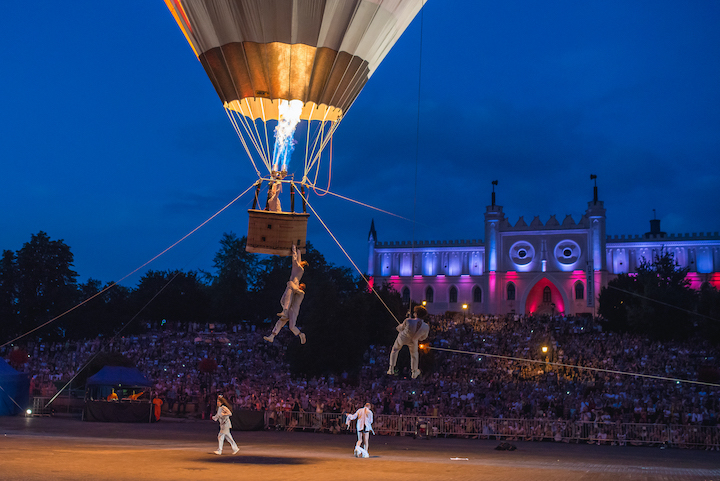
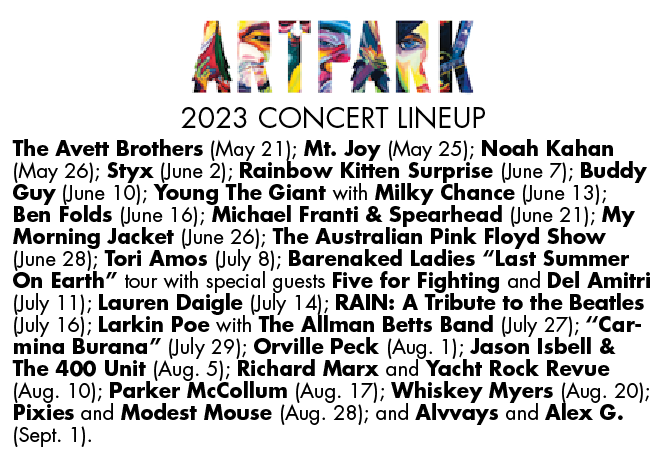
Organizers shared, “Hotly anticipated events this summer include the North American premiere of the spectacular production of ‘Carmina Burana’ by Spain’s La Fura dels Baus; a hot air balloon escape act by the French Cirque Inextremiste and a ‘Cirque Celebration’ fundraiser directed by Sxip Shirey; guitar legend Buddy Guy’s farewell tour; the 13th annual Artpark Fairy House Festival, this year adding a celebration of the culture of Ukraine under the creative collaboration of Kyiv’s theater director Vlad Troitskyi and Tbilisi’s designer Uta Bekaia; concert attractions like Ben Folds and double-headers like Pixies with Modest Mouse; rising music artists like Noah Kahan, Orville Peck and Larkin Poe; and the Artpark Strawberry Moon Festival, celebrating Indigenous cultures of the Buffalo-Niagara Region. …

“Artpark has already announced more than 30 performances and concerts, two festivals, several art installations, six international creative residencies, art camps, and even the launch of Artpark’s ‘Art Ale’ in partnership with Resurgence Brewing Co.”

President Sonia Kozlova Clark previewed the new season in a recent Q&A. This is part one of her interview.

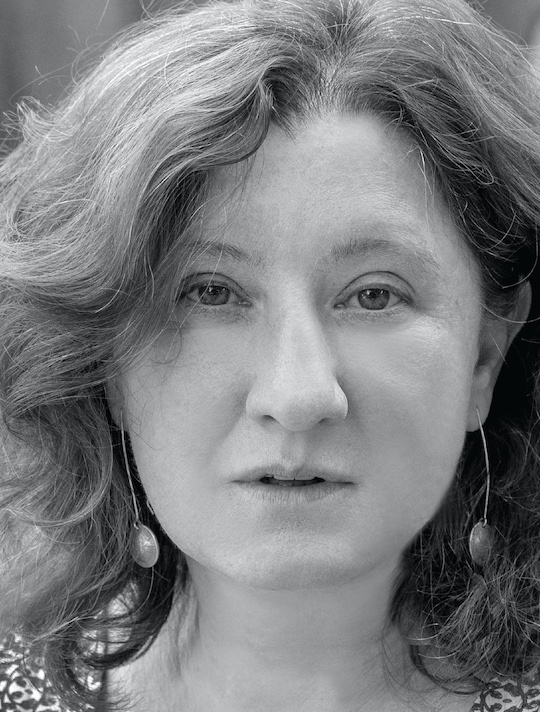
Artpark & Company President Sonia Kozlova Clark (Photo by dellas, traffic east)

••••••••

Q: I would say Artpark probably fared better than most over the pandemic – the site remained open, you came up with creative new programming, and received several grants and awards. You had crowds in thick and thin. What have you learned about your audience in recent years, and how do you best serve them in 2023?

Sonia Kozlova Clark: That’s a very good question – and it is complicated because our audiences are changing – and they are changing more rapidly since COVID.

To define what is our audience today versus what it was three years ago, I would say that, during COVID, we were able to think about our strengths, our unique features, and also our future with support from federal and state funding sources and the local community. We were able to strengthen our partnerships with presenters like Live Nation, AEG Live, Funtime; grow our artistic and management team; and with that take some risks. What we learned in the process of trying some new bands and recalibrating some of our event structures and expectations, is that there’s a tremendous new audience for Artpark, both locally, which includes Lewiston, Buffalo, the rest of Western New York, and as far as Canada, as Canadians are starting to come back.

We learned that our audiences are, indeed, interested in the great diversity of music and other programs. They represent different demographics, segments or pockets of the population that we can serve in very different ways.

Artpark itself occupies a vast territory, and its 150 acres offers some very interesting opportunities for engagement. We have several stages: the well-known Artpark Amphitheater with a large capacity of up to 10,000 people. We also have the Artpark Mainstage Theater, which is the enclosed theater with an open lawn with which Artpark opened in 1974.

We also have the intimate Emerald Grove stage, named after the installation by Jesse Walp that surrounds it. This chamber stage has a garden-like setting and has become the primary setting for the fast-growing “New Music in the Park Series” where the informal atmosphere gives our audiences permission to experience something very new to them.

We also have been using the grounds of Artpark, rich with performance and festival opportunities. Both our Strawberry Moon Festival celebrating the local Indigenous cultures and the Fairy House Festival this year focusing on the art of Ukraine mixed with the local fairy house creations in the woods will take advantage of the wonderful nature of the lower park.

The Cirque Inextremiste performance calling for a large outdoor area for the hot air balloon hoisting acrobats up in the air will take place on the upper parking lot B. One of the “New Music in the Park” concerts – “L’ouiseau,” curated by now local conductor Brett Chancellor – will take our audience on a walking music tour on the stunning Niagara Gorge to explore the work of contemporary composers Kaija Saariaho, Iannis Xenakis, Brent Chancellor and Messiaen with dance and Native American spoken word.

We will have on-stage performances of music by Philip Glass and Vivaldi and take advantage of the natural acoustic dome of the Emerald Grove with Third Coast Percussion.

And, of course, the massive theatrical production of “Carmina Burana” by La Fura dels Baus with Buffalo Philharmonic, Buffalo Philharmonic Chorus conducted by Gil Rose, and 200-plus performers will take place on our exceptional, one-of-a-kind opera stage.

Image: Carnaval Sztukmistrzów // Lublin // Exit fot. Natalia Wierzbicka

Cirque Inextremiste (Photo provided by Artpark & Company)

••••••••

Q: I think, certainly, diversity in programming is something that you’ve been very successful at over the years.

The previous administration, out of necessity – then I would say popularity and practicality – focused on outdoor concerts. There was no indication the cultural programming you’ve initiated would become as well-received as it is today. What led you to believe those programs were possible – and that they could work at Artpark?

Sonia Kozlova Clark: When I first came to Artpark, what I saw was, again, this vibrant palette of opportunities for presentation. I have produced very different types of arts and events in the past, and I could see how Artpark is unique from any other venues I had worked with.

Artpark as a place of nature and as a community presents almost limitless ways to explore the different types of performance, theater, music, Cirque, street theater, or art in public spaces. Also, of course, visual arts is a tremendous legacy and opportunity for Artpark, which we are strategically rebuilding. We are approaching these opportunities in phases and by layering one new discipline at a time.

The opportunities come from the site itself – its history, also its legacy, and, very importantly, from the people around us. It’s the Buffalo community, so fond of innovative music and theater; the Lewiston community, so rich with people who know their history and the memories of coming to Artpark to experience the various types of performances. It’s also the Indigenous people who were here long before any others.

Our understanding of what is diversity, specifically, at Artpark is also a very interesting subject. We often times talk with our board, funders, artistic partners and curators about how to make our organization more diverse, and how to make our audience more diverse. Oftentimes, the fallback is to say, “Well, Lewiston is a pretty homogenous society.” Initially, I thought, the local diversity was economic and maybe educational. But soon I have discovered the incredible depth and richness of the Haudenosaunee and their predecessors, thank you to Eva (Nicklas) and Irene (Rykaszewski) from the Lewiston Art Council, and Michele-Elise Burnett, who I’ve met through our board member Seymour Knox IV.

With their help, some reading, and the stories told by Neil Patterson Sr. of the Tuscarora Nation, or Peter Jamison of the Seneca Nation, and many others, I learned that the Haudenosaunee Nations are in themselves very diverse, but also so present here. Their presence here is not always the most obvious, as we see them through the limited focus of shared festivals or events, but the reality is so much richer.

Through the work of Michele-Elise, Artpark’s Indigenous arts producer and staff member, our relationship has been flourishing now for a number of years, starting with the Artpark Strawberry Moon Festival and expanding now to a summer-long program focused on Indigenous ways of knowing. I am grateful to Kehala and Jordan Smith and all the scholars and artists helping us build a more close-knit relationship, which sometimes feels like family.

The success of attracting an audience is through seeing your community, all its fine tones and different shades of cultural and economic differences, social and even political views. And for us at Artpark, there is such an interesting palette to work with here.

Another path for success is in programming strategy. Layering the new over time, mixing it with the familiar. When you bring something new, the recognition doesn’t happen all at once. You have to adjust the strategy for each particular kind of art and audience. It’s not one-size-fits-all.

Cirque Inextremiste (Photo provided by Artpark & Company)

••••••••

Q: Of course, we know concerts are still a very big draw. What can you tell me, looking at this year’s lineup, that stands out to you – or that people should be excited about or even curious about, with regard to the bands and the acts you’ve booked?

Sonia Kozlova Clark: As you said, it’s a very diverse lineup, and addresses different types of audiences.

I am, as always, excited about Barenaked Ladies, which now has become a staple event in Western New York. They are more popular here in Western New York, or at Artpark, than practically anywhere else. It’s just a very special relationship that we have developed over time between our community and the band. So, for that alone, it’s absolutely a special to Artpark event, and all of us always look forward to it.

I think, of course, Styx on June 2, is something that so many of us are looking forward to, as well. They’ve been to Artpark now a number of times, and this year it seems bigger than ever.

We rarely ever start that early, but this year our first concert is May 21, with the Avett Brothers. Again, a great band. They’ve been to Artpark twice before. So great to see them back, and it looks like it is going to be a packed house. And it’s great to see the audiences coming back, and then some.

Buddy Guy is an iconic figure in music. It’s his last – or self-proclaimed last – tour. We’ll see. I hope he changes his mind. He will definitely be a highlight, for me personally, and I’m sure for many in the community.

I think Larkin Poe is a fantastic duo that I think everybody should discover, if they haven’t yet – with the Allman Betts Band. Together, it’s a great pairing.

One of my favorite musicians is Ben Folds. To me, it’s definitely a highlight. I’ve followed his career from the very early days, and I’m so glad to see him back with us.

Pixies and Modest Mouse will close our amphitheater season, and what a great, incredible pairing that is. I’m definitely looking forward to that. I was doing the happy dance when we confirmed that particular concert.

And then we have not one but two North American premiers: Carl Orff’s “Carmina Burana,” in a spectacular production by La Fura dels Baus with Buffalo Philharmonic Orchestra, Buffalo Philharmonic Chorus, conducted by Gil Rose. It’s a modern spectacle. It’s a very edgy spectacle based on a medieval collection of poems and songs written in Latin and Middle High German. The texts cover a wide range of themes, such as drinking, gambling, love and the fickleness of fortune.

The poems were discovered in a Bavarian monastery in the 19th century and later set to music by composer Carl Orff in the 1930s. Musically it is extraordinary, recognizable and powerful. I call it the “Heavy Metal of the ’30s.” Its main song, “O Fortuna!,” was recorded and remixed in so many different styles. The Trans-Siberian Orchestra has done a track; in addition to all the classical interpretations, of course. It runs the whole gamut. There’s hardly a human being on this planet that doesn’t know this tune.

The production is by a renowned company in Spain – La Fura dels Baus – who I have been in conversations with over a number of years now – their focus is on opera as a spectacle, oftentimes outdoors with immersive video, flying acts and spectacular stage effects. They’ve been in the United States a number of times. The last time they were at the Mostly Modern Festival at Lincoln Center with a production of Haydn in 2018.

Their Carmina production has toured around the world for over 10 years, but it’s never been in North America. And I’m very excited to be able to present this just at Artpark, just for us, just because we can, and just because it makes sense for us.

We are also fortunate to be working with the visionary conductor Gil Rose with whom we are building a long-term plan for reintroducing opera to Artpark, and, as always, with our friends at the Buffalo Philharmonic Orchestra and the Buffalo Philharmonic Chorus, also the Tanzen Dance and other local performers.

And the second North American premiere at Artpark will be with Cirque Inextremiste on Aug. 27, which we are bringing in partnership with University of Arizona and Rochester Fringe Festival. This French group are completely unique and out of their own kind, they define themselves as “sweet lunatics trapped in spite of themselves in a life-size epic” in one of the wildest shows you will ever see, called “EXIT.”

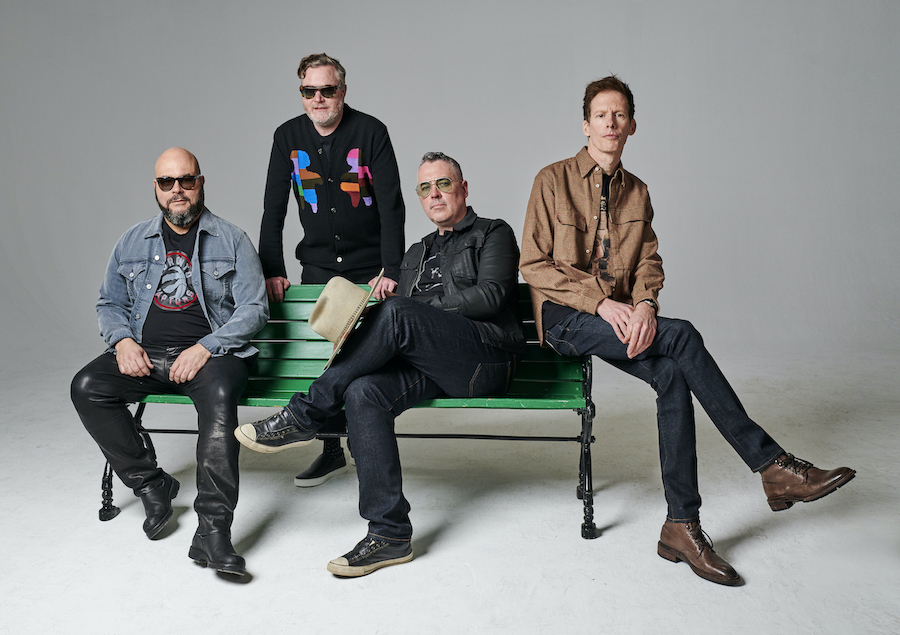
Barenaked Ladies (Photo by Matt Barnes // provided by Artpark & Company)

••••••••

Q: It’s a big anniversary season. How will that milestone be recognized this summer?

Sonia Kozlova Clark: We plan to celebrate by the continuous growth of Artpark as an institution and exploration of its potential while also recognizing its legacy. We have programs that highlight our Haudenosaunee people through Strawberry Moon Festival and summer-long Indigenous programs. We are restarting the opera program, once so prominent at Artpark, and so well known in this country. We are bringing new voices and international productions, which are impactful not only for our own audience, but for the artists themselves. Through these international collaborations and national partnerships, Artpark’s name is now present in the professional discourse around the world.

I was recently at Carnegie Hall, at a concert, and a number of people I ran into from New York City ran up to me with their memories of Artpark as an opera hub back in the 1980s. It’s still in the memories of people far away from here. So, being able to reinstate this program with a tremendous conductor – we call him a conductor in residence and also a curator of opera – Gil Rose – I think that’s a very momentous kind of occasion.

Being able to produce a series of “New Music” concerts, that’s very much, again, an homage to something that was celebrated and developed at Artpark. It’s what we call “New Music.” Something that was started by Creative Associates in Buffalo, and very much developed in Artpark, as well, and really translated to the very fabric of this cultural organization, and to see it carried forward with the musicians of today. Jeremy Dutcher, Third Coast Percussion – these are very well-known new musicians working, and experimenting with the types of music that are both very new to us today, but also date back to the traditions that were first honed in the 1970s – just when Artpark was established.

So, there are all these kinds of overtones of going back and also moving forward, all at the same time – and building a brand-new program we have not had in the past, is Cirque. So, we’ve done smaller productions as a part of our Fairy House Festival and other special events: Cirque Orange from Hamilton, Cirque Barcode from Montreal, Giraffe Royal from Estonia and others over the past six years.

They all represent the artform known as Cirque Nouveau mixed with street theater, as we’ll call it. It is a fast-emerging popular form of performance, normally not involving a tent nor animals, not necessarily with the kind of acrobatics and clowns that everybody expects from the past – the red nose kind of act. In this new type of cirque, the acrobats and clowns are also actors – they act within the parameters of dramaturgy. They tell stories. It’s half circus, half theater.

And this year, we’re bringing this French production called “Exit” by a circus company called Cirque Inextremiste. Again, it’s quite a feat. It’s a big risk – on many levels. We’re doing it in partnership with two other presenters in North America: the University of Arizona and the Rochester Fringe Festival. We could not do this alone.

But again, it signals the beginning of something new and pretty large-scale going forward.

The Artpark opportunities are tremendous – and the 50th season brings it all together.

I’ll also mention that, next year, we’ll be celebrating our 50th anniversary. So, prepare to party for the next two years.

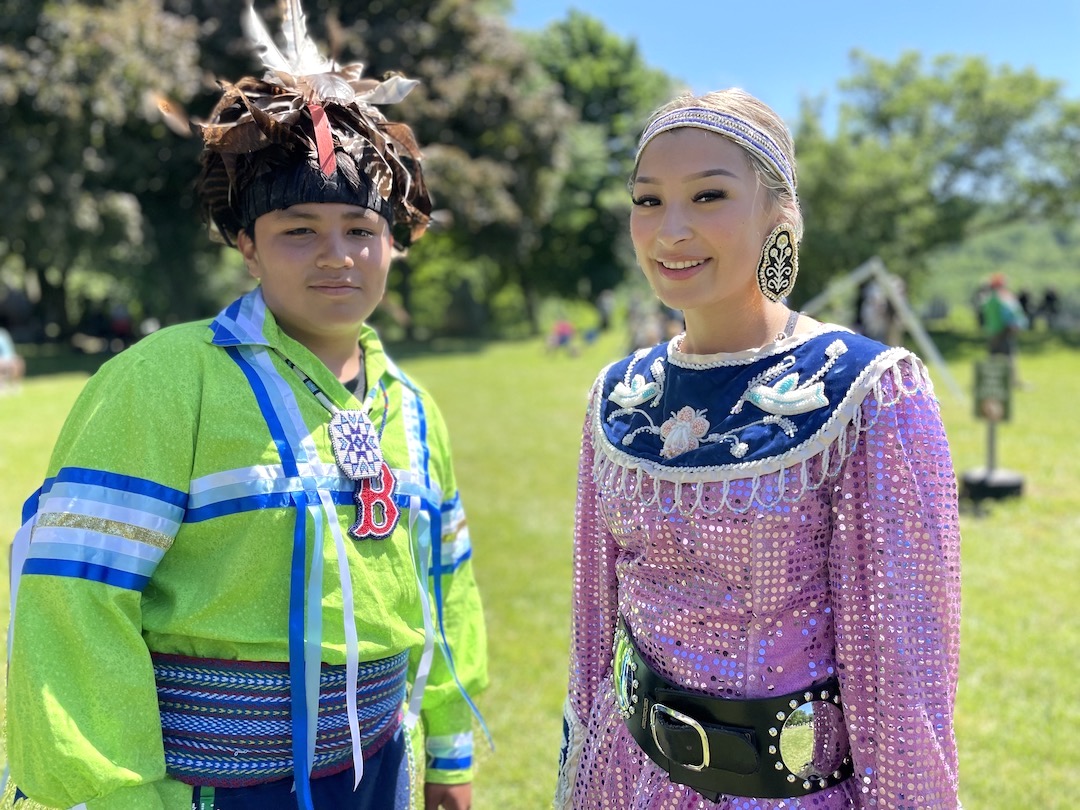
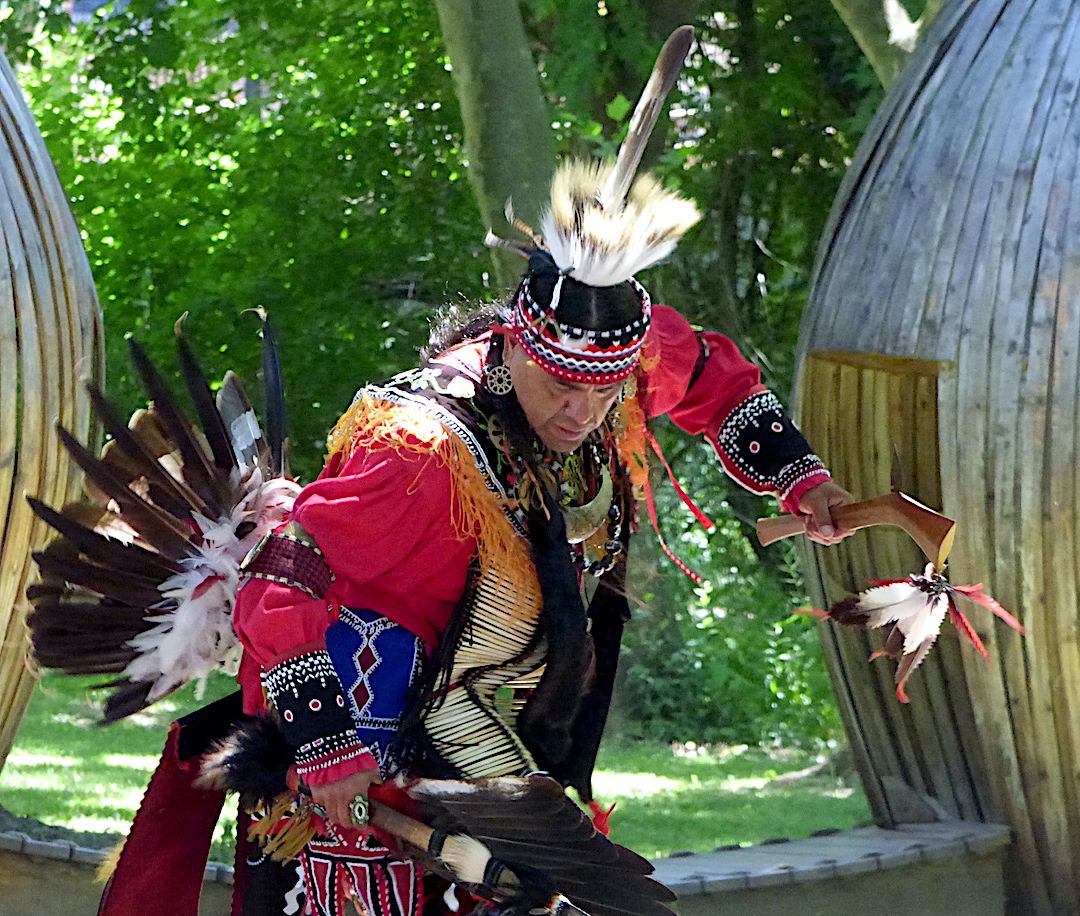
Images from the 2022 Strawberry Moon Festival at Artpark in Lewiston.

Third Coast Percussion (Photo by Rich Polk // provided by Artpark & Company)

••••••••

Q: We’ve spoken about the various initiatives Artpark is taking to give back to the community – and even to use the word you mentioned, “risk,” as far as some of the programming and events Artpark is undertaking to benefit the community. How can that community – how can patrons – give back to Artpark?

Sonia Kozlova Clark: Thank you for that question. For us, the most important thing you can do is to come. Bring your friends. Bring your children. Bring your parents. Come, come, come. Come to anything you don’t know yet. Come to things you have been too many times and love. Come, be here. Be with us. That’s No. 1.

And, of course, we’re a nonprofit organization. We are a self-sustaining organization. We do work in partnership with New York State Parks, who maintain the facilities; but our park operates with only less than 5% of state funding. The rest is raised by our own team led by our very powerful and dedicated board of directors, through various funding opportunities. And the foundation for these resources is in the individual giving, so every small gift brings a compounded effect.

Our individual donor drive is always on and you can make a difference today by going to artpark.net; there’s a button at the top of the menu that says, “Donate Now & Support.” Any gift is good enough – $5, $20, $5,000 – we will honor it, and use it appropriately, and it will move us forward, and make our programming available to the whole community in the long term.

•For more information on Artpark & Company programming, visit www.artpark.net. Tickets are available online at www.ticketmaster.com.

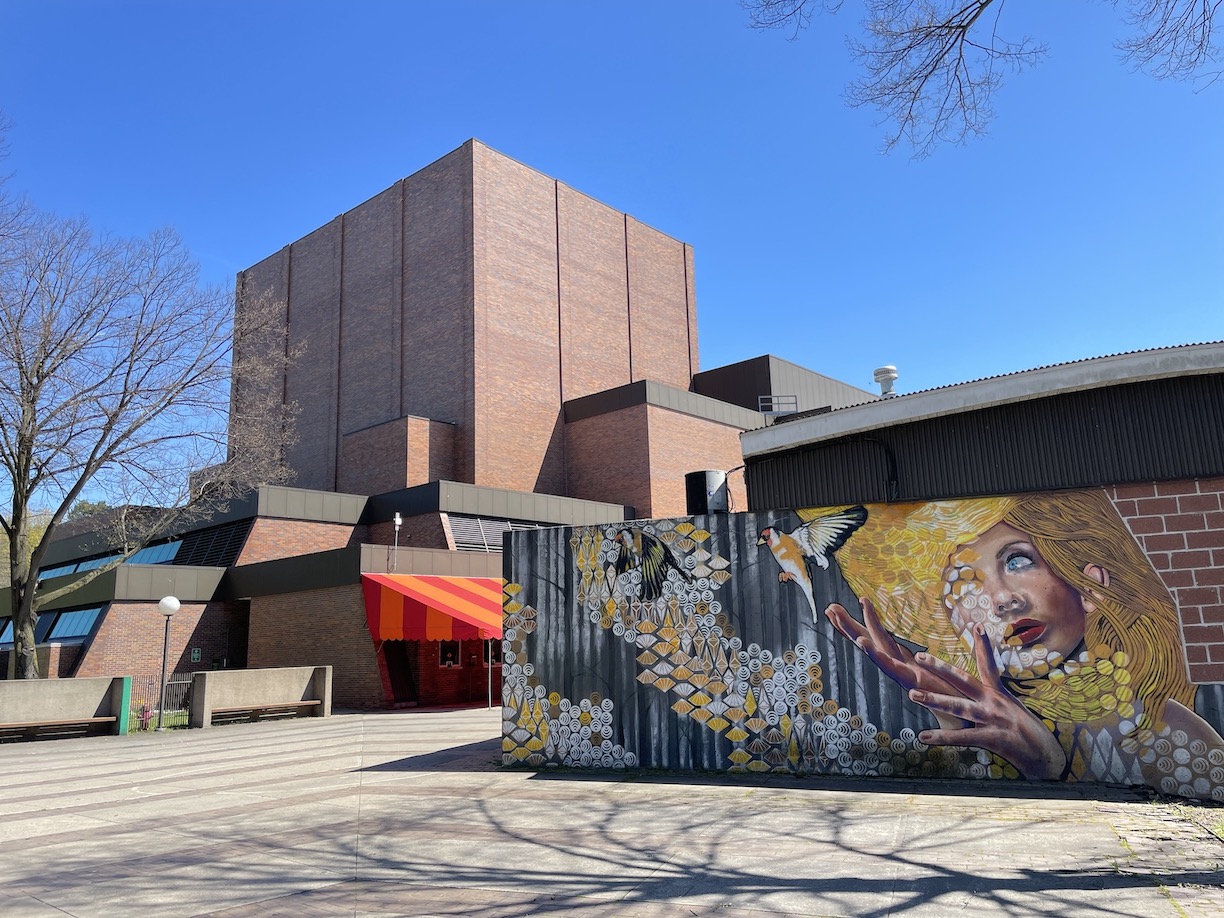
Artpark’s front outdoor lobby area and ticketing courtyard

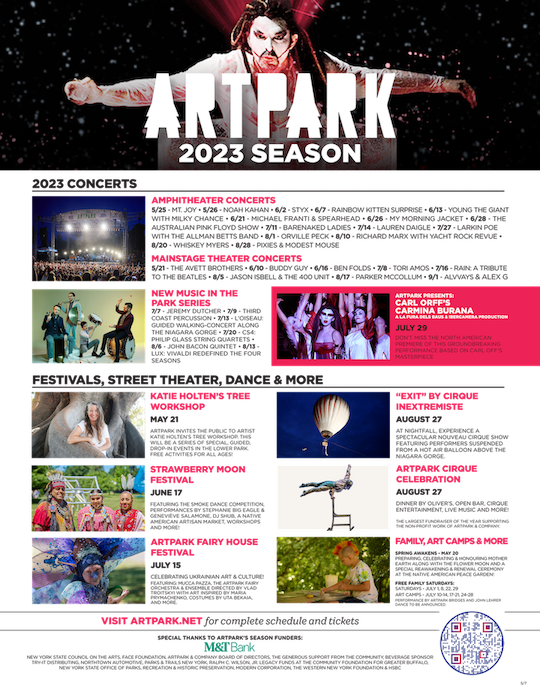
Click to download the Artpark & Company schedule (PDF)