Native

Cleve Carney Museum of Art’s Andy Warhol exhibition among the summer’s most anticipated cultural events

Cleve Carney Museum of Art’s Andy Warhol exhibition among the summer’s most anticipated cultural events

Among the suburbs’ most anticipated cultural events this summer is the Cleve Carney Museum of Art exhibition “Andy Warhol Portfolios: A Life in Pop/Works from the Bank of America Collection” opening Saturday, June 3, at the McAninch Arts Center.

Exclusive to the Cleve Carney Museum of Art, “Andy Warhol Portfolios” consists of 200 Warhol works, 94 of them from the Bank of America collection, along with 150 Warhol photographs and original works from the museum’s permanent collection. The exhibition, which comes on the heels of CCMA’s 2021 blockbuster “Frida Kahlo: Timeless,” also includes “Andy Warhol: Silver Clouds,” an interactive installation consisting of oversize, metallic balloons on loan from The Andy Warhol Museum in Pittsburgh.

The combination of Warhol works, an historical exhibit highlighting parts of his life, a kids’ pop art print factory, a Studio 54 experience and a Central Park-inspired outdoor area along with concerts, a workshop and free lectures, makes for an accessible, “multifaceted experience that tells the story of Warhol,” said CCMA curator Justin Witte.

While many CCMA visitors will gravitate toward the iconic pieces inspired by Marilyn Monroe and Campbell’s Soup, Witte encourages them to take in his favorite works, the sunset series.

“Andy was a talented colorist. His use and understanding of color is fantastic and comes through in all of his work,” especially that series, Witte said.

“They’re incredibly beautiful, subtle and skilled pieces,” said Witte, who predicts “Silver Clouds” will be a favorite among visitors.


Andy Warhol’s “Campbell’s Soup II: New England Clam Chowder (1969)” is among the works on display at Glen Ellyn’s Cleve Carney Museum of Art this summer.
– Courtesy of The Andy Warhol Foundation for the Visual Arts, Inc.

“It’s dynamic, beautiful and interactive,” he said. “It’s also very fun. And it’s accessible.”

The photographs from the CCMA collection offer a deeper understand of the artist in that they illuminate Warhol’s inner life, Witte said.

“The photos we have highlight his process of doing portraits and making silk-screens,” he said. “It gives us a peek into his everyday life. You get a sense of Andy the person.”

“Andy Warhol Portfolios” runs through Sept. 10 at the CCMA, McAninch Arts Center, College of DuPage, 425 Fawell Blvd., Glen Ellyn. Tickets range from $25-$40 and are available at (630) 942-4000 or warhol2023.org.


The Warhol exhibition may be among the biggest suburban events this summer, but it’s not the only one. Here are noteworthy exhibitions running at suburban and city venues.

Suburban exhibitions

“65 Years”: May 29 through Nov. 11 at the First Division Museum, Cantigny Park, 1S151 Winfield Road, Wheaton. A nod to Cantigny’s 65th anniversary this year, the exhibition consists of more than 465 artifacts, some of which have never been displayed. Reflecting the mundane and the momentous, the items highlight soldiers’ everyday lives as well as their honors including medals, patches and flags. (630) 668-5161 or cantigny.org.

Elmhurst Art Museum debuts “Marvelocity: The Art of Alex Ross” showcasing artist/illustrator Alex Ross who, over his 30 years, has revitalized such characters as Spiderman, Captain America, Black Panther and Storm from the X-Men.
– Courtesy of Alex Ross

• “Marvelocity: The Art of Alex Ross”: June 3 through Aug. 20 at the Elmhurst Art Museum, 150 Cottage Hill Ave., Elmhurst. The exhibition includes more than 50 works by the acclaimed illustrator, who has translated images of The Avengers, Captain America, Spider Man, Black Panther and the X-Men’s Storm into fine art. It chronicles Ross’ evolution through childhood drawings to sketches to paintings to his three-dimensional busts of Marvel Universe characters. (630) 834-0202 or elmhurstartmuseum.org.

Storm, of the X-Men, is among the superheroes included in Elmhurst Art Museum’s “Marvelocity: The Art of Alex Ross.”
– Courtesy of Alex Ross

• “No Rest: The Epidemic of Stolen Indigenous Women, Girls, and 2Spirits”: Through September at the Mitchell Museum of the American Indian, 3001 Central St., Evanston. Twelve Indigenous artists contributed 35 works to this exhibition, which highlights crimes committed against Native American women and members of the Native American LGBTQIA community. According to federal sources, urban, rural and reservation-based Native communities experience the nation’s highest violent crime rates including domestic and sexual violence. (847) 475-1030 or mitchellmuseum.org.

Children playing among the wreckage of D-Day Invasion, Omaha Beach, Normandy, France, in 1947 is among the photographs on display as part of the Illinois Holocaust Museum’s “Chim: Between Devastation and Resurrection” showcasing works by the famed photographer who was born Dawid Szymin and published under the name David Seymour.
– Courtesy of The International Center of Photography

• “Chim: Between Devastation and Resurrection”: Through Feb. 4, 2024, at the Illinois Holocaust Museum and Education Center, 9603 Woods Drive, Skokie. This photography exhibition showcases the work of the 20th-century photographer who was born Dawid Szymin in 1911 and published under the name David Seymour. An astute observer of 20th-century European politics, social life and culture, he covered the struggle against fascism and the rebuilding of countries ravaged by World War II, including the struggle for workers’ rights. The exhibition’s more than 50 photographs highlight postwar reconstruction of Europe, elections, the effect of the war on children and the birth of the new state of Israel. (847) 967-4800 or ilholocaustmuseum.org.

“Stillness in Motion” is among the large-scale sculptures by artist Olga Ziemska included in the Morton Arboretum’s “Of the Earth” exhibition.
– Courtesy of Olga Ziemska

• “Of the Earth”: Through spring 2025 at the Morton Arboretum, 4100 Illinois Route 53, Lisle. This installation showcasing works by Polish American artist Olga Ziemska includes five, large-scale sculptures “created from reclaimed tree branches and other natural materials gathered from various locations throughout the arboretum’s 1,700 acres.” It examines Ziemska’s “we are nature” philosophy designed to remind people that the same basic elements form everything in nature, including ourselves. (630) 968-0074 or mortonarb.org.

“Titanic: A Tribute to the Tragedy”: Ongoing at the Volo Auto Museum, 27582 Volo Village Road, Volo. The exhibition recounts the maritime tragedy of April 14, 1912, when the luxury ocean liner struck an iceberg and sank nearly three hours later. It includes tributes to the ship’s artifacts including a collection of Titanic-era automobiles, a 1910 Steinway grand piano like the one onboard and some personal effects of ship band leader Wallace Hartley. (815) 390-4853 or volocars.com.

The National Museum of Mexican Art presents “Nuestras Historias: Stories of Mexican Identity,” an exhibition showcasing the Chicago museum’s permanent collection.
– Courtesy of Michael Tropea

Chicago exhibitions

“Nuestras Historias: Stories of Mexican Identity From the Permanent Collection”: Ongoing at The National Museum of Mexican Art, 1852 W. 19th St., Chicago. The exhibition highlights works from the museum’s permanent collection, which showcase the stories of Mexican identity in North America through ancient Mesoamerican and colonial artifacts, modern Mexican art and folk art from both sides of the U.S.-Mexico border. nationalmuseumofmexicanart.org.

Rodolfo Morales’ 1990 painting “Mystical Woman/Mujer Mística” is among the works included in the National Museum of Mexican Art’s current exhibition “Nuestras Historias: Stories of Mexican Identity From the Permanent Collection.”
– Courtesy of the National Museum of Mexican Art

• “Gary Simmons: Public Enemy”: June 13-Oct. 1 at The Museum of Contemporary Art Chicago, 220 E. Chicago Ave., Chicago. MCA’s exhibition marks the first career retrospective of the multidisciplinary artist whose work is rooted in examinations of race, class and gender as depicted in America’s visual culture. (312) 397-4010 or mcachicago.org.

“Diaspora Stories: Selections From the CCH Pounder Collection”: Through July 16 at The DuSable Black History Museum and Education Center, 740 E. 56th Place, Chicago. This exhibition features paintings from the collection of Emmy Award-nominated CCH Pounder (“NCIS: New Orleans,” “Avatar,” “The Shield”). An avid art collector for more than 40 years, Pounder’s collection numbers more than 500 works including Kehinde Wiley, Robert Pruitt, Ebony G. Patterson, Mickalene Thomas, Betye Saar and Geoffrey Holder, among others. The exhibition consists of 24 works by artists from Cuba, Senegal, South Africa, Martinique, Cameroon, Trinidad, Jamaica, Cape Verde and the U.S. in a capsule collection that showcases contemporary art’s current Black Renaissance. (773) 947-0600 or dusablemuseum.org.

“Kwame Brathwaite: Things Well Worth Waiting For”: Through July 24 at The Art Institute of Chicago, 111 S. Michigan Ave., Chicago. Inspired by music, Kwame Brathwaite picked up a camera in 1956 intending to document the “Black is Beautiful” movement. Over the course of his career, Brathwaite documented the lives of Black people — ordinary citizens and celebrities — alongside the civil rights and Black Power movements. This exhibition focuses on the photographer’s passion for music. Also at The Art Institute, “Van Gogh and the Avant-garde: The Modern Landscape” features 25 of the artist’s paintings along with works by his fellow pioneers Georges Seurat, Paul Signac, Emile Bernard and Charles Angrand, whose vivid colors and brush strokes reflected novel painting techniques. The exhibition runs through Sept. 4. artic.edu.

“Pompei: The Exhibition,” which includes replica body casts representing the disaster’s human toll, runs through Sept. 4 at Chicago’s Museum of Science and Industry.
– Courtesy of Museum of Science and Industry, Chicago

• “Pompei: The Exhibition”: Through Sept. 4 at The Museum of Science and Industry, 5700 S. DuSable Lake Shore Drive, Chicago. “Pompei” offers visitors a glimpse into what life was like in ancient Rome through more than 150 artifacts — including sculptures, armor, jewelry and coins — and immersive, multimedia experiences. Holographic displays include a simulation of Mount Vesuvius’ eruption and a gladiator competition. msichicago.org.

“First Kings of Europe”: Through Jan. 28, 2024, at The Field Museum, 1400 S. Lake Shore Drive, Chicago. The Varna treasure, consisting of human-made gold objects from 6,000 years ago; Bronze Age swords and armor; and a Thracian prince’s gold crown are among the 700 objects included in this exhibition. Twenty-six museums in 11 European countries contributed prehistoric tools, weapons and sculptures that reveal life within these early societies and chronicle how warriors evolved into kings. (312) 922-9410 or fieldmuseum.org.

Immersive exhibitions

“Immersive Van Gogh” returns to the Lighthouse ArtSpace to run in conjunction with “Mozart Immersive: The Soul of a Genius.”
– Courtesy of Michael Brosilow

• “Immersive Van Gogh,” a digital exhibition consisting of Vincent Van Gogh’s masterworks, runs in repertory with “Mozart Immersive: The Soul of a Genius” at the Lighthouse Artspace at the Germania Club, 108 W. Germania Place, Chicago. The Mozart exhibition chronicles the composer’s life using some of his most famous compositions accompanied by recorded video that includes dancer/actor Mikhail Gorbachev and his father, Leopold. mozartimmersive.com.

Summer preview: The comprehensive guide to Artpark & Company’s 2023 season

Summer preview: The comprehensive guide to Artpark & Company’s 2023 season

Fri, May 19th 2023 10:00 am

Artpark’s anniversary celebration begins with international performers, Indigenous artists, rising musical stars

√ Interview with President Sonia Kozlova Clark

By Joshua Maloni

GM/Managing Editor

Artpark & Company’s focus for this summer – its 50th season – centers on five key words: spectacle, drama, Indigenous & global influences.

Indeed, arts and culture will take center stage this year, as the award-winning venue will host educational and entertaining events across the Lewiston state park’s 150-acre campus.

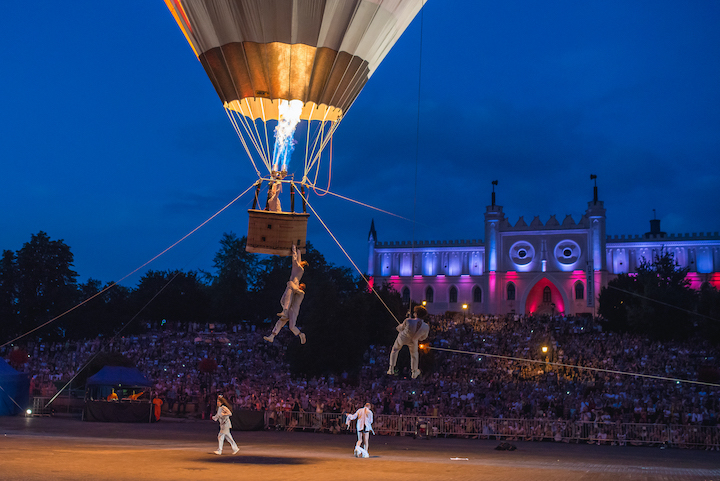
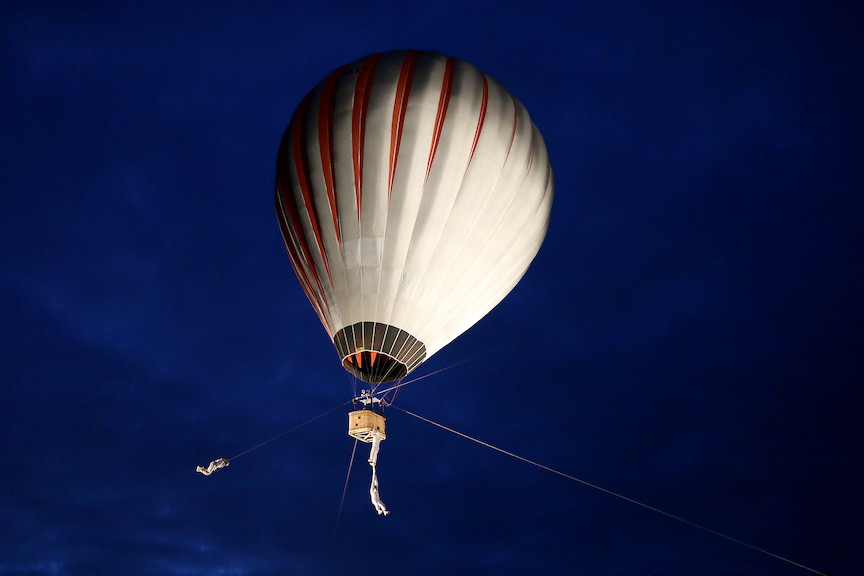
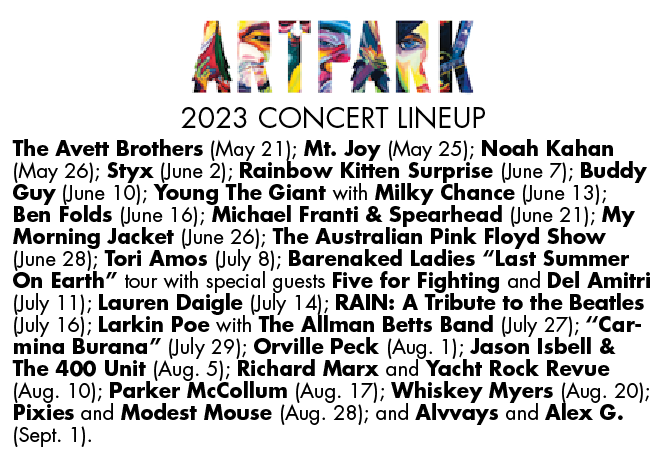
Organizers shared, “Hotly anticipated events this summer include the North American premiere of the spectacular production of ‘Carmina Burana’ by Spain’s La Fura dels Baus; a hot air balloon escape act by the French Cirque Inextremiste and a ‘Cirque Celebration’ fundraiser directed by Sxip Shirey; guitar legend Buddy Guy’s farewell tour; the 13th annual Artpark Fairy House Festival, this year adding a celebration of the culture of Ukraine under the creative collaboration of Kyiv’s theater director Vlad Troitskyi and Tbilisi’s designer Uta Bekaia; concert attractions like Ben Folds and double-headers like Pixies with Modest Mouse; rising music artists like Noah Kahan, Orville Peck and Larkin Poe; and the Artpark Strawberry Moon Festival, celebrating Indigenous cultures of the Buffalo-Niagara Region. …

“Artpark has already announced more than 30 performances and concerts, two festivals, several art installations, six international creative residencies, art camps, and even the launch of Artpark’s ‘Art Ale’ in partnership with Resurgence Brewing Co.”

President Sonia Kozlova Clark previewed the new season in a recent Q&A. This is part one of her interview.

Artpark & Company President Sonia Kozlova Clark (Photo by dellas, traffic east)

••••••••

Q: I would say Artpark probably fared better than most over the pandemic – the site remained open, you came up with creative new programming, and received several grants and awards. You had crowds in thick and thin. What have you learned about your audience in recent years, and how do you best serve them in 2023?

Sonia Kozlova Clark: That’s a very good question – and it is complicated because our audiences are changing – and they are changing more rapidly since COVID.

To define what is our audience today versus what it was three years ago, I would say that, during COVID, we were able to think about our strengths, our unique features, and also our future with support from federal and state funding sources and the local community. We were able to strengthen our partnerships with presenters like Live Nation, AEG Live, Funtime; grow our artistic and management team; and with that take some risks. What we learned in the process of trying some new bands and recalibrating some of our event structures and expectations, is that there’s a tremendous new audience for Artpark, both locally, which includes Lewiston, Buffalo, the rest of Western New York, and as far as Canada, as Canadians are starting to come back.

We learned that our audiences are, indeed, interested in the great diversity of music and other programs. They represent different demographics, segments or pockets of the population that we can serve in very different ways.

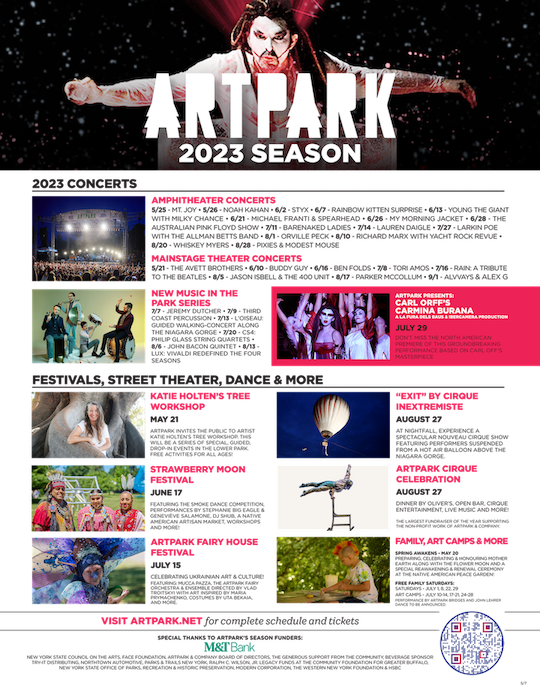
Artpark itself occupies a vast territory, and its 150 acres offers some very interesting opportunities for engagement. We have several stages: the well-known Artpark Amphitheater with a large capacity of up to 10,000 people. We also have the Artpark Mainstage Theater, which is the enclosed theater with an open lawn with which Artpark opened in 1974.

We also have the intimate Emerald Grove stage, named after the installation by Jesse Walp that surrounds it. This chamber stage has a garden-like setting and has become the primary setting for the fast-growing “New Music in the Park Series” where the informal atmosphere gives our audiences permission to experience something very new to them.

We also have been using the grounds of Artpark, rich with performance and festival opportunities. Both our Strawberry Moon Festival celebrating the local Indigenous cultures and the Fairy House Festival this year focusing on the art of Ukraine mixed with the local fairy house creations in the woods will take advantage of the wonderful nature of the lower park.

The Cirque Inextremiste performance calling for a large outdoor area for the hot air balloon hoisting acrobats up in the air will take place on the upper parking lot B. One of the “New Music in the Park” concerts – “L’ouiseau,” curated by now local conductor Brett Chancellor – will take our audience on a walking music tour on the stunning Niagara Gorge to explore the work of contemporary composers Kaija Saariaho, Iannis Xenakis, Brent Chancellor and Messiaen with dance and Native American spoken word.

We will have on-stage performances of music by Philip Glass and Vivaldi and take advantage of the natural acoustic dome of the Emerald Grove with Third Coast Percussion.

And, of course, the massive theatrical production of “Carmina Burana” by La Fura dels Baus with Buffalo Philharmonic, Buffalo Philharmonic Chorus conducted by Gil Rose, and 200-plus performers will take place on our exceptional, one-of-a-kind opera stage.

Image: Carnaval Sztukmistrzów // Lublin // Exit fot. Natalia Wierzbicka

Cirque Inextremiste (Photo provided by Artpark & Company)

••••••••

Q: I think, certainly, diversity in programming is something that you’ve been very successful at over the years.

The previous administration, out of necessity – then I would say popularity and practicality – focused on outdoor concerts. There was no indication the cultural programming you’ve initiated would become as well-received as it is today. What led you to believe those programs were possible – and that they could work at Artpark?

Sonia Kozlova Clark: When I first came to Artpark, what I saw was, again, this vibrant palette of opportunities for presentation. I have produced very different types of arts and events in the past, and I could see how Artpark is unique from any other venues I had worked with.

Artpark as a place of nature and as a community presents almost limitless ways to explore the different types of performance, theater, music, Cirque, street theater, or art in public spaces. Also, of course, visual arts is a tremendous legacy and opportunity for Artpark, which we are strategically rebuilding. We are approaching these opportunities in phases and by layering one new discipline at a time.

The opportunities come from the site itself – its history, also its legacy, and, very importantly, from the people around us. It’s the Buffalo community, so fond of innovative music and theater; the Lewiston community, so rich with people who know their history and the memories of coming to Artpark to experience the various types of performances. It’s also the Indigenous people who were here long before any others.

Our understanding of what is diversity, specifically, at Artpark is also a very interesting subject. We often times talk with our board, funders, artistic partners and curators about how to make our organization more diverse, and how to make our audience more diverse. Oftentimes, the fallback is to say, “Well, Lewiston is a pretty homogenous society.” Initially, I thought, the local diversity was economic and maybe educational. But soon I have discovered the incredible depth and richness of the Haudenosaunee and their predecessors, thank you to Eva (Nicklas) and Irene (Rykaszewski) from the Lewiston Art Council, and Michele-Elise Burnett, who I’ve met through our board member Seymour Knox IV.

With their help, some reading, and the stories told by Neil Patterson Sr. of the Tuscarora Nation, or Peter Jamison of the Seneca Nation, and many others, I learned that the Haudenosaunee Nations are in themselves very diverse, but also so present here. Their presence here is not always the most obvious, as we see them through the limited focus of shared festivals or events, but the reality is so much richer.

Through the work of Michele-Elise, Artpark’s Indigenous arts producer and staff member, our relationship has been flourishing now for a number of years, starting with the Artpark Strawberry Moon Festival and expanding now to a summer-long program focused on Indigenous ways of knowing. I am grateful to Kehala and Jordan Smith and all the scholars and artists helping us build a more close-knit relationship, which sometimes feels like family.

The success of attracting an audience is through seeing your community, all its fine tones and different shades of cultural and economic differences, social and even political views. And for us at Artpark, there is such an interesting palette to work with here.

Another path for success is in programming strategy. Layering the new over time, mixing it with the familiar. When you bring something new, the recognition doesn’t happen all at once. You have to adjust the strategy for each particular kind of art and audience. It’s not one-size-fits-all.

Cirque Inextremiste (Photo provided by Artpark & Company)

••••••••

Q: Of course, we know concerts are still a very big draw. What can you tell me, looking at this year’s lineup, that stands out to you – or that people should be excited about or even curious about, with regard to the bands and the acts you’ve booked?

Sonia Kozlova Clark: As you said, it’s a very diverse lineup, and addresses different types of audiences.

I am, as always, excited about Barenaked Ladies, which now has become a staple event in Western New York. They are more popular here in Western New York, or at Artpark, than practically anywhere else. It’s just a very special relationship that we have developed over time between our community and the band. So, for that alone, it’s absolutely a special to Artpark event, and all of us always look forward to it.

I think, of course, Styx on June 2, is something that so many of us are looking forward to, as well. They’ve been to Artpark now a number of times, and this year it seems bigger than ever.

We rarely ever start that early, but this year our first concert is May 21, with the Avett Brothers. Again, a great band. They’ve been to Artpark twice before. So great to see them back, and it looks like it is going to be a packed house. And it’s great to see the audiences coming back, and then some.

Buddy Guy is an iconic figure in music. It’s his last – or self-proclaimed last – tour. We’ll see. I hope he changes his mind. He will definitely be a highlight, for me personally, and I’m sure for many in the community.

I think Larkin Poe is a fantastic duo that I think everybody should discover, if they haven’t yet – with the Allman Betts Band. Together, it’s a great pairing.

One of my favorite musicians is Ben Folds. To me, it’s definitely a highlight. I’ve followed his career from the very early days, and I’m so glad to see him back with us.

Pixies and Modest Mouse will close our amphitheater season, and what a great, incredible pairing that is. I’m definitely looking forward to that. I was doing the happy dance when we confirmed that particular concert.

And then we have not one but two North American premiers: Carl Orff’s “Carmina Burana,” in a spectacular production by La Fura dels Baus with Buffalo Philharmonic Orchestra, Buffalo Philharmonic Chorus, conducted by Gil Rose. It’s a modern spectacle. It’s a very edgy spectacle based on a medieval collection of poems and songs written in Latin and Middle High German. The texts cover a wide range of themes, such as drinking, gambling, love and the fickleness of fortune.

The poems were discovered in a Bavarian monastery in the 19th century and later set to music by composer Carl Orff in the 1930s. Musically it is extraordinary, recognizable and powerful. I call it the “Heavy Metal of the ’30s.” Its main song, “O Fortuna!,” was recorded and remixed in so many different styles. The Trans-Siberian Orchestra has done a track; in addition to all the classical interpretations, of course. It runs the whole gamut. There’s hardly a human being on this planet that doesn’t know this tune.

The production is by a renowned company in Spain – La Fura dels Baus – who I have been in conversations with over a number of years now – their focus is on opera as a spectacle, oftentimes outdoors with immersive video, flying acts and spectacular stage effects. They’ve been in the United States a number of times. The last time they were at the Mostly Modern Festival at Lincoln Center with a production of Haydn in 2018.

Their Carmina production has toured around the world for over 10 years, but it’s never been in North America. And I’m very excited to be able to present this just at Artpark, just for us, just because we can, and just because it makes sense for us.

We are also fortunate to be working with the visionary conductor Gil Rose with whom we are building a long-term plan for reintroducing opera to Artpark, and, as always, with our friends at the Buffalo Philharmonic Orchestra and the Buffalo Philharmonic Chorus, also the Tanzen Dance and other local performers.

And the second North American premiere at Artpark will be with Cirque Inextremiste on Aug. 27, which we are bringing in partnership with University of Arizona and Rochester Fringe Festival. This French group are completely unique and out of their own kind, they define themselves as “sweet lunatics trapped in spite of themselves in a life-size epic” in one of the wildest shows you will ever see, called “EXIT.”

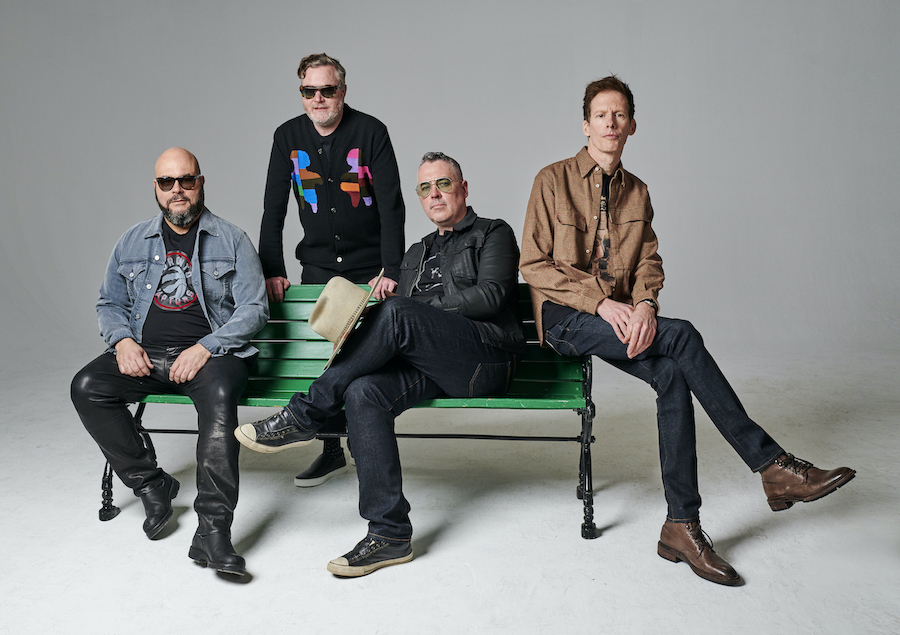
Barenaked Ladies (Photo by Matt Barnes // provided by Artpark & Company)

••••••••

Q: It’s a big anniversary season. How will that milestone be recognized this summer?

Sonia Kozlova Clark: We plan to celebrate by the continuous growth of Artpark as an institution and exploration of its potential while also recognizing its legacy. We have programs that highlight our Haudenosaunee people through Strawberry Moon Festival and summer-long Indigenous programs. We are restarting the opera program, once so prominent at Artpark, and so well known in this country. We are bringing new voices and international productions, which are impactful not only for our own audience, but for the artists themselves. Through these international collaborations and national partnerships, Artpark’s name is now present in the professional discourse around the world.

I was recently at Carnegie Hall, at a concert, and a number of people I ran into from New York City ran up to me with their memories of Artpark as an opera hub back in the 1980s. It’s still in the memories of people far away from here. So, being able to reinstate this program with a tremendous conductor – we call him a conductor in residence and also a curator of opera – Gil Rose – I think that’s a very momentous kind of occasion.

Being able to produce a series of “New Music” concerts, that’s very much, again, an homage to something that was celebrated and developed at Artpark. It’s what we call “New Music.” Something that was started by Creative Associates in Buffalo, and very much developed in Artpark, as well, and really translated to the very fabric of this cultural organization, and to see it carried forward with the musicians of today. Jeremy Dutcher, Third Coast Percussion – these are very well-known new musicians working, and experimenting with the types of music that are both very new to us today, but also date back to the traditions that were first honed in the 1970s – just when Artpark was established.

So, there are all these kinds of overtones of going back and also moving forward, all at the same time – and building a brand-new program we have not had in the past, is Cirque. So, we’ve done smaller productions as a part of our Fairy House Festival and other special events: Cirque Orange from Hamilton, Cirque Barcode from Montreal, Giraffe Royal from Estonia and others over the past six years.

They all represent the artform known as Cirque Nouveau mixed with street theater, as we’ll call it. It is a fast-emerging popular form of performance, normally not involving a tent nor animals, not necessarily with the kind of acrobatics and clowns that everybody expects from the past – the red nose kind of act. In this new type of cirque, the acrobats and clowns are also actors – they act within the parameters of dramaturgy. They tell stories. It’s half circus, half theater.

And this year, we’re bringing this French production called “Exit” by a circus company called Cirque Inextremiste. Again, it’s quite a feat. It’s a big risk – on many levels. We’re doing it in partnership with two other presenters in North America: the University of Arizona and the Rochester Fringe Festival. We could not do this alone.

But again, it signals the beginning of something new and pretty large-scale going forward.

The Artpark opportunities are tremendous – and the 50th season brings it all together.

I’ll also mention that, next year, we’ll be celebrating our 50th anniversary. So, prepare to party for the next two years.

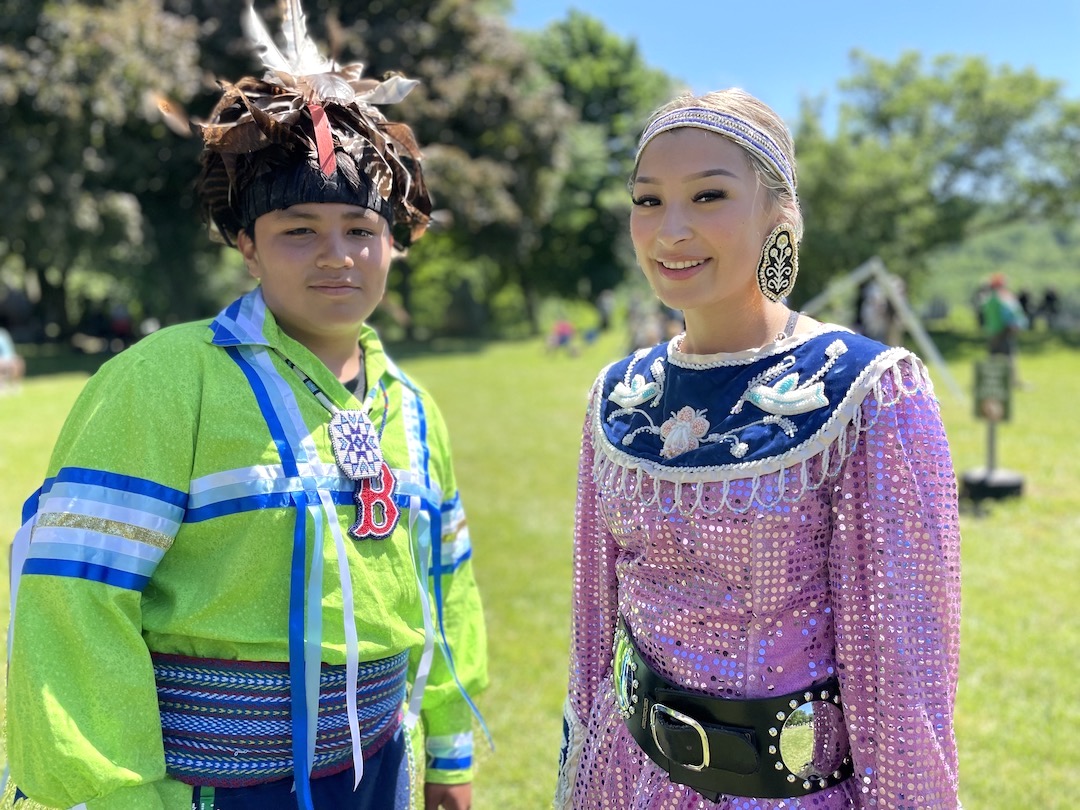
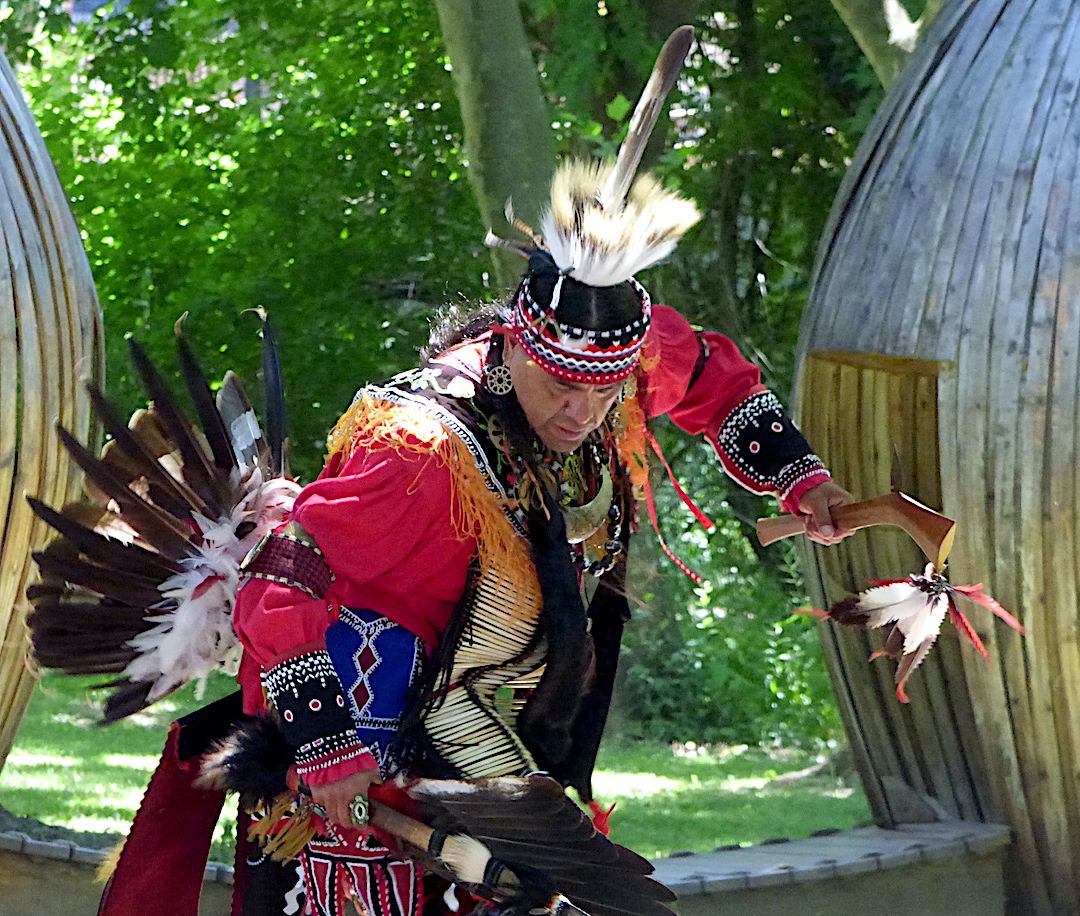
Images from the 2022 Strawberry Moon Festival at Artpark in Lewiston.

Third Coast Percussion (Photo by Rich Polk // provided by Artpark & Company)

••••••••

Q: We’ve spoken about the various initiatives Artpark is taking to give back to the community – and even to use the word you mentioned, “risk,” as far as some of the programming and events Artpark is undertaking to benefit the community. How can that community – how can patrons – give back to Artpark?

Sonia Kozlova Clark: Thank you for that question. For us, the most important thing you can do is to come. Bring your friends. Bring your children. Bring your parents. Come, come, come. Come to anything you don’t know yet. Come to things you have been too many times and love. Come, be here. Be with us. That’s No. 1.

And, of course, we’re a nonprofit organization. We are a self-sustaining organization. We do work in partnership with New York State Parks, who maintain the facilities; but our park operates with only less than 5% of state funding. The rest is raised by our own team led by our very powerful and dedicated board of directors, through various funding opportunities. And the foundation for these resources is in the individual giving, so every small gift brings a compounded effect.

Our individual donor drive is always on and you can make a difference today by going to artpark.net; there’s a button at the top of the menu that says, “Donate Now & Support.” Any gift is good enough – $5, $20, $5,000 – we will honor it, and use it appropriately, and it will move us forward, and make our programming available to the whole community in the long term.

•For more information on Artpark & Company programming, visit www.artpark.net. Tickets are available online at www.ticketmaster.com.

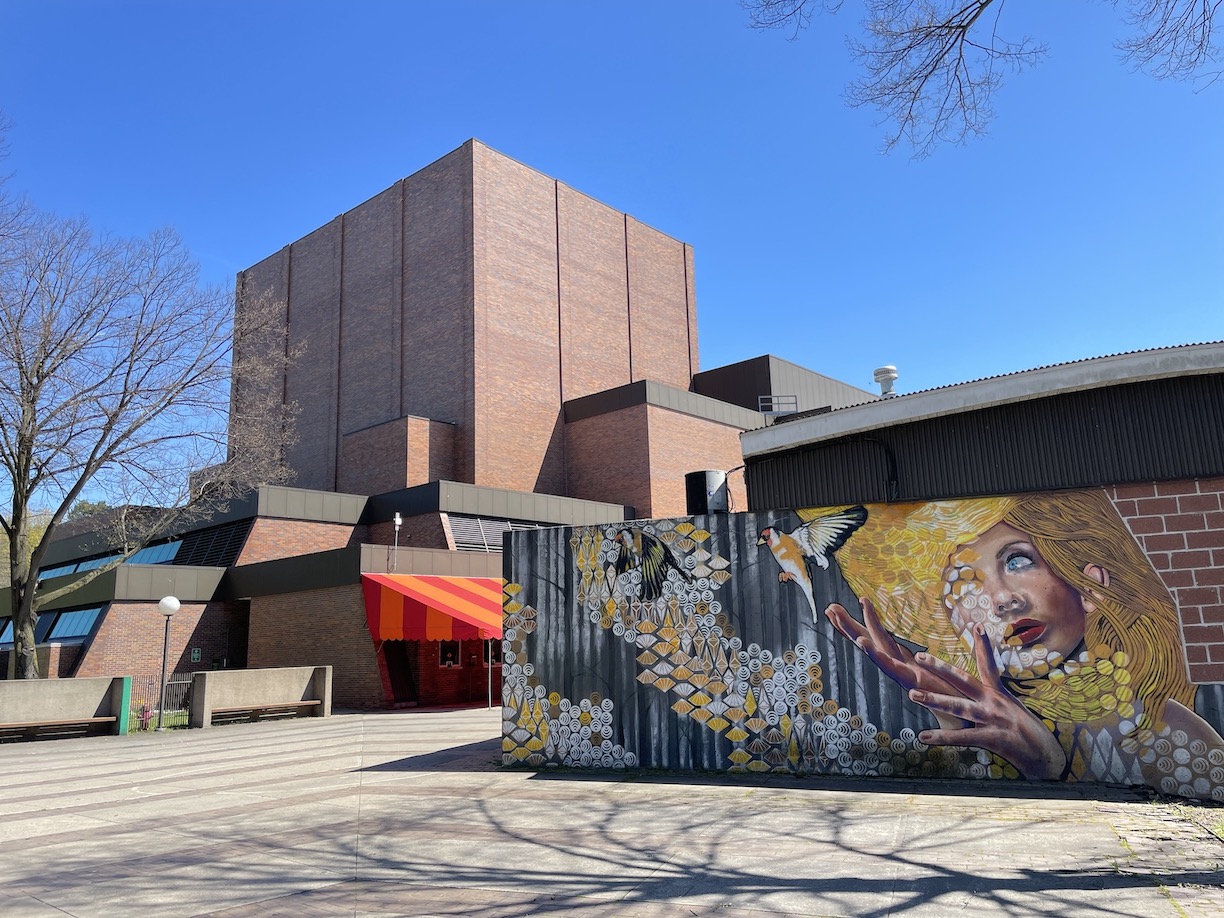
Artpark’s front outdoor lobby area and ticketing courtyard

Click to download the Artpark & Company schedule (PDF)

First Major Retrospective for Artist Robert Houle To Go on View at

First Major Retrospective for Artist Robert Houle To Go on View at

The Smithsonian’s National Museum of the American Indian in Washington, D.C., will open “Robert Houle: Red is Beautiful” May 25. It is the first major retrospective of Robert Houle’s (Saulteaux Anishinaabe, Sandy Bay First Nation, b. 1947) work and covers more than 50 years of his career. The exhibition, which is organized by the Art Gallery of Ontario and curated by Wanda Nanibush (Anishinaabe-kwe, Beausoleil First Nation), will be on view until June 2, 2024.

A colorist primarily working in oil, Houle’s work has brought his Indigenous cultural heritage together with Euro-American ways of making and thinking about art, a result he calls “transcultural.” The exhibition includes large installations, paintings, video, mixed-media sculpture and drawings created between 1970 and 2021.

The exhibition is divided into themes that more deeply explore Houle’s work at various points in his career. These include “Beyond History Painting,” which sees Houle inserting an Indigenous perspective into historic events, and “Sacred Geometry,” where the artist’s work fuses modernist painting and ancestral design to create powerful expressions of emotion. In “Residential School Years,” Houle explores his childhood memories of the trauma he experienced while at Sandy Bay Residential School. Other themes examine tribal sovereignty and its defense and the spiritual legacy of the Anishinaabe people.

Some of the works featured in the exhibition are “Red is Beautiful” (1970), the piece for which the exhibition is named; “Kanata” (1992), a reimagining of Benjamin West’s famed painting “The Death of General Wolfe”; “Parfleches for the Last Supper” (1983), a group of 13 acrylic paintings representing Jesus and his apostles; and “The Pines” (2002 to 2004), which was created in support of the Kanien’kehá:ka (Mohawk) defense of Kanehsatake, their tribal territories near Montreal.

“Robert Houle: Red is Beautiful” is organized by the Art Gallery of Ontario. Support is provided by the Canada Council for the Arts and Ameriprise Financial.

Media Preview

The National Museum of the American Indian will hold a media preview Tuesday, May 23, from 9 to 11 a.m. Members of the media wishing to attend need to RSVP to nmaipressoffice@si.edu.

“Robert Houle: Red is Beautiful” Artists’ Conversation

The museum will host an artists’ conversation Saturday, June 3, at 11 a.m. featuring Houle,  Kay WalkingStick (Cherokee Nation, b. 1935) and Nanibush, the exhibition’s curator. The panel will be moderated by David Penney, the National Museum of the American Indian’s associate director for museum research, scholarship and public engagement.

Catalog

The exhibition is accompanied by the fully illustrated hardcover catalog “Robert Houle: Red is Beautiful.” It features essays by Houle’s niece Ala Goodwill, Gerald Vizenor, Mark Cheetham, Michael Bell, Jessica Horton and Nanibush, as well as intimate recollections and tributes from fellow artists WalkingStick, Duke Redbird, Jamelie Hassan, Ron Benner and Faye HeavyShield and curators Penney and Stephen Borys. The catalog is co-published by the Art Gallery of Ontario and DelMonico Books/D.A.P. 

About the National Museum of the American Indian

In partnership with Native peoples and their allies, the National Museum of the American Indian fosters a richer shared human experience through a more informed understanding of Native peoples. The museum strives toward equity and social justice for the Native peoples of the Western Hemisphere through education, inspiration and empowerment. Through two locations, it features exhibitions and programs in New York City and the National Mall in Washington, D.C. For additional information, including hours and directions, visit AmericanIndian.si.edu. Follow the museum via social media on Facebook, Twitter and Instagram.

About the Art Gallery of Ontario

Located in Toronto, the Art Gallery of Ontario is one of the largest art museums in North America, attracting approximately 1 million visitors annually. The AGO collection of more than 120,000 works of art ranges from cutting-edge contemporary art to significant works by Indigenous and Canadian artists to European masterpieces. The AGO presents wide-ranging exhibitions and programs, including solo exhibitions and acquisitions by diverse and underrepresented artists from around the world. The AGO is committed to being welcoming and accessible: admission is free for anyone under 25 years, and anyone can purchase an annual pass for $35. In 2022, the AGO began the design phase of an expansion project intended to increase exhibition space for the museum’s growing modern and contemporary collection. When construction begins in 2024, it will be the seventh expansion that the AGO has undertaken since it was founded in 1900. Visit AGO.ca to learn more.

The AGO is funded in part by the Ontario Ministry of Tourism, Culture and Sport. Additional operating support is received from the City of Toronto, the Canada Council for the Arts and generous contributions from AGO Members, donors and private-sector partners.

 # # #

SI-176-2023

2 Gibbes shows mine North Carolina upbringings in provocative, evocative ways

2 Gibbes shows mine North Carolina upbringings in provocative, evocative ways

The art world has long mucked about in biographical matter to get to the nub of the art, as if it were an elusive, illuminating Holy Grail revealing a work’s deepest meaning.

But in the work of Beverly McIver, they can dispense with such pursuits. Her work spares you that sort of “Where’s Waldo” fact ferreting. It’s all right there on the canvas.

Whether lavishing saturated, layered brush strokes or tracing tentative, spare black lines, the Greensboro, N.C. native (who now lives in Canada) has long laid her own life bare in the name of her art. From poignant family dynamics to the exploration of racial identity, McIver’s work has centered on her own likeness to mine the depth and range of human emotion, from joy to despair, from frustration to serenity.

Up now at the Gibbes Museum of Art, a survey exhibition of McIver’s work, which runs through Aug. 6, reveals all the deeply felt candor of a decades-long practice. To borrow a phrase from the show’s title, “Beverly McIver: Full Circle,” the artist indeed comes full circle, channeling her personal experiences — and very person for that matter.

Organized by the Scottsdale Museum of Contemporary Art, the exhibition was curated by Kim Boganey, arts and culture manager at Museum of History and Art, Ontario, Canada, and was first shown at Southeastern Center for Contemporary Art in Winston-Salem, N.C.

Much about McIver is there for the viewing on the third-floor walls of the Gibbes Galleries 8 and 9. But for more context still, there is “Raising Renee,” the 2011 HBO documentary that chronicles the artist’s journey with her developmentally and intellectually disabled sister Renee. It also examines her upbringing in racially charged Greensboro, as one of three girls raised by a single mother.

While not required viewing for the show, the film does shed light on some of the paradoxes at play in McIver’s richly and often vibrantly dipped paintbrush. Among them is how the artist took great pains to create portraits of her sister, “My Pretty Red Outfit, 1994,” only to then smear her sister’s features into a lashing blur. She then does the same to her own in other works.

In “Loving in Black and White #5, 1999,” she rests her head on the lap of her white lover, her tranquil face covered in black clown paint, which many have identified for its unsettling association with minstrelsy, a choice that in the documentary the artist stands by, considering it part of the complexity of her identity.

In “Invisible Me, 1999,” the artist/subject dances with this partner, her smile all that remains in tact in the rubbed-through, painted-and-painted-upon face. Above them on a shelf is a tilted slice of watermelon.

As a high school student from an impoverish part of town, the artist was bussed from a housing project to a better-resourced school elsewhere in town, where she found solace in a clown class on offer. The black clown makeup is a through line of her self-portraiture, seen in works like “Clown Portrait, 2018.”


pc-052023-ne-hoganphoto2

Artist Beverly McIver’s oil-on-canvas “Defiant, 2020” is among the works in the survey exhibition of the artist at the Gibbes Museum of Art through Aug. 6, 2023. Courtesy of Laura Lee Brown and Steve Wilson, 21c Museum Hotels/Provided


The “Dear God” series goes so far as to take the form of personal journal entries that relay the events of the day, like the election of President Barack Obama, accompanied by self-portraits. As the events of her family life unfold, her art reflects them: her mother’s death, her once-estranged father’s birthday, her own struggles with depression and collaborations with movement artist Eiko Otake.

It might also lead you, as it did me, to mull how a work can be at once laden with thick, rich oil paint, which dissipates in a blink into scant black lines forming figures on the white canvas beneath, as if forever reminding us that this is but paint on a surface, and this imagined world is finite.

Still, whether McIver coats dense dollops or pulls back, this striking artist’s singular, beating heart is on full, fearless display, bearing its salves and its shame for all of us to see, perhaps so that we may be seen, too.

In Galleries 2 and 3, another North Carolina native forages in the personal, but with a notably different twist of the brush.

In “Damian Stamer: Ruminations,” up through Oct. 15, we get a semblance of his hometown trappings: the North Carolina imagery through which he mines the human experience. But in a departure from his fellow artist, his are produced with an assist from A.I.

Yes, the topic dominating the headlines today is front and center in the art world, too, sufficiently raising all manner of head-wrecking questions that during its recent Art Charleston weeklong event, the Gibbes devoted a session to them.

Moderated by Chase Quinn, curator of education and programs at the Gibbes, the panel discussion included Stamer, along with two other digitally-focused artists — Charleston native CONCEPT RXCH and Carla Gannis, a Brooklyn-based artist with Appalachian roots whose show “wwwunderkammer” is up through July 15 at the Halsey Institute of Contemporary Art.

As for Stamer’s work: Lest visions of starkly digitized landscapes and grids cranked out with sterile precision dance from the realm of your not-so-artificial intelligence, you may want to think again. The artist renders rough-hewn, rural Southern scenes with a detailed brush, but he does so by using a text-to-image generator for the source imagery.

The resulting works are at once elegant and raw, vivid and charged. Merging realism and abstraction, they are punctuated by the detritus of rural North Carolina — its abandoned houses, its time-worn barns.

Thus in the large-scale, oil-on-panel “Horry County 31, 2023,” a rendering of window through which one can see what appear to be loblolly pines ignites the somber, interior space from which we stand, going wild with scratches of white and patches of teal and peach and yellow.

In a more frenetic treatment still, “South Lowell 159, 122,” cats light the doorway of a rustic wooden barn now a spectrum of charged strokes. In a series of three “collaborations,” presumably with that partner being A.I. , the palette is emboldened by sweeping arcs of color, some identified as “Rembrandt blue,” to portray the artist’s photographic memory of a home heaped in junk.


pc-052023-ne-hoganphoto3

“South Lowell 159, 122” is on display at the Gibbes Museum of Art as part of the solo show, “Damian Stamer: Ruminations,” through Oct 15, 2023. Gibbes Museum of Art/Provided


Stamer has said in interviews that fellow North Carolina native McIver had encouraged him, and there are certainly affinities from one artist’s vision to the other. Both imbue memories of the South with vivid, oil-based color, segueing from realism to representational, from the layered to the fleeting. Like McIver, at times Stamer stops short, the pulse on his panel abruptly truncated by unblinking white space.

Together, the shows make for a Gibbes foray that is as dynamic as it is probing, as anchored in painterly tradition as it is forward-moving, as personal for two artists from the state up the road as they are strikingly, truthfully, perhaps soothingly, universal.

input#fieldEmail {width:100%; border: 1px solid #b0b6bb; box-shadow: inset 0 1px 2px rgba(0,0,0,0.1); border-radius:3px;}
button.js-cm-submit-button {width:100%; font-family:”adelle-sans”, sans-serif; color: #fff; background-color:#F15062; padding:3px 0; border:0px;}
h3.signup-header {font:18px ‘adelle-sans’, sans-serif; border-bottom: solid 1px #cccccc; padding-bottom:8px;}
h5.description {font-family:”adelle-sans”, sans-serif !important; line-height:inherit;}
label {font-size:smaller; font-family:”adelle-sans”, sans-serif; font-weight: 400;}

Get a weekly list of tips on pop-ups, last minute tickets and little-known experiences hand-selected by our newsroom in your inbox each Thursday.
.asset-tags {display:none !important;}

LG OLED COLLABORATES WITH SIX N. FIVE TO PUSH BOUNDARIES IN THE WORLD OF DIGITAL FINE ART

LG OLED COLLABORATES WITH SIX N. FIVE TO PUSH BOUNDARIES IN THE WORLD OF DIGITAL FINE ART

Premier of “Among the Sky” infused with LG OLED and Lifestyle TVs
during Frieze New York from May 17-21, 2023

NEW YORK, May 19, 2023 /PRNewswire/ — LG Electronics (LG OLED) announced today another breakthrough collaboration with Six N. Five (Ezequiel Pini b. 1985), an award-winning Argentinian designer and digital artist based in Barcelona. Over the last decade, Pini has increasingly explored how 3D tools and software can be used in his artistic practice to create imaginary, dreamlike worlds whose aesthetic is at once modernist, contemporary and, above all, elegant. The collaborative exhibition Among the Sky, includes six specially commissioned artworks presented on large-scale format LG OLED and Lifestyle Screens, is being launched and exhibited during Frieze New York during a private preview held at The Shed May 17, and during the fair from May 18 – 21.

LG OLED Arts’ collaboration with Six N. Five highlights a continuing and concerted effort in bringing together the world of digital art and advanced technology by presenting contemporary art experiences through LG OLED screens to inspire new and changing forms of the platform and broadening the ways viewers can and will experience visual culture. With premium self-lit picture quality and powerful image processing technologies, LG OLED TVs elevate the viewing and user experience in digital art display.

“We believe that LG OLED will break through the limitations of conventional media and open up the possibilities for digital art and artists,” said Kate Oh, vice president of the Brand Communication Division at the LG Home Entertainment Company. “In accordance with our motto, We inspire art, LG OLED will inspire many artists as they advance into new forms of art, transcending the borders of different fields. We could not be more excited in working with the most talented digital native artists – such as Six N. Five who understand this space.”

The series of six newly commissioned works, “Among the Sky” are inspired by landscape paintings, expressionism, and fantasy realms of the surrealist masters but whose practice draws on digital tools of digital artwork to produce animate vignettes that blur the distinction between natural and outer worldly expressions – one physical and the other, digital. Through this unique collaboration with LG OLED and LG Art Lab, each work can be seen and experienced viscerally in the physical world while also being made available across purely large-scale, digital platforms. Aptly presented on LG’s state-of-the-art OLED evo TVs, which accurately reproduce the textures and colors of the work. Offering higher brightness, clarity and detail, LG OLED evo delivers exceptionally immersive images.

“The sky has no boundaries. Its immensity has always represented a sacred journey beyond perceived limits to me. The world as we know and experience has a finite horizon. It is broken when our vision is raised to connect with the sky,” shares Six N. Five. “For some, it proposes the connection to the beyond, to our divine and spiritual essence. We look up there when we ask for things, when we seek an explanation, or simply when we decide to “end” the verticality of our bodies to allow us a physical and mental rest, surrounded by nature.”

The six series of works by Six N. Five will be available as NFTs (Non-Fungible Token) via LG Art Lab on May 25th at 12:00AM EDT and also be exhibited during Frieze New York from May 17 – 21, 2023 at The Shed 8th Floor, Tisch Skylights located at 545 W 30th Street, New York, NY. The exhibition is curated by Ezequiel Pini and supported by Triple X.

Instagram: @lg_oledart #LGOLED #LGOLEDArt
Twitter: @LGArtLab
Website: lgoledart.com and lgartlab.com

About LG Electronics Home Entertainment Company
The LG Home Entertainment Company is a recognized innovator in televisions and audio-video systems. LG offers an elevated home entertainment experience through its award-winning OLED TVs, which, in 2023 mark the 10th anniversary, and QNED LED TVs powered by the innovative webOS smart TV platform. Aiming to help provide consumers with top-class user experience, all of LG’s home entertainment products are designed with environmental sustainability in mind, from production all the way through to disposal. For more news on LG, visit www.LGnewsroom.com.

About LG Art Lab
LG Art Lab is a curated digital art marketplace designed to bring together digital art and technology. By combining the best of both worlds, LG Art Lab enables artists to showcase and distribute their work to a larger audience, while providing art lovers with access to artworks they may not have been able to find elsewhere. Through their platform, they offer digital artworks, NFTs, digital prints, and curated collections by various artists. Follow the journey of LG ART LAB, visit www.lgartlab.com.

About Six N. Five
The artist Six N. Five (Ezequiel Pini b. 1985), is award-winning Argentinian designer and digital artist based in Barcelona. His signature style coupled with the rejuvenative, spiritual narratives embedded in his works makes Six N. Five one of the most recognizable digital artists in the world. Six N. Five’s artwork has recently been exhibited in Art Basel, Moco Museum, Fotografiska Stockholm, Museo della Permanente, and his design work was recently featured in Microsoft Windows 11 and Microsoft Surface wallpapers. Pini and Six N. Five are now represented by Triple X exclusively, an organization founded by Derrick Li that specializes in digital art, and aims to be at the forefront of building and supporting new and sustainable digital art ecosystems.

Media Contact:

Irene Lam 
[email protected] 

SOURCE LG Electronics USA

Williston Art On the Street gets more colorful

Williston Art On the Street gets more colorful

Downtown Williston visitors may have noticed a new mural at the intersection of 4th Street and 1st Avenue.

The North Dakota wildlife theme was painted by Bismarck artist Mel Gordon, who was paid through a grant to paint the murals at the invitation of 4th Street West Cultural Corridor, a non-profit group devoted to beautifying the city of Williston.


Mel Gordon 2

Onesti Krieger, left, of 4th Street West Cultural Corridor, and artist Mel Gordon.


.link-button {
border-radius: 5px;
border-color: #333;
background-color: #C5D9E2;
color:#333;
width:50%;
align:center;
max-width: 175px;
margin: 5px;
}

.button-text {
font-family: ‘Open Sans’,Helvetica,Arial,sans-serif;
color: #000000;
font-size: 14px;
line-height: 1.42857143;
}

Cool Tattoo. Is It From the ’90s?

Cool Tattoo. Is It From the ’90s?
image

Tribal tattoos, once dismissed for being culturally appropriative and meathead-y, are back.

Sometimes, a customer walks into Name Brand Tattoo on North Main Street and asks Julian Bast to design a tattoo just like the ones on his Instagram account. They use words like “psychedelic,” “abstract” and “swirly.”

“You mean, tribal?” Mr. Bast responds.

At this point, according to Mr. Bast, some of the customers recoil. No, not those bold, all-black, geometric designs, allegedly based on Indigenous motifs, which adorn the biceps and deltoids of meatheads and cultural appropriators around the Western world. Everyone knows tribal tattoos are uncool, permanent reminders of 1990s bad taste. Right?

Julian Bast, at left, has brought tribal tattoos to a younger generation, like Nathan Collier, at right.Nic Antaya for The New York Times

Maybe not. Today, thanks to the alchemy of the long-term trend cycle and the social media algorithm, tribal tattoos are making a return. On arms, legs and torsos from Los Angeles to London and from Santiago to Seoul, spiny tribal shapes climb hip bones, cross chests and crawl up necks. Some of them look like they’ve been lifted straight out of Woodstock ’94 (or ’99). Others are a new twist on the old patterns, idiosyncratic to individual tattoo artists.

“Sometimes there will be a week of nothing but tribal,” said Mr. Bast, 30, whose long hair and neo-Deadhead style give him the look of an Online Ceramics model.

Just as those seeking tribal tattoos 20 and 30 years ago were drawn to the aesthetics of an exoticized, ancient culture, so too are many of the new, Gen Z tribal fans: specifically, to the years 1997 to 2004, and their curious folkways.

That is the cultural period Aesthetics Wiki defines as “Y2K,” an era that is in the process of being strip-mined by cool internet people under 30 for outfit ideas, design trends and general vibes.

“The street culture pages on social media are relentless in the way they upload ’90s and 2000s content,” said Lewis James Dixon, who runs Cold Archive, a social media research firm and brand consultancy.

For some of these customers — and some of the tattoo artists — a dash of authentic ’90s bad taste is the whole idea.

“It all started for me when my ex-girlfriend wanted a tramp stamp,” said Gian Luca Matera, a tattoo artist in Berlin, referring to the lower back tattoos that were popular around, yes, Y2K. “And she wanted it to have a trashy ’90s tribal vibe.”

Mr. Matera, 26, found an enthusiastic response on Instagram for his tribal-inspired work. “I probably stepped into it at the right time in the right place,” he said. Now he has cultivated his own style, a sort of severe tribal-meets-BDSM, which is popular with young ravers in the German capital.

In the ’90s, he said, tribal tattoos had a fairly limited range of design, but now the art is a little looser and tattoo artists can do “whatever comes to our mind.”

Pages from Mr. Zulueta’s influential 1991 flash.Nic Antaya for The New York Times

The man generally credited with pioneering and popularizing the tribal style in the United States is Leo Zulueta, 71, a tattoo artist in Ann Arbor, Mich., who recently retired after a 40-year career and has mentored younger artists like Mr. Bast.

Mr. Zulueta, who is Filipino American, grew up in Hawaii and developed a passion for collecting old images of Indigenous tattoo designs from Southeast Asia and Polynesia, traditions that are several thousand years old. (The word “tattoo” comes from the Polynesian word “tatau.”)

According to Lars Krutak, an anthropologist who has studied Indigenous tattooing in about 35 countries, tattoos in those cultures were frequently used to signify tribal identity, as well as to mark rites of passage.

At first, Mr. Zulueta displayed his riffs on a handful of these designs in a San Francisco gallery. Then, in 1980, he did his first tattoo — on his own calf, under the supervision of his mentor, Don Ed Hardy, the legendary tattoo artist. (Mr. Hardy’s name is better known to the general public for the namesake clothing line that licensed his name and art.)

With Mr. Hardy’s encouragement, Mr. Zulueta went to work trying out his tribal designs, mostly on Los Angeles punks.

Some of Leo Zulueta’s own tattoos.Nic Antaya for The New York Times

The tattoo world at the time was dominated by a largely underground network of bikers, skinheads and body modification enthusiasts sharp contrast to the broad acceptance that tattoos have in Western culture today. In this milieu, a tattoo from Mr. Zulueta was a signal of membership in, well, a kind of tribe.

“It was a very outlaw scene,” said Ron Athey, a performance artist who was tattooed by Mr. Zulueta in the 1980s. “There was a lot more stigma and therefore a lot more cool around it.”

In 1989, the punk publisher V. Vale released “Modern Primitives,” a book documenting the body modification scene: tattooing, piercing and scarification. The book, which featured Mr. Zulueta’s work, was a hit, and pointed the way toward the mass adoption of piercings and tattoos by the Lollapalooza set.

Two years later, in 1991, Mr. Zulueta created a set of designs — called “flash” in the tattoo world — that featured some of the most iconic contemporary tribal motifs, including a rosette and a scorpion inspired by Indigenous tattoos from Borneo. Though tattoo artists could exert far more control over the ownership of their designs before the internet, these images proved so popular that they quickly passed into the common vernacular of tattooing.

“I try to be humble,” Mr. Zulueta said. “But this flash made people a lot of money.” He said he still sometimes receives envelopes in the mail bearing cash from grateful artists.

As Mr. Zulueta’s profile grew — he tattooed Dennis Rodman, Jim Jarmusch and Tommy Lee — his style of tattooing became widespread. Jean Paul Gaultier’s celebrated 1994 Les Tatouages collection featured tribal tattoos, and in “From Dusk Till Dawn,” a 1996 movie, George Clooney wore a huge tribal flame design on his arm and neck. Bad imitations followed.

Mr. Zulueta’s old shop, Spiral Tattoo, in Ann Arbor.Nic Antaya for The New York Times

“There were legions of people trying to do this and screwing it up,” Mr. Zulueta said.

Dave Holmes, an editor-at-large at Esquire and an MTV host from 1998 to 2002, remembers the tattoos as part of the mid-’90s uniform in the Chelsea neighborhood of Manhattan, along with the Caesar haircut and a sleeveless T-shirt.

Then, Mr. Holmes said, “the line between Chelsea gay guy and Jersey Shore guy got super-blurry. The big muscles and the eyebrow maintenance and the tribal tattoos.”

By the early 2000s, tribal tattoos had become a punchline. “What tribe are you from, Chad?” the comedian Carlos Mencia joked in a 2004 performance, summing up a general attitude about the designs.

The question of cultural appropriation still hovers over tribal tattoos, as it does for many tattoo designs.

According to Anna Felicity Friedman, a tattoo historian, it’s a complicated issue that depends on the culture the tattoo comes from, as well as the intention of the person getting tattooed. For example, the Maori of New Zealand, she said, have a stronger prohibition against their tattoos being given to outsiders than other Polynesian cultures, some of which have designed tattoos specifically to be used on foreigners.

As far as the American versions of these tattoos go, Ms. Friedman said, many of them are fairly abstracted from their origins.

“The problem is more in the name,” she said. “If they just called it neo-blackwork, there wouldn’t be an issue.”

The newer generation of tribal enthusiasts seems to have largely avoided these questions, perhaps because their inspiration comes from a fantasy about a lost time in their own culture rather than a fantasy about a lost culture out of time. More than that, the contemporary tribal artists appear intent on establishing their own styles.

For some, that means pulling from their own cultural heritage, as Mr. Zulueta did 40 years ago. Evgenij Weimer, a tattoo artist in Berlin, bases his tribal work on the intricate designs inside the nomadic yurts from his native Kazakhstan. For others, like Mr. Bast, who is part Filipino, it means developing a style that juxtaposes the American traditional tattoos he’s also known for with tribal designs inspired by Mr. Zulueta.

One place to see this style is on the torso of Nathan Collier, 31, given over entirely to Mr. Bast’s work. Black, Borneo-style tribal tendrils stretch from Mr. Collier’s collarbone to his shoulders and down his flanks, crossing his chest and his lower abdomen, framing his other, American traditional tattoos. Mr. Collier, who lives in Lincoln Park, Mich., said he gets plenty of compliments on the tribal ink on his neck that is visible in a T-shirt.

“A lot of people think it’s cool,” Mr. Collier said. “But hey, I’m sure no one is going to come up to you and say, that’s a terrible tattoo.”

Cool Tribal Tattoo. Is It From the ’90s?

Cool Tribal Tattoo. Is It From the ’90s?
image

The style, once dismissed for being culturally appropriative and meathead-y, is back.

Sometimes, a customer walks into Name Brand Tattoo on North Main Street and asks Julian Bast to design a tattoo just like the ones on his Instagram account. They use words like “psychedelic,” “abstract” and “swirly.”

“You mean, tribal?” Mr. Bast responds.

At this point, according to Mr. Bast, some of the customers recoil. No, not those bold, all-black, geometric designs, allegedly based on Indigenous motifs, which adorn the biceps and deltoids of meatheads and cultural appropriators around the Western world. Everyone knows tribal tattoos are uncool, permanent reminders of 1990s bad taste. Right?

Julian Bast, at left, has brought tribal tattoos to a younger generation, like Nathan Collier, at right.Nic Antaya for The New York Times

Maybe not. Today, thanks to the alchemy of the long-term trend cycle and the social media algorithm, tribal tattoos are making a return. On arms, legs and torsos from Los Angeles to London and from Santiago to Seoul, spiny tribal shapes climb hip bones, cross chests and crawl up necks. Some of them look like they’ve been lifted straight out of Woodstock ’94 (or ’99). Others are a new twist on the old patterns, idiosyncratic to individual tattoo artists.

“Sometimes there will be a week of nothing but tribal,” said Mr. Bast, 30, whose long hair and neo-Deadhead style give him the look of an Online Ceramics model.

Just as those seeking tribal tattoos 20 and 30 years ago were drawn to the aesthetics of an exoticized, ancient culture, so too are many of the new, Gen Z tribal fans: specifically, to the years 1997 to 2004, and their curious folkways.

That is the cultural period Aesthetics Wiki defines as “Y2K,” an era that is in the process of being strip-mined by cool internet people under 30 for outfit ideas, design trends and general vibes.

“The street culture pages on social media are relentless in the way they upload ’90s and 2000s content,” said Lewis James Dixon, who runs Cold Archive, a social media research firm and brand consultancy.

For some of these customers — and some of the tattoo artists — a dash of authentic ’90s bad taste is the whole idea.

“It all started for me when my ex-girlfriend wanted a tramp stamp,” said Gian Luca Matera, a tattoo artist in Berlin, referring to the lower back tattoos that were popular around, yes, Y2K. “And she wanted it to have a trashy ’90s tribal vibe.”

Mr. Matera, 26, found an enthusiastic response on Instagram for his tribal-inspired work. “I probably stepped into it at the right time in the right place,” he said. Now he has cultivated his own style, a sort of severe tribal-meets-BDSM, which is popular with young ravers in the German capital.

In the ’90s, he said, tribal tattoos had a fairly limited range of design, but now the art is a little looser and tattoo artists can do “whatever comes to our mind.”

Pages from Mr. Zulueta’s influential 1991 flash.Nic Antaya for The New York Times

The man generally credited with pioneering and popularizing the tribal style in the United States is Leo Zulueta, 71, a tattoo artist in Ann Arbor, Mich., who recently retired after a 40-year career and has mentored younger artists like Mr. Bast.

Mr. Zulueta, who is Filipino American, grew up in Hawaii and developed a passion for collecting old images of Indigenous tattoo designs from Southeast Asia and Polynesia, traditions that are several thousand years old. (The word “tattoo” comes from the Polynesian word “tatau.”)

According to Lars Krutak, an anthropologist who has studied Indigenous tattooing in about 35 countries, tattoos in those cultures were frequently used to signify tribal identity, as well as to mark rites of passage.

At first, Mr. Zulueta displayed his riffs on a handful of these designs in a San Francisco gallery. Then, in 1980, he did his first tattoo — on his own calf, under the supervision of his mentor, Don Ed Hardy, the legendary tattoo artist. (Mr. Hardy’s name is better known to the general public for the namesake clothing line that licensed his name and art.)

With Mr. Hardy’s encouragement, Mr. Zulueta went to work trying out his tribal designs, mostly on Los Angeles punks.

Some of Leo Zulueta’s own tattoos.Nic Antaya for The New York Times

The tattoo world at the time was dominated by a largely underground network of bikers, skinheads and body modification enthusiasts sharp contrast to the broad acceptance that tattoos have in Western culture today. In this milieu, a tattoo from Mr. Zulueta was a signal of membership in, well, a kind of tribe.

“It was a very outlaw scene,” said Ron Athey, a performance artist who was tattooed by Mr. Zulueta in the 1980s. “There was a lot more stigma and therefore a lot more cool around it.”

In 1989, the punk publisher V. Vale released “Modern Primitives,” a book documenting the body modification scene: tattooing, piercing and scarification. The book, which featured Mr. Zulueta’s work, was a hit, and pointed the way toward the mass adoption of piercings and tattoos by the Lollapalooza set.

Two years later, in 1991, Mr. Zulueta created a set of designs — called “flash” in the tattoo world — that featured some of the most iconic contemporary tribal motifs, including a rosette and a scorpion inspired by Indigenous tattoos from Borneo. Though tattoo artists could exert far more control over the ownership of their designs before the internet, these images proved so popular that they quickly passed into the common vernacular of tattooing.

“I try to be humble,” Mr. Zulueta said. “But this flash made people a lot of money.” He said he still sometimes receives envelopes in the mail bearing cash from grateful artists.

As Mr. Zulueta’s profile grew — he tattooed Dennis Rodman, Jim Jarmusch and Tommy Lee — his style of tattooing became widespread. Jean Paul Gaultier’s celebrated 1994 Les Tatouages collection featured tribal tattoos, and in “From Dusk Till Dawn,” a 1996 movie, George Clooney wore a huge tribal flame design on his arm and neck. Bad imitations followed.

Mr. Zulueta’s old shop, Spiral Tattoo, in Ann Arbor.Nic Antaya for The New York Times

“There were legions of people trying to do this and screwing it up,” Mr. Zulueta said.

Dave Holmes, an editor-at-large at Esquire and an MTV host from 1998 to 2002, remembers the tattoos as part of the mid-’90s uniform in the Chelsea neighborhood of Manhattan, along with the Caesar haircut and a sleeveless T-shirt.

Then, Mr. Holmes said, “the line between Chelsea gay guy and Jersey Shore guy got super-blurry. The big muscles and the eyebrow maintenance and the tribal tattoos.”

By the early 2000s, tribal tattoos had become a punchline. “What tribe are you from, Chad?” the comedian Carlos Mencia joked in a 2004 performance, summing up a general attitude about the designs.

The question of cultural appropriation still hovers over tribal tattoos, as it does for many tattoo designs.

According to Anna Felicity Friedman, a tattoo historian, it’s a complicated issue that depends on the culture the tattoo comes from, as well as the intention of the person getting tattooed. For example, the Maori of New Zealand, she said, have a stronger prohibition against their tattoos being given to outsiders than other Polynesian cultures, some of which have designed tattoos specifically to be used on foreigners.

As far as the American versions of these tattoos go, Ms. Friedman said, many of them are fairly abstracted from their origins.

“The problem is more in the name,” she said. “If they just called it neo-blackwork, there wouldn’t be an issue.”

The newer generation of tribal enthusiasts seems to have largely avoided these questions, perhaps because their inspiration comes from a fantasy about a lost time in their own culture rather than a fantasy about a lost culture out of time. More than that, the contemporary tribal artists appear intent on establishing their own styles.

For some, that means pulling from their own cultural heritage, as Mr. Zulueta did 40 years ago. Evgenij Weimer, a tattoo artist in Berlin, bases his tribal work on the intricate designs inside the nomadic yurts from his native Kazakhstan. For others, like Mr. Bast, who is part Filipino, it means developing a style that juxtaposes the American traditional tattoos he’s also known for with tribal designs inspired by Mr. Zulueta.

One place to see this style is on the torso of Nathan Collier, 31, given over entirely to Mr. Bast’s work. Black, Borneo-style tribal tendrils stretch from Mr. Collier’s collarbone to his shoulders and down his flanks, crossing his chest and his lower abdomen, framing his other, American traditional tattoos. Mr. Collier, who lives in Lincoln Park, Mich., said he gets plenty of compliments on the tribal ink on his neck that is visible in a T-shirt.

“A lot of people think it’s cool,” Mr. Collier said. “But hey, I’m sure no one is going to come up to you and say, that’s a terrible tattoo.”

These 20 local artists are a must-see at Boston Calling 2023

These 20 local artists are a must-see at Boston Calling 2023

These 20 local artists are a must-see at Boston Calling 2023

Alaska Native traditional parka exhibit tells story of tradition, adaptation and connection

Alaska Native traditional parka exhibit tells story of tradition, adaptation and connection
image

Crafted from bear, caribou and muskrat, adorned with embroidery, feathers and beads, traditional parkas in an upcoming exhibit at the Museum of International Folk Art in Santa Fe tell a story of tradition and connection among Alaska Native communities.

“It is person to person, people to people, animal to human, these relationships represented in the parka,” said co-curator Melissa Shaginoff, who is part of the Udzisyu (caribou) and Cui Ui Ticutta (fish-eater) clans from Nay’dini’aa or Chickaloon Village in Alaska.

The exhibition is entitled Ghhúunayúkata, which means ‘To Keep Them Warm’, in the language of the St. Lawrence Island Yupik community, explained co-curator Suzi Jones.

She said that the idea for the exhibit began with a number of parkas, which are worn for warmth and also for ceremony, already in the museum’s collection, and was planned in the course of a 2019 colloquium of Alaska Native women, “who are skin-sewers, parka-makers or tradition-bearers.”

The women contributed information about the history and technology of parka-making, and the Anchorage Museum and the University of Alaska Museum of the North lent items for the show.

The exhibit includes 20 parkas, some contemporary and some more than a century old.

In addition there are illustrations, dolls, contemporary photographs and a film interviewing the makers. Shaginoff said the meaning of the parkas goes beyond individual communities and adaptation to the climate.

“It’s also the connection to the animals, and the connection to the land and the deep connection to being a good person,” she said. “While this is an Indigenous belief system that is being represented here and an Indigenous way of being, I think that a larger, broader audience can really benefit from knowing this story.”

The exhibition opens Sunday, May 18 at 1pm, with a conversation with featured artists. It is scheduled to run until April 7, 2024.