Native

Sealaska Heritage Institute seeks art for this year’s Celebration

Sealaska Heritage Institute seeks art for this year’s Celebration
Celebration 2018 grand processional June 6, 2018, Juneau. (Photo by Adelyn Baxter)

Sealaska Heritage Institute is seeking Alaska Native artists to pitch designs for Celebration – the every-other-year gathering of Indigenous people in Southeast Alaska. The multi-day event takes place June 5 through 8.

SHI President Kaaháni Rosita Worl says this year’s theme is “Together we live in balance,” and designs should depict that using Northwest Coast style art. The winning design will appear on all Celebration materials, including t-shirts and the event program.

Worl said creating a balance between the different Southeast Alaska Native people in the region is essential to maintaining lasting relationships for future generations. 

“The whole concept of social and spiritual balance is a basic underlying theme or value in our culture,” she said. “We need to have both social and spiritual balance to maintain a healthy society.” 

Worl said balance is an important belief in Lingít culture that goes back thousands of years. An example of that can be seen with the Lingít moieties of Raven and Eagle. She said even today, it’s essential that a balance is struck between the moieties during gatherings. 

“When we have someone from a Raven clan speak, we have to have balance and so an Eagle has to respond,” Worl said. “If we don’t do that, our belief is that, you know, the spirits can go wandering, and cause harm. 

Worl said SHI is asking artists to encapsulate that balance not only between Alaska Native peoples but also in the natural world around Juneau. The sketches of proposed concepts are due Jan. 12 and artists can apply online. The winning artist will receive a cash award.

Hettinger man shares history behind Native American ledger art collection

Hettinger man shares history behind Native American ledger art collection

HETTINGER, N.D. (KFYR) – Native American history is rich in North and South Dakota.

While you can see much of it in museums, there’s a home in Hettinger filled with artifacts and clues to the past.

Dr. Thomas Jacobsen’s home feels a lot like a museum. There are historical pieces scattered throughout. And then there’s this: an entire wall filled with ledger art passed down from his great aunt, Mary C. Collins. She was a missionary on Standing Rock in the late 1800s.

“She did baptisms. She did funerals. She did everything there. She taught school. And she collected these pictures and she asked some of the natives to do them for her,” said Dr. Jacobsen.

Known as ‘ledger art,’ these pieces offer a glimpse into life on the reservation more than 100 years ago.

“Some of them were very good artists,” remarked Dr. Jacobsen.

Their canvas: papers taken from a ledger like this.

Dr. Jacobsen’s collection includes 22 pieces.

“Most of the time it was things that they had experienced themselves,” he explained.

All of the pieces were collected by his great-aunt during her years as a missionary.

“I just wish I had known her,” he said.

But through her collection of ledger art, Dr. Jacobsen has learned a lot about his great aunt and her influence on the people she served.

“She became fluent in Lakota,” he said. “She fit right in, and she won the respect and trust of the natives. She would sometimes be in charge of handing out commodities and she would tear a page out of a ledger book and ask them to draw a picture.”

To Dr. Jacobsen, these pieces are a valuable part of his family history and the history of this country. He hopes all who see these drawings walk away with a greater understanding and respect for Native Americans.

“These people were under a lot of duress. They were not treated very nicely by the government, by the soldiers, by the Indian agents, things of that sort. And yet they were willing to trust my great aunt,” he explained.

A trust and a relationship Dr. Jacobsen hopes to honor by keeping these pieces of history on display.

Dr. Jacobsen has had offers from people who want to purchase his collection. He’s turned them all down, saying he’d like the collection to stay in his family.

He has worked with the South Dakota Historical Society to preserve some of Mary C. Collins’ papers and he has donated copies of a few pieces to the Hettinger museum.

Lexington native creates entertainment company

Lexington native creates entertainment company

LEXINGTON, Ky. (WKYT) – A Lexington native aims to put his hometown on the map in the entertainment industry.

James Turley grew up off Georgetown Street. He is proud to be from Lexington and hopes to make a difference in the entertainment industry here, not just for himself but for other local artists too.

“Everybody else has a market,” said James Turley. “New York has a market, Florida has a market, Tennessee, Texas. Everybody has a market. Lexington is untouched.”

James Turley has been creating music for 20 years.

“Always want to perfect the craft,” said Turley.

His years of experience led him to launch his own music label.

“Let’s get our music out there,” said Turley. “What’s the best way to get our music out there? Create a visual. Let’s create a series because music videos are something that everybody’s doing. So, let’s go outside the norm. Let’s create a series.”

The series features nine other local artists and their work and some familiar sites.

“You’re gonna see a lot of Georgetown Street, and you get to see some of Masterson Station,” said Turley.

His vision goes beyond just music.

“We’re looking to bring concerts here. We’re looking to have artists meet up with major artists,” said Turley. We’re looking to maybe sign an artist.”

He’s creating an entertainment company, Turley Marshall Video Productions, that’s home-based.

“I want to be somebody who creates a path. So, that’s just something I do,” said Turley. “I create my own path.”

Through hard work, he’s creating a pathway to serve generations to come.

“I always say that I don’t dream,” said Turley.” You know, I wasn’t sleeping when this happened. This is more of a reality. I just woke up and said you know what, let’s go with something different. This is where it all begins.”

James is hosting a premier for his first three episodes at the Lyric Theater on January 12th. Here is where you can buy tickets.

5 Artists Making Contemporary Native American Public Art

5 Artists Making Contemporary Native American Public Art
Nani Chacon Mural at Coe Art Center

“You Can’t Take It With You….” (detail) by Nani Chacon

Through sculpture, murals, and ephemeral installations, contemporary Native artists are honoring their heritage, while also giving voice to the indigenous community. By working on public art projects, indigenous artists are also making a statement by reminding the public, “We Exist.” Whether that means creating memorials to honor the contribution of Native American veterans to reclaiming public spaces, the work of these artists is invaluable in teaching the public to move beyond stereotypes.

We’re looking at five contemporary Native American artists who often focus on public work in an effort to bring native art to a wider audience. Scroll down to read more about them and discover where you can travel to see their incredible murals and installations.

Here are 5 contemporary Native artists who create public art that reflects their heritage.

Table of Contents
hide

Nani Chacon

Nani Chacon Mural ArtNani Chacon Mural Art

Photo: Nani Chacon

Nani Chacon is a Diné and Chicana painter and muralist who uses her public art to facilitate social engagement and community-based integration. One of her most impressive pieces is a 100-foot-long mural, You Can’t Take It With You…., located at the Coe Center for the Arts in Santa Fe, New Mexico. Inspired by a contemporary Diné and a traditional Seneca basket in the center’s collection, Chacon’s piece speaks to how artistic traditions can connect people through time and space.

Andrea Wilbur-Sigo

Renovated Gravesite

Renovated Gravesite

Squaxin Island artist Andrea Wilbur-Sigo is breaking barriers as a female carver. Raised on the Skokomish Reservation in Washington State, she came from a family of artists but was told that women are not carvers. Despite this obstacle, Wilbur-Sigo became a master of Coast Salish art. Today, she is known for her incredible carved boxes, masks, panels, and figures that pay homage to her Native heritage. Her carvings can be found throughout the Pacific Northwest, including the Squaxin Island Tribe Veterans Memorial and two large wood figures outside of the Seattle Convention Center’s new Summit Building.

Anna Tsoulharakis

Anna Tsouhlarakis: She Made For Her

Anna Tsouhlarakis: She Made For Her

Anna Tsoulharakis is a performance, video, and installation artist of Greek, Navajo, and Creek heritage. She seeks to push the boundaries of Native American art by creating thought-provoking work. Oftentimes, she asks Natives to recount their experiences or share personal objects as a way to break the stereotypes of how they are perceived by the outside world.

Nora Naranjo-Morse

The Guardians

The Guardians

Artist and poet Nora Naranjo-Morse works in several mediums but is most well-known for her metal sculptures. A member of the Tewa tribe, her work explores issues of environment, culture, and creating community art. In 2013, she created Guardians, a set of three abstract steel sculptures. These pieces are located in Albuquerque’s Altura Park, looming over the environment with their imposing structures. The silhouettes of these sculptures were inspired by the shapes Naranjo-Morse encountered in her visits to the park and are a calm meditation on the land.

Jaque Fragua

Decolonize and Chill - We are Still Here

Decolonize and Chill - We are Still Here

Indigenous artist Jaque Fragua grew up in Jemez Pueblo, New Mexico. He connects traditional Native American design with current trends through graffiti, mural art, and sculpture. In 2016, he made headlines for painting the phrase, “This is Indian Land,” on a temporary construction wall in Los Angeles. One of his most iconic pieces is in an alley in Los Angeles’ Skid Row neighborhood, called Indian Alley. Fragua painted a warrior on horseback next to the words, “Decolonize and Chill.” He continues to use his artistry to work as an agitator, activating his community and advocating for his culture.

Related Articles:

First Indigenous Composer To Win Pulitzer Prize for Music

14 Groundbreaking African American Artists Who Shaped History

Native American Artist Covers Historical Ledgers With Portraits of Indigenous Peoples [Interview]

Oneida Indian Nation Debuts Art Installation of Illuminated Tipis, Offering Messages of Remembrance and Peace

Artist of the Year 2023 runners-up: Dyani White Hawk and Kelsey Cook

Artist of the Year 2023 runners-up: Dyani White Hawk and Kelsey Cook

Dyani White Hawk

This year, the MacArthur Foundation declared what Minnesota art fans have long known: Dyani White Hawk is a genius.

That’s the label that will be forever affixed to the Sičáŋǧu Lakota artist since she and 19 others were awarded MacArthur fellowships, known as the “genius grant,” in 2023.

And frankly, it fits. White Hawk’s most striking, shimmering pieces, made with thousands of bugle beads, honor and elevate Lakota art forms. Their geometric designs, infused with symbolism, spotlight the influence Indigenous aesthetics have had on Western abstraction. They’re beautiful, too.

This year, those works popped up in publications and art galleries nationwide. In February, W Magazine highlighted White Hawk, who has a Minneapolis studio and a Shakopee home, in a lengthy feature on Native artists “Doing It Their Way.” In March, Elle declared: “Dyani White Hawk Is Rewriting Art History.”

Then, in news that made the New York Times, the Whitney Museum of American Art picked White Hawk to create one of two new public artworks for its restaurant reboot. The resulting ceramic tile piece, “Nourish,” spans more than 30 feet, her largest work to date.

In November, White Hawk opened her first exhibition in Los Angeles, titled “Reflection,” still on view at Various Small Fires. It features nine new beautifully detailed paintings and a video installation with eight Indigenous women speaking their languages. ARTnews included her works at Frieze Los Angeles, a precursor to that solo show, among its best booths.

Then there were at least 10 group shows, too. And the Walker Art Center announced that in 2025 it will exhibit White Hawk’s first career survey.

Just as she’s challenging art history’s long-held ideas, she might be shifting how we think about the lone genius. Upon winning the prestigious $800,000 MacArthur grant, she honored a wide web of people, past and present, including the many friends and family members who help her bead her canvases.

Brilliance, indeed.

Jenna Ross

Kelsey Cook

Chad Daniels has long reigned as the most famous comic residing full-time in Minnesota. But he may be getting surpassed by his girlfriend. Kelsey Cook bought a house in the Twin Cities with Daniels earlier this year, establishing herself as one of us.

Not that she’s been able to spend a ton of time here. Cook is a wildly successful road comic with two appearances on “The Tonight Show Starring Jimmy Fallon” under her belt. Her recent YouTube special, “The Hustler,” has attracted more than 2.3 million views.

Cook leans into her All-American looks to trick audiences into thinking they won’t get anything edgier than knock-knock jokes. Then she bowls them over with bits about the joys and tribulations of dating an older man in painfully funny — and raunchy — detail. Woe to the heckler who dares to flirt or belittle. Same goes to anyone who challenges her to a foosball match (she’s a former world champion player).

Cook may have spent much of the year crisscrossing the country, but the Washington state native made time to put down some local roots, helping to judge Acme Comedy Company’s Funniest Person in the Twin Cities contest and closing out the 10,000 Laughs Comedy Festival with Daniels. Her podcast, “Self-Helpless,” which she hosts with Delanie Fischer, is distributed by Lemonada Media, which is based in Minneapolis.

But she’ll continue to be in demand everywhere else. One of her best friends, Taylor Tomlinson, takes over the CBS late-night spot from James Corden early next year. Don’t be surprised if that program becomes Cook’s second home.

Neal Justin

Staff Picks 2023: “It’s us, it’s who we are.” Terri O’Connor on her role and the importance of Native American artwork and culture

Staff Picks 2023: “It’s us, it’s who we are.” Terri O’Connor on her role and the importance of Native American artwork and culture

We’re revisiting some of our favorite stories of the year. This one was originally published July 20.

picked this one because I appreciate all the individual and groups of artists I have gotten the opportunity to talk to, but I think it is especially important to highlight Indigenous culture, history, and life given that our dominant culture is strategically designed to ignore, erase, or destroy those precious things, and Terri is a wonderful woman playing her part in fighting that. 

— Isaac Trussoni

Wisconsin is no stranger to the presence of deep, yet often under-discussed Native American history that ties in so closely with the state. While much of the visual representation of Native history is most immediately seen in the geography of Wisconsin, many artists are pushing for more visibility and vocality around Native history and culture through their own creations. 

Terri O’Connor is one such local artist. While Terri now lives in Poynette, Wisconsin, she has been around the Madison area since her early 20s. O’Connor’s passion for art started long before she found her way to Madison as art was second nature at home.    

“I started my art way back when I was young,” O’Connor told Madison365. “I just always dabbled in the art scene a bit, slowly working with the tribe on quite a few little projects that they had. My dad was an artist, so he had paintings that he had done in the house like some horses, I remember. I also had my mom’s brother who was an artist, so he did a lot of beautiful artwork, too, as a painter, as well. I saw that and was always interested in art.”

O’Connor grew up surrounded not just by art, but by Native American art and culture specifically that fueled a passion for learning more. Being raised on the Stockbridge-Munsee Band of Mohicans Reservation, O’Connor was exposed to culture and connections within the tribe that eventually led to working in smaller ways to provide artistic needs for her community. 

“Going to the Pow-Wows in the summertime was a huge influence on me,” said O’Connor. “I just loved the character. I’m a people person when I draw. I love looking at faces and I was intrigued with the history. I like old photos, so working at the museum, I got to see some of the history. It just really influenced me on the culture. The tradition of Native Americans’ respect for their elders, and the Pow-Wows as gatherings and always giving thanks. It’s basically a gathering to get together to see family and see people that you haven’t seen in a while.”

Connecting with people gave O’Connor the opportunity needed to practice her art in ways that may not be immediately thought of such as designing badges for the tribal Natural Resources Department, and logo design for businesses out of the tribe, such as Tribal Sun Soap. However, the most inspiring things for O’Connor’s artwork may just be the joining together of people in ways that uplift and support the community. 

“I did a piece honoring women called ‘The Gatherer,’ O’Connor said. “A lot of the women in our culture were gatherers of not only the food, but they were a great support for the community. I like to do a lot of my art in honor of men, women, and children, because it’s all part of us. We’re all part of that community. We all make a difference in all the things that we do and contribute to help each other. I think that’s true in all cultures.”

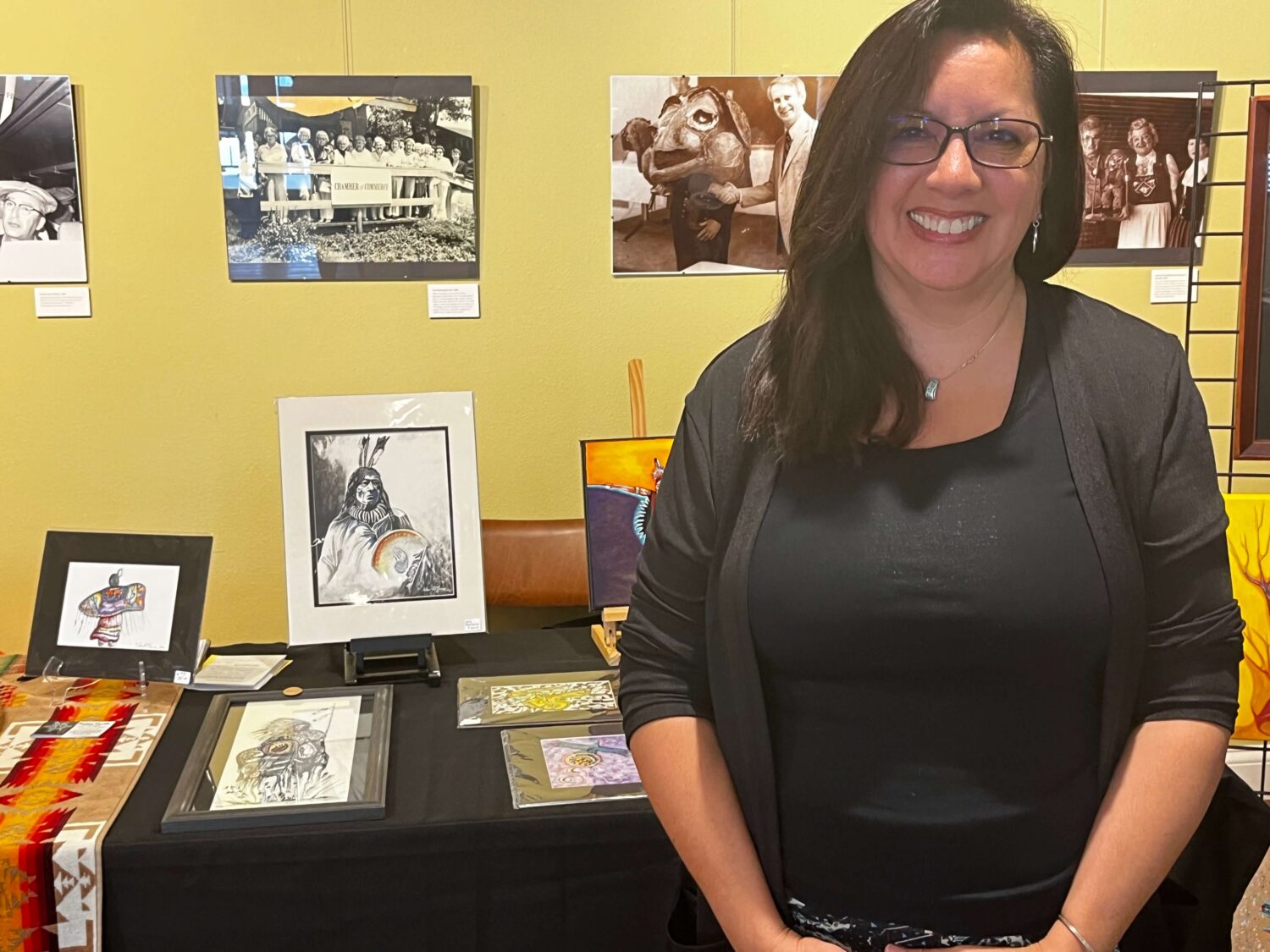
Terri O’Connor at the Native Art Marketplace in Mt. Horeb.
(Photo by Robert Chappell.)

One of the communities O’Connor has found herself in is with other local Native American artists who frequently do shows around the area such as the Native Art Marketplace that took place early last month in Mt. Horeb. It is in spaces such as these that she says people may be surprised to find art and culture in a variety of ways including storytelling and carvings as well.   

“There’s such a diversity with some of the artwork in Native culture,” expressed O’Connor. “You’ve got basketmakers and the beadwork that is amazing. There’s so many influential pieces of artwork that maybe a lot of people don’t even realize are out there.”

As time moves forward, many Native cultural traditions and ways of understanding are lost both to the cycle of life, but also to silence. As artists and community members such as O’Connor push to make their history, culture, and passion visible, it takes the community to respond and invest their interest and support in remembering the deep and beautiful Native history that is crucial to maintain for future generations. 

“We want to show people our culture and our passion for it while always having appreciation for everything that’s around us. We are a part of this earth, and there’s so many beautiful things of this earth for us to express and show in our art,” O’Connor said, praising the perseverance and continued collective effort of local artists, especially Native artists. 

“They’re multitalented and they need to be seen and heard because it’s part of our lives. It’s us, it’s who we are, and it’s great that it’s being recognized that we are artists. We are actual artists working out there, and doing it because we love it.”

Native American Artists Offer Unique Takes on Contemporary Art

Native American Artists Offer Unique Takes on Contemporary Art

Before we bid adieu to 2023 and welcome in 2024, we at the Artnet Gallery Network pulled together one last roundup for the year of art that intrigued or inspired us. Over the thousands of combined galleries, artists, and artworks we came across, we found a distinct and exciting presence of art made by Native American artists. From pieces made using traditional, hand-beaded techniques and others showing innovative uses of abstraction in painting, this collection of works by Native American artists certainly caught our eye.

The works below are only a glimpse of everything that can be found with the Artnet Gallery Network, where you can search thousands of galleries and explore diverse art and artists from around the world with just a few simple clicks. And be sure to keep a lookout for our first Artnet Gallery Network deep dive of the year in January!

Nicholas Galanin
Signal Disruption, American Prayer Rug (2020)
Inquire Here

Nicholas Galanin, Signal Disruption, American Prayer Rug (2020). Courtesy of Peter Blum, New York.

James Luna
Half Indian/Half Mexican (2010)
Inquire Here

James Luna, Half Indian/Half Mexican (2010). Garth Greenan Gallery, New York.

Anonymous
Plains Indian Beaded Burial Moccasins (ca. 1890–1900)
Inquire Here

Anonymous, Plains Indian Beaded Burial Moccasins (ca. 1890–1900). Courtesy of Owings Gallery, Santa Fe.

Marie Watt
Companion Species (What’s Going On) (2017)
Inquire Here

Marie Watt, Companion Species (What’s Going On) (2017). Courtesy of Greg Kucera Gallery, Seattle.

Fritz Scholder
Orange Butterfly #2 (n.d.)
Inquire Here

Fritz Scholder, Orange Butterfly #2 (n.d.). Courtesy of LewAllen Galleries, Santa Fe.

Pablita Abeyta
Sitting Woman (n.d.)
Inquire Here

Pablita Abeyta, Sitting Woman (n.d.) Courtesy of Tilting at Windmills Gallery, Manchester Center.

Sara Siestreem
couplet (2017)
Inquire Here

Sara Siestreem, couplet (2017). Courtesy of Elizabeth Leach Gallery, Portland.

Explore and discover more new artists to watch with the Artnet Gallery Network.

Follow Artnet News on Facebook:
Want to stay ahead of the art world? Subscribe to our newsletter to get the breaking news, eye-opening interviews, and incisive critical takes that drive the conversation forward.

This Indigenous artist created miniatures as a child to escape into a world of ‘magic, imagination and fun’

This Indigenous artist created miniatures as a child to escape into a world of ‘magic, imagination and fun’

Lance Cardinal is a First Nations, 2-Spirit artist, designer, and television personality from the Bigstone Cree Nation in Treaty 8 territory. He’s known for his work on the new Indigenous jersey logo for the Edmonton Oilers hockey team.

Lance says he started making miniatures as a child, ” I remember constructing a working replica of a midway I love to go to in the summertime out of construction paper, glue and tape. I was just six years old and this was one of the only ways I could escape from my troubled and sometimes traumatizing childhood into a world of magic, imagination, and fun.”

Although Lance moved to Vancouver in his 20s to work as a set designer, he later returned home to his reserve near Edmonton to teach kids art. He considers his APTN children’s art show, Indigenous Art Adventures somewhat of an Indigenous Mr. Rogers, complete with puppets. “I love creating work that allows people to also feel good times, positivity, magic.”

He often focuses on TV or movie sets or pop culture references. He’s most proud of a replica house he made of the 2017 movie IT

A spooky haunted house with a wild flower garden in front.
A recreation of the house from the movie IT. (Lance Cardinal)

For Season 3 of Best in Miniature, he wanted to design an Indigenous tipi. “I approach my work with a cultural lens, celebrating First Nations, Métis and Inuit culture within my design choices,” he says, “my rooms tell a story visually, they create a mood and atmosphere as if I was creating a set for a stage or film. I try to use a lot of natural materials from Mother Earth, and I use my Cree ideals in decision-making as well.”

Watch the video above to take a look inside. 

“I am here to represent my people, to show that Indigenous people can be successful, we can be creative, and we can be winners, not in spite of who we are, but because of it.”

Watch Best in Miniature on CBC Gem.

Ho-Chunk filmmakers receive tribe’s first Emmy for documenting the

Ho-Chunk filmmakers receive tribe’s first Emmy for documenting the

A new short film documenting the life of artist Truman Lowe has won a Midwest Regional Emmy Award. It’s the first time a member of the Ho-Chunk Nation has won the award.

Lowe was a sculptor and woodworker and a member of the Ho-Chunk. His pieces were rooted in Native culture, showcasing the natural world by combining traditional woodworking with more modern techniques. His work is said to have pushed the boundaries of contemporary art.

The short film, titled “Exploring the Artistic Process of Truman Lowe: A Journey Through Native American Art & Education,” details Lowe’s legacy.

[embedded content]

Casey Brown is a member of the Ho-Chunk Nation and one of the film’s creators. He recently told WPR’s “Central Time” that more people have seen the film thanks to the award.

“I’m just overjoyed that we won. And the biggest thing is that it’s a Ho-Chunk story that the Ho-Chunk Nation produced about just this remarkable Ho-Chunk person,” Brown said.

Lowe grew up in Black River Falls and attended the University of Wisconsin-La Crosse. In addition to being an artist, he worked as a professor at UW-Madison and was the coordinator of the American Indian and Indigenous Studies Program from 1975 to 1988.

Sign up for daily news!

Stay informed with WPR’s email newsletter.

During that time, he became a mentor to many of the university’s Native American students — Brown being one of them.

“I remember being a kid, and how I first knew about Truman was he had quote ‘weird art’ … and that is right then and there that I knew I loved weird art,” Brown recalled. “He was a mentor, honestly. He was here at UW and mentored so many students.”

Lowe died in 2019. In 2022, UW-La Crosse renamed its Center for the Arts in his honor. In September, UW-Madison acquired Lowe’s aluminum sculpture “Effigy: Bird Form,” placing it at the eastern edge of Observatory Hill.

Brown said he’s noticed a renewed interest in Lowe’s legacy and hopes the attention helps inspire the next generation of Native artists.

“His art really shows … just historically that Native people can adapt. And they always have adapted, especially with colonization, always adapting to new materials, new ideas, new media, and Truman really did that,” Brown said.