Native

Native American artists hope to pass their tradition on to future generations

Native American artists hope to pass their tradition on to future generations

CAMERON, Ariz. – Near the southern end of the Grand Canyon is a trading post where you can find the work of Native American artisans, and if you’re lucky, you might catch the artist working there, too.

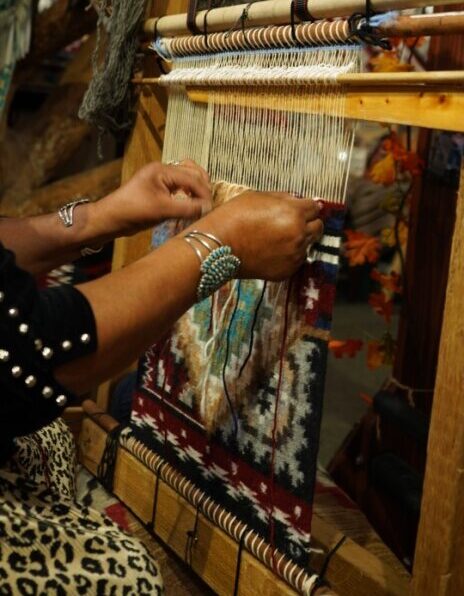
Vivian Descheny is one of those artisans, and amidst the tourists and traders you can hear a sound that’s been heard for generations – rug weaving.

Vivian Descheny has been a rug weaver for 34 years, a tradition she hopes to pass along to her children and grandchildren. (Erin Cox, KSL TV)

“My grandkids really love the thump of this pattern,” Descheny said as she worked on a rug that would take her a week or so to complete.

Descheny grew up listening to the sound of rug weaving, something her grandmother passed on to her when she was 14 years old.

“She told me you don’t need a university degree, all you need is your hands, your weaving, your thoughts and your prayer,” Descheny said.

Born in Salt Lake City, Descheny later moved to Arizona and is the only remaining Navajo rug weaver at the Cameron Trading Post.

“They’re all deceased, and they didn’t really teach their children or grandchildren,” Descheny said.  

Using 40 separate colors, Descheny weaves five patterns into one rug. Her pattern, known as the Burntwater weave, is one of a kind.

“All my rugs, they have a part of me,” Descheny said.

Jimmy Jensen makes handmade jewelry, anywhere from silver hummingbirds, dragonflies, and friendship hands, to deer. Erin Cox, KSL TV)

Vivian Descheny working on a small rug involving five separate patterns and 40 colors. (Erin Cox, KSL TV)

Known as the “Spiderwoman,” Descheny worries that the rug weaving tradition will not continue on with the next generations.

“These days, children are not really interested in learning the culture of weaving,” she said.

Others share same opinion

A sentiment shared by Jimmy Jensen, a Navajo silversmith at the trading post.

When he was 8 years old, Jensen discovered he could make jewelry.

“Anything that I can draw on a piece of paper without picking it up, I can make,” Jensen said. ”It’s just my hand and my trusty pliers.”

Jensen makes silver deer charms that tell the story of a 4,000-year-old talisman found in a cave near the Grand Canyon, it was originally created to help bring good luck and help his ancestors find food.

The tradition of making a silver deer was passed down by his grandfather and is one he hopes to continue.

Jimmy Jensen makes handmade jewelry, anywhere from silver hummingbirds, dragonflies, and friendship hands, to deer. (Erin Cox, KSL TV)

“That’s why I share with my kids,” Jensen said. “My kids all make the same type of jewelry.”

It’s not just about creating a livelihood from their craft or even displaying their art, but for Jensen and Descheny, it’s about preserving these traditions.

“This is what we do,” Descheny said. “You got to pass it down. Our little family has to continue.”

6 most famous and iconic paintings by Indian artists | The Times of India

6 most famous and iconic paintings by Indian artists  | The Times of India

One of the most multi-talented men in India is without a doubt Shri Rabindranath Tagore. He is a renowned poet, philosopher, and a Nobel laureate. But, not many are aware that he was also a gifted artist. Many of his paintings have been displayed in the National Gallery of Modern Art in Delhi and among them all, his ‘Self-Portrait’ stands as evidence of his many talents and accomplishments. Through bold, expressive strokes and confused expression, Tagore’s self-portrait captures a sense of introspection, inviting viewers into his inner world. And unarguably, if you look at the portrait, you too will stand in silence for some time debating with yourself what Tagore must have thought before drawing it.

(Image: Museum of Arts and Photography/Google Arts)

Native American fine artists and performers will gather at Litchfield Park show on January 13 & 14

Native American fine artists and performers will gather at Litchfield Park show on January 13 & 14

Litchfield Park, Arizona, is a small, charming city just 30 minutes west of Phoenix.  It is home to the historic four-star Wigwam Resort and Golf Course.  It is also home to several award-winning annual festivals, including the Litchfield Park Gathering.  The Gathering, which is free and open to the public, is a celebration of indigenous arts and cultures.  This year’s festival will be held on January 13 and 14, 2024.  The festival is open daily from 10am until 5pm. 

Now in its 32nd year of production, longtime participants look forward to this festival each year to “gather” and reconnect with family members and friends that they don’t often see.  More than one hundred Native American artists are participating in the Litchfield Park Gathering, which is an outdoor street festival held in the center of town.  Several longtime participants including Larry Ashkie, Bob Lansing, Daniel Ramirez, and Virgil J. Nez have pieces in museum and gallery collections. Even more are consistently juried into the nation’s most prestigious shows, including the Heard Museum Guild Indian Market and the Santa Fe Indian Market

 The Litchfield Park Gathering will provide festival patrons with an incredible selection of Native American masterpieces, including beadwork, jewelry, fetishes, kachinas, paintings, pottery, sculptures, and clothing and textiles. Both traditional and contemporary styles of art will be included, helping attendees understand that indigenous creativity comes in many forms and should not be stereotyped. Live artist demonstrations will also serve as teaching tools. These demonstrations enable festival goers to appreciate and interact with the artists and artisans on a personal level. 

Dancing, storytelling, and musical performances will be held on the main stage, as well as in the Cultural Education Area, where audience members can ask questions of the performers.  World champion hoop dancers Tony Duncan and Moontee Sinquah will be among the performers, along with world renowned classical guitarist Gabriel Ayala. In the nearby Children’s Area, children can create complimentary make and take arts and crafts, such as arrowhead necklaces, cornhusk dolls and mini clay pots. Violet Duncan will also hold daily hoop dancing workshops for children. Of course, Native American fare will also be available for purchase in the festival’s food court.

This is an exciting opportunity for artists to sell their work to both collectors and consumers. Participating artists will showcase their unique talents and perspectives to the thousands of festival goers who descend upon Litchfield Park every January. 

All artists go through a jurying process before being accepted into the show.  This process includes verification of tribal affiliations.  All artwork and pieces sold at the festival are original creations handcrafted and exhibited by the artists.  Accepted artists at Litchfield Park Gathering also have an opportunity to enter a juried art competition.  This special onsite review process will be performed by an expert panel on Friday, January 12, the afternoon before the festival. Judging will take place at the Wigwam Resort, which is right across from the festival grounds.  Winners will be notified when they retrieve their pieces that evening. Winners will also be announced and showcased during the festival.  Winning pieces are frequently coveted by festival attendees who purchase them during the festivals each year.    

For additional information about the Litchfield Park Gathering, including the artist list and performance schedule, please call the City of Litchfield Park’s Special Events Department at 623-935-9040 or visit litchfieldpark.gov.  This festival is supported in part by the Arizona Commission on the Arts, the National Endowment for the Arts, and by tourism dollars received through the Arizona Office of Tourism.

In a world filled with inaccurate narratives about Native Americans, we spotlight the overlooked, unheard and underrepresented stories that are often overlooked by the mainstream media. Our journalism is free for all to read, but it is not free to produce. Your donation provides the much-needed financial support for us to produce inclusive Indigenous journalism that inspires, informs and uplifts Native Americans. Thank you for being a force behind our work. Together, we are rewriting the narrative.

Found Polaroids Reveal a History of Oklahoma’s Indigenous Art Scene

Found Polaroids Reveal a History of Oklahoma’s Indigenous Art Scene

Oh my god, oh my god, oh my god,” said Leslie Halfmoon as she moved her flashlight across a series of dusty Polaroids. She and several other citizens of the Caddo Nation were rummaging through an abandoned portion of McKee’s Indian Store, in Anadarko, Oklahoma, shortly after their tribe acquired it in March 2023. The electricity had been turned off long ago. Halfmoon and the others were surrounded by piles of old boxes, broken furniture, and vintage electronics. Yet Halfmoon knew at once what they had found. She was gazing upon the illuminated faces of six of the founding figures of Oklahoma Indian art: Comanche painters Rance Hood, Doc Tate Nevaquaya, and George “Woogie” Watchetaker; Kiowa-Comanche painter Blackbear Bosin; Kiowa painter Stephen Mopope; and Cheyenne painter Archie Blackowl. Taken in the late 1960s or early ’70s, the Polaroids capture the artists during the prime of their careers, in vigorous health, between the ages of 30 and 50. One exception: Hood looks like a teenager.

McKee’s was established in 1962, and attached to it was the Susan Peters Gallery, once a celebrated center for Indian art and Indian art supplies. Halfmoon serves as the marketing and media director for the Caddo Nation of Oklahoma, and she and the others had been eager to explore the defunct space. In addition to the photos, they found several paintings by Blackowl as well as prints by T.C. Cannon, a Kiowa-Caddo artist. Halfmoon recalls being surprised by the rugged good looks of the painters in the photos: “I was like, Doc Tate! Hubba-hubba!”

This article appears in Issue 26 of Alta Journal.
SUBSCRIBE

The Caddo Nation, a tribe of approximately 7,000 enrolled citizens, intends to do something novel with McKee’s. Instead of investing in a casino, as many other tribes in Oklahoma have done, they’ve already reopened the gallery and plan to resurrect the building as a destination for Indigenous art and culture. “We have a couple of gas stations; this store is the biggest [investment]; this is what’s important to us,” Halfmoon says.

mckees indian store, downtown anadarko, oklahoma

McKee’s Indian Store in Anadarko, Oklahoma.

Joseph Rushmore

BRUSHWORK AND PAINT

I remember going to McKee’s with my dad, Comanche artist Hollis Asenap. Actually, I barely remember going there—it had to be the early ’80s, and I would have been a very young boy.

“There was a championship [powwow] war-dance buckle, and I really wanted it, but I didn’t have no money,” my dad tells me, chuckling over his fond memories of the store. “Just amazing stuff there that you wouldn’t find anywhere else.”

I remember that the store glowed orange with fluorescent light and was filled from top to bottom with Indian art and crafts: paintings hung on the walls; beadwork and jewelry were stored in glass cases. Old Indian stores like this were, and still are, some of my father’s favorite places to visit.

“I would have bought the place out had I had the money,” he tells me over the telephone. I’m in Albuquerque, New Mexico, and I can practically hear him smiling on the other end from Anadarko, where he heads up the Kiowa Tribe’s new business, Indian City Screen Printing. He’s training a new generation of Kiowas in the art of screen printing and design.

My dad looks at the images I texted him of the Polaroids of his old friends, and he chuckles again. He came to know these artists later, after the photos were taken. “I started seeing them more and more and became friends with them,” he says. Hood and Nevaquaya could be spotted in Anadarko selling work and hanging out at the local bar. “Dad used to drink with Rance.” Hood isn’t that much older than my dad, so it’s hard to visualize him as a young man drinking beer with my grandpa at the bar. “Rance was crazy and wild and liked to fight. Doc wasn’t like that—he was older,” my dad says. I wonder whether my grandfather helped keep Hood out of trouble but then remember that my grandfather was pretty wild himself. He probably got along well with Hood.

leslie halfmoon, director of media and marketing for the caddo nation, susan peters gallery, mckees indian store, anadarko, oklahoma, 2023

Leslie Halfmoon of the Caddo Nation.

Joseph Rushmore

It was hard to sell Indian art in Oklahoma in the ’70s and ’80s. My dad remembers these outsider Indian artists with little to no training but with lots of raw talent, practicing their craft: “There was no help. They were just on their own. Doc used to use his drugstore tempera, and Rance would just use anything—whatever they could find to paint with. And brushes, they had really bad brushes. Their paints were not very good. They was just self-taught; nobody told them about how to use good brushes and ink and stuff.”

My dad had studied art at Oklahoma State Tech in Okmulgee and had learned the importance of having the proper tools: “The best paint was Winsor & Newton, and it was made to dry flat, which was perfect for Indian art. And the brushes, they made the best brushes in the world.”

Dad tried his best to introduce the idea of better supplies to his fellow Comanche painters, but to no avail. “It was just foreign to them,” he says. “They didn’t know what I was talking about. If they could just use better paint and better brushes, you know that would really improve their work.”

After many attempts to try to wean these artists off their cheap materials, my dad took matters into his own hands: “I gave up. I said, I’m just going to have to buy them a set. And I did. I bought all of them a set [of Winsor & Newton paints] and brushes, too, to show them this is what you should be using.” In particular, he purchased materials for Hood, Nevaquaya, and Watchetaker. It was just the thing they needed to advance their work. “The paintings that came out of that process is some of the best work that Woogie did. He made prints of eagle dancers, and Rance’s work just took off, and Doc’s too. Doc started selling his work for $1,000,” a large sum at that time for Indian art in Oklahoma.

department of interior, detail from a mural of a ceremonial shield, stephen mopope, kiowa,1939

Detail from a mural of a ceremonial shield, by Stephen Mopope (Kiowa, 1898–1974).

Library of Congress
archie blackowl, indigenous artist, painting, buffalo hunt, cheyenne

Detail from “Buffalo Hunt,” by Archie Blackowl (Cheyenne, 1911–1992).

Pierson Gallery
george woogie watchetaker, comanche, cry to the great spirit

Detail from “Cry to the Great Spirit,” by George “Woogie” Watchetaker (Comanche, 1916–1993).

Pierson Gallery

DESTINATION FOR ART

“A place like Anadarko in the 1960s and 1970s became one of the larger markets for Native art. Oklahoma has always been the second-largest market for Native art, second only behind Santa Fe, and McKee’s is one of those North Stars in that constellation,” says Scott W. Hale of SouthWest Art Appraisals, who has been working with Native art for more than 25 years in Santa Fe and Oklahoma City. Hale is the one who sent me—via text—my first glimpse of the artists’ Polaroids. He wrote that I bore an eerie resemblance to Bosin (it’s probably the glasses).

“The portraits represent a snapshot of a particular place in a particular time of these noteworthy individuals,” says Hale. “Today, we are seeing a resurgence of the historic Native painting market, and the values on these artists’ works are really starting to climb. I can remember when you couldn’t get $5,000 for an Archie Blackowl, and I’ve now seen them sell for $15,000. A really great Doc Tate today will cost you five figures.” Watchetaker, in addition to painting, performed dances and cultural presentations and as a result did not paint as much. Because he was not as prolific as Nevaquaya, his paintings actually sell for more, no less than $25,000, according to Hale.

Hood’s work became heavily influenced by the Native American Church and the visions that came from it, peyote visions. “Doc’s style and Woogie’s style definitely comes out of the Bacone [College] and OU [University of Oklahoma] and Santa Fe Indian School Studio tradition. Rance’s really began to incorporate much more,” Hale says, “but it becomes much more designy.” Hale sees graphic design and 1960s psychedelic poster art as being hugely influential on Hood during his peak years. “That renaissance in terms of Southern Plains Indian painting in the 1960s and ’70s is directly correlated to the rise of Native American Church.”

Looking back, there was a connection between the prevalent psychedelia of the period and Native art that incorporated peyote accoutrement, it being a substance that hippies sought out. “There’s just this great big cultural stew,” Hale explains. “What’s a stew? You take all these different types of meat and vegetables and spices and mix them all together and make something really tasty. In a lot of ways, that was Anadarko in the 1970s, and McKee’s was the prismatic reflection of that.”

hollis asenap, indian city screen printing shop, anadarko, okla, 2023

The author’s father, Comanche artist Hollis Asenap, at the Indian City Screen Printing shop in Anadarko, Oklahoma.

Joseph Rushmore

END OF A GENERATION

“McKee’s was something special in Anadarko,” my father says. “I thought that would be a neat place to live, with Indians and Kiowas, and be right there in the middle of it.”

My dad got his wish: at the age of 75, he now spends his weekdays in Anadarko, living in an RV beside the screen print shop he runs, returning home on weekends to my mom in Grand Prairie, Texas. He draws inspiration from the town and its famous store: “Right now, people just walk into [McKee’s] with beadwork, amazing work.” My father was talented enough to sell one of his own paintings to McKee’s, but he wasn’t the one to sell it. His sister sold it for burial funds after their mother died; the Comanche tribe eventually bought it for the Comanche Museum and Cultural Center in Lawton, Oklahoma.

“I had some Rance Hoods and Docs, and I sold them,” my dad says. “I needed the money, so I’d buy it and resell it. I wish I had the paintings back. Before Rance had his stroke, he gave me one of his paintings of a hand game that’s in his book.” He reflects that maybe Hood knew he was in his last days of painting. Dad tried to pick him up for a last adventure a few years back, but Hood couldn’t go. “I’d call him, and he would say, ‘I can’t, I can’t just get up and go.’ ” Hood is now in his 80s and lives in a nursing home in Snyder, Oklahoma.

My dad is one of the last of his generation of Comanche painters to keep producing work. He still paints and continues to look out for great Indian art from Anadarko to add to his collection. He can afford to keep it now. “I just met a guy who does feather work with real eagle feathers.… I saw a woman today—she’s kinda homeless, living with her daughter. She does great bolo ties, beautiful work,” he says. I hope he buys one of her ties.•

Headshot of Jason Asenap

Jason Asenap is a Comanche and Muscogee Creek writer, critic, and filmmaker based in Albuquerque, New Mexico.

Resilient Peoples and Place: Celebrating and supporting Southeast Alaska’s growing arts economy

Resilient Peoples and Place: Celebrating and supporting Southeast Alaska’s growing arts economy

Our beautiful region is, perhaps unsurprisingly, full of artists. In 2014, Southeast Conference reported that artists are 2.6 times more prevalent in Southeast Alaska than the rest of the United States as a whole. At the time of the study, there were over 2,300 full-time and part-time artists with earnings of $29.9 million — nearly twice the size of the regional timber industry, marking a shift in cultural economic priority. In 2021, the U.S. Bureau of Economic Analysis reported the arts and culture sector contributed just under $1.38 billion and 11,180 jobs to Alaska’s overall economy — a 13% growth in revenue and 5% growth in jobs in a single year.

Despite our burgeoning creative economy, the arts are often cast off as non-lucrative disciplines to young professionals making critical decisions about their lives and careers. The threat of the “starving artist” continues to pass on generationally and economic contributions of the arts sector are often overshadowed by political focus on tourism, fisheries, and other economic sectors.

Spruce Root, Sealaska Heritage Institute, Sealaska and Oweesta partner on a market for Indigenous vendors at Sealaska Plaza in downtown Juneau. (Photo by Ḵaa Yahaayí Shkalneegi Muriel Reid)

Spruce Root, Sealaska Heritage Institute, Sealaska and Oweesta partner on a market for Indigenous vendors at Sealaska Plaza in downtown Juneau. (Photo by Ḵaa Yahaayí Shkalneegi Muriel Reid)

Yet in Southeast Alaska art has been an honored pathway for thousands and thousands of years. This region is rich with creative potential with our access to unique natural resources and strong cultural identity. Although making a living in the arts does not come without its challenges including market competition, resource management and regulations, housing and more.

Individuals and organizations like Spruce Root (a community development financial institution), Sealaska Heritage Institute, tribal governments, local schools and universities, culture bearers, and more — are stepping up to the challenge with educational opportunities, resources and cultural preservation efforts.

What is the Arts Economy?

Today art in Southeast includes traditional mediums like painting, carving, weaving, beading, drawing and sculpture, as well as other creative industries like photography, graphic arts, music, writing, film and playwriting. When it comes to understanding the full scope of the arts economy, people often focus on the role of independent artists in teaching, freelancing and selling, but overlook opportunities in arts organizations and beyond. Southeast Alaska is home to a rich array of art institutions including nonprofits, museums, art galleries and schools.

Spruce Root, Sealaska Heritage Institute, Sealaska and Oweesta partner on a market for Indigenous vendors at Sealaska Plaza in downtown Juneau. (Photo by Ḵaa Yahaayí Shkalneegi Muriel Reid)

Spruce Root, Sealaska Heritage Institute, Sealaska and Oweesta partner on a market for Indigenous vendors at Sealaska Plaza in downtown Juneau. (Photo by Ḵaa Yahaayí Shkalneegi Muriel Reid)

In 2022, nonprofit arts/culture organizations and their audiences nationally generated a total of $151.7 billion in economic activity with $73.3 billion in spending by the organizations on events. In Southeast, that includes everything from artist markets like those that Sealaska hosts to Aak’w Rock, an Indigenous music festival presented by the Central Council of the Tlingit and Haida Indian Tribes of Alaska and the Juneau Arts and Humanities Council.

Even our own partnership, the Sustainable Southeast Partnership, which is a regional collective impact network, has a robust team of creatives that work in journalism, photography, graphic design, videography and more while supporting interns throughout the year. SSP is one of many institutions that offer communications internships through Sealaska, a for-profit Native corporation, with more than 20% of Sealaska’s internships being communications focused or related with applications due Jan. 22, 2024. Currently, the Department of Labor is predicting a 4% growth in the communications field through 2028, and tribal entities, nonprofit organizations, for-profit companies and more throughout Southeast Alaska are seeking professional communications employees.

The arts economy is broad and also extends to opportunities in the visitor sector, public art (think the new Kootéeyaa Deiyí Totem trail in Juneau), and more.

What are Challenges Facing Southeast Alaskan Artists?

Southeast Alaska boasts globally unique natural resources, such as our ancient cedar trees, spruce roots, sea otters and more. When combined with our unique cultural ingenuity, our region boasts a globally revered and sophisticated arts legacy. A leader in Northwest Coast (NWC) Arts, Southeast Alaska is uniquely positioned to support artists. However, local artists, especially those early in their careers, are still facing challenges.

Charles Skultka Jr. teaches formline design during a Sitka High School class supported by Sitka Native Education Program and Sealaska Heritage Institute. (Photo by Bethany Goodrich)

Charles Skultka Jr. teaches formline design during a Sitka High School class supported by Sitka Native Education Program and Sealaska Heritage Institute. (Photo by Bethany Goodrich)

Charles Skultka Jr. is an educator at Sitka High School who offers Pacific Northwest Coast design classes with support from the Sitka Native Education Program and Sealaska Heritage Institute. As a Haida man, Skultka Jr. for many years has been teaching traditional arts and culture classes for the Sitka Native Education Program, integrating Alaska Native arts and culture into schools with other teachers through Sitka’s Arts, Culture and Technology programs. Skultka Jr., being someone who integrates art in many spaces, sees the career potential in the arts.

“There’s a definite career pathway to being an Indigenous artist. When you travel Southeast you can tell there’s a tourist boom going on and somebody needs to supply these visitors with original artwork. There’s absolutely no reason that we’re not training these kids and building that workforce now,” says Skultka Jr. “There’s all kinds of opportunities right now to enter the workforce through becoming an educator, becoming a graphic designer and more. Jobs that we’d like to see filled by local Alaska Natives instead of bringing people in from outside — it just makes sense to create opportunities for kids to stay in their hometowns and make a living wage.”

When asked what the challenges are for young people pursuing the arts, Skulkta Jr. reminds us that the impediments to young artists are holistic regional challenges faced by nearly every industry.

“Oh, man, our biggest challenge right now is affordable housing. Local affordable housing and a living wage. Somehow we have to employ these kids or give them a kickstart so they can afford to produce art in the first place.” Real estate and property in Alaska are limited and expensive, and create additional barriers for artists looking to afford retail space.

Skweit Jessie Morgan, a “Business Basics for Artists” participant, shares her business plan ideas with peers to workshop. (Photo by Shaelene Grace Moler)

Skweit Jessie Morgan, a “Business Basics for Artists” participant, shares her business plan ideas with peers to workshop. (Photo by Shaelene Grace Moler)

In a “Business Basics for Artists” class hosted by Chilkoot Indian Association in Haines and Spruce Root, participants talked about the values of a triple-bottom-line business model and the challenges that artists in our region face. From beadwork, to carving, to fur sewing, many types of artists were represented in this space.

In discussing the purpose of a triple-bottom-line model, Marc Wheeler, who is the program manager of technical assistance, said, “You also measure the environmental impact and the community impact. So not only is this business making a profit, but it’s also impacting the community by providing jobs, providing intergenerational connections, providing a space to gather, and providing education.” The arts are a perfect example of businesses that give back to communities culturally, educationally, and economically by supporting local supply chains and embracing creative and cultural work by the people who live there. Supporting the arts can in turn, support community well-being and the unique quality of life that keeps many of us here.

Of the challenges discussed, there was heavy emphasis on fake “authentic Alaskan” art and longstanding appropriation by tour companies coming in just for the summer competing with authentic Alaska-made businesses. In mid 2023 there were proposed amendments to the Indian Arts and Crafts Act (IACA), which is a truth-in-advertising law that prohibits misrepresentation in the marketing of Native art and craft products within the U.S.

The most problematic of the draft revisions aimed to expand the definition of “Indian Product” to allow for non-Native labor in certain situations. Products made by non-Native labor can then use a new trademark to certify that an item is an authentic Native product, even if it is created by a non-Native person, simply because it is a Native design — competing directly with Alaskan Native artists in an already challenging market. This change would allow for mass production of “authentic” Native art at a lower price point saturating the market for small businesses. As shared at the business basics class by the artists, it is already a challenge to get the asking price for their art. Many fear the implementation of this amendment will cause more harm for Alaskan Native artists. It is equally a challenge to break out of their communities and sell across the region or out of the state.

Chilkoot Indian Association’s and Spruce Root’s “Business Basics for Artists” class in Haines discusses pricing art with Izzy Haywood, Spruce Root’s program manager for events and facilitation, guiding the conversation. (Photo by Shaelene Grace Moler,)

Chilkoot Indian Association’s and Spruce Root’s “Business Basics for Artists” class in Haines discusses pricing art with Izzy Haywood, Spruce Root’s program manager for events and facilitation, guiding the conversation. (Photo by Shaelene Grace Moler,)

Additional challenges discussed include managing inventory, and meeting demand fast enough, especially considering resource scarcity with existing policies on managing resources. For example, the Marine Mammals Protection Act in which sea otter regulations are housed under limits the harvest and processing of sea otter hides exclusively to Indigenous people whose blood quantum is 25% or more. Indigenous identity, being complex as it is, is often primarily determined by a person’s social and political connections within the Indigenous community with a traced lineage and should not be reduced to a person’s blood quantum. The blood quantum requirement in harvesting and processing sea otters prohibits a huge portion of our Indigenous communities from using sea otter fur in their crafts and traditions until it is considered a “significantly altered product.”

Additionally, the disappearance of and difficult access to important cultural resources like large old-growth cedar trees, which are essential for carving canoes and totem poles alike, make growth in cultural revitalization and arts activity a challenge.

Existing Opportunities

There are many efforts in the region to address these challenges and provide better access to arts education by Sealaska and Sealaska Heritage Institute as well as other SSP partners. For example, the United States Forest Service and partners like the Alaska Youth Stewards program, Tlingit and Haida, and community forest partnerships in Hoonah, Kake and Prince of Wales Island are trying to better integrate cedar tree inventory and long-term management plans into the Tongass Forest Plan Revision — a process individuals and artists can take part in over the next few years. As part of the Southeast Alaska Sustainability Strategy, cultural-use wood is a priority, with staff identifying and cataloging trees to set aside for carving projects — to ensure the next seven generations of carvers and weavers have access.

The Alaska Youth Stewards crew on Prince of Wales Island works with the Klawock Indigenous Stewards Forest Partnership and U.S. Forest Service on inventorying large red cedars in the Tongass National Forest to provide data for long-term management of the culturally revered resource. (Photo by Bethany Goodrich)

The Alaska Youth Stewards crew on Prince of Wales Island works with the Klawock Indigenous Stewards Forest Partnership and U.S. Forest Service on inventorying large red cedars in the Tongass National Forest to provide data for long-term management of the culturally revered resource. (Photo by Bethany Goodrich)

“I believe that tree management is of paramount importance for the future of Indigenous culture and arts to continue into the time of the seventh generation of our grandchildren to enjoy the world of creativity with old-growth timber — whose days seem to be numbered at the present pace of deforestation,” says Master Lingít Carver Wayne Price. He has been a major advocate for protecting the “standtalls,” the massive red cedar trees that are needed to carve totem poles, canoes and other cultural art pieces. His work as an advocate has been an inspiration to the Sustainable Southeast Partnership, and his work as a carver nationally renowned focusing on healing canoes and totems dedicated to Indigenous people lost to substance abuse.

The arts are also greatly supported by many organizations: nonprofit and for-profit alike. The Box of Treasures Program is a partnership between Sealaska Heritage Institute and the University of Alaska Southeast (UAS), and their partner communities Klawock, Sitka and Juneau that teaches Northwest Coast (NWC) art by the Tlingit, Haida and Tsimshian peoples. This program offers dual-credit options to further develop NWC Arts Career Pathways for high school students.

Also, in SHI’s partnership with UAS, they developed and now offer an associate of arts degree with an emphasis on NWC arts. This undergraduate program offered in Juneau, Ketchikan and Sitka offers a wide variety of classes from toolmaking to design including classes in basketry, formline design, carving, weaving and more. There is movement to establish a four-year degree track through UAS and the Institute of American Indian Arts (IAIA) in Santa Fe, New Mexico, in NWC arts.

The Alaska Youth Stewards crew on Prince of Wales Island works with the Klawock Indigenous Stewards Forest Partnership and U.S. Forest Service on inventorying large red cedars in the Tongass National Forest to provide data for long-term management of the culturally revered resource. (Photo by Bethany Goodrich)

The Alaska Youth Stewards crew on Prince of Wales Island works with the Klawock Indigenous Stewards Forest Partnership and U.S. Forest Service on inventorying large red cedars in the Tongass National Forest to provide data for long-term management of the culturally revered resource. (Photo by Bethany Goodrich)

Sealaska Heritage Institute’s vision is to train new Tlingit, Haida and Tsimshian artists, teach Indigenous art in schools, educate the public on art and expand the art market, and integrate Indigenous art in public spaces, designating Indigenous art as a national treasure opening up many career opportunities for our people. Beyond SHI’s direct offerings, there are community efforts throughout the region to deliver classes in the arts such as the Rocky Pass Tannery in Kake which teaches fur sewing and tanning often supplying local artists with furs as well. Classes like these are often funded by Sealaska Heritage Institute, Tlingit and Haida and local tribal entities throughout the region.

These programs better equip artists and school teachers of NWC arts to discuss career pathways in the arts with youth across our communities. Skultka Jr., who spent over 19 years working with countless youth in the arts, sees opportunities in growing impact. “Place-based learning and culture combined in the classroom, just helps grow better humans. We get to instill our cultural values and enhance our art and culture regionally. I usually focus on working with students, but lately I’ve been really toying with the idea of starting to educate educators just to make a bigger impact,” says Skultka Jr.

The Alaska Youth Stewards crew on Prince of Wales Island works with the Klawock Indigenous Stewards Forest Partnership and U.S. Forest Service on inventorying large red cedars in the Tongass National Forest to provide data for long-term management of the culturally revered resource. (Photo by Bethany Goodrich)

The Alaska Youth Stewards crew on Prince of Wales Island works with the Klawock Indigenous Stewards Forest Partnership and U.S. Forest Service on inventorying large red cedars in the Tongass National Forest to provide data for long-term management of the culturally revered resource. (Photo by Bethany Goodrich)

Currently, Spruce Root is working to support the Sealaska Heritage Institute’s summer arts camp, facilitating networking opportunities between youth and professional Southeast Alaskan artists. Together, SHI and Spruce Root help young Southeast Alaskans better recognize the value of creativity and show how they can build a career in the arts by connecting them with working artists, visiting Indigenous public art installations, and through work-readiness and soft skills training.

At the Spruce Root “Business Basics for Artists” class in Haines, Tlingit artist Skweit Jessie Morgan, shared about how important it is to have art that reflects the communities and cultures that occupy the region, “There’s a lot of monuments in town that I just don’t connect to, that don’t resonate with what I grew up with — the knowledge that comes from attending potlatches or just being in community. There’s people out there making artwork that are a reflection of us, that are in these spaces and are spending time in our community giving back.”

With 1% of public project funding going to art, these communities with their complex histories and cultures would be best served by integrating public art that prioritizes local artists and reflects the people of this place. This is a growing opportunity in Southeast Alaska.

Master carver Wayne Price, seen here working, has expressed concerns about the sustainability of massive red cedar trees on the Tongass. (Photo by Bethany Goodrich)

Master carver Wayne Price, seen here working, has expressed concerns about the sustainability of massive red cedar trees on the Tongass. (Photo by Bethany Goodrich)

In 2024, in addition to financing and one-on-one business coaching, Spruce Root also plans to offer two virtual “Business Basics for Artists” classes in collaboration with Sealaska Heritage Institute in late January and autumn. Marc Wheeler shares, “We want to build a community of artists first and foremost. During workshops, artists connect across communities and get to know each other on a personal level, providing secrets and much-needed support for one another.”

More than an Economic Booster

The arts are also key in fostering and maintaining our connections with one another and our home region. Traditional art practices are important in transferring knowledge and history, developing relationships across generations through mentorship and education, is a primary attraction in the tourism industry, and provides a fulfilling career pathway that can either become a person’s main career or supplement their income. In Southeast Alaskan communities where Alaska Native art is the dominant art form, art provides an important income stream for many Alaskan Natives.

Art, in many ways, serves as a reflection of who we are and where we come from. It can cultivate community pride while teaching many important values in life such as patience, limitations, healthy processing, healing, emotional regulation and more while providing fulfilling careers for Southeast Alaskans. When we support the arts, we are investing in both economic and community well-being.

Master Lingít Carver Wayne Price and former University of Alaska student Andrea Cook hold masks done in Price’s university class. Price works to protect the “standtalls,” the massive red cedar trees that are needed to carve totem poles, canoes and other cultural art pieces he sees as integral to a strong future in the arts. (Photo by Bethany Goodrich)

Master Lingít Carver Wayne Price and former University of Alaska student Andrea Cook hold masks done in Price’s university class. Price works to protect the “standtalls,” the massive red cedar trees that are needed to carve totem poles, canoes and other cultural art pieces he sees as integral to a strong future in the arts. (Photo by Bethany Goodrich)

“I think all people should support the arts because it’s the one thing that brings everything together — people, communities, regions. It connects us to each other and to place. Art isn’t just something that you hang on the wall, there’s all kinds of living forms with dance and music,” says Skultka Jr. who believes art makes life more vivid. “At the end of the day, without it, culture and society would be pretty dull.”

Shop local, support local. If you are interested in supporting small businesses and artists like the ones mentioned in this article, consider buying locally from the Spruce Root, Sustainable Southeast Partnership, Sealaska and Sealaska Heritage’s gift guide at https://www.spruceroot.org/giftguide. Visit spruceroot.org to learn more about business workshops and resources for artists or https://www.sealaskaheritage.org for art educational opportunities. If you are interested in becoming a Sealaska intern, or know someone who may be interested, visit https://www.sealaska.com/careers/summer-internships.

• Shaelene Grace Moler is a rural, Indigenous writer from Kake. She was the senior editor of Tidal Echoes and has been published in Capital Weekly, 49 Writers, Alaska Women Speak, First Alaskans Magazine, and Ravencall. She worked in storytelling and engagement for the Sustainable Southeast Partnership through a Sealaska internship for two years before joining Spruce Root as a fellow and First Alaskans Institute. The Sustainable Southeast Partnership is a dynamic collective uniting diverse skills and perspectives to strengthen cultural, ecological, and economic resilience across Southeast Alaska. SSP can be found online at sustainablesoutheast.net. Resilient Peoples & Place appears monthly in the Juneau Empire.

Rocky Pass Tannery in Kake offers classes on otter skin sewing to youth during the Keex’ Kwaan Culture Camp. (Photo by Bethany Goodrich)

Rocky Pass Tannery in Kake offers classes on otter skin sewing to youth during the Keex’ Kwaan Culture Camp. (Photo by Bethany Goodrich)

APYACC Part 9

APYACC Part 9

“An independent panel investigating the APY Art Centre Collective has found substantial evidence of wrongdoing in every area that it was tasked to investigate by the South Australian government, including fraud, bullying and white hands on black art”.

That’s the claim of relentless journalist, Greg Bearup at The Australian newspaper. He goes on to add, “Sources close to the tri-­government review have told The Weekend Australian the panel found “substantial wrongdoing” in every area it was tasked to investigate after spending six months interviewing more than 200 people from the sector”.

However, the SA Government, which initiated the review with NT and Federal arts ministers, isn’t nearly as clear on that “substantial evidence”. It says: “The Panel considered current and historical allegations that APYACC staff intervened in the artwork of Indigenous artists connected to the APYACC, that efforts were made to conceal this activity, that APYACC was not supporting culturally safe work practices, as well as assessing management practices and terms of engagement for artists”.

But as a result, because “The panel couldn’t compel witnesses, they couldn’t offer whistleblower protection … but they found sufficient information to warrant them referring matters to these regulatory bodies,” according to quotes from SA Arts Minister Andrea Michaels.

And the bodies that now are handed the problem – belatedly, one might argue since this whole process was kicked off by The Australian on 8th April 2023 – are, the Office of the Registrar of Indigenous Corporations (ORIC) regarding matters of governance and management practice; and, the Australian Competition and Consumer Commission (ACCC) regarding consumer protection and contracting matters. Both have the power to initiate criminal and civil proceedings.

In July, the SA Government announced the review into the APYACC to be conducted by Megan Krakouer – a Menang Woman of the Noongar Nation and a renowned activist, social justice advocate and law reformer. Megan is a Director of both the National Suicide Prevention and Trauma Recovery Project, and of the South West Aboriginal Land and Sea Council; by SA Lawyer Anne Sibree; and by Cameron Costello – a Quandamooka man from Moreton Bay in Queensland, who sits on the State’s Healthy Land and Water Board and is Deputy Chair of the Queensland Tourism Industry Council.

According to the Panel, the overwhelming response from participants is that they want the matter resolved and for the industry to move forward. “This review was about ensuring that Aboriginal artists are being respected and that the integrity of their art is being maintained. We are committed to supporting our First Nations artists to share their art with the world for the future”.

Which all suggests to those outside the loop that the 8 months of pain and confusion (now extended indefinitely) surrounding the artists, the National Gallery which had to cancel a major exhibition of their work, the National Gallery’s own enquiry which came to conclusion there was nothing to see, and the wider First Nations art industry which has almost unanimously come down against the APYACC, that a swifter solution should surely have been found.
An undoubted stumbling block to this, though in the continuing refusal of APYACC general manager Skye O’Meara to stand down from office, a decision which continues to have the support of her governing board, lead by artist Sally Scales.

Oddly that body has released a supposedly confidential note from the Review Panel declaring that “It was not its job to make, and has not made, any findings or is inferring or determining guilt or innocence of the APYACC on matters referred”.

Which would seem to make nonsense of Arts Minister Michaels’s statement that “they found sufficient information to warrant them referring matters to these regulatory bodies”.

Duh!

Url:

Indigenous art collective stunned by referral to consumer watchdog

Indigenous art collective stunned by referral to consumer watchdog

After two lengthy investigations into the integrity of its artwork, the Indigenous-owned APY Art Centre Collective faces further scrutiny – a development that has stunned its artists and staff.

A South Australian government-led review of various allegations, including that APY collective staff intervened in the work of Indigenous artists, came back with no findings last week and has instead referred the centre to the Office of the Registrar of Indigenous Corporations (ORIC) and the Australian Competition and Consumer Commission (ACCC).

Artist Yaritji Young rejects any suggestion she’s been told what to paint.

Artist Yaritji Young rejects any suggestion she’s been told what to paint.Credit: Rohan Thomson

The result has devastated the artists and staff of the APY Art Centre Collective who had hoped to end the year with its reputation restored.

“Our frustration is that we have been continuously examined since Easter this year, robust examinations, examinations that really hurt artists and staff because there are constant questions being asked about our integrity as arts professionals,” says the collective’s general manager Skye O’Meara.

“The can has been kicked further down the road by government, which is devastating for us.”

When asked by this masthead on what grounds the collective had been referred to ORIC and the ACCC given that no findings had been made, South Australian Arts Minister Andrea Michaels said in an email: “The review panel interviewed more than 200 people and received sufficient information relating to the allegations that they determined it warranted referrals to the ACCC and ORIC.”

The review was conducted by Adelaide lawyer Anne Sibree; Menang woman and director of the National Suicide Prevention and Trauma Recovery Project Megan Krakouer; and Quandamooka man and deputy chair of the Queensland Tourism Industry Council Cameron Costello.

“The panel did not have powers to compel information, and accordingly has referred relevant information to investigative agencies with greater information-gathering and witness protection powers,” Michaels said.

Advertisement

However, in a confidential letter sent to the collective, which has been seen by this masthead, the reviewers wrote: “The panel wants to clearly emphasise that it is not its job to make, and has not made, any findings or is inferring or determining guilt or innocence of the APY ACC on matters referred.”

They further noted: “The sector is a highly commercial and competitive environment and there have been instances in the past where referrals have been weaponised to inflict damage, reputational or otherwise, to parties.”

Sally Scales says the collective is the “most scrutinised arts organisation in the country”.

Sally Scales says the collective is the “most scrutinised arts organisation in the country”.

Artist Sally Scales, who paints at the collective’s Adelaide studio, commended the reviewers’ work, particularly Krakouer, who she said “fully understood and respected the trauma that we’ve been in this year”.

But Scales added: “We’re the most scrutinised arts organisation in the country, not First Nations, just arts organisation. How many times do me and my elders have to go through this rigmarole? How many times do we have to justify our successes … do people think that we’re dumb Blacks from the bush?

“The strength of my elders and the strength of their resolve is incredible. They’re like, we’ve got stuff to get on with. They all want to continue in their artistic practice. Let’s not forget that art centres are the only source of non-government money on remote communities. These are artists that are living on the poverty line and whose artworks help support families and put food on the table for those families.”

It has been the worst year on record for the collective.

The group, which represents more than 500 artists across the vast APY Lands of South Australia, as well as 60 artists in Coober Pedy and 30 in Port Augusta, had been riding a wave of success. Its artists celebrated nationally and internationally include Vincent Namatjira, Betty Muffler, Tuppy Goodwin, Iluwanti Ken and this year’s Wynne Prize winner Zaachariaha Fielding.

But that all came to a crashing end following the publication in April of a seemingly damning video showing a white studio assistant laying base layers of paint on the canvas of senior law woman and artist Yaritji Young.

After taking a hit earlier this year, art sales had picked up again and were doing well, O’Meara said.

“I think it’s fair to say that it paralysed the marketplace for a period of time and that’s something that impacted not only us and the APY Lands but Indigenous artists all over the country, which is why we trusted the [SA] state government when they committed to finding a fast resolution.”

The Office of the Registrar of Indigenous Corporations confirmed it had received the referral from the South Australian government.

“We will assess that referral and determine whether there are possible breaches of the CATSI [Corporations Aboriginal and Torres Strait Islander] Act,” a spokesperson said. “There are offences under the CATSI Act that do carry potential penalties, financial or imprisonment, but that would be a matter for a court to decide.”

When asked whether the video of a white studio assistant painting base layers onto the canvas of Yaritji Young might constitute a criminal act, the spokesperson said: “That’s not a governance matter, ORIC investigates matters of governance.”

The Australian Competition and Consumer Commission was also contacted but did not respond by deadline.

Earlier this year the National Gallery of Australia found there had been no improper interference in the making of 28 paintings that had been destined for the Ngura Pulka (Epic Country) exhibition. The exhibition has been indefinitely postponed.

The Booklist is a weekly newsletter for book lovers from books editor Jason Steger. Get it delivered every Friday.

Gabriella Coslovich is an arts journalist with more than 20 years’ experience, including 15 at The Age, where she was a senior arts writer. Her book, Whiteley on Trial, on Australia’s most audacious of alleged art fraud, won a Walkley in 2018.

Most Viewed in Culture

Missoula Art Museum accepting applications for missing Indigenous people exhibit

Missoula Art Museum accepting applications for missing Indigenous people exhibit

The Missoula Art Museum is inviting Indigenous artists to participate in an exhibition to bring awareness to the Missing and Murdered Indigenous Relative in Montana.

The exhibition is only open to artists who are Indigenous or who identify as descendants.

Applications are due on Jan. 5 at 11:59 p.m. and the results will be announced Feb. 29.

The exhibition will be open to the public on May 3 from 5 p.m. to 8 p.m. and will run through Sept. 7 2024.

Missoula Art Museum released the following:

Missoula Art Museum invites Indigenous and descendant artists to participate in a juried exhibition focused on bringing awareness to the Missing and Murdered Indigenous Relative crisis in Montana. The exhibition welcomes a variety of Indigenous voices, including artists residing in communities across the state with any Tribal affiliations. It is only open to artists who are Indigenous or who identify as descendants but does not require proof of enrollment status or blood quantum. MAM asks the public to please share this call for art widely. The submission deadline is Jan. 5, 2024 (11:59pm Mountain Time); artists will be notified of jury results Feb. 29, 2024.

Rachel Allen (Nimiipuu/Nez Perce) serves as juror of this exhibition in her role as MAM’s first Indigenous guest curator. Allen grew up in Great Falls and is exhibition special project manager and co-curator of the upcoming Joe Feddersen retrospective at the Northwest Museum of Art and Culture in Spokane, WA. This position is part of MAM’s initiative to expand the curatorial voice to include broader Indigenous representation and to create new opportunities for Indigenous museum professionals and leadership in the arts.

To participate, artists can apply through MAM’s Submittable account, linked on the museum website. There is no cost to apply. If the Submittable process is not accessible, artists can contact MAM Senior Curator Brandon Reintjes for alternative instructions. Participating artists receive honoraria, support shipping artworks, and a Friend Circle Membership.

Participants and their loved ones will be invited to an artist/family preview on Apr. 22, 2024. The exhibition will open to the public with a First Friday reception on Friday, May 3, 5-8 PM, and will run through Sept. 7, 2024.

‘Christie’s broke multiple records for Indian artists’

‘Christie’s broke multiple records for Indian artists’
image

New Delhi: Indian art is having its moment in the sun. British auction house Christie’s said while announcing its year-end results, that in an auction this September in New York, it sold 96% of all lots for the Modern and contemporary south Asian art and 60% of its buyers were from India. It also had a white-glove sale in March which was dominated by Indian artists.

The auction house broke multiple records for artists including Zarina Hashmi and Ranjani Shettar. It is now seeing high activity out of India even though it has not had a sale here in some years. It does though, have a permanent presence in India.

“The way we approach India is the same we approach other important regions or countries where we may not have sales. But it is no longer the market it was 5-10 years ago. It is a strong hub for us to transact in and we manage to drive engagement with buyers here. The strategy we have is to bring South Asian art to global platforms and that has been showing great results,” Guillaume Cerutti, CEO of the iconic auction house, told Mint.

At a global level, Christie’s said at the end of 2023, the year looked like a bit of a paradox as the business declined 25% vis-a-vis 2022. The total for art and luxury sales (including projected numbers for December) reached $6.2 billion of which $5 billion came from auctions and the remaining $1.2 billion from private sales. But this number is still 7% higher than 2019’s pre-covid levels.

The auction house had a sell-through rate of 84% for all lots at auction. Strong underlying dynamics including new buyer spending, APAC bidder development and millennial and Gen Z participation drove the market.

“We have seen a continuing influx of new collectors, especially coming from Asia, something that has been achieved against market’s contraction within the more challenging macro-economic and geopolitical landscape,” he added. Luxury collecting as a category has also grown strongly for them. The company has observed that younger collectors out of Asia who generally began buying handbags and other collectables in 2020 and 2021, have since started going for top lots of art too.

Its regional buying from Asia has been very resilient, led by mainland China. New buyers coming from mainland China are up 30% and 2024 will be important in the Asian context. Asian buyers made up 28% of all buyers.

Unlike other parts of the world, throughout 2023, it saw a growth in Asia. Fifty-four per cent of the new buyers in value are coming from Asia. At a global level, 66% of all its new buyers year-to-date were seen in online-only sales. There was a 33% growth in new bidders and buyers from the Americas, too. The art auction house projects that it will approach 2024 with cautious optimism though, seeing the global economic conditions.

Unlock a world of Benefits! From insightful newsletters to real-time stock tracking, breaking news and a personalized newsfeed – it’s all here, just a click away! Login Now!

Related Premium Stories

Catch all the Corporate news and Updates on Live Mint.
Download The Mint News App to get Daily Market Updates & Live Business News.

More
Less

Published: 18 Dec 2023, 06:17 PM IST