Native

Honoring Native American Heritage Month with the Native American and Indigenous Alliance

Honoring Native American Heritage Month with the Native American and Indigenous Alliance

Body

In 1990, a joint resolution designated November as Native American Heritage Month (NAHM), nationally recognizing what had previously been state-designated holidays. Throughout the month, Americans are encouraged to recognize and uplift the innumerable contributions, both past and present, of Indigenous people.

George Mason University’s student organization Native American and Indigenous Alliance (NAIA) is dedicated to promoting Indigenous culture, raising awareness of Native issues, and providing a safe environment for Native and non-Native students. We spoke with members of NAIA to hear about how they’ve found community here at Mason and their perspectives on the importance of NAHM.

‘Can’t Drink Salt Water’ spotlights missing and murdered Indigenous women, human trafficking, and allyship—plus, salmon!

‘Can’t Drink Salt Water’ spotlights missing and murdered Indigenous women, human trafficking, and allyship—plus, salmon!
image

Front Row Center co-host Lauren Korn speaks with Lummi playwright and filmmaker Kendra Mylnechuk Potter about Can’t Drink Salt Water, which is being staged and presented by the Montana Repertory Theatre (MRT) on Sunday, November 19, 2023, at 4PM.

From the MRT website:

Continuing its commitment to developing new works, Montana Repertory Theatre proudly announces a staged reading of Can’t Drink Salt Water, a powerful new play by Indigenous playwright Kendra Mylnechuk Potter [Lummi].

Can’t Drink Salt Water is a gripping play juxtaposing a mother’s relentless search for her missing daughter with the journey of a young woman newly arrived at Bethel House, an evangelical shelter for victims of sex trafficking. Weaving together Native tradition, maternal grief, contemporary religious faith, humor, and a call to action, the reading is recommended for adult audiences. A conversation with [Carissa Heavy Runner, mother of Mika Westwolf] will follow. Resources and more information on MMIP, [as well as Indigenous artists and vendors] will be in the lobby before and after the reading.

This reading is made possible by a generous grant from The Roy Cockrum Foundation.

For more information and to purchase tickets, go the MRT website here.

A renowned teddy bear artist in 1998; a ‘dead animal meat racket’ in 1948 [Lancaster That Was]

A renowned teddy bear artist in 1998; a ‘dead animal meat racket’ in 1948 [Lancaster That Was]

Excerpts and summaries of news stories from the former Intelligencer Journal, Lancaster New Era and Sunday News that focus on the events in the county’s past that are noteworthy, newsworthy or just strange.

25 years ago

“World renowned artist” is an impressive title, but “world renowned teddy bear artist” might be just as impressive – and much more unusual.

In 1998, Lititz native Lynn Schaffstall was named one of the top 10 teddy bear artists in the world by the Tateshina Teddy Bear Museum in Japan, and her handmade Wunderbar Collection bears were sold all over the world.

In November of that year, Schaffstall was returning home to Lititz for an appearance and signing at the Teddy Bear Emporium shop.

Schaffstall, born Lynn Reidenbaugh, was a member of the last graduating class of the former Lititz High School in 1956 and said she always considered Lititz “home.” Her house in Hellertown served as her base of teddy bear operations – a one-woman shop that turned out thousands of one-of-a-kind bears over the 14 years since she made her first teddy in 1984.

Schaffstall, a lifelong seamstress, said she made her first bear at the request of her son, who was in college at the time and wanted a unique bear to sit next to his girlfriend’s teddy bear.

In the headlines:

Starr says president broke laws

McDonald’s wins coffee suit

Grants eroding as college students’ costs rise

Check out the Nov. 19, 1998, Lancaster New Era here.

50 years ago


Piano festival at the Futon, 1973

Sitting at 12 pianos on the Fulton Opera House stage, 24 music students perform as part of the Fulton’s second Piano Festival, held in November 1973.


For the Fulton Opera House’s second Piano Festival, 24 piano students took the stage in November 1973 – and all performed at the same time.

Twelve pianos were arranged onstage, with students sitting two to a piano to perform works that focused on timing, coordination and playing as part of a larger group.

A total of 150 students performed, 24 at a time, and the festival was closed by a performance by 12 piano teachers playing Von Weber’s “Invitation to the Waltz.”

In the headlines:

Nixon cheered, jeered during Georgia visit

Senators say gas rationing essential

Greek riot results in martial law

Check out the Nov. 19, 1973, Intelligencer Journal here.

75 years ago

A gruesome and wide-ranging conspiracy to process and sell unauthorized meat products – for both pet and human consumption – was uncovered in November 1948, and a Lancaster County man was arrested in connection with the allegations.

Pennsylvania Department of Agriculture officials said a lengthy investigation revealed a “dead animal meat racket” across several counties in southeastern Pennsylvania, including Lancaster County. Twenty-nine people were charged in connection with the operation – in addition to Lancaster County, the accused lived in Bucks, Chester, Delaware, Lehigh and Montgomery counties and in Philadelphia.

Officials said the ring operated unauthorized slaughterhouses and rendering facilities where animals unapproved for consumption – mostly horses – were processed into ground meat products sold as dog food and hamburger patties.

They discovered more than 250 violations of food safety codes related to the operation, and believed that “the average family seeking bargain buys” in meats may well have consumed unauthorized products.

Among the most egregious of the violations were instances of horse meat being sold to small restaurants as hamburger patties, with advice to cooks that they should “add a little grease and you can’t tell the difference from beef.”

In the headlines:

Continental air defense set up

Britain asks UN to slash Israel’s area

Usable power from atom is a decade away

Check out the Nov. 19, 1948, Intelligencer Journal here.

100 years ago

Prohibition-era beer drinkers in Lancaster were disappointed in November 1923, as the former Sprecher’s Brewery had been seized by federal agents and shut down.

The brewery, which during Prohibition had been rebranded as the Superior Beverage Co., was allegedly still manufacturing “real” beer. Not only was the plant shut down, but three government agents camped out in the building, intending to stay there until the case could be brought up in federal court.

From the Intelligencer:

“Devotees of ‘real’ beer in Lancaster were in a quandary today as to where they might obtain their favorite beverage as it was reported that several retail establishments where ‘high-powered’ beer could be obtained recently by those ‘in the know’ were mournfully doling out the perfectly legal but highly unpopular ‘half-of-one,’ with few cash customers in sight.”

(Half-of-one here refers to so-called “near beer,” which was limited to an alcohol content of 0.5 percent.)

In the headlines:

Break between Britain and France balked

Food prices still soaring across U.S.

Check out the Nov. 19, 1923, Lancaster Intelligencer here.

.lnp-revcontent-wrapper {
border-top: 1px solid #75767d;
display: block;
margin-top: 20px;
padding-top: 20px;
width: 100%;
}

What to Read Next

{{hammer}}
{{kicker}}

Muscogee Nation hosts Native Christmas Market at Jenks Riverwalk.

Muscogee Nation hosts Native Christmas Market at Jenks Riverwalk.
image

JENKS, Okla. — The Muscogee Nation hosted a Native Christmas Market Saturday at the Jenks Riverwalk.

The event took place at the Jenks Riverwalk from 3 p.m. to 7 p.m.

During that time, more than 25 Native American vendors from various tribes were all showcasing their goods.

Sisters Brittany Hill and Breana Hill were selling handmade goods including beadwork, shellwork, paintings, ledger art and hand painted Christmas ornaments.

“We got it from our father, our father is a self-taught artist, and all our lives we’ve just been painting and drawing and so, we’re just now kind of starting to get into the art market specialty of it all,” Breana said.

They said their art depicts both their Muscogee and Ihanktonwan Dakota art styles.

Brittany said the event was a great place to showcase native art.

“We’re so happy to be here, it’s always such a great time when we have multiple vendors from different tribes come out and it’s just a great place to showcase native art,” she said.

Breana said she was thankful people were supporting local vendors and artists because of the amount of time and work that goes into the pieces.

“People take a lot of time outside of their daily life, whether that be their full-time job or not, to put these pieces together and just show a lot of their hard work and it’s a good depiction that we are still here today as indigenous people and showing our art pieces in modern and traditional times,” Brenea said.

She also said supporting local Native American artists is important because for many, art is a part of their identity.

The event also had live music, carolers, and a kids zone.

‘For Our Stories to be Told’: Hope Valley Native artist Brooke Waldron centers Indigenous narratives in her artwork

‘For Our Stories to be Told’: Hope Valley Native artist Brooke Waldron centers Indigenous narratives in her artwork

HOPKINTON — Native artist Brooke Waldron — painter, potter and proud Seaconke Wampanoag/Narragansett — sat inside her Hope Valley studio one morning last week, turning her pottery wheel and talking about contemporary Native art.

On the wall behind her, a painting of a white horse, framed by an orange rectangle and centered in a rich purple background, hung on a white wall. On the floor nearby, an enormous painting — featuring half a dozen different-colored horses galloping under a starry, moonlit sky — was leaning against a wall.

“We are not just tipis and dream-catchers,” said Waldron with a soft smile as she trimmed the edges of a small clay bowl. “Native art is so much more … and we’ve got to reclaim our seat at the table.”

Contemporary Native art often goes unnoticed, Waldron said, “and our culture and representation continues to be profoundly underrepresented.

“Our narratives, stories and artistic practice is almost exclusively told in the past tense and is rarely exhibited in an equitable way.”

Waldron will talk more about Native art, and take questions from the audience, this afternoon at 4:30 at the Gamm Theatre in Warwick, where an exhibit of her work is currently on display at the Gamm Theatre Gallery.

The solo exhibit — paintings from “Those That Guide Us” — features 12 of Waldron’s newer works, paintings that “present a breadth of style and color,” according to installation organizers, who note that the “collection is steeped in Indigenous symbolism.”

Waldron, who explores the relationship between color, nature and traditional native symbolism and contemporary techniques, has a deep affinity for the natural world and for animals.

“Our four-legged relatives” are common themes in Waldron’s work.

Rabbits and horses appear in her paintings, feathers and ferns pop up in her pottery. Birds and eagles too.

Also an equestrian and riding instructor, Waldron, 33, grew up on a 118-acre farm in Exeter with her parents and an older sister, Kara.

“She’s my biggest supporter,” said Waldron with a smile, “along with my parents, of course.”

Waldron graduated from Exeter-West Greenwich High School before heading off to work and to study at the Community College of Rhode Island.

Waldron, who is employed by the Rhode Island Regional Indian Council and works in the subsidiary office in North Stonington assisting Native communities in career development, said she knew from an early age that she was an artist.

In high school, she said, she was positively influenced by her high school art teacher and friend, Elizabeth Lind, who helped her realize there was space for the art she was making.

“She was very encouraging,” said Waldron. “She made time.”

Waldron participated in her first exhibit — as a teenager — at the Hera Gallery in Wakefield. She exhibited at the Hera again years later. She has also exhibited at the South County Art Association, where she has taken many classes, and the Warwick Center for the Arts. 

In 2007, Waldron attended the solo exhibit of noted Comanche Artist Nocona Burgess at the Peck Gallery in Providence, an event that stays with her.

It was an emotional experience for Waldron who had seen Burgess’ work in Santa Fe and Albuquerque and had become what she calls “a fangirl.”

She said she feels a sort of thread that connects her work with Burgess’ work and “pulls on through.”

Burgess, who has earned widespread recognition for his bold acrylic portraits of historic American Indian figures, including his famous great-great-grandfather, Comanche chief Quanah Parker, is known for his modern depictions of Indigenous men and women from various tribal nations of North America.

According to his biography, Burgess “explores the cultural context, life story and identity of each sitter. In this way, the artist urges us to update our perceptions of Native people and consider the intriguing and often highly politicized place of Native American portraiture.”

It is a philosophy shared by Waldron, who said she’d like to be a sort of change agent for the way people think about contemporary Native American art.

Especially now, during the month of November, which has been designated as Native American Heritage Month.

Waldron said when she was approached about the idea for the exhibit by Lauryn Sasso, the Gamm’s institutional engagement associate who facilitates the theater’s art installations, she was thrilled.

“I’m honored to be there,” said Waldron. “They have been very welcoming and I’m grateful for the space.”

Sasso called Waldron’s use of color in her paintings “stunning.”

“She is an intelligent and unique talent,” said Sasso, who first saw Waldron’s work at an exhibit at the Warwick Center for the Arts.  

Waldron’s work is “really, really singular in the way she delves into and integrates Indigenous lore and symbolism,” added Sasso. “And her ceramic work is beautiful too.”

“The collection is steeped in Indigenous symbolism, a departure from the human form,” reads a statement from the Rhode Island Humanities about the exhibit. “The series invites the viewer to interpret the many lessons we can learn from self-reflection.

“Using animals as the north star of her focus, the artist creates a narrative that shares her own personal story while connecting with the audience in a familiar way.”

Now that she’s completed her “dream project” — the creation of her Hope Valley studio — Waldron is pondering her next steps.

Maybe she’ll open a gallery for Native artists, a place “for our stories to be told,” she said. 

“I’m in a constant experimental state,” Waldron added with a smile.

Waldron plans to participate in a Dec. 9 holiday event in Hope Valley, will have some pieces at the Village Art Studio and maybe she’ll be at a Christmas market or two. In the meantime, “Those That Guide Us” will be on exhibit at the Gamm through Nov. 26. 

For more information, visit www.grayhorsestudioart.com and www.gammtheatre.org.

Little Big Horn College group learns how to make Crow moccasins

Little Big Horn College group learns how to make Crow moccasins

BILLINGS — Little Big Horn College’s Ak Bacheeitchiilewioosh Youth Leadership Council met Saturday at the MSU Billings Native American Achievement Center to learn the traditional art of moccasin making.

“It starts right with their feet. They’re learning how to make these moccasins and get on that cultural path. We talk to them in our language, we speak Crow to them, and we want them to learn leadership and continue on in life knowing who they are and not forgetting where they come from,” said one of the organizers of the council, Jonella Hill.

About a dozen students were taught how to measure their feet and make patterns to design their own buckskin moccasins.

For many, this was their first experience learning how to bead. The group hopes that once the youth members learn how to make their own, they can then teach others and keep the tradition alive.

“In order for them to start learning and having awareness of who they are and where they come from, they need to walk in the shoes of their ancestors. They were pretty tough people back then and they used moccasins to get anywhere,” said Noel Two Leggins, another organizer.

Many of the participants, like Vanessa Afraid of Bear, watched their own grandparents make moccasins growing up.

“I’m almost making my ancestors proud because this is something obviously they did, and for me, to be in a society that we are but still able to return and do that, I think is really significant to me to know how to do it for myself and generations to come,” Afraid of Bear said.

Moccasin making is just one of several activities the council hopes to share with the younger generation. The group is planning on wearing their moccasins in the spring for powwows.

An Icelandic artist’s response to climate change

An Icelandic artist’s response to climate change

Charlotta Hauksdóttir is a Palo Alto-based mixed media artist whose works incorporate the stunning natural landscapes of Iceland, her native country. As Hauksdóttir’s awareness of climate change has developed, her works have evolved along with it. This is the story of that evolution.

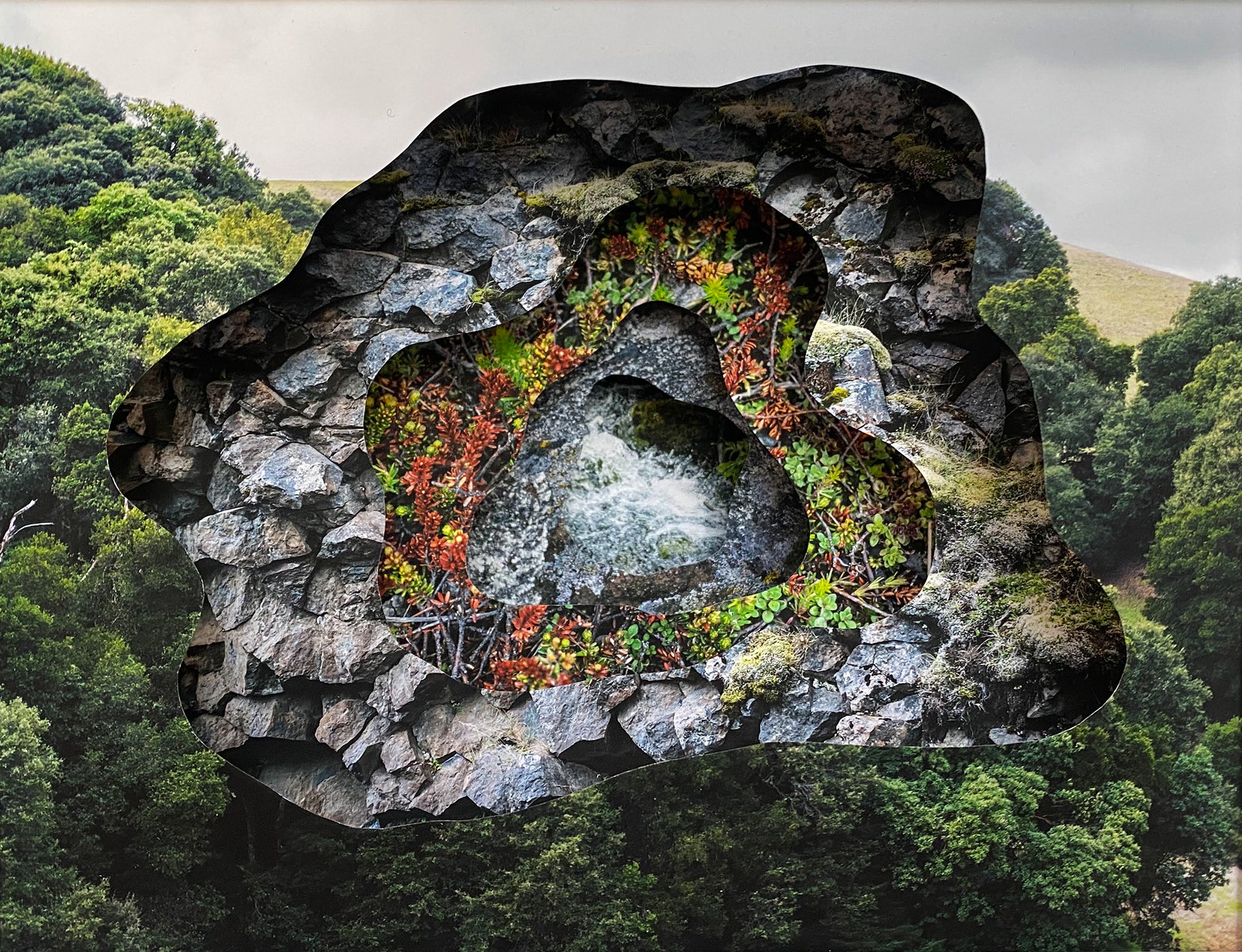
Enter Here IV, by Charlotta Hauksdóttir

Hauksdóttir has a deep and abiding love for Iceland’s “magical” landscapes with their broad vistas, glowful lighting, varied terrain and ever-changing weather. As a child she spent summers camping, picking blueberries, and recreating outdoors with family and friends, forming deep bonds with people and the land.

After leaving Iceland to study photography at the San Francisco Art Institute, a bout of homesickness led her to put together sets of photographs, “Dreamscapes”, that reflected her memory of the land she loved. Imperfections in our memory, and our movement through the landscapes, are represented by gaps between photos and selective blurring. The photographs are not objective mirrors of landscapes, but instead reflect our perception of places. People are represented in the art, and the connection between people and nature, even though we are not visible.

image
Sharp Edges, by Charlotta Hauksdóttir

It had long been a dream of Hauksdóttir to study in San Francisco, but each time she traveled back to Iceland, even the moss-covered lava fields by the airport reminded her how much she missed her home. Her art diverged from the “fairy tale” dreamscapes to a more immersive format that could almost envelop the viewer. The human-scale art, placed at eye level, allows a viewer to look down by their feet, or up by the horizon, and see what you might see if you were there. Seams between the photos are visible to remind us that perception is not reality.

image
Walk on Water, by Charlotta Hauksdóttir

As her children grew, her work switched to focus more on family and life changes, with the themes of time evolving and nostalgia for moments in time coming to the fore. But in 2016 she turned back to landscapes, this time feeling an urgency “not to assemble the landscape, but to disperse it in pieces”. She wasn’t sure where this impetus was coming from, or what it would look like. She knew only that the dispersal should be a meaningful pattern, something organic. It took a lot of trial and error until she found a technique that resonated, cutting up her photographs and layering them. This was a destructive act for her, as she described it, “physically cutting up these memories”. But Iceland was changing, and it felt right.

Hauksdóttir began with a fingerprint pattern, here rendered in black velvet, that reminds viewers that we are more than passive observers of nature.

image
Impression XXV, by Charlotta Hauksdóttir

She also employed a cut-out pattern of retinal veins, conveying “our unwillingness to admit or see what’s happening in nature”.

image
Imperception IV, by Charlotta Hauksdóttir

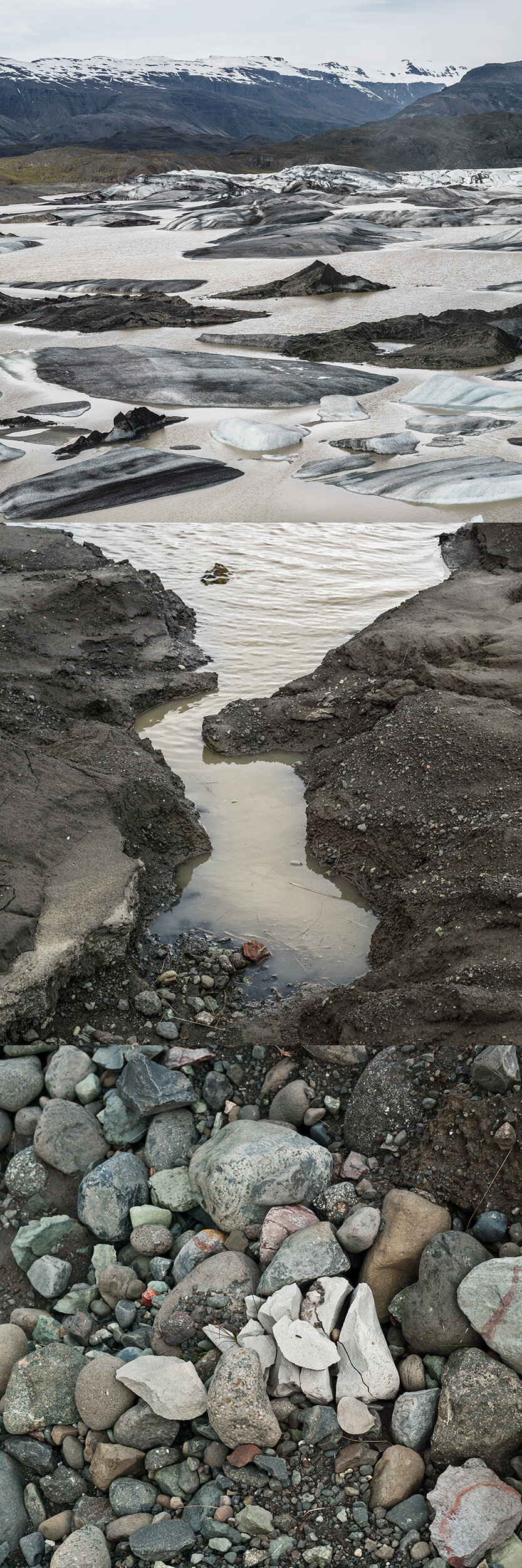
In other works gaps in the terrain, often where snow or ice might have been, are filled with texts about global warming.

image
Erosion VII, by Charlotta Hauksdóttir

Hauksdóttir recalls seeing Iceland change through her twenty years of photographing it. “If you look at the glacier in this photo, I took that in 2014. I went back in 2019, and the glacier was so much smaller, with pieces coming off as I watched. The erosion of nature that I have witnessed is represented in these works.”

A series of topographic works physically removes pieces of the landscape, giving a sense of time passing as erosion happens.

image
Topography Study XV, by Charlotta Hauksdóttir

“People often visualize topography,” Hauksdóttir observes, “with the pieces being built up from the base. But in mine they are cut away from the surface, showing the wearing away of our natural environment.” In an upcoming exhibition in Berkeley, viewers will themselves be taking away some of these pieces, reinforcing our involvement in the environmental degradation we are seeing.

Hauksdóttir’s work continues to evolve. With the storms of last year, she incorporated both the destructive force of the winds and our ability to repair by weaving together pictures bound around sticks. This work is more hopeful in that it not only cuts things up but also binds things together.

image
Reclamation IV, by Charlotta Hauksdóttir

This year, after many walks with her dog looking at plants growing in the smallest of sidewalk cracks, she developed new works that emphasize the resilience of nature in the face of the changes we are seeing.

image
Resurgence III, by Charlotta Hauksdóttir

“Sometimes I get criticism that my works are too beautiful, that they do not show enough of the destruction from climate change, or the harm that we are doing to the planet. But at the same time, it is important to draw viewers in. I find that people appreciate the works even more when they understand what they are about.”

Art can help us to connect with our feelings. Even Hauksdóttir does not know what her works are about until after she has created them and reflected upon them. We need to bring both our hearts and our minds to the environmental challenges we are facing. It is not enough to know without caring, or to care without knowing. Art that incorporates climate change themes can help us to reflect more deeply on the scale of the change, the destruction, the uncertainty, and the resilience that we are living with as the planet warms.

image
Indentation I, by Charlotta Hauksdóttir

You can see more of Hauksdóttir’s work on her website. She has a studio in Palo Alto’s Cubberley Community Center. She also has multiple pieces up at the Garvey Simon Gallery in San Anselmo, and will soon have several on display at 120710 in Berkeley. I hope many of you will take a look.

Happy Thanksgiving to everyone!

Current Climate Data
Global impacts (October 2023), US impacts (October 2023), CO2 metric, Climate dashboard

Globally, October 2023 was the warmest October in the 174-year NOAA record. The year-to-date (January–October) global surface temperature ranked as the warmest such period on record. October 2023 marked the fifth consecutive month of record-warm global temperatures. According to NCEI’s Global Annual Temperature Outlook and data through October, there is a greater than 99% probability that 2023 will rank as the warmest year on record.

Comment Guidelines
I hope that your contributions will be an important part of this blog. To keep the discussion productive, please adhere to these guidelines or your comment may be edited or removed.
– Avoid disrespectful, disparaging, snide, angry, or ad hominem comments.
– Stay fact-based and refer to reputable sources.
– Stay on topic.
– In general, maintain this as a welcoming space for all readers.

Rest with Music series features live music at planetarium for MSU community

Rest with Music series features live music at planetarium for MSU community

MSU’s Rest with Music events jump back into action this Monday. This event features a live free concert, allowing students and faculty to sit back in the Abrams Planetarium and relax with professional musicians

These events, which take place every third Monday of the month, are run by MSU Health4U, a program dedicated to giving the community the opportunity to unplug and take a break from their day through relaxing events. 

“We want to give folks the opportunity to come enjoy the planetarium while enjoying live music from artists and just getting a chance to unplug and get away from their work,” program consultant TJ Hall said. “It’s a super cool event, and the venue makes it all the more better.”

This is the eighth annual Rest with Music series at MSU. Throughout the years, the events have aimed to provide the community with a wide variety of diverse and dedicated artists

On Nov. 20, local and Indigenous singer-songwriter Jessica Dominic will serve as the selected talent. With this being Native American Heritage month, Hall and MSU Health4U partnered with the Native American Institute to bring Dominic to MSU to tell her story through song. 

This will be the third Rest with Music concert this semester. The first concert featured professional guitarist Hiroya Tsukamoto on Oct. 6, and the second concert featured local artist Phoebe Holmes on Oct. 16. Hall called both of these events “a success.” 

“The first two shows were great,” Hall said. “In shows like this, we try to bring in a diverse array of talent that bring a nice representation of the different music styles from around the world. It’s a unique show for the artist as well, because they’re playing in a totally dark and silent room. Tsukamoto and Holmes both did a fantastic job.” 

This event will be the last of the semester, but it’ll pick back up on Jan. 22 with Michigan born singer-songwriter Monte Pride being the main talent.

Multi-genre guitarist Justin Hatt will perform on Feb. 19, followed by jazz pianist performer Ricky Nalett on March 18. To end the spring semester, a diverse, Lansing-based band called the Dangling Participles will perform on April 15.

Rest with Music also continues into the summer season: singer-songwriter Taylor Taylor on May 20, folk musician Samuel Nalangira on June 17 and music duo Denning & Johnson on July 15. 

“The goal of the program is to give folks the opportunity to take a break and rest,” Hall said. “Though, we also want to let the campus community know there’s resources available through university health and wellbeing. We do programs like this all the time and all over campus, and they’re usually free.”  

Other programs that MSU Health4U hosts are courses and events like food and nutrition counseling, emotional wellness courses, yoga and more. More information about these can be found at MSU Health4U website

Rest with Music’s third and final show of the fall semester takes place on Monday, Nov. 20, from 12 p.m. to 12:50 p.m. in the Abrams Planetarium, with Jessica Dominic as the singer. While in-person admission is free, spots are limited. Community members can register online at the MSU Health4U website. There will also be a Facebook live of the event, which does not require registration, and can also be found on the website

Support student media!
Please consider donating to The State News and help fund the future of journalism.

Discussion

Share and discuss “Rest with Music series features live music at planetarium for MSU community ” on social media.

Hastings Native runs Shop Meg Ann after chasing her dreams

Hastings Native runs Shop Meg Ann after chasing her dreams

HASTINGS, Neb. (KSNB) – More than 25 vendors showed up to Braeder Barn on Saturday showing their crafts off to customers, including Megan Eddy who started her business Shop Meg Ann back in college.

“I have been doing art for my entire life,” Eddy said. “During 2020 like a lot of other people I needed a new hobby. I decided to take my business full-time, I started out by making stickers, I hand draw all of my stickers. Overtime I have grown it out to include scrunchies, earrings and pet bandanas.”

When Eddy launched her online business during her junior year of college she faced the challenge of balancing handling her shop while taking college courses, but at the same time it became her stress reliever. Now that she has graduated she can spend more time focusing on Shop Meg Ann. The passion started as a kid and for those who have goals, Eddy said chase them.

“Just go after your dreams,” Eddy said. “I have dreamed of doing this since I was a kid. My mom jokes because when I was younger I had a chillax and art studio in my basement where I tried to sell stuff to my family and now I am doing this full time and it is a full circle moment.”

You can find her shop here.

Click here to subscribe to our KSNB Local4 daily digest and breaking news alerts delivered straight to your email inbox.