Photography

John Goto obituary

John Goto obituary

For a couple of years in the late 2000s, the photographer John Goto, who has died aged 74 of hypersensitivity pneumonitis, and his wife Celia, a psychoanalyst, posed for a series of images he titled West End Blues. Singly or together, they stood in profile in front of restaurants and theatres around Soho, London, in costumes dating from the end of the first world war to the end of the Vietnam conflict. Their figures were then Photoshopped out of the resulting photographs, leaving negative images like the ones silhouetted on walls by a nuclear blast.

Each photograph was named after a famous jazz musician – Louis Armstrong, Ken “Snakehips” Johnson, Adelaide Hall – who had come to play in London between 1919 and 1974. Most were black, many of them migrants. The 17 images in West End Blues were variously troublesome. In terms of genre, they seemed closest to street photography, and yet their subjects were posed rather than happened upon. The bleached-out Gotos were flat, the backgrounds behind them three-dimensional; the photographs affected to be archival, and yet were entirely contemporary. Worst of all, the images had been openly, joyously manipulated on a computer. When Goto turned his series into an augmented reality walking tour downloadable on a mobile phone, critics of a purist bent shuddered.

This discomfort was intentional. As Goto recalled, his fondness for Armstrong et al had begun on youthful visits to Soho to listen to jazz. Just as the musicians in West End Blues had seen London as an escape from life back home, so Goto saw his trips to hear them as a release from the English provinces.

Goto had his first one-man show in 1981, a retrospective at the Photographers’ gallery

Born in Stockton, near Manchester, to Bernard Glithero, an engineer, and Catherine (nee Craig), a housewife, he had moved with his family to Berkshire as a child. After attending grammar school in Windsor (which he disliked), he went to the Berkshire College of Art in Maidenhead in 1965 and then to study painting at St Martin’s School of Art in London. It was there that he discovered the cinema as another, and more permanent, means of escape. Impressed by Walerian Borowczyk’s film Goto, l’île d’amour (1969), John Glithero took the island of its title as his name.

The hybrid nature of the images in West End Blues suggested another form of permanence. Their apparently random settings had actually been archaeologically sought out. The Chinese restaurant in the photograph called Sidney Bechet stood on the site of the Royal Philharmonic Hall where Bechet had played in 1919; the block of flats in Shake Keane and Ambrose Campbell had once been home to the Abalabi Club. “My West End is inhabited by the spectre of musicians past and sounds lost,” Goto said. “But are they really lost? I’m convinced that on a quiet night, towards dawn, the attentive listener can still hear the strains of Rent House Stomp or Yolanda.”

This taste for muddying the typological waters had come early. In 1981, Goto had his first one-man show, a retrospective at the Photographers’ Gallery of 60 photographs taken over the previous decade. This, unusually, was advertised by a movie poster made by the graphic artist and sometime film-maker Andrzej Klimowski, a St Martin’s friend. The exhibition also had its own soundtrack, of voices speaking in Czech and Polish.

In 1978, Goto had spent several months on a scholarship in Prague, a place he described as “poised between past and present”. The experience left him with a profound sense of himself as a European photographer, and resentment at the postwar dominance in Europe of American photography. Echoes of Russian constructivism and the Bauhaus would recur in his art for the rest of his career.

In the year before Prague, he had taught photography evening classes at the Lewisham youth centre in south London. As he had with jazz musicians, so he felt a kinship with his predominantly black students. The previous year had seen riots at the Notting Hill carnival; in August, a National Front march had sparked the so-called Battle of Lewisham. “Young black people were being actively criminalised,” Goto recalled, and yet there was “no space for accounts of their cultural life”. This he provided in the form of portraits of his students, taken in a dance hall next to the youth centre.

Lovers’ Rock, Lewisham Dancehall Portraits, 1977

Typically, there was no interest in these at the time. It was only in 2013 that the series was finally shown, in an exhibition at Art Jericho in Oxford called 1977: Lewisham & Belleville. (The Belleville images were taken when Goto spent part of that year in Paris on a British Council scholarship.) To coincide with the show, the Lewisham photographs were published as a book called Lovers’ Rock, which also included a series of essays, one of them by Lady Young of Hornsey, who noted that the portraits were something more than just a corrective “to pictures of black youth rioting”. Goto admitted to “a resonance” with his subjects, “the recognition of a struggle I knew and carried within me”.

“It may only be a bleak hope,” he went on, “but in this struggle, I believe, lies our dignity.”

In 1980, Goto moved to Oxford, where he would live for the rest of his life, teaching at Oxford Polytechnic (which became Oxford Brookes University) for 20 years. At lunchtimes, students would be shown the work of his favourite film-makers, including Kurosawa and Tarkovsky. In 2003, he was made professor of fine art at the University of Derby, and then emeritus professor from 2013 until his death.

The terrace house he shared with Celia he liked to describe as “the smallest palace in the world”, its walls hung with the work of St Martin’s friends, such as Klimowski and Craigie Horsfield, jazz inevitably playing in the background. He regularly passed the plaster dog outside a jeweller’s shop on the High Street that the Bauhaus artist László Moholy-Nagy, fleeing nazism, had photographed in 1936. The dog, and other Moholy photographs, inspired Goto’s own show, Two Days at Oxford, in 2016.

In 1967, while at St Martin’s, Goto had met Linda Gowan; they married in 1972 and divorced in 1982. He met Celia Farrelly the following year, and married her in 1992. She survives him, as do the daughters, Jade and Zoey, of his first marriage.

Suns out, buns out! Sunflower farm erects signage banning nude photography

Suns out, buns out! Sunflower farm erects signage banning nude photography
image

Stoke Fruit Farm, located on an island off the coast of England, has posted signs disallowing nude photography with their sunflowers. Evidently this is to protect the children. The United Kingdom needs a Disney theme park to sue or something.

CNN:

The owners of Stoke Fruit Farm on Hayling Island, off England’s south coast, issued the unusual request on social media, having noticed a growing number of visitors stripping naked to pose for pictures among the blooms.

In a post on Facebook earlier this month, the farm wrote: “Reminder to all we are a family area and please keep your clothes on in the sunflowers! We are having a increase of reports of naked photography taking place and this must not happen during our public sessions please!”

Sam Wilson and sister Nette Petley run the farm that their grandfather set up. It comprises 350 acres, producing wheat, peas, potatoes, pumpkins, squash, sweetcorn, hay – and sunflowers.

Wilson told CNN Friday that there had been about six incidents of people stripping off among the sunflowers since the field opened to visitors at the end of last month.

Six whole incidents. Please visit the beach in Los Angeles.

Amazon World Photography Day sale: Here’s what you can get

Amazon World Photography Day sale: Here’s what you can get

Amazon India is celebrating World Photography Day with a new sale. Photography enthusiasts can avail of attractive discounts on products from several top brands during this sale. The e-commerce giant is offering discounts on cameras and accessories from top brands including Canon, Sony, Fujifilm, Panasonic, GoPro, Digitech and more. At this sale, customers can avail of an instant discount of up to Rs 4,000 on HDFC bank credit/debit card EMI transactions and up to 12 months of no-cost EMI.
Amazon World Photography Day sale: Products and deals
Here are some products to choose from the Amazon World Photography Day sale that are available with multiple deals and offers from sellers:
Amazon Basics Smartphone Gimbal:Say goodbye to shakes and jerks while shooting photographs, selfies, vlogs and live streams.Get smooth, steady footage and upgrade your vlogging skills with the Gimbal stabiliser available on Amazon for Rs 5,499.
Canon EOS R10 Mirrorless camera: Find your story with EOS R10. This camera is an ideal travel companion and serves as the ultimate hybrid content creation tool. Get this on Amazon for Rs 96,490
Canon M50 MKII Mirrorless camera: The lightweight and stylish EOS M50 Mark II has user-friendly features like Wi-Fi connectivity. Get this Canon’s flagship mirrorless camera on Amazon with an additional Rs 4,000 bank discount for Rs 58,990
DJI OM6 Smartphone Gimbal: DJI’s premier OM6 gimbal can improve shooting skills as it features integrated advanced stabilisation technology that counteracts unwanted movements and captures moments with cinematic smoothness. Get this on Amazon for Rs 14,490
Digitek DSG 007 Smartphone Gimbal: Capture precious moments with Digitek gimbal that comes with 3 creative operation modes that include all follow mode, half follow mode and all lock mode for precise shooting. Get this on Amazon at an additional Rs 200 off for Rs 5,799
Digitek 14-inch Ring Light with Tripod: Upgrade your vlogging skills with the light effects from Digitek ring lights. It comes with intensity control, colour temperature control and a power button making it easier to operate. Additionally, it has a step-less adjustment of colour temperature to maintain product tone or create subject details. Get this on Amazon at 60% off for Rs 1,399.
FitSpark Eagle i9 Plus Action Camera: FitSpark Eagle i9 is the first-in-class action camera to offer dual screens. It comes with a Pro Wi-Fi-enabled smartphone-controlled remote to capture the scenes from a long distance. Get this on Amazon for Rs 9,499.
Fujifilm Instax Mini 12 Instant Camera (Purple): Capture photos regardless of the time and place with Instax Mini 12 and present them as instant memories. It can also be a gift for your loved ones. Get this on Amazon for Rs 5,999
GoPro Hero 9 Action Camera Bundle: The Hero 9 Black features a 23.6MP sensor enabling 5K videos and 20MP photos. A new front display offers a live preview for framing alongside a rear touch screen with touch zoom providing swift and intuitive control. Get this on Amazon for Rs 27,490 along with a free original GoPro battery.
Hohem iSteady Smartphone Gimbal: The iSteady M6 gimbal integrates the iSteady 7.0 stabilisation algorithms enabling users to capture creations while on the move, free from shakes. Whether walking or running, it ensures filming with stabilisation resulting in smooth footage creation. Get this on Amazon for Rs 16,990
IZI Dual Screen Action Camera: Unleash your creativity with this action camera that boasts a 48MP camera resolution and offers 5K at 30fps and 4K at 60fps. It captures breathtaking moments in stunning detail and fluid motion pushing the boundaries of adventure. Get this on Amazon for Rs 9,499.

Kodak Instant Camera: The Kodak Mini Shot 3 Retro is a Polaroid camera with a built-in photo printer, allowing users to print their images or discard them after capture. With this instant camera, one can also print photos directly from their mobile gallery via Bluetooth. It is compatible with Apple iPhone, iPad and Android devices. Get this on Amazon for Rs 12,999.
Osaka 55-inch Professional Tripod: This tripod is equipped with 3 adjustable quick-turn leg locks and 4-stage upright legs featuring quick-release lever locks. These allow one to adjust the working height from 16 inches to 55 inches within seconds, making it 5 inches longer than other common tripods. It can be swiftly set up and disassembled rendering it suitable for diverse shooting environments and various photography needs. Get this on Amazon for Rs 899.
Panasonic Lumix G7 Mirrorless Camera: This is the most budget-friendly mirrorless camera from Panasonic. Equipped with a 16MP Micro Four Thirds sensor, it boasts no low-pass filter ensuring the capture of sharp images with improved dynamic range and artifact-free performance. Get this on Amazon extra 23% off for Rs 42,490
Sony 7M3K Mirrorless Camera: The Alpha 7 III gives the power, precision and flexibility to capture moments in a compact body. Get this premium mirrorless camera from Sony on Amazon now at an extra 20% off for Rs 1,43,990
Sony ZV1 Vlog Camera: ZV 1 is tailored for content creators and bloggers. Accompanied by a Sony Bluetooth wireless shooting grip, it is crafted for handheld shots and vlogging. The camera ensures the assurance of blur- and shake-free shots. Get this affordable vlogging camera on Amazon at 20% off for Rs 62,990
Sigma 150-600 mm for Canon cameras: Now take long-range shots with ease and zoom into the subject with Sigma’s hyper-telephoto lens. Get this on Amazon at 20% off for Rs 79,990.

5 Tips for Capturing Beautiful Waterfall Photos

5 Tips for Capturing Beautiful Waterfall Photos
[embedded content]

Landscape photographer Michael Shainblum is extremely experienced across a diverse range of landscape photo subgenres, including woodland, seascape, and abstract landscape photography. Among Shainblum’s favorite landscape photography genres is waterfall photography, the subject of his latest tutorial.

Shainblum’s first tip for shooting waterfalls is to use an ultra-wide lens, such as a 14-24mm or 16-35mm zoom. Shainblum recently touted the value of longer zoom lenses for landscape photography, but shooting waterfalls with a wide-angle perspective helps create immersion, especially if the photographer can stand in the water beneath the waterfall. Shainblum explains that if someone ventures into the water, they should exercise caution.

“Personally, I walk through the water cautiously, ensuring it’s not too deep or forceful. For those new to this experience, take your time to acclimate to the surroundings and gauge your comfort level. If standing in the stream feels uneasy, nature often provides logs or rocks that offer stable platforms for observation,” he writes.

Michael Shainblum waterfall photography

As for composition, Shainblum likes to point his camera slightly downward to include two-thirds or three-quarters of the ground, which creates a pathway to the waterfall itself.

“If the flow of water doesn’t naturally guide the viewer’s eye toward the falls, experiment with your positioning until you achieve a satisfying composition. This adjustment might require some patience, but the resulting image is well worth the effort,” recommends Shainblum.

His next tip is to bring out that long telephoto lens to shoot a bit of minimalist waterfall photography.

“Telephoto photography introduces a distinct departure from the previous technique. Instead of immersing yourself in the lively waterflow, opt for a serene experience on the shore. Choose a dry spot where you can comfortably enjoy the waterfall spectacle,” Shainblum explains. “With the telephoto lens, you’ll zoom in on specific details of the falls, rather than encompassing the entire scene.”

Michael Shainblum waterfall photography

With a longer lens, photographers can zero in on specific details in the scene and find intriguing colors and patterns. Shutter speed selection can dramatically impact the image’s ” feel ” as well, with a shorter speed showing more power and texture in the waterfall and a slower shutter speed offering a dreamier, soft look.

These are just a couple of ways photographers can improve their waterfall photography using two very different approaches. Shainblum delivers three additional excellent waterfall photography tips in the video above and on his blog, including finding compelling framing elements, utilizing reflections, and embracing spontaneity in the field.

Michael Shainblum waterfall photography

More of Michael Shainblum’s photography tutorials are featured on his website and more of his beautiful imagery is available in his portfolio and on Instagram.


Image credits: All images © Michael Shainblum

Museum archivist speaks on Ruohomaa photographs

Museum archivist speaks on Ruohomaa photographs

ROCKPORT — Kevin Johnson, photo archivist for the Penobscot Marine Museum in Searsport, presents a slide show and talk entitled “Kosti Ruohomaa: The Maine Assignments” Sunday, Aug. 27, at 2 p.m. at the Rockville Community Chapel, 87 Old Rockland St. (behind the Green Thumb). The Ruohomaa Collection has come home to Maine as the newest addition to the photography holdings of the Penobscot Marine Museum. The Rockland photographer’s collection was recently donated to the PMM by Black Star of New York, Ruohomaa’s photography agency, and consists of thousands of medium and large format negatives, 35-mm negatives and slides, as well as contact sheets and vintage prints.

During the age of the photo magazine, Ruohomaa was a rock star in the photography world. His photographs graced the cover of Life Magazine numerous times. Other major magazines such as Look, National Geographic and Life used his photos regularly. He moved to Dodge Mountain in Rockland at the age of 13, where his family had a blueberry farm. He discovered his love for photography in the 1930s while working as a cartoonist for Disney. During the 1940s and ’50s, his career blossomed. While he photographed around the world, Maine was his favorite subject, both the people and land. He died prematurely in 1961 at the age of 47.

The 19th Century Photographer Who Shined a Light on American Poverty | The Saturday Evening Post

The 19th Century Photographer Who Shined a Light on American Poverty | The Saturday Evening Post

Weekly Newsletter

The best of The Saturday Evening Post in your inbox!

The last few decades of the 19th century brought unprecedented changes to New York City. The population exploded, growing from about 800,000 people in 1860 to more than 3 million by 1900, according to U.S. Census Bureau numbers. The Metropolitan Museum moved into its impressive Fifth Avenue location in 1880. The Brooklyn Bridge opened in 1883. Construction was completed on the luxurious Dakota Apartments in 1884. The Statue of Liberty was dedicated in 1886.

But just a few miles from the Gilded Age glory, more than a million people — many of them recent immigrants — were packed into squalid, dank neighborhoods where disease ran rampant and thousands of children died every year from the filthy conditions. As images of New York’s iconic landmarks were being shared across the world, the poor suffered just out of sight.

But one man decided to train his camera on the millions packed into the city’s shoddily built, six- to seven-story windowless tenements that offered no plumbing, light, ventilation, or fire escapes. In his efforts to expose New York’s poverty-stricken underbelly, Jacob August Riis produced some of the most iconic photographs of the late 19th century. International Photography Day on August 19 is a good day to remember the mighty impact of his photographs and how they helped the world realize the power of photography to expose injustice and repression.

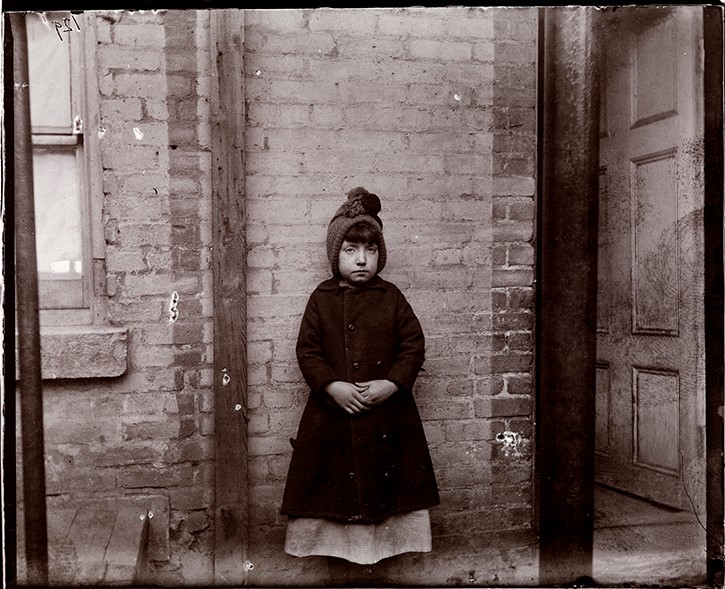
image“I Scrubs”— Little Katie from the West 52nd Street Industrial School, 1891–1892 (Jacob Riis, Library of Congress)
” data-medium-file=”https://www.saturdayeveningpost.com/wp-content/uploads/satevepost/poverty-01-400×325.jpg” data-large-file=”https://www.saturdayeveningpost.com/wp-content/uploads/satevepost/poverty-01-500×406.jpg” decoding=”async” loading=”lazy” class=”size-full wp-image-1154813″ src=”https://www.saturdayeveningpost.com/wp-content/uploads/satevepost/poverty-01.jpg” alt width=”725″ height=”589″ srcset=”https://www.saturdayeveningpost.com/wp-content/uploads/satevepost/poverty-01.jpg 725w, https://www.saturdayeveningpost.com/wp-content/uploads/satevepost/poverty-01-400×325.jpg 400w, https://www.saturdayeveningpost.com/wp-content/uploads/satevepost/poverty-01-500×406.jpg 500w, https://www.saturdayeveningpost.com/wp-content/uploads/satevepost/poverty-01-300×244.jpg 300w, https://www.saturdayeveningpost.com/wp-content/uploads/satevepost/poverty-01-600×487.jpg 600w” sizes=”(max-width: 725px) 100vw, 725px”>
“I Scrubs”— Little Katie from the West 52nd Street Industrial School, 1891–1892 (Jacob Riis, Library of Congress)

Arriving in New York City in 1870 from Denmark, the 21-year-old Riis often was forced into the squalid conditions he would later record. By the time he was 28, he had found steady work as a writer, editor, and journalist, and was able to forge a firm path into the middle class. But his job never let him forget the misery he had experienced. A night-shift police reporter for a popular newspaper, he trailed policemen into some of the worst slums and seediest spots in the city.

When Riis tried to expose the squalid living conditions through his writing, he discovered that words had a limited effect. In his 1901 autobiography, The Making of an American, Riis wrote, “It was upon my midnight trips with the sanitary police that the wish kept cropping up in me that there were some way of putting before the people what I saw there.”

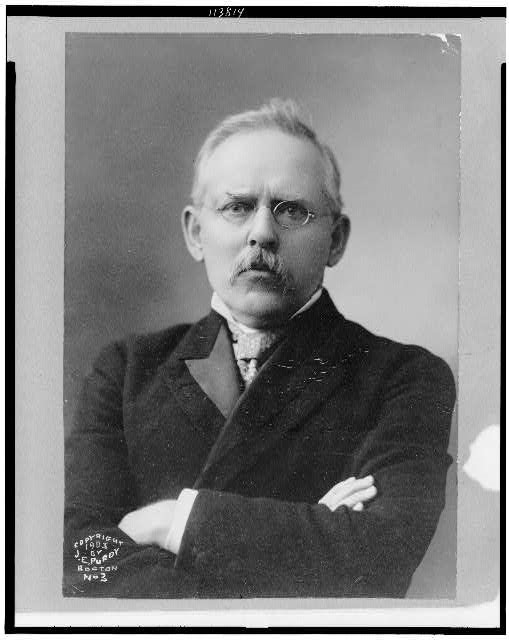
imageJacob Riis, ca. 1903 (Library of Congress)
” data-medium-file=”https://www.saturdayeveningpost.com/wp-content/uploads/satevepost/poverty-02-400×503.jpg” data-large-file=”https://www.saturdayeveningpost.com/wp-content/uploads/satevepost/poverty-02-500×629.jpg” decoding=”async” loading=”lazy” class=” wp-image-1154814″ src=”https://www.saturdayeveningpost.com/wp-content/uploads/satevepost/poverty-02.jpg” alt width=”392″ height=”493″ srcset=”https://www.saturdayeveningpost.com/wp-content/uploads/satevepost/poverty-02.jpg 509w, https://www.saturdayeveningpost.com/wp-content/uploads/satevepost/poverty-02-400×503.jpg 400w, https://www.saturdayeveningpost.com/wp-content/uploads/satevepost/poverty-02-500×629.jpg 500w, https://www.saturdayeveningpost.com/wp-content/uploads/satevepost/poverty-02-300×377.jpg 300w” sizes=”(max-width: 392px) 100vw, 392px”>
Jacob Riis, ca. 1903 (Library of Congress)

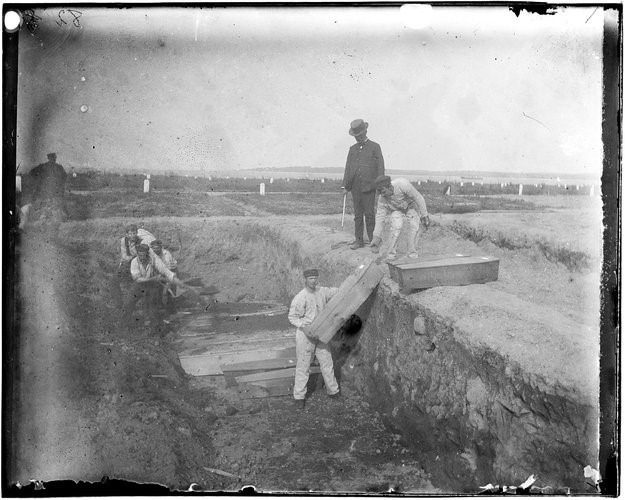
In 1887, Riis saw an advertisement heralding the invention of magnesium flash that would allow photographers to illuminate dark places. He found two amateur photographers who were interested in the new technology to help him photograph life in the tenements, but they soon lost interest, so he learned to use the camera himself. He took his first picture at the Potter’s Field on Hart’s Island, where the poorest of the poor were buried. The overexposed photograph was an inauspicious technical beginning, but the image of gravediggers standing over a trench filled with a row of caskets remains as shocking today as it was then.

image“The Potter’s Field, the Common Trench,” Hart’s Island, ca. 1890 (Jacob Riis, Museum of the City of New York)
” data-medium-file=”https://www.saturdayeveningpost.com/wp-content/uploads/satevepost/poverty-03-400×320.jpg” data-large-file=”https://www.saturdayeveningpost.com/wp-content/uploads/satevepost/poverty-03-500×400.jpg” decoding=”async” loading=”lazy” class=”wp-image-1154815″ src=”https://www.saturdayeveningpost.com/wp-content/uploads/satevepost/poverty-03.jpg” alt width=”800″ height=”640″ srcset=”https://www.saturdayeveningpost.com/wp-content/uploads/satevepost/poverty-03.jpg 625w, https://www.saturdayeveningpost.com/wp-content/uploads/satevepost/poverty-03-400×320.jpg 400w, https://www.saturdayeveningpost.com/wp-content/uploads/satevepost/poverty-03-500×400.jpg 500w, https://www.saturdayeveningpost.com/wp-content/uploads/satevepost/poverty-03-300×240.jpg 300w, https://www.saturdayeveningpost.com/wp-content/uploads/satevepost/poverty-03-600×480.jpg 600w” sizes=”(max-width: 800px) 100vw, 800px”>
“The Potter’s Field, the Common Trench,” Hart’s Island, ca. 1890 (Jacob Riis, Museum of the City of New York)

Thus began Riis’s journey of providing photographs that opened people’s eyes to the suffering of the poor. His unique photographs have only gained power and significance in the decades, providing an important historical record of life in the shadows of New York’s wealth. Some photos show only tenement buildings, while others record people sleeping in police stations, living in city dumps, hanging out in bars, or standing in alleyways. Many pictures focus on poor children working in sweatshops, selling newspapers, and sleeping in streets.

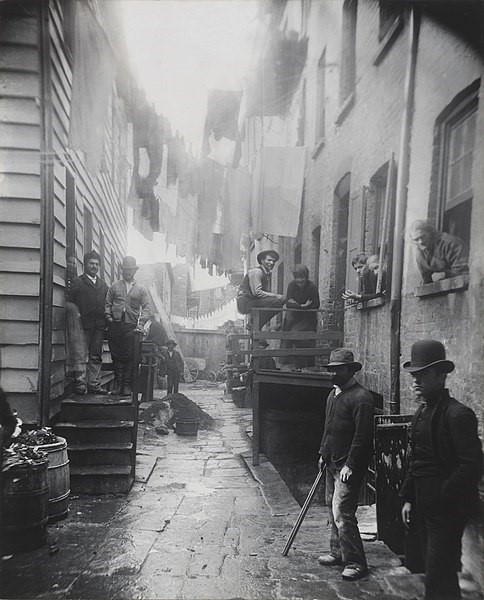
image“Bandit’s Roost,” 1888 (Jacob Riis, MoMA)
” data-medium-file=”https://www.saturdayeveningpost.com/wp-content/uploads/satevepost/poverty-04-400×496.jpg” data-large-file=”https://www.saturdayeveningpost.com/wp-content/uploads/satevepost/poverty-04.jpg” decoding=”async” loading=”lazy” class=”size-full wp-image-1154816″ src=”https://www.saturdayeveningpost.com/wp-content/uploads/satevepost/poverty-04.jpg” alt width=”484″ height=”600″ srcset=”https://www.saturdayeveningpost.com/wp-content/uploads/satevepost/poverty-04.jpg 484w, https://www.saturdayeveningpost.com/wp-content/uploads/satevepost/poverty-04-400×496.jpg 400w, https://www.saturdayeveningpost.com/wp-content/uploads/satevepost/poverty-04-300×372.jpg 300w” sizes=”(max-width: 484px) 100vw, 484px”>
“Bandit’s Roost,” 1888 (Jacob Riis, MoMA)
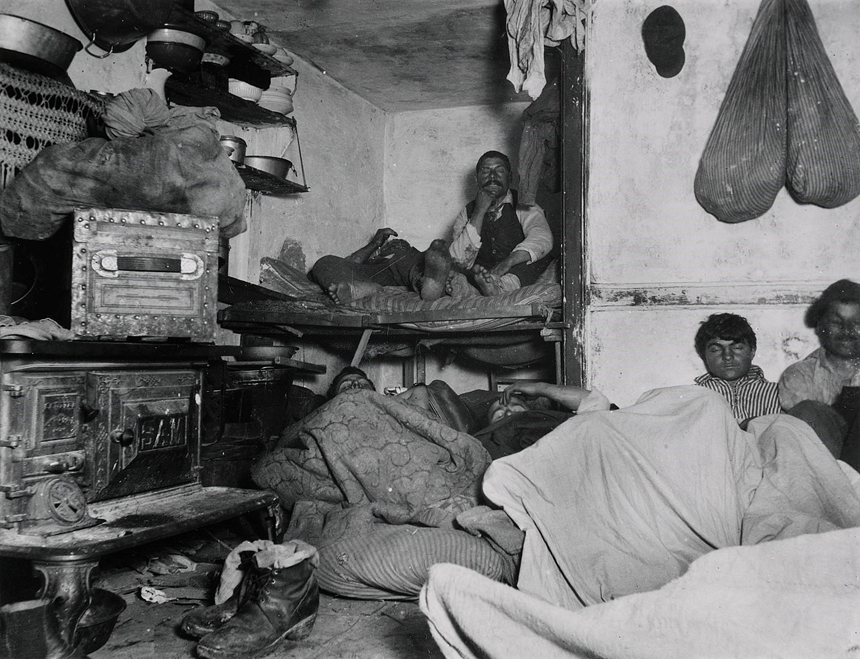
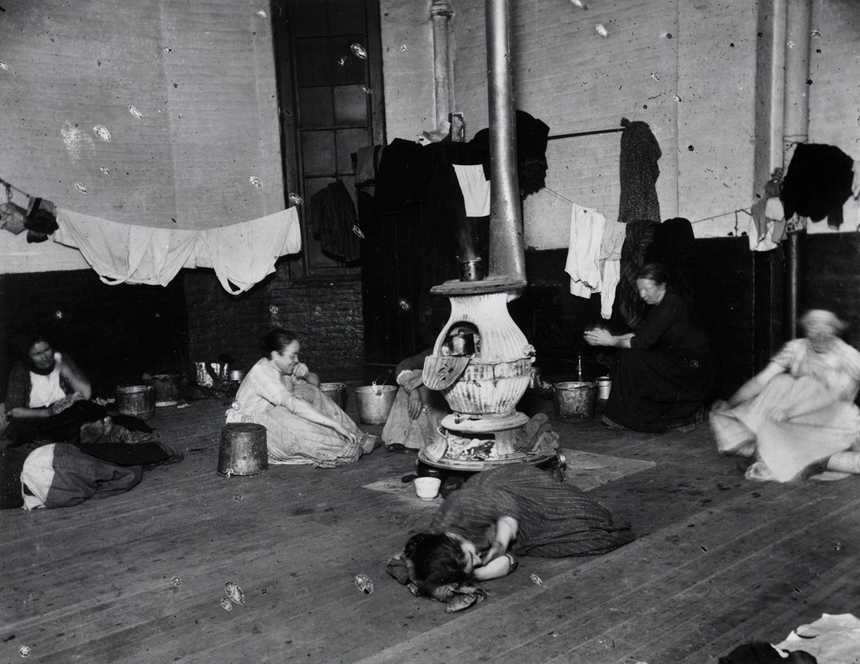
image“Lodgers in Bayard Street Tenement, Five Cents a Spot,” 1889 (Jacob Riis, MoMA)
” data-medium-file=”https://www.saturdayeveningpost.com/wp-content/uploads/satevepost/poverty-05-400×307.jpg” data-large-file=”https://www.saturdayeveningpost.com/wp-content/uploads/satevepost/poverty-05-500×383.jpg” decoding=”async” loading=”lazy” class=”size-full wp-image-1154817″ src=”https://www.saturdayeveningpost.com/wp-content/uploads/satevepost/poverty-05.jpg” alt width=”860″ height=”659″ srcset=”https://www.saturdayeveningpost.com/wp-content/uploads/satevepost/poverty-05.jpg 860w, https://www.saturdayeveningpost.com/wp-content/uploads/satevepost/poverty-05-400×307.jpg 400w, https://www.saturdayeveningpost.com/wp-content/uploads/satevepost/poverty-05-500×383.jpg 500w, https://www.saturdayeveningpost.com/wp-content/uploads/satevepost/poverty-05-768×589.jpg 768w, https://www.saturdayeveningpost.com/wp-content/uploads/satevepost/poverty-05-300×230.jpg 300w, https://www.saturdayeveningpost.com/wp-content/uploads/satevepost/poverty-05-600×460.jpg 600w” sizes=”(max-width: 860px) 100vw, 860px”>
“Lodgers in Bayard Street Tenement, Five Cents a Spot,” 1889 (Jacob Riis, MoMA)

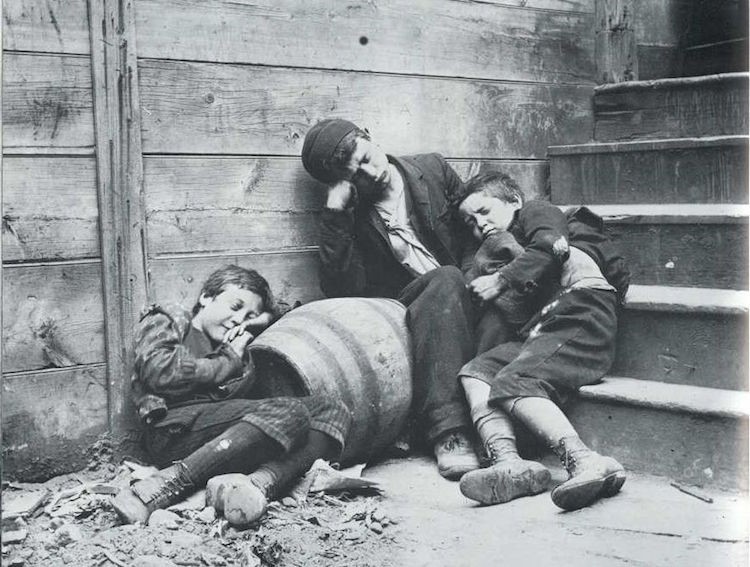
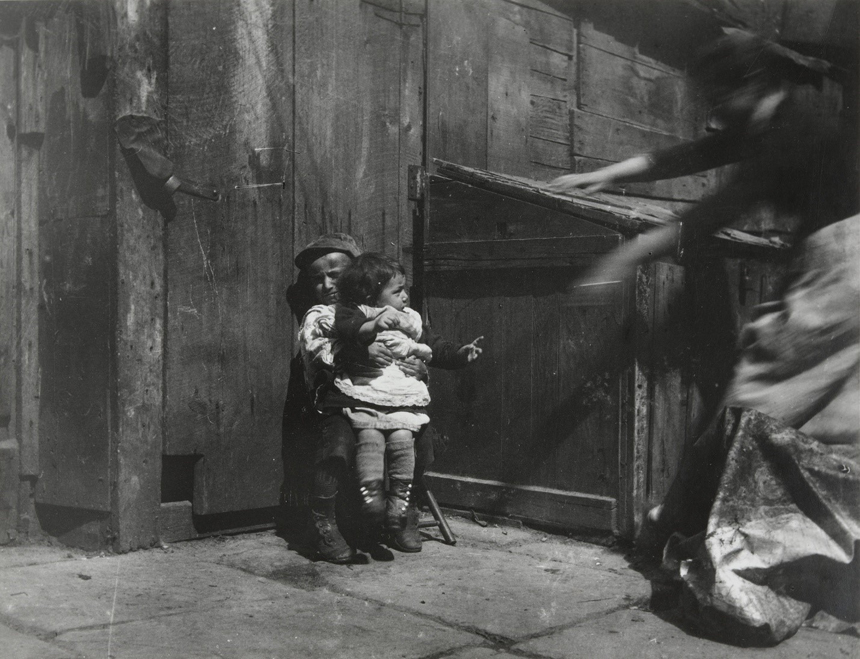
These images are raw, vulnerable, and realistic, revealing the chaos and trauma of poverty. Claustrophobic cramped rooms. Broken windows. Dark, streaked walls. Rumpled, torn, and ill-fitting clothes. Uncombed, matted hair and dirty faces. Kids in rags with no shoes, sleeping on stairs and in the streets.

image“Minding the Baby” (Jacob Riis, MoMA)
” data-medium-file=”https://www.saturdayeveningpost.com/wp-content/uploads/satevepost/poverty-06-400×307.jpg” data-large-file=”https://www.saturdayeveningpost.com/wp-content/uploads/satevepost/poverty-06-500×383.jpg” decoding=”async” loading=”lazy” class=”size-full wp-image-1154818″ src=”https://www.saturdayeveningpost.com/wp-content/uploads/satevepost/poverty-06.jpg” alt width=”860″ height=”659″ srcset=”https://www.saturdayeveningpost.com/wp-content/uploads/satevepost/poverty-06.jpg 860w, https://www.saturdayeveningpost.com/wp-content/uploads/satevepost/poverty-06-400×307.jpg 400w, https://www.saturdayeveningpost.com/wp-content/uploads/satevepost/poverty-06-500×383.jpg 500w, https://www.saturdayeveningpost.com/wp-content/uploads/satevepost/poverty-06-768×589.jpg 768w, https://www.saturdayeveningpost.com/wp-content/uploads/satevepost/poverty-06-300×230.jpg 300w, https://www.saturdayeveningpost.com/wp-content/uploads/satevepost/poverty-06-600×460.jpg 600w” sizes=”(max-width: 860px) 100vw, 860px”>
“Minding the Baby” (Jacob Riis, MoMA)
image“Street Arabs in their Sleeping Quarters” (Jacob Riis, My Modern Met)
” data-medium-file=”https://www.saturdayeveningpost.com/wp-content/uploads/satevepost/poverty-07-400×302.jpg” data-large-file=”https://www.saturdayeveningpost.com/wp-content/uploads/satevepost/poverty-07-500×378.jpg” decoding=”async” loading=”lazy” class=”size-full wp-image-1154819″ src=”https://www.saturdayeveningpost.com/wp-content/uploads/satevepost/poverty-07.jpg” alt width=”750″ height=”567″ srcset=”https://www.saturdayeveningpost.com/wp-content/uploads/satevepost/poverty-07.jpg 750w, https://www.saturdayeveningpost.com/wp-content/uploads/satevepost/poverty-07-400×302.jpg 400w, https://www.saturdayeveningpost.com/wp-content/uploads/satevepost/poverty-07-500×378.jpg 500w, https://www.saturdayeveningpost.com/wp-content/uploads/satevepost/poverty-07-300×227.jpg 300w, https://www.saturdayeveningpost.com/wp-content/uploads/satevepost/poverty-07-600×454.jpg 600w” sizes=”(max-width: 750px) 100vw, 750px”>
“Street Arabs in their Sleeping Quarters” (Jacob Riis, My Modern Met)

Riis first presented his photographs in lectures, “How the Other Half Lives and Dies in New York,” projecting images onto a screen by a “magic lantern.” He delivered his two-hour presentations to churches and civic groups in New York City and throughout the Northeast. Appealing to the tenets of his Christian faith, Riis petitioned for compassion and help for the people trapped in the tentacles of poverty.

image“Police Station Lodgers,” women`s lodging room in the West 47th Street station (Picryl, Preus Museum)
” data-medium-file=”https://www.saturdayeveningpost.com/wp-content/uploads/satevepost/poverty-08-400×309.jpg” data-large-file=”https://www.saturdayeveningpost.com/wp-content/uploads/satevepost/poverty-08-500×386.jpg” decoding=”async” loading=”lazy” class=”size-full wp-image-1154820″ src=”https://www.saturdayeveningpost.com/wp-content/uploads/satevepost/poverty-08.jpg” alt width=”860″ height=”664″ srcset=”https://www.saturdayeveningpost.com/wp-content/uploads/satevepost/poverty-08.jpg 860w, https://www.saturdayeveningpost.com/wp-content/uploads/satevepost/poverty-08-400×309.jpg 400w, https://www.saturdayeveningpost.com/wp-content/uploads/satevepost/poverty-08-500×386.jpg 500w, https://www.saturdayeveningpost.com/wp-content/uploads/satevepost/poverty-08-768×593.jpg 768w, https://www.saturdayeveningpost.com/wp-content/uploads/satevepost/poverty-08-300×232.jpg 300w, https://www.saturdayeveningpost.com/wp-content/uploads/satevepost/poverty-08-600×463.jpg 600w” sizes=”(max-width: 860px) 100vw, 860px”>
“Police Station Lodgers,” women`s lodging room in the West 47th Street station (Picryl, Preus Museum)

In 1890, he packaged his lecture material into a book, How the Other Half Lives, which became a bestseller and led to national fame. Although Riis characterized immigrants in terms that today would be considered racist, his work as a writer, lecturer, and photographer helped Americans recognize and combat some of the worst poverty and misery in New York. His efforts led to the abolition of the most decrepit tenements and the construction of many city parks, including today’s Columbus Park in what had been Mulberry Bend, one of the City’s most crime- and disease-ridden neighborhoods. Today, Riis’s legacy is commemorated through developments that still bear his name, such as the Jacob Riis Houses on the Lower East Side, the Jacob A. Riis Settlement House in Long Island City, and Jacob Riis Park in Far Rockaway.

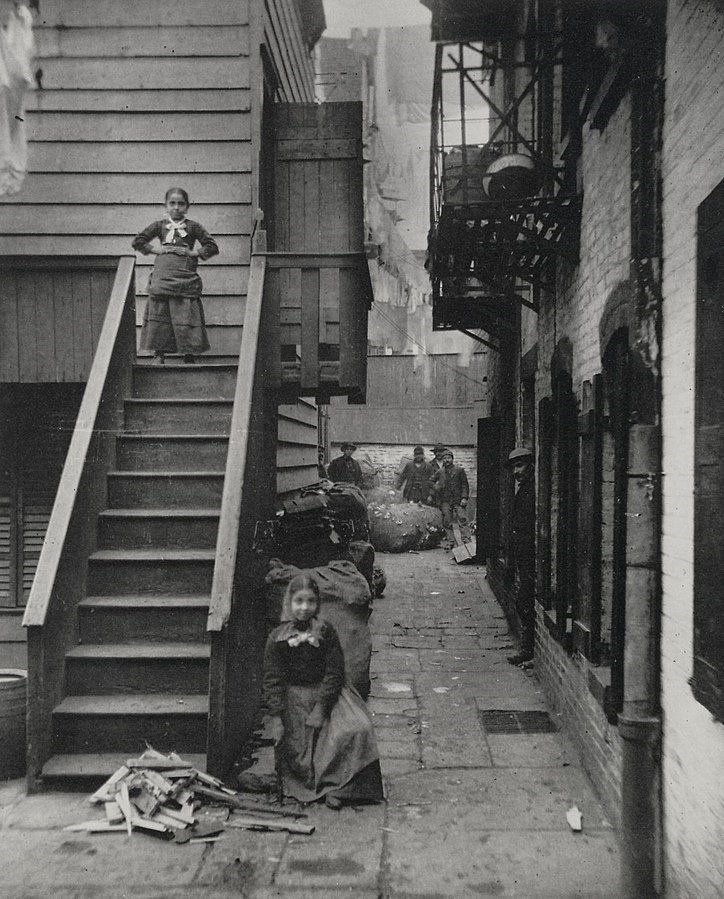
imageBaxter Street Alley in Mulberry Bend (Jacob Riis, Museum of the City of New York)
” data-medium-file=”https://www.saturdayeveningpost.com/wp-content/uploads/satevepost/poverty-09-400×497.jpg” data-large-file=”https://www.saturdayeveningpost.com/wp-content/uploads/satevepost/poverty-09-500×621.jpg” decoding=”async” loading=”lazy” class=”size-full wp-image-1154821″ src=”https://www.saturdayeveningpost.com/wp-content/uploads/satevepost/poverty-09.jpg” alt width=”724″ height=”899″ srcset=”https://www.saturdayeveningpost.com/wp-content/uploads/satevepost/poverty-09.jpg 724w, https://www.saturdayeveningpost.com/wp-content/uploads/satevepost/poverty-09-400×497.jpg 400w, https://www.saturdayeveningpost.com/wp-content/uploads/satevepost/poverty-09-500×621.jpg 500w, https://www.saturdayeveningpost.com/wp-content/uploads/satevepost/poverty-09-300×373.jpg 300w, https://www.saturdayeveningpost.com/wp-content/uploads/satevepost/poverty-09-600×745.jpg 600w” sizes=”(max-width: 724px) 100vw, 724px”>
Baxter Street Alley in Mulberry Bend (Jacob Riis, Museum of the City of New York)

By the time he died in 1914, Riis had written 12 books and crisscrossed the country many times to give lectures. “Riis was the first muckraker and the first American social documentary photographer,” Bonnie Yochelson and Daniel Czitrom write in their 2014 book, Rediscovering Jacob Riis: Exposure Journalism and Photography in Turn-of-the-Century New York. “A century later, [his photographs] remain a powerful and unique record of the lived material conditions in turn-of-the-century New York.”

Riis’s work reminds us that much of what he witnessed over 100 years ago remains relevant to this day: that grinding poverty is still with us, and a segment of our society still dwells in homes that are dangerous and unfit, or live unhoused on the streets. But Riis understood we have a hard time fixing problems that we can’t — or don’t want — to see, and he showed how shining a light in dark places can often be the first step toward real change.

Become a Saturday Evening Post member and enjoy unlimited access.
Subscribe now

Creating a Riot of Color, in a Studio of Her Own

Creating a Riot of Color, in a Studio of Her Own
image

“I think we must all agree,” the British photographer Yevonde declared in 1921 to the Professional Photographer’s Association in London, “photography without women would be a sorry business.”

With a focus on female representation, “Yevonde: Life and Color,” a vivid display of her idiosyncratic oeuvre at the city’s newly reopened National Portrait Gallery, argues for her role as a pioneer of color photography.

Born Yevonde Cumbers in South London in 1893, she was known professionally as Madame Yevonde, rarely by her married name (Mrs. Edgar Middleton). On her own terms, she used the singular Yevonde, with which she signed her prints, exhibition invitations and 1940 autobiography, “In Camera.”

After a succession of private schools in the home counties and a convent school in Belgium, Yevonde was sent to a finishing school in Paris. Though her teachers there dismissed an impassioned essay she wrote on Mary Wollstonecraft, Yevonde returned to England a convinced feminist in 1909, at the height of the women’s suffrage movement. After a stint marching, chalking sidewalks and selling papers for the Women’s Social and Political Union, Yevonde glimpsed potential career independence in the examples of two successful woman photographers, one of whom employed her as an apprentice.

In 1914, aged just 21, Yevonde opened a studio with the help of her father Frederick Cumbers, the co-founder of an ink manufacturer. (A love of color was perhaps her inheritance.) The young photographer quickly placed portraits of prominent figures, including royals, in the booming illustrated magazines of the time — the so-called “midweeklies”— including Sketch and Tatler.

“Margaret Sweeny (Whigham, later Duchess of Argyll) 1” (1938)National Portrait Gallery, London
“Joan Maude” (1932)National Portrait Gallery, London

Yevonde’s career continued unabated until her death in 1975. The subjects of her pictures are a veritable panoply of Britain’s who’s who — if you can keep track of surnames and titles endlessly shifted by scandal, divorce and remarriage. Hung chronologically, portraits of suffragettes, socialites, sportswomen, sovereigns and celebrities move quickly from tentative investigations in black-and-white to theatrical studies in the saturated hues that became Yevonde’s hallmark.

When Vivex — the first color process available to professional photographers in Britain — arrived in 1931, a spokesman described it as “the bad boy of the photographic family.” In (typically male) spheres of fine art photography, color was disdained as a distracting stunt. For Yevonde, who immediately began using the method to produce rich natural colors, it was an uncharted world of experiment: “Red hair, uniforms, exquisite complexions and colored fingernails came into their own,” she later reflected in her memoir. “Hurrah! We were in for exciting times!,” she wrote. “No history, no tradition, no old masters, but only a future!”

This new realm of visual possibility was also, she said, particularly apt for women practitioners, given their familiarity with makeup, fashion and interior design. “Let’s have a riot of color,” she demanded, as if domestic tradition might yield bold new frontiers. “None of your wishy-washy hand-tinted effects.”

The next year, Yevonde held the first British exhibition of color portraits.

Her photographs of the 1930s dazzle with crimson: The film star Vivien Leigh appears in two-thirds profile against a glinting red backdrop that intensifies her rosebud lips; the sports car driver and aviator Jill Scott pops in head-to-toe cherry red against a pale background; “LONDON CHEMIST’S S.O.S.” a tabloid headline screams behind two newspaper sellers with red lips and tawny hair.

“Mask (Rosemary Chance)” (1938)National Portrait Gallery, London
“Dorothy Gisborne (Pratt) as Psyche” (1935)National Portrait Gallery, London

A darker palette and vision emerges in Yevonde’s most famous series, “Goddesses and Others,” from 1935. These 26 photographs — some seen here for the first time in new archival prints made by the National Portrait Gallery, which recently acquired 2,000 of Yevonde’s color separation plates — are fantastical studies of women aged 15 to 40, dressed as mythological characters. Already known for her elaborate use of props, painted and fabric backgrounds, dramatic lighting and colored filters, here Yevonde elevated artifice and performative mise-en-scène to new, dreamlike ends.

Margaret Sweeny, purportedly the most photographed woman of her time (later renowned as the “Dirty Duchess” of Argyll), appears as Helen of Troy, her porcelain complexion and dark marcelled bob shrouded in a gauzy blue veil. Lady Dorothy Campbell is Niobe weeping for her slain sons, her tightly framed face shining with glycerin tears — a nod to Man Ray’s surrealist “Larmes” of a few years earlier. Sheila Milbanke, one of Evelyn Waugh’s “bright young things” (later a Russian princess), is the ill-fated Amazonian Queen Penthesilea: Scantily clad in leopard skin, head thrown back, her brightly lit throat is pierced by Achilles’s arrow.

While critics of the time, and after, derided the “Goddesses” as garish and unserious — they were “posh decadence,” one wrote — but given the portraits’ vibrant compositions and risqué interpretation of female identity, they belong with those of Yevonde’s more lauded male contemporaries, Cecil Beaton and Angus McBean.

Color printing ceased during World War II, and Yevonde returned to more conventional black-and-white portraiture. Her later playful photomontages and solarized portraits (including one of young Judi Dench) are not the strongest works. They affirm, however, that Yevonde’s photography studio remained a place of artful experiment and financial freedom — a room of her own.

Yevonde: Life and Color
Through Oct. 15 at the National Portrait Gallery, in London; npg.org.uk.