Photography

Custom Star Wars Figure Photography For May 4 Be With you

Custom Star Wars Figure Photography For May 4 Be With you
Image for article titled Enjoy These Incredible Star Wars Toy Photos for May 4
Image: Truupperi

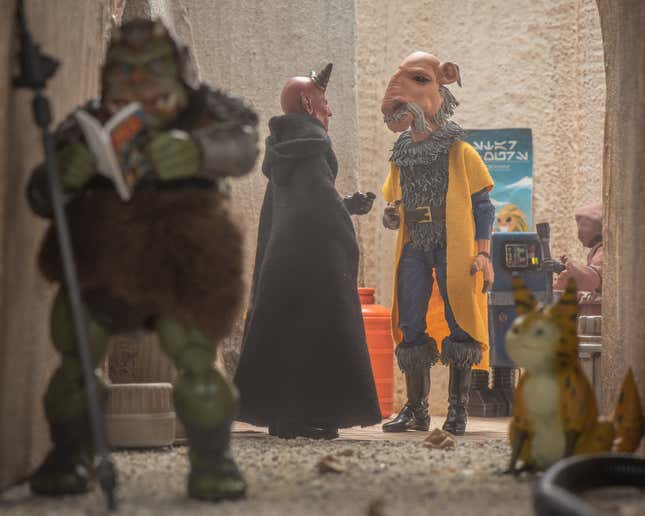
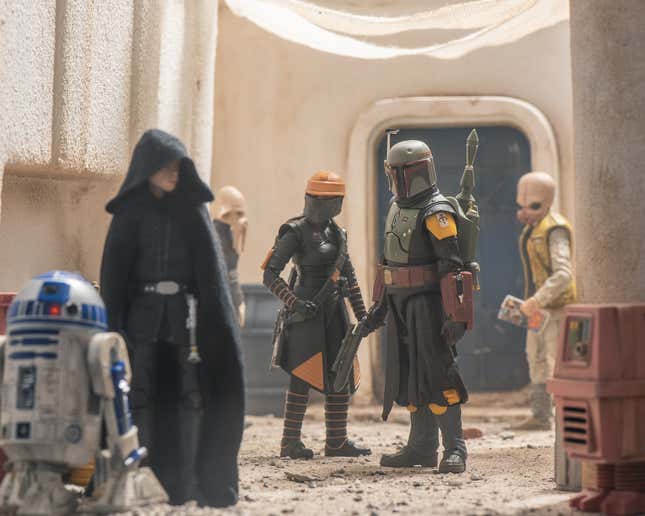
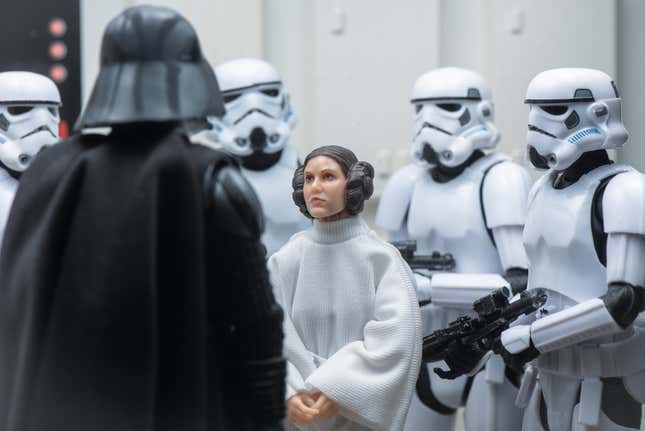
It’s funny that May 4 has become the official Star Wars day, because if you follow movies, television, and pop culture, every day is basically a Star Wars day. It’s one of the most popular franchises in the world and we all talk about it so much that, on a day like May 4, maybe you want something different.

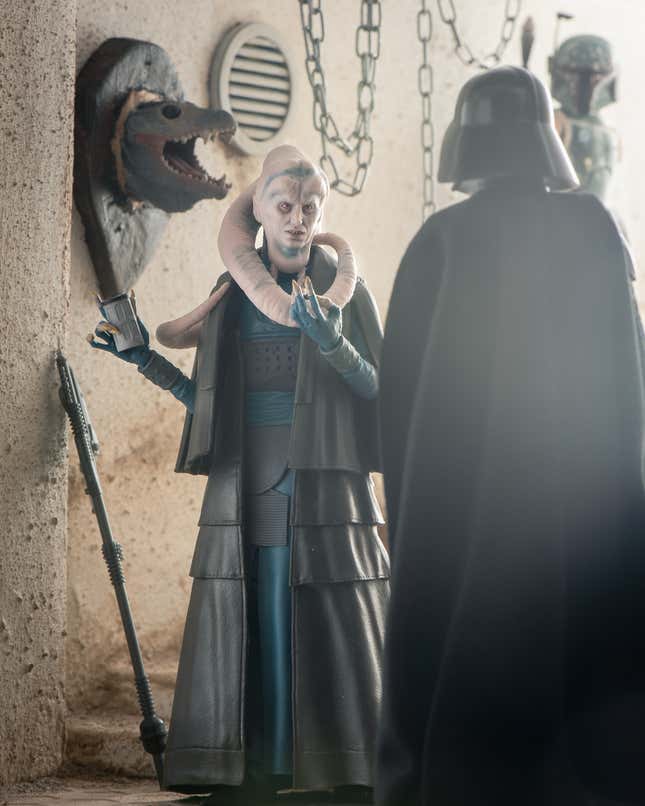
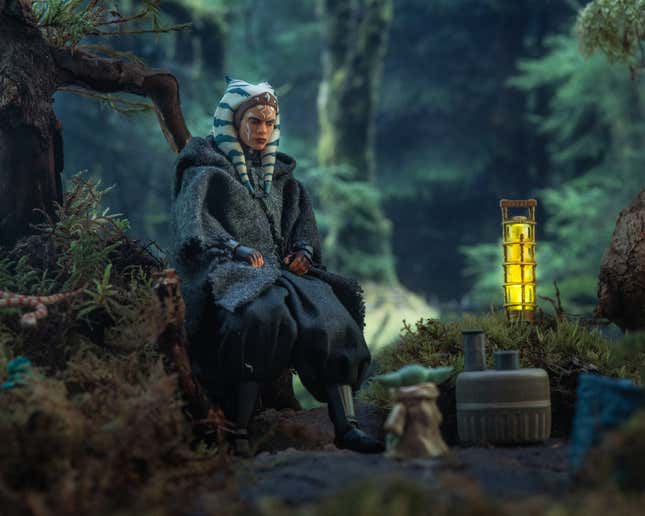
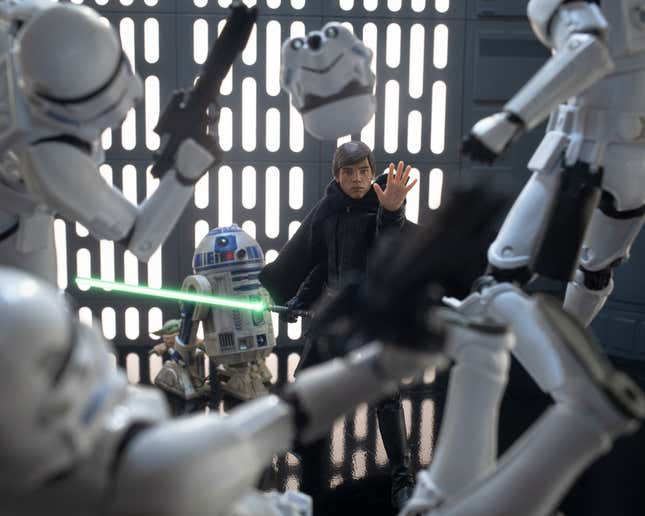
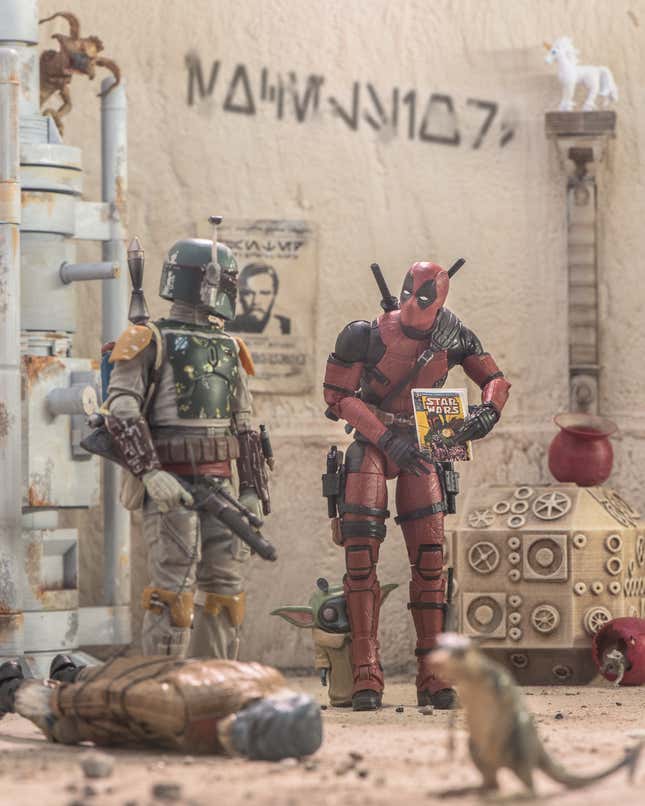
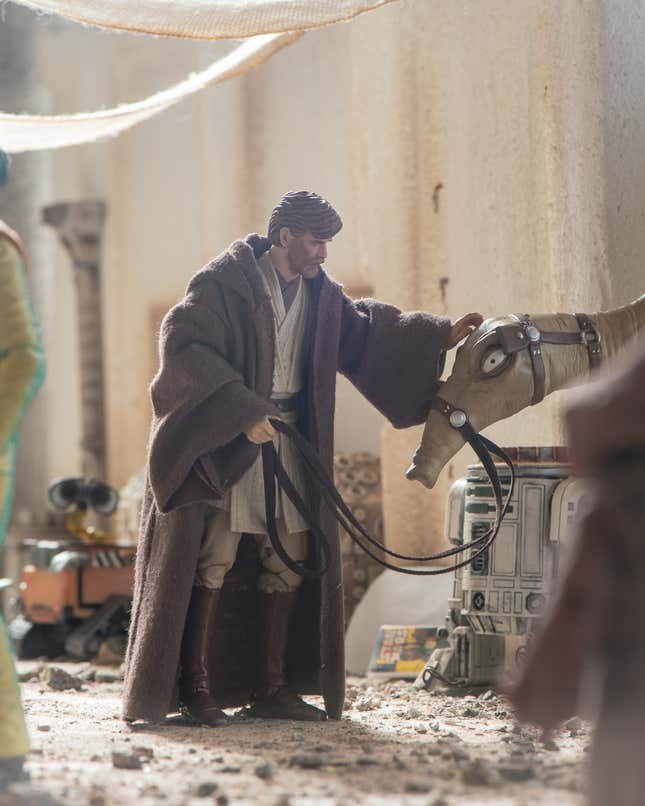
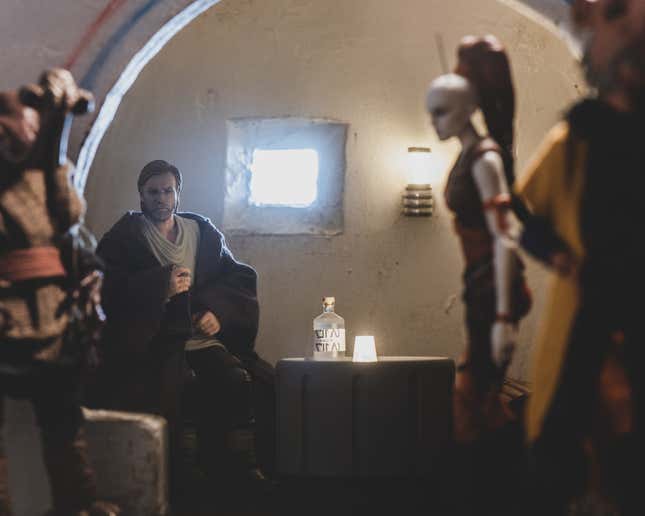
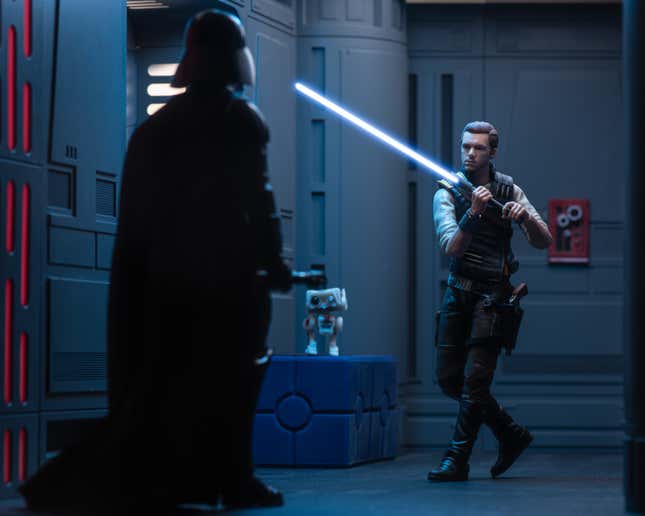
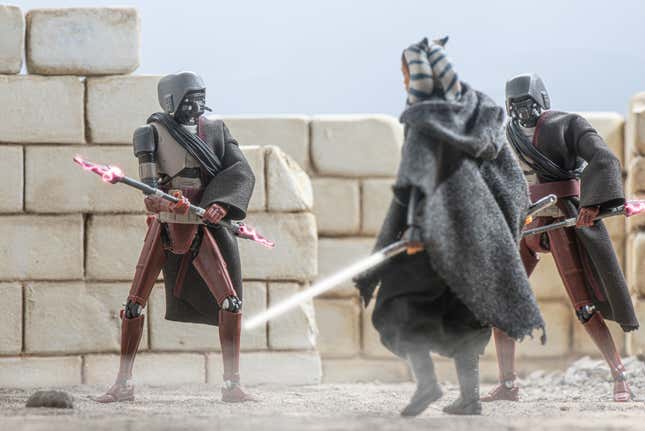
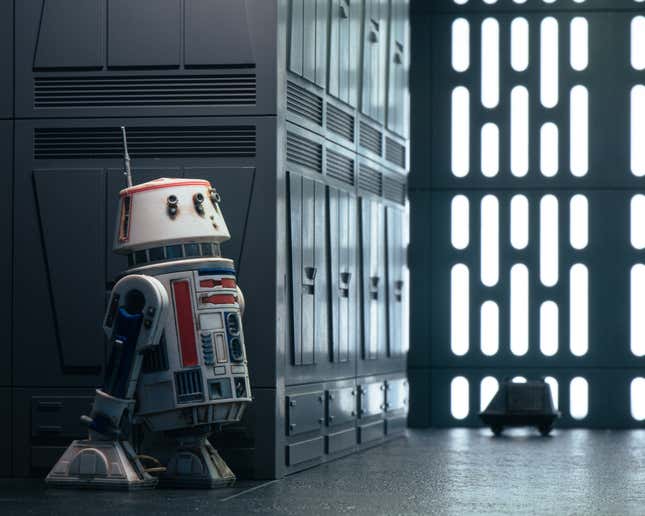
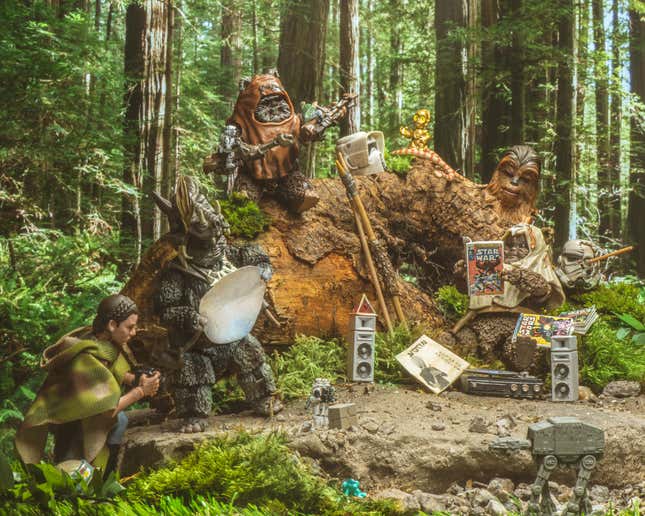
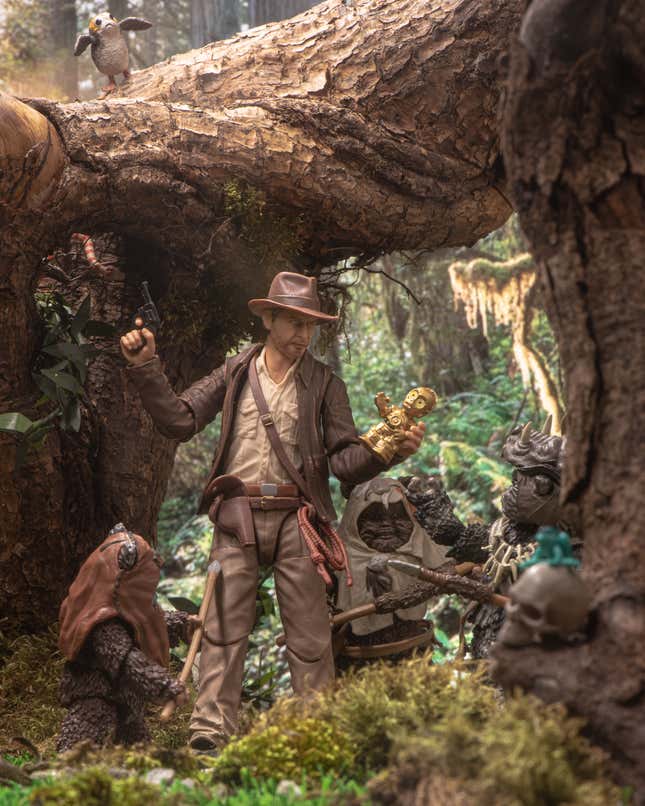
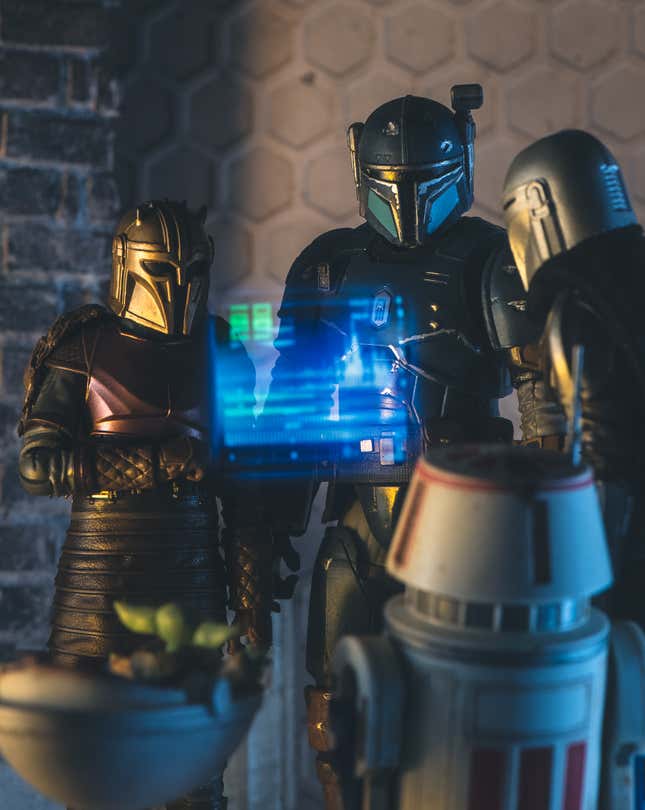
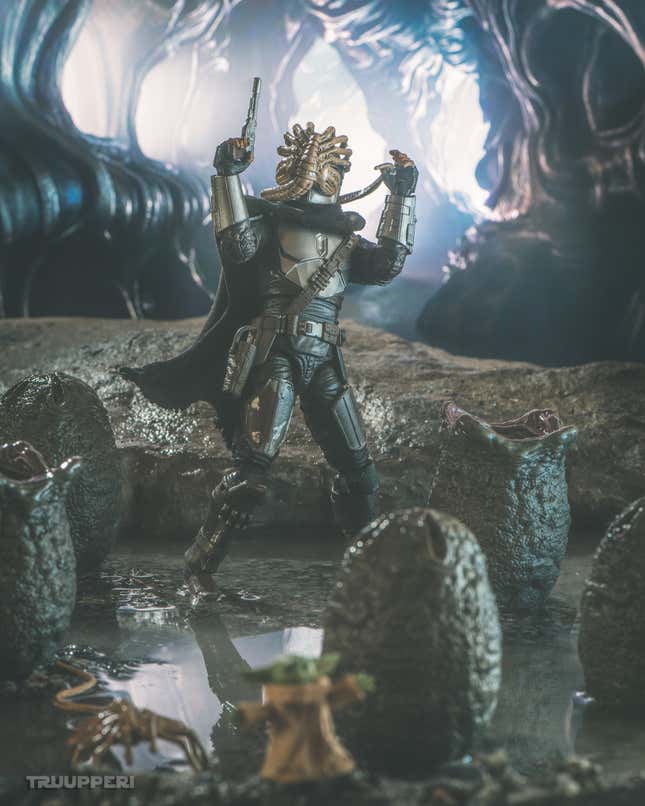
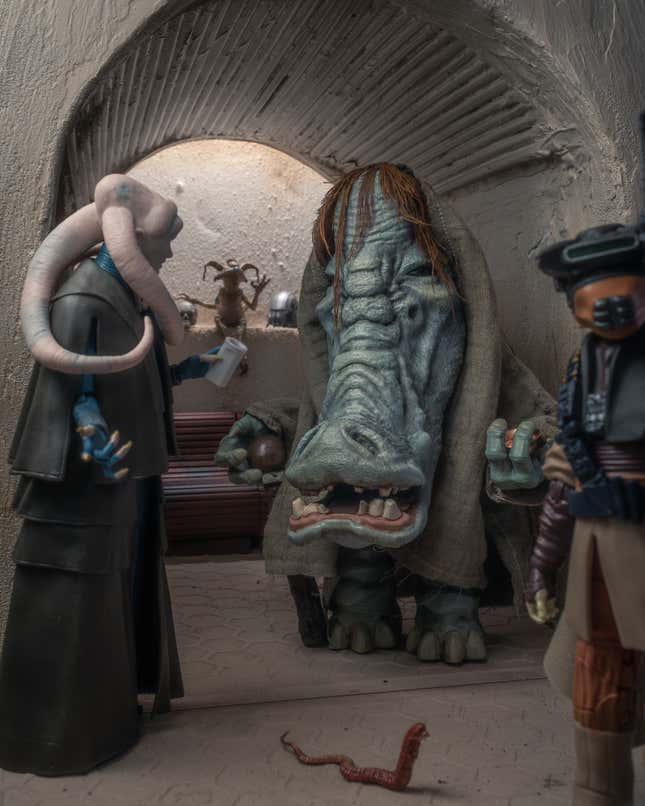
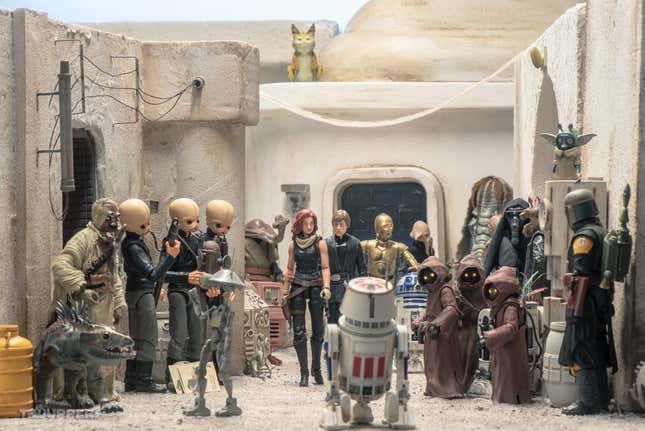
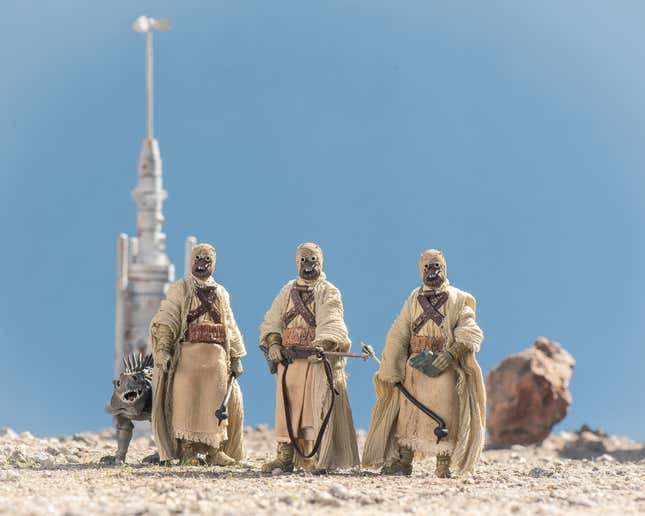
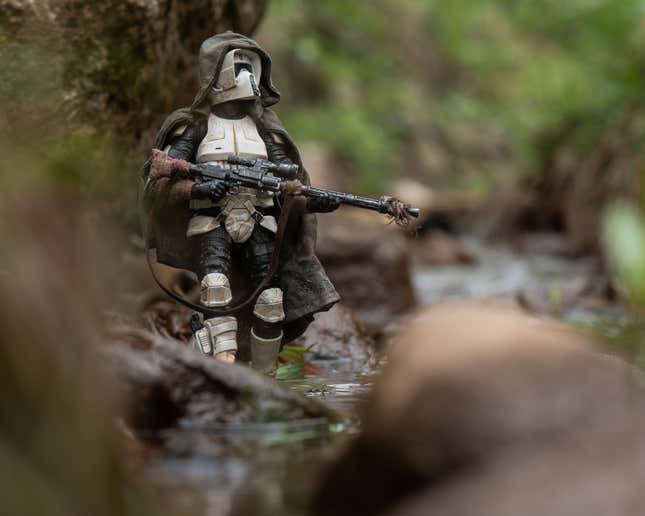
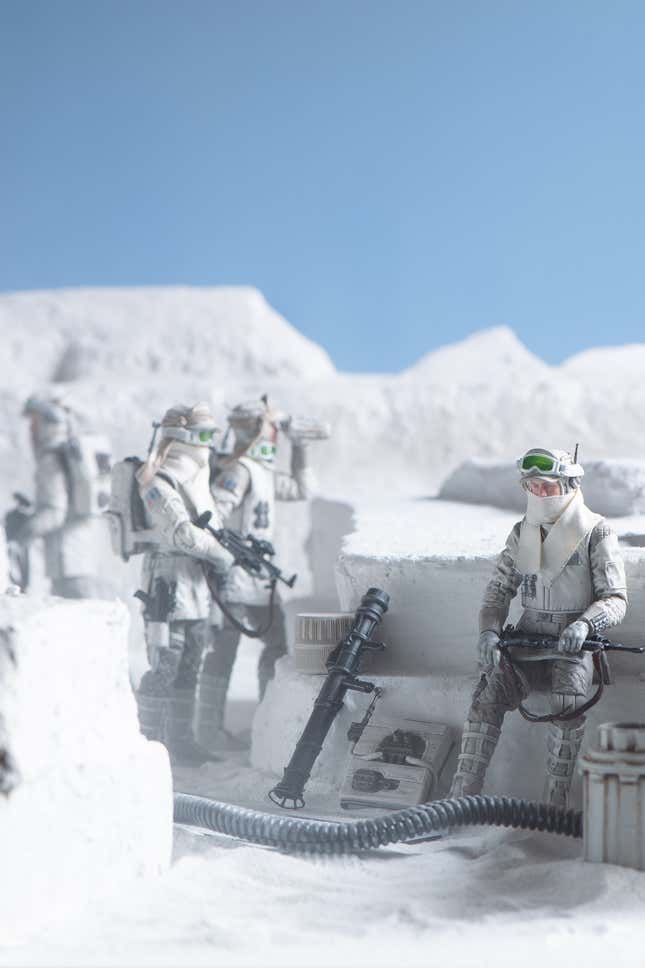
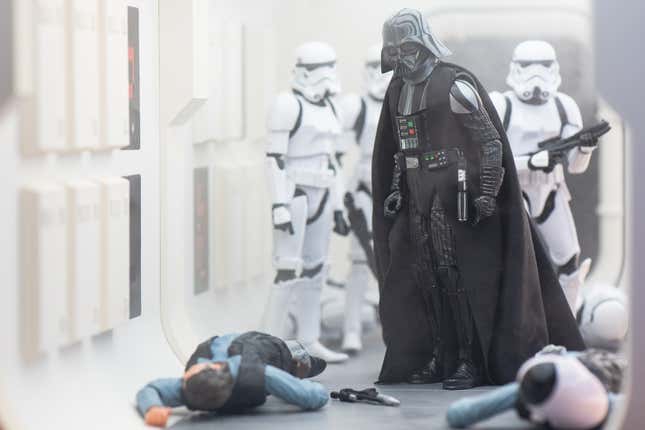
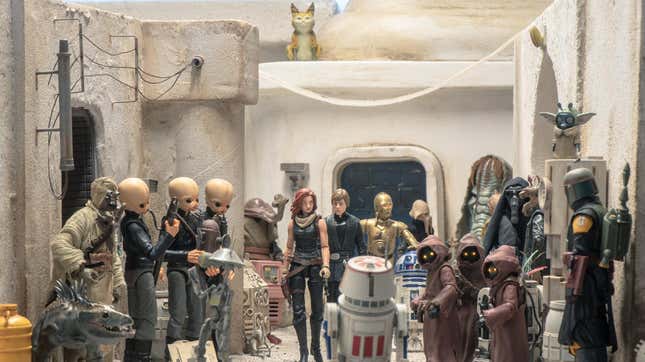
We’ve got just the thing. A Finnish photographer who goes by the name Truupperi has given io9 permission to share some of their incredible Star Wars-themed photography. Truupperi uses a mix of bought and custom figures, along with custom backgrounds, to recreate some of your favorite scenes—and bring to life some you didn’t know you wanted.

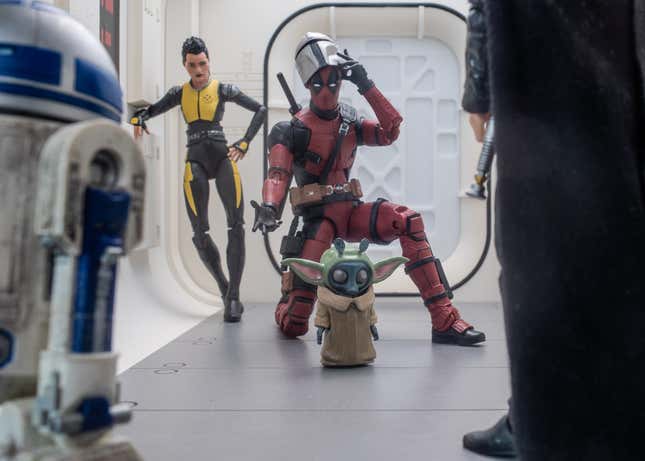
And then Truupperi gets cheeky. They’ll sneak in characters from other franchises, like Marvel or Alien, and make them look perfectly at home in Star Wars. It’s a lot of fun. We’ve got a ton of photos to click through here; for more work by Truupperi, you can visit their Instagram.
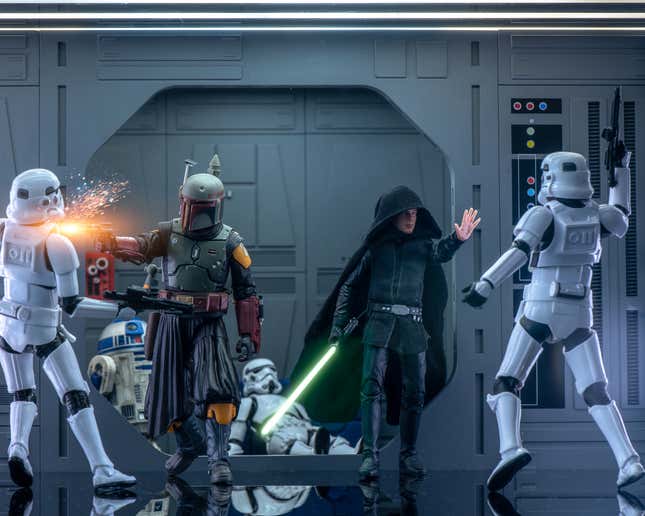
Image for article titled Enjoy These Incredible Star Wars Toy Photos for May 4
Image: Truupperi
Image for article titled Enjoy These Incredible Star Wars Toy Photos for May 4
Image: Truupperi
Image for article titled Enjoy These Incredible Star Wars Toy Photos for May 4
Image: Truupperi
Image for article titled Enjoy These Incredible Star Wars Toy Photos for May 4
Image: Truupperi
Image for article titled Enjoy These Incredible Star Wars Toy Photos for May 4
Image: Truupperi

It’s Deadpool!

Image for article titled Enjoy These Incredible Star Wars Toy Photos for May 4
Image: Truupperi
Image for article titled Enjoy These Incredible Star Wars Toy Photos for May 4
Image: Truupperi
Image for article titled Enjoy These Incredible Star Wars Toy Photos for May 4
Image: Truupperi
Image for article titled Enjoy These Incredible Star Wars Toy Photos for May 4
Image: Truupperi
Image for article titled Enjoy These Incredible Star Wars Toy Photos for May 4
Image: Truupperi
Image for article titled Enjoy These Incredible Star Wars Toy Photos for May 4
Image: Truupperi
Image for article titled Enjoy These Incredible Star Wars Toy Photos for May 4
Image: Truupperi
Image for article titled Enjoy These Incredible Star Wars Toy Photos for May 4
Image: Truupperi
Image for article titled Enjoy These Incredible Star Wars Toy Photos for May 4
Image: Truupperi
Image for article titled Enjoy These Incredible Star Wars Toy Photos for May 4
Image: Truupperi
Image for article titled Enjoy These Incredible Star Wars Toy Photos for May 4
Image: Truupperi
Image for article titled Enjoy These Incredible Star Wars Toy Photos for May 4
Image: Truupperi
Image for article titled Enjoy These Incredible Star Wars Toy Photos for May 4
Image: Truupperi
Image for article titled Enjoy These Incredible Star Wars Toy Photos for May 4
Image: Truupperi
Image for article titled Enjoy These Incredible Star Wars Toy Photos for May 4
Image: Truupperi
Image for article titled Enjoy These Incredible Star Wars Toy Photos for May 4
Image: Truupperi
Image for article titled Enjoy These Incredible Star Wars Toy Photos for May 4
Image: Truupperi
Image for article titled Enjoy These Incredible Star Wars Toy Photos for May 4
Image: Truupperi
Image for article titled Enjoy These Incredible Star Wars Toy Photos for May 4
Image: Truupperi

Dorothy Bohm, a Roving and Enduring Photographer, Dies at 98

Dorothy Bohm, a Roving and Enduring Photographer, Dies at 98
image

In a peripatetic life, beginning with a flight from the Nazis, she found a kind of stability in making pictures for more than seven decades.

For more than seven decades, the click of a camera shutter was the soundtrack to Dorothy Bohm’s life.

She was a teenager in Lithuania when her father gave her a Leica as she boarded a train to flee the Nazis. She studied photography in Manchester, England, after the Blitzkrieg drove her from London. Her camera was a steadfast companion when she traveled the world, chronicling her travels and the people she saw with an empathetic eye. And as her renown as a photographer grew, she switched to color film and experimented with bold new styles.

Mrs. Bohm created a vast body of photographs, in the process becoming a grande dame of the art form, before she died at 98 on March 15 at a care facility in Northwest London. Her daughter Monica Bohm-Duchen confirmed the death.

Mrs. Bohm began as a portraitist, but her photography blossomed when she left the studio. She branched out to make black-and-white landscapes and street photographs that documented life in cities like London and Paris; colorful abstract compositions; and still lifes.

There was a permanence to photography that Mrs. Bohm, whose life was uprooted repeatedly, found appealing.

“A photograph fulfills my deep need to stop things from disappearing,” she told The Times of Israel in 2016.

A glimpse of Córdoba, Spain, during the 1950s. Dorothy Bohm estate

Her photographs have appeared in more than a dozen books and more than two dozen exhibitions:

A streetlamp casts a filigreed shadow in a beam of sunlight slanting into a deserted alley.

A sturdy woman selling flowers seems to rise out of a cloud of petals in front of a striped umbrella propped on its side.

Israeli and Palestinian children play on a sun-drenched street, laughing into the lens.

A woman and a child stare down at a small dog in a starkly-lit courtyard as Mrs. Bohm’s camera stares down at them.

Regardless of the subject, warmth suffused much of her work.

Mrs. Bohm in an undated photo. “Dorothy Bohm knows her camera not only sees, it feels,” wrote Roland Penrose, an English artist and historian, in the introduction to her first book.

“Dorothy Bohm knows her camera not only sees, it feels,” wrote Roland Penrose, an English artist and historian, in the introduction to her first book, “A World Observed” (1970).

Mrs. Bohm wanted those feelings to be positive. As she said in 2016: “I’ve seen a lot. But I don’t show the ugliness of life; I try to show the good.”

Dorothea Israelit was born on June 22, 1924, to Tobias and Ethel (Meirovich) Israelit in Koenigsberg, East Prussia (now Kaliningrad, Russia). Her mother was a homemaker, and her father was a successful textile industrialist.

After a privileged childhood, the Israelit family, who were Jewish, moved to Lithuania in 1932, where Mr. Israelit had business interests. In June 1939, with the rise of Nazi Germany and its persecution of Jews, her father sent Dorothy to a boarding school in England for her safety.

When she said farewell to her parents, her father handed her his Leica and said, “It might be useful to you,” she recalled in 2016. She made it to England but would not see her parents again for more than 20 years.

Ms. Bohm photographed street life all over the world during her travels with her husband.Dorothy Bohm estate

Dorothy was attending a boarding school in Ditchling, a village in East Sussex, in the south of England, when a relative there suggested that she try photography. After interviewing with the London studio photographer Germaine Kanova, she was hired to be her assistant.

But with London being bombed in the Blitz, beginning in September 1940, Ms. Kanova was forced to close her studio, and Dorothy moved north to Manchester. In 1942, in the midst of war, she graduated from a photography program at the Manchester College of Technology (now the University of Manchester Institute of Science and Technology).

While in Manchester she met Louis Bohm, a Polish Jewish refugee whose mother and sister had died in the Warsaw Ghetto. They married in 1945, and Mrs. Bohm insisted that he complete his studies for a chemistry Ph.D. while she worked. She opened a portrait studio in Manchester, called Studio Alexander, in 1946.

By the late 1940s, Dr. Bohm was working for a petrochemical company and traveling frequently. Mrs. Bohm, carrying her Rolleiflex camera, accompanied him on trips to Israel, Mexico, Russia, Egypt, Portugal, Italy and Switzerland, at first producing black-and-white, usually plein-air, photographs.

Ms. Bohm was in Lisbon, Portugal, when she took this photo in 1963.Dorothy Bohm estate

The couple lived in Paris, New York City and San Francisco before settling in London’s Hampstead neighborhood, where Mrs. Bohm lived until her death.

In the late 1950s, Mrs. Bohm learned from the Red Cross that her parents and sister Dina had survived the war but, by then living in Soviet-controlled territory, had all been deported to Siberian labor camps as capitalist enemies of the Kremlin and had spent years there before being released. They were living in Riga, then part of the Soviet Union and now the capital of Latvia, when Mrs. Bohm visited them for a reunion in 1960.

Three years later, Mrs. Bohm’s parents obtained permission to go to England. Her younger sister, Dina, moved to Israel in the early 1970s.

Mrs. Bohm’s first show of her photographs was held in 1969 at the Institute of Contemporary Arts in London.

Mrs. Bohm created an abstract image in photographing torn posters in London in 1984. Dorothy Bohm estate

Beginning in 1971, she became associate director of the Photographers’ Gallery, one of London’s first galleries devoted solely to photography. It had been founded that year by Sue Davies. Mrs. Bohm spent 15 years at the gallery in that role, nurturing up-and-coming photographers like Martin Parr and Marketa Luskacova and working with stars like Manuel Álvarez Bravo, Henri Cartier-Bresson, Bill Brandt and André Kertész.

Impressed by Polaroid photos shot by Mr. Kertész, Mrs. Bohm worked with Polaroids in the early 1980s and switched to color film exclusively in 1984. Her color work included abstract images of torn posters, reflections of store displays in puddles and mannequins leaning in storefronts. Her photographs of Hong Kong and Japan were all shot in color.

Dr. Bohm died in 1994. In addition to her daughter Monica, she is survived by another daughter, Yvonne Nicholas; four grandchildren; and two great-grandchildren.

Ms. Bohm in an undated photo. Her first exhibition was held in 1969 in London.

Mrs. Bohm’s other books include “A World Observed 1940-2010: Photographs by Dorothy Bohm” (2010) and “About Women: Photographs by Dorothy Bohm” (2015). She was the subject of two documentaries, one for the BBC titled “Dorothy Bohm — Photographer” (1980) and “Seeing Daylight: The Photography of Dorothy Bohm” (2018).

By 2018, Mrs. Bohm had stopped making photographs but, as she told The Guardian, the visual world still brought her joy.

“From my bedroom there’s a wonderful view, as beautiful as any in the Mediterranean,” she said.

ArtDependence | Works from Pier 24 Photography from the Pilara Family Foundation Soared Well Beyond High Estimate to Achieve Nearly $11 Million

ArtDependence | Works from Pier 24 Photography from the Pilara Family Foundation Soared Well Beyond High Estimate to Achieve Nearly $11 Million

On Tuesday, Sotheby’s concluded the first part of a landmark multi-auction sale series for Pier 24 Photography from the Pilara Family Foundation, achieving an astounding $10.6 million – nearly 120% of the combined presale high estimate – with two thirds of lots outpacing their presale high estimates to benefit the Pilara Family Foundation in support of charitable initiatives in healthcare research, education, and the arts.

The exceptional sale results, attracting bidders from 23 countries, reinforce the unprecedented depth of the Collection, charting the historical intersection of modern art and photography and reflecting the power of the image in contemporary culture.

The two-part single-owner sale set numerous new benchmarks and auction records, including for Robert Frank, whose renowned Charleston, S.C. attracted the highest number of bids (32), leading the sale series for a total of $952,500 and shattering Frank’s previous auction record. Robert Adams’s Selected Images from Eden, Colorado marked another artist record, achieving 130% of its presale high estimate for a total of $330,200. Other notable accolades for the collection include new records for a singular work from Richard Avedon’s In the American West series for Juan Patricio Lobato, Carney, Rocky Ford, Colorado, August 23, 1980 and Clarence Lippard, Drifter, Interstate 80, Sparks, Nevada, August 29, 1983,both of which yielded 150% of their presale high estimates, each realizing $444,500 as well as a record for the highest price for a portrait of Bob Dylan from Bob Dylan, Singer, New York, New York, February 10, 1965, which trounced the previous record by more than double; Deborah Luster, whose One Big Self: Prisoners of Louisiana more than tripled its presale high estimate for a total of $101,600 in her auction debut; Dorothea Lange’s Migrant Mother, Nipomo, California, which realized $609,600, marking a new record for the iconic image and the second highest price for Lange overall.

Auction records were also achieved for Larry Clark, Shomei Tomatsu, Katy Grannan, David Goldblatt, Bruce Davidson, Wright Morris, Josef Koudelka, and Erica Deeman, who made her auction debut.

Images :Robert Frank, Charleston, S.C.

             Dorothea Lange, Migrant Mother, Nipomo, California  

Dugan gives presentation on windjammer photography

Dugan gives presentation on windjammer photography

CAMDEN – On Thursday, May 11, at 6:30 p.m., the Camden Public Library, 55 Main St., welcomes Rockland photographer Jim Dugan for an illustrated presentation about his photography and videos of Maine’s magnificent windjammers, many of which will be familiar to Camden residents and visitors.

“Pretty Ladies Dancing Around the Bay: Photography of Maine’s Windjammers” is a hybrid event and will take place in the Picker Room and on Zoom. Register to attend on Zoom here.


Jim Dugan_Rowboat.jpg


Top Creative Photographers Have 10 Things in Common: Part One |

Top Creative Photographers Have 10 Things in Common: Part One |

Do you struggle with creativity? In the first of this two-part series, we will look at what science and psychology have discovered about people who are creative. The good news is that they are habits that you can learn. Here are some exercises to help you with that.

Creativity is an elusive thing. It’s so easy to take a photo that is nothing more than a recording of what we see. However, research has discovered creative people’s common traits and behaviors and, with learning, practice, and exercise, we can become more creative with our photography.

1. Challenge Commonly Held Beliefs

I am a great believer that commonly held beliefs should be challenged. If we don’t challenge them, we don’t think for ourselves. Unless you live in an autocratic and oppressive society, thinking for yourself is generally considered a good thing. Challenging the world around us is an important aspect of creativity. Every human progression has resulted from people thinking differently.

Dean Keith Simonton, Distinguished Professor Emeritus of the Department of Psychology, University of California, found that the quality of creative ideas is directly related to quantity. In other words, the more ideas a creator generates, the higher the probability that they will eventually produce a masterpiece.

Those that think differently take risks and are not scared of failing. Failure is important because it means we will try repeatedly until we get it right. The more attempts we make, the more chance there is of creating something incredible.

Experimenting with different ways of photographing means you will probably make mistakes. If you expect that to happen, then it allows you not to let caution get in the way of your creativity.  

Creative Practice Exercise

Go out and take the photos that you usually shoot, but change everything about the way you do it. You could experiment with different camera positions and settings. Or, maybe, try a different lens that you would otherwise consider to be inappropriate for your subject or genre. You will be forced to approach your subject differently. Remember, if it fails, it doesn’t matter. But ask yourself, why did it fail? What are the good points? What could you do differently again?

2. Be Compassionate

Someone recently commented I was the most contentious writer at Fstoppers. I happily accepted that as a badge of honor. It meant that I was thinking differently. Moreover, writing is a form of art and if art doesn’t provoke an emotional response and debate, it becomes worthless.

However, in the comments of another article, someone referred to my response to that and said I had admitted to being a troll. That demonstrates a misunderstanding of what I said and what a troll is.

The Collins Dictionary says this about trolling:

If you troll someone, you deliberately try to upset them or start an argument with them, especially by posting offensive or unkind things on the internet.

The Oxford English Dictionary describes trolling as writing false or offensive messages on the internet to make other people angry. That is very different from offering up a point of view and challenging commonly held beliefs, especially about an inanimate object like a camera.

I’ve met hundreds of successful talented artists and musicians. The vast majority always challenge the status quo, but at the same time, are supportive of others. They exhibit compassionate behavior. That is the opposite of trolling. Compassion toward others is central to becoming creative. It is one form of sensitivity, a heightened awareness of the world around us and the people within it, something that is essential for creativity.

We’ve all met people who lack compassion and are forever trying to pick holes in others. I have yet to meet any of them that fall under the heading of talented creators. They seemed to have lost the art of conversation and debate and that it is okay to disagree with others’ opinions. Instead, they accuse anyone who has a different point of view of offending them. Absurdly, at the same time, they will not debate but abuse others and claim freedom of speech when their abusive words are challenged. Creative people are the opposite of that. They show respect for each other’s points of view and opinions, even if they disagree.

Creative Practice Exercise

Find some photography online from an unknown photographer that isn’t to your taste; you will find plenty on Instagram, Flickr, and in the galleries at Fstoppers. Ask yourself why that photo appeals to the photographer and not to you. Get in contact with the photographer and ask them to tell you about the photograph and what it means to them. Tell them you have difficulty understanding why they chose to shoot it that way, and ask them to explain. Learn to see it through their eyes.

3. The Subconscious Mind and Creativity

Although the story of Newton being hit on the head by an apple is a myth, his theory of gravity is said to have come to him by daydreaming and seeing an apple fall from a tree. J.K. Rowling’s Harry Potter books occurred to her when she was staring out of the window when stuck on a train. Mark Twain’s Tom Sawyer came to him in a daydream too, and Paul McCartney woke from sleep with the song Yesterday in his head. Einstein is said to have allowed his mind to wander, and he came up with his Theory of Relativity.

I think people are losing the ability to daydream. So, many people I know are continuously tied to their phones, watching YouTube videos, or listening to podcasts that they don’t allow their minds to drift.

As photographers, new projects or ideas of approaching how to carry out a photo shoot can occur to us in a daydream. An ongoing project of mine is about capturing the shape of birds’ movements using longer exposures. That idea first came to me some 10 years ago. One afternoon when I had a post-lunch nap. I had previously been thinking of the two genres of artistic photography I really enjoy: long-exposure seascapes and wildlife. Sitting in my office chair, with my head starting to nod, it suddenly occurred to me that I could use an ND filter and take longer exposures of the seabirds here to examine their shapes.

I’m sure others have also done this, but it’s something I still enjoy doing once in a while. It’s especially easy now there is the Live ND filter on my OM-1, so I don’t have to screw a filter in front of the lens. I’ve also started to add other creative techniques to the images.

Creative Practice Exercise

Next time you are trying to start a creative project, put aside some time to daydream. Keep a pen and paper to hand, and if anything comes to mind, jot it down. Daydreams can be as fleeting as those we have when we are asleep.

4. Turning Good and Bad Situations to Your Advantage

All of us have experienced loss or suffering at some point in our lives. Somehow, we find a way to grow past it, which changes us.

Suffering and loss make us re-examine our lives and think about what is important. That can be a great source of inspiration for creative thinking. Paradoxically, so can enormously happy events.

If you think of the greatest songs, poems, stories, and works of art, they are all built around emotionally charged human experiences, either good or bad. The same can be true of photography. Moments of intense feelings can motivate and inspire us to take photos. Here’s an example. I’ve recently had two major losses. One of the things that upset me was the meaningless platitudes uttered by others. “I’m sorry for your loss,” or “My thoughts and prayers are with you,” seemed crass clichés when uttered by people whom I believed couldn’t give a flying fruit bat. I’ve since taken that thought and it’s become a foundation of a personal photography project I am starting.

Creative Practice Exercise

Whether you are grieving or just met the love of your life, think about how that experience has made you notice things you didn’t before. Even if it’s painful and your life is turbulent, try to let the experience inspire you to start a short photographic project of twelve pictures.

5. Playing Imaginatively

As we become adults, we often forget to play. Children do it all the time and they are far more creative than we are. Our jobs and our responsibilities are serious. We are told we are grown up. So, it’s easy to believe that we adults have lost that ability to play.

Yet we still watch movies and read fiction, and enjoy experiencing the excitement, suspense, fright, love, and a myriad of other emotions that we feel when we do that. We put ourselves in the minds of the main characters and sympathize with them.

Even as adults, imaginative play brings joy, and that, in turn, sets our creative juices flowing. Being childlike in our imagination leads us to explore and discover new ways of doing things. We question why things are the way they are and consider different approaches. We imagine ourselves walking in the shoes of other people and thinking about how they would approach a subject.

Creative Practice Exercise

Imagine you are a character from your favorite work of fiction, as you might have done when you were a child. This could be anyone from Jane Bennet to James Bond. Think about how that character would approach your next photoshoot. I’m not suggesting you dress in clothing from the turn of the nineteenth century or a tux, nor that you should do this for a commercial shoot. Next, try a very different character. Would they do it differently?  

Let Me Know How You Get On

Those are just the first five traits that top creators have in common.

What do you do to increase your creativity? Have you tried any of these techniques before? Are you going to give any of them a go? Please let me know how you get on and whether you find your creativity improving.

The following article will look at five more attributes common to creatives, including the most important one of all.

Africa Wildlife Photography Competition Winners On View In Palm Beach, FL

Africa Wildlife Photography Competition Winners On View In Palm Beach, FL

Images from the 2022 Benjamin Mkapa Wildlife Photography Awards plainly reveal animals’ extraordinary humanity. A gorilla’s wisdom. The gentleness of an elephant. The community of wildebeest.

That’s easy to see.

Beneath the surface of each picture, no less clear when looking close, man’s inhumanity reveals itself.

Wantonness. Cruelty. Exploitation.

All of these animals are in danger from the most reckless predator the planet has ever known: man.

Be it poaching, habitat destruction or a dozen other extractive and exploitative behaviors which have caused wildlife populations to collapse around the globe, it increasingly feels like a miracle any of these wonderous creatures remain. Enjoy the miraculous while you can in Africa and through the winning entries of the 2nd Annual Benjamin Mkapa African Wildlife Photography Awards which can be seen at The Society of the Four Arts in Palm Beach through June 4, 2023.

“When you look into the eyes of this beautiful silverback, you see a lot of yourself looking back,” Africa Wildlife Federation Senior Vice President Craig Sholley told Forbes.com of the grand prize-winning image (pictured below). “It represents an endangered species and a conservation success story. Mountain gorillas are the only great ape in the world whose population is increasing. This success story is a result of a four-decades effort orchestrated by non-governmental organizations like AWF in direct collaboration with the Rwandan government. The product of this work is one that benefits both wildlife and people.”

People and wildlife, connection, our shared fate comes through in another crowd pleaser from the competition, an animal keeper being caressed by an elephant’s trunk in an orphanage.

“This image portrays the importance of the work of Africans who have devoted their lives to the future of threatened wildlife,” Sholley said. “These are individuals who are passionate about conservation and in many cases put their lives on the line–protecting species from poachers and the illegal wildlife trade.”

The picture recalls one of the most famous and heartbreaking wildlife-human photographs ever taken, that of the last male white rhino with his keeper in 2018 moments before the animal died. An image not simply of death, but extinction. Forever death. They both know.

Africa comes to Palm Beach

Credit for bringing the exhibition from Nairobi, Kenya to Palm Beach goes to Wilber James, Trustee Emeritus of AWF and board member of The Society of the Four Arts, along with fellow AWF Trustee Payson Coleman. They approached Director of Programs at Four Arts Sofia Maduro about showing the photographs.

“Payson and I have been involved in African wildlife conservation for over 50 years and knew that a number of our friends in Palm Beach shared our enthusiasm for the preservation of the animals and habitat in Africa as well as the well-being of the people,” James told Forbes.com. “We felt that an exhibition of the Mkapa Awards at the Four Arts would be a powerful way to highlight the majesty of Africa’s animals and also educate the public about the challenges they face. Sofia was in complete agreement about the importance of the exhibition and felt that the Four Arts could also reach out to the schools in Palm Beach and West Palm Beach to invite students to tour the exhibition for a powerful learning experience.”

The competition was co-created by AWF and Nature’s Best Photography to celebrate AWF’s 60-year anniversary as the only African global conservation organization protecting wildlife and its ecosystems as an essential part of a modern and prosperous Africa.

“Craig Sholley and I are equally passionate about African wildlife and the creative skills our Mkapa Awards entrants have shared since its launch in 2021,” Steve Freligh, President and CEO of Nature’s Best Photography Fund, told Forbes.com. “These talented photographers, of all ages and backgrounds, are as interesting and diverse as the photographs they submit, delivering immediate and long-lasting impact that will motivate change.”

Forty-eight award-winning prints from the competition are on view.

“There are those photographs that immediately stop you in your tracks, but also ones where new perspectives are revealed as you examine their details,” Freligh said. “Each image shares an extraordinary moment in Africa, a single experience that may be enjoyed personally as well as collectively.”

The winning images were selected from over 9,500 entries representing 57 countries, chosen by a panel of judges including accomplished wildlife photographers, leading conservation professionals, highly regarded safari guides, and youth conservation activists.

“Through the art of photography and video, the primary goal was to attract, inspire, and involve photographers from Africa and around the world at all levels of camera experience so that they may share stories from the field and encourage new advocates for conservation change,” Sholley said. “Effectively, AWF wanted to ‘Bring Africa to the World, and the World to Africa.’”

Benjamin Mkapa

H.E. Benjamin Mkapa (1938–2020) was president of Tanzania in east Africa, south of Kenya bordering the Indian Ocean, from 1995 to 2005. The astounding “Great Migration” begins in Tanzania.

More than a million wildebeest along with hundreds of thousands of zebra, topi and other gazelle start their annual journey in the Serengeti National Park creating the largest herd movement of animals on the planet. Over the course of the year, the animals move north and clockwise, up into Kenya and the Masai Mara National Reserve, back down through the Serengeti and then to Ngorongoro Conservation Area, famed for the Ngorongoro Crater.

“Mkapa began his career as a journalist, understanding the importance of educating the public on important conservation topics,” Sholly explains. “Today, Mkapa’s name remains widely respected for his legacy of principled leadership and protecting Africa’s wild heritage.”

As one example, during his time on AWF’s Board of Trustees, Mkapa played a critical role in the establishment of Manyara Ranch Conservancy in northern Tanzania, an important 45,000-acre wildlife corridor connecting several of the country’s national parks.

Throughout much of the 20th century, visitors to Africa went primarily to shoot animals, not pictures. Limited legal hunting on the continent persists, in part due to the United States’ continued allowance of trophy hunters to import animals killed in Africa.

Fortunately, photographic safaris have mostly replaced their bloodthirsty predecessors.

“During the launch of the Four Arts exhibition, attendees posed many questions about ‘organizing their first or next safari’ and how to get involved in helping to secure the future of the wildlife and wilderness areas they saw represented in the photos of the competition,” Sholley said. “My greatest thrill has been watching people’s reactions as they view the exhibition images for the first time. When the subject matter revolves around Africa’s iconic wildlife and remote wilderness areas, the impact is clear and visible.”

Africa: Closer than you Think

Americans, by and large, are daunted by the idea of travel to Africa. Many even frequent, life-long, world travelers from the States have never seen southern Africa with their own eyes. Never spent a morning game drive 10-feet from a feeding pride of lions. Never stared eye-to-eye with a cape buffalo.

Too far. Too expensive.

Once in a lifetime.

That needn’t be the case.

While there are undeniably super-expensive and difficult to reach locales and experiences such as the water safaris around the Okavango Delta in Botswana or gorilla trekking in Rwanda or Uganda, visiting Kruger National Park or Greater Kruger in South Africa via flight to Johannesburg and car or bus to the wildlife can accommodate many non-luxe budgets.

Kenya safaris and Tanzania safaris are good middle-ground choices with a non-stop flight from JFK airport in New York direct to Nairobi now an option, shortening travel time to east Africa dramatically.

Africa, particularly when traveling from the eastern half of the U.S., proves no more arduous to reach or expensive to enjoy than Hawai’i, Australia, Asia or India–oftentimes less so. And the rewards are unmatched.

As wonderful as the pictures are, they don’t compare to real thing.

Family finds success in rural photography business; new Richville studio opens

Family finds success in rural photography business; new Richville studio opens

IMG_0524.JPG

With her new studio space, all Sarah Pearson needs to do is move her lights instead of completely setting up a new backdrop with new props, making photography a fast and easy process for clients.

Elizabeth Vierkant / Perham Focus

PERHAM — Sometimes, returning to where you grew up can be how you find happiness and success. For one Richville family, the Pearsons, this is certainly the case. After 12 years of building their business, Photography by Sarah Jean, photographer Sarah Pearson and her husband/editor Rhett Pearson recently got to build just what they’d wanted for years: a brand new photography studio.

In fact, this new studio itself was built by Sarah’s father. Her mother, Pam Donley, even acts as “groundskeeper.” The Pearsons’ son, Aiden, will soon learn to edit himself, and their daughter, Piper, helps entertain the young kids and babies that enter the studio. Not only do clients receive photos of memorable moments when they enter this new studio, but they’re also welcomed with open arms by this full-family operation.

“In the long run, (my old studio) has been a small space, which is why we needed to build something,” Sarah explained. “It’s taken a long time to get here — 12 years to get to this point. It’s something to be excited about.”

Continuing with the “homey” and familial roots of their business, the new studio is built right next to their rural Richville family home. While Sarah is mostly an outdoor photographer — hence the beautiful outdoor space of their property — it’s nice to have indoor options available for clients when the weather cools.

WyQw3HLY.jpeg

Sarah and Rhett smile as they stand with their two kids, Aiden and Piper, who help out with the business when they can.

Contributed / Sarah Pearson

Though this new studio symbolizes yet another huge step forward for the Pearsons and Photography by Sarah Jean, it did take them many long years to get there. It all began when Sarah was growing up in Richville, just a couple of miles from where she currently lives. At around 15 years old, she moved with her sister and mother to Stillwater, a suburb of the Twin Cities, where she later met Rhett. It was here that she began to discover her love for photography.

ADVERTISEMENT

“She wanted to be a model when she was 16, 17,” her mother, Pam, shared. “So we got her into modeling school, and she started sitting in front of the camera. She was always asking the photographers what they were doing. I guess that’s what (made her think), ‘I want to be on the other side of the camera,’ and that’s when she started venturing into it.”

Sarah continued, “And I’ve always kind of been an artist — drawing. In high school, I did photography. It was like, ‘I don’t want to be in the picture; I want to be on the other side of the picture.'”

And so her passion for photography began. She earned a bachelor’s in fine arts and photography at the College of Visual Arts in St. Paul, and once she graduated, she began pursuing her photography career in Stillwater.

3_y2W7Bo.jpeg

A photo of yours truly (Elizabeth Vierkant, writer of this article) as taken by Sarah Pearson on the day of our chat.

Contributed / Sarah Pearson

Things were a little rough near the Twin Cities, however, and she and Rhett were struggling to get by. While Sarah had some photography clients, she wasn’t able to quite make a living off of it, especially with rent being about $1,100 a month for the couple. Once they had their first kid, Aiden, they really started to reconsider what they were doing.

“I was working two jobs,” Rhett said, remembering the struggle. “I was doing construction, and then I was going and working at a deli at night, until 9 or 10 at night … We were just throwing our money away to rent and kind of just spinning our wheels … We’re just kind of wondering what the heck we’re going to do with the rest of our lives, and Sarah said, ‘Well, we could move back to my home town and kind of start over.’ And at the time, I was just like, ‘You know, what do we have to lose?'”

And so, the Pearsons got a U-Haul on a Tuesday and moved to Richville on a Wednesday. Rhett interviewed for a job on Thursday and started working on Monday. Everything happened so fast, but clearly, it worked out. Rhett joked that he and Sarah are polar opposites. While he tends to be quite pessimistic, she’s ever the optimist. She was the one who wanted to buy a house in Richville. She was the one who wanted to start Photography by Sarah Jean. Eventually, she was even the one who wanted to get the new studio done.

“She’s always right,” he laughed.

“And it always worked out,” Pam added.

ADVERTISEMENT

IMG_0517.JPG

Sarah shows off her new studio space, complete with multiple backdrops and set-ups.

Elizabeth Vierkant / Perham Focus

The family spent the last 12 years continuing to build the business side-by-side. Though Rhett was originally a landscaper, the business grew to the point that Sarah asked him to be her “chief editor.” As quite the tech-savvy guy, he ended up being the perfect person for the job. Soon, their oldest, Aiden, plans to learn how to edit to help the family business grow and keep up with the busy client list.

The Pearsons are now able to completely live off the money earned from Photography by Sarah Jean, which is a big step forward from their struggles to get by in Stillwater. With the new studio officially completed as of about three weeks ago, the business can continue to grow.

“I’m really excited to start this new chapter,” Sarah said. “(The new studio) is great.”

Now with a new, much larger space, Sarah can set up multiple backdrops and sets with a variety of furniture and props. Whenever she wants to take photos at a new set, all she has to do is move the lighting and help the client make the perfect pose. There’s no more completely tearing down a set to put up a new one. Not only is the process a lot smoother, but it’s easier on both Sarah and the client.

Complete with a lounge space for people to relax and chat during a photo session, clients can enjoy the cozy atmosphere of sunny lighting, wood floors and music in the background. Though close to the Pearson home, it’s also separate, allowing for the homey feeling to stay without the chaos of a family house. A separate room was even built in the back with long tables and a fridge for a comfortable editing space.

Photography by Sarah Jean is currently hosting a grand opening special for their new studio. For more information, visit

Photography by Sarah Jean on Facebook

, email sarjeanels@yahoo.com or call 651-472-3381.

“(I love) being around people, and the outcome of photography is happiness,” Sarah said. “People are excited to get a picture taken or to see the results.”

Photography Exhibition – Thaddé Comar Wins the 6th AOYF Award for Human Rights Photography

Photography Exhibition – Thaddé Comar Wins the 6th AOYF Award for Human Rights Photography

Thaddé Comar wins the sixth edition of the AOYF Human Rights Photography Award for his project entitled How was your dream? which looks at new forms of protest and insurgency in a contemporary era dominated by controlling societies.

The AOYF Human Rights Photography Award 2023 was presented on Thursday 27 April 2023 to early career artist Thaddé Comar for the quality and originality of his strong and engaging work on the theme of digital technologies and their impact on our daily lives (“Human Rights 3.0”). The winning artist and the four other finalists will exhibit their work for one month at the Geneva Centre of Photography. The winning artist will also receive a financial contribution to produce an exhibition based on the winning project and to continue his or her commitment to human rights. This award is given by the Act On Your Future Foundation, in partnership with the Geneva Centre of Photography and six renowned European art schools. In addition, throughout the group exhibition, a series of lectures, practical workshops and school visits will be offered to raise public awareness of human rights through the works on display.

The Act On Your Future Foundation, the Geneva Centre of Photography and the partners of the AOYF Human Rights Photography Award 2023 are pleased to announce the name of Thaddé Comar, winner of the sixth edition of the competition, who graduated from a prestigious European art school: Comar Thaddé, How was your dream? (ECAL, Lausanne, born in 1993) The winner’s project and those of the four other finalists will be exhibited at the Centre de la photographie Genève from 28 April to 28 May 2023. In addition, several free events, including a photo-conference, round tables, hands-on workshops and school visits, will be offered during the exhibition to raise awareness of human rights through the eyes of the artists on display.

Thaddé Comar

Thaddé Comar was born in France in 1993. In 2018, he graduated with distinction from the ECAL in Lausanne. His practice is deeply linked to current events and social movements and ranges from editorial to commissioned and personal projects.

The jury notes that the winning project in particular takes a critical and informed look at the issue of social movements and their evolution in relation to the tools of surveillance and repression linked to new digital technologies. In addition to taking a critical look at this issue, and its implications for the specific case of Hong Kong, it also looks with relevance at possible strategies of empowerment and emancipation.

Awards

As the winner of the 2023 edition of the competition, the winner will receive an amount of CHF 10’000, distributed as follows

A contribution equivalent to the sum of CHF 7’000.00 exclusively for the project.

Award

As the winner of the 2023 edition of the competition, the winner will receive a sum of CHF 10,000, distributed as follows

A contribution equivalent to the sum of CHF 7,000, which will be used exclusively for the preparation of the exhibition (material and production), which will be considered as an integral part of the winning project
A sum of CHF 3,000 in cash, which can be freely used by the winner.

The four other finalists will each receive CHF 500 in cash for the quality of their work.
The projects of the winner and the four other finalists 2023 can be seen at the Geneva Centre of Photography from 28 April to 28 May 2023.

Programme of events 

A series of lectures, practical workshops and school visits will be offered throughout the group exhibition to raise awareness and make one of the great challenges of our time more tangible. These activities, which are open to the public and free to access, will be aimed primarily at art schools, educational institutions in the region, artists and professionals in the sector, as well as the networks of partner organisations.
Photo-conference and round tables

3 May 2023 at 6.30 pm Photo-conference: Iran, faces of a plural youth With Hanieh Ziaei, political scientist, and Gwenvaël Engel, photographer.
15 May 2023 at 6.30 pm Round table organised with the Empowerment Foundation: Privacy and human dignity in the virtual world

School visits and practical workshops

School visits Offered to classes from 5P onwards, from 28 April to 28 May 2023.

14 and 24 May 2023 Workshops for artists and professionals:
Strategies of invisibility with Zoé Aubry, artist and former finalist of the AOYF Prize

www.actonyourfuture.org

www.centrephotogeneve.ch

The V&A is opening its huge new photography centre this month

The V&A is opening its huge new photography centre this month

The V&A has a huge, world-class photography collection. And a huge, world class photography collection, obviously, deserves a huge, world-class photography gallery, so that’s what they’re opening at the end of May. The first bit of the V&A Photography Centre was opened in 2018, but now they’re launching the second half, which will make it the largest space in the UK for a permanent photography collection. 

The newly completed centre will feature seven galleries dedicated to the history of the medium, all drawn from the V&A’s 200 year old collection. Two of the new rooms will be dedicated to changing exhibitions of contemporary and experimental photography from around the world. The other new spaces will look more closely at how photography is made, preserved and studied. 

There will be new acquisitions to ogle by contemporary photographers like Liz Johnson Artur, Sammy Baloji and Vera Lutter, as well as new commissions by Jake Elwes and a huge new photographic sculpture by environmentally focused artist Noémie Goudal.

Photography redefined, and continues to define, how we see the world, both artistically and on an everyday level. The V&A Photography Centre gives the medium the attention it deserves. Combine it with The Photographers’ Gallery, the annual Photo London fair and London’s seemingly countless smaller photography galleries, and you start to build a picture of a city in love with the camera.

The V&A Photography Centre opens May 25. Free. More details here.

Want more? Here are the top photography exhibitions in London.

Want even more? Here are the top ten exhibitions in London.