Photography

Here’s What Happens When You Post for Two Weeks Straight on Major

Here’s What Happens When You Post for Two Weeks Straight on Major

Social media is a necessary evil for a lot of photographers, as it is the place where many potential clients will see your work and first contact you. However, with so many platforms and the need for continued, consistent posting, you might wonder where your time and efforts are best spent. This great video features a filmmaker discussing the results from a two-week experiment of posting to TikTok, Instagram Reels, and YouTube Shorts. 

Coming to you from YCImaging, this interesting video discusses an experiment in which he posted to TikTok, Instagram Reels, and YouTube Shorts for two weeks and measured his growth on each platform. While some photographers can go entire careers without engaging with social media, it is a necessary business tool for many others. Even though I rarely post, I still get many of my inquiries through accounts, as people often use platforms like Instagram as their starting point in seeking out video and imagery. As such, it is worth having at least a presence on one or two platforms, though you do not need to be the obsessive who spends multiple hours a day making and posting content. A carefully planned and regular content strategy is often most effective, as many platforms reward consistency with increased reach. Check out the video above for the full rundown.

Pace University Presents Outdoor Student Photography Exhibition on Equity, Inclusion, and Sustainability

Pace University Presents Outdoor Student Photography Exhibition on Equity, Inclusion, and Sustainability

Pace University will host At a Point of Change II, an outdoor student photography exhibition, which will be on view in front of One Pace Plaza from May 1–15 before moving to Pace’s Westchester campus until October 1.

At a Point of Change II features photography from two Pace alumni, as well as 14 undergraduate students enrolled in the Dyson College of Arts and Sciences interdisciplinary course entitled “Seeing the World Differently…Through Economics and Photography,” which combines economics concepts with photographic principles.

“The goal of this exhibit is to create a powerful visual statement that Pace is committed to sustainability, equity, and inclusion,” said Associate Professor of Economics Anna Shostya, PhD, who co-teaches the course with Associate Professor of Art, Inbal Abergil, MFA.

The course and the students’ work focus on using photography to represent the United Nations’ Sustainable Development Goals, a group of 17 objectives set to be achieved by 2030 to better our world, centering on issues such as immigration, equality, climate action, and sustainable economic growth.

“The issue of sustainable development is critical in our world today, and what better way to raise it and call for action than to educate people about it,” said Jack Nierenberg ’25, Art. “This course not only educated me and my fellow students but gave us the opportunity to do the same for the public.”

This year marks the halfway point between the introduction of the Sustainable Development Goals and the 2030 target. Shostya notes that this exhibit reflects Pace students’ understanding of the success stories that have flourished since the goals were launched, as well as the challenges that continue to lie ahead.

“This exhibition creates a platform for students to connect to these subject matters on a personal level and highlights the power of photography and storytelling,” added Abergil.

Each photograph in the exhibit is accompanied by a written piece, showcasing the students’ understanding and creative interpretation of the underlying principles of the goals.

“This class gave me the opportunity to expand my perspective on the interconnectedness of the world,” said Tasfia Rahim ’23, Economics and Political Science.“Professor Shostya and Professor Abergil have found a way to connect two seemingly unrelated subjects and spark conversations.”

About Pace Unviversity

Pace University has a proud history of preparing its diverse student body for a lifetime of professional success as a result of its unique programs that combine immersive academics and real-world experiences. Pace is ranked the #1 private, four-year college in the nation for upward economic mobility by Harvard University’s Opportunity Insights, evidence of the transformative education the University provides.

About Dyson College of Arts and Sciences

Pace University’s liberal arts college, Dyson College, offers more than 50 programs, spanning the arts and humanities, natural sciences, social sciences, and pre-professional programs (including pre-medicine, pre-veterinary, and pre-law), as well as many courses that fulfill core curriculum requirements. The College offers access to numerous opportunities for internships, cooperative education and other hands-on learning experiences that complement in-class learning in preparing graduates for career and graduate/professional education choices.

Today’s Photo from Ted Grussing Photography: In Silence

Today’s Photo from Ted Grussing Photography: In Silence

… on the way back home from West Sedona this afternoon, I stopped by the columbarium at Church of The Red Rocks for a short visit … it was quiet except for the sound of the wind soughing in the trees … remembering the life I lived with Cork and the friends with whom we spent many a day sharing life and laughter with, now silent. The view is beautiful and the life I continue to live is magnificent with a new sense of richness shared with friends and family still here. Without question my life is blessed!

The photo above I took at the end of a great soaring day … Cathedral Rock is slipping beneath my nose and the airport is above it …on the horizon from the left is Sitgreaves Mountain, Kendrick Peak, the San Francisco Peaks and Mt. Elden. Few things in life can compare with slipping through the air on silent wings and you are one with all that is.

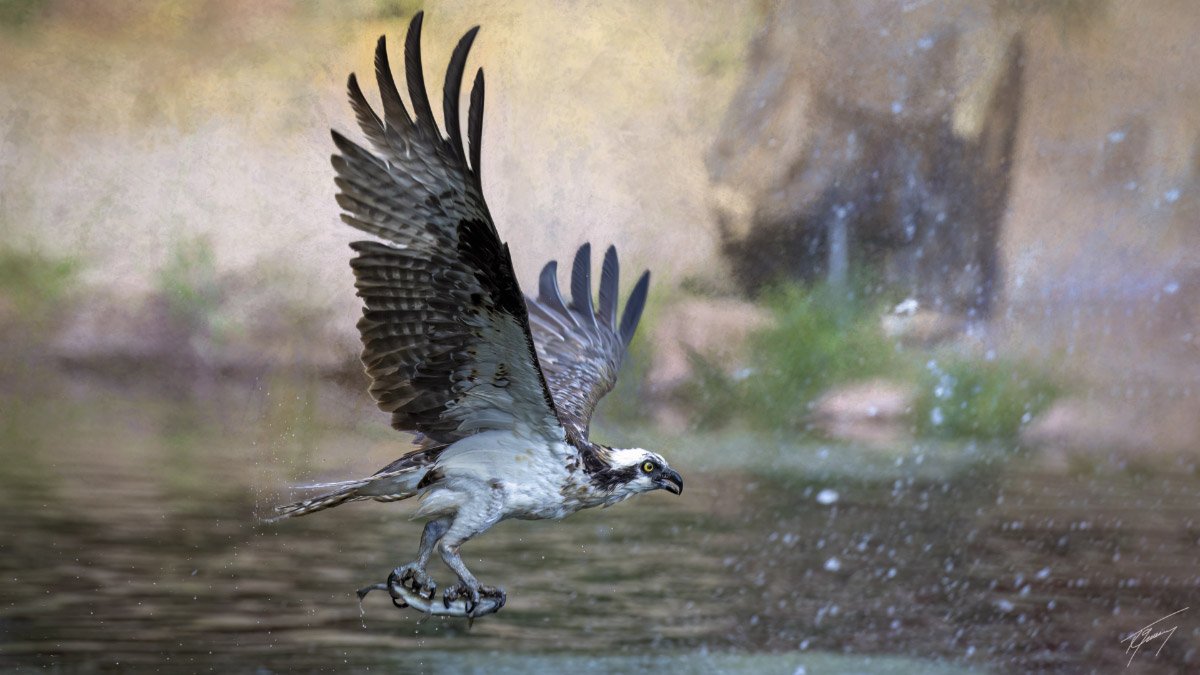
Below is an Osprey making his get away with dinner firmly in his talons and the sound of the attack and escape covered by the sound of the aerators pumping water into the air only to splash down in the pond.

Have a beautiful day, keep breathing and smiling … you are here and with choices to make!

Cheers,

Ted

Therefore, while yet you have
the strength, cherish a desire to do
some useful work in your
little corner of the world, and
have the steadfastness to labor.
For this is the way to the
happy life; with health and
endearing ties, it is the way to the
glorious life.

excerpt from Happiness by Max Ehrmann

###

photo_tedgrussingThe easiest way to reach Mr. Grussing is by email: ted@tedgrussing.com

In addition to sales of photographs already taken Ted does special shoots for patrons on request and also does air-to-air photography for those who want photographs of their airplanes in flight. All special photographic sessions are billed on an hourly basis.

Ted also does one-on-one workshops for those interested in learning the techniques he uses.  By special arrangement Ted will do one-on-one aerial photography workshops which will include actual photo sessions in the air.

More about Ted Grussing

Photographer Captures the ‘Spirited’ Personalities of Stuffed Animals

Photographer Captures the ‘Spirited’ Personalities of Stuffed Animals

sloth stuffed animal hanging from top of image frame against plain white background

Delightful and full of exuberant whimsy, photographer Jared Schoenemann’s series Anthropromophism, is a charming spectacle of stuffed animals bustling with playful souls.

In a quest to appreciate each of his daughter’s “stuffies” just as she does, Schoenemann was inspired to make a kind of visual encyclopedia to not only keep track of the many toys but to meet his daughter’s approval of the unique personalities she sees in them.

“The inspiration was my forgetfulness. My daughter loves her stuffed animals, therefore they are very important to our family, of course. After I got the business for forgetting a few of their names one too many times (on last count she had 137), I decided I should take them into the studio for some portraits.” Schoenemann says, speaking to PetaPixel.

black and white panda stuffed animal sitting with stretched arms against plain white background

brown rabbit stuffed animal sitting against plain white background

With a background in cinematography and athleticism, Schoenemann has a long-held appreciation for what photography has allowed him to personally express and the atmosphere of community it fosters.

“Photography connected all the right dots, (and) allowed me to produce a higher quality of work and collaborate with some wonderful people,” he says.

Utilizing the medium as a means of deeper connection with his daughter and intrigued by the challenge of capturing the “personalities” of each stuffed animal — while appeasing a tough critic — Schoenemann approached the task of photographing her many toys just as he would when shooting live animal portraits. Using a simplistic background, and no props or distractions, the photographer simply just captured the observations and implemented input from his daughter.

black white a grey raccoon stuffed animal sitting against plain white background

“I could talk it up with fancy words but it’s just a simple project anyone can do. My daughter chose her favorites and the ones with the most expressive features, and we got shooting. No props. I wanted just the animal alone, removed from any distractions (similar to my regular animal work). They were shot as they are. Not fresh and new, but well loved.”

Dragon with purple wings stuffed animal sitting against plain white background

When peering into the eyes of one of the stuffed critters it’s easy to become increasingly enchanted by the subtle yet vivacious “spirit” and quirky aura captured in every one of Schoenemann’s shots, attributes that he also credits to the toy maker’s skills,

“The designers of these stuffed animals are very talented and did a great job creating them. All I had to do was find the right angle, light them well, and not mess up their work. There was hardly any post-processing except for removing some dust and errant strings. The background is as it was shot, shadows and all, and that was that. I encourage others to do the same with their kid’s toys. It’s tons of fun.” Schoenemann shares.

up close view of Pink hippo stuffed animal sitting against plain white background

As for challenges, despite some slight trepidation from his daughter and a few undesirable subjects, the photographer was resolute.

“The biggest challenge was finding the proper angle to reveal their personality. Often they had to be pinned or posed, not unlike other work. Some had no personality or were difficult, and were kindly asked to leave (not unlike other work),” he continues.

“My daughter was a bit apprehensive about letting me shoot them, but once she saw their faces popping up on the monitor, she was all in. Oddly enough, their personalities do shine through, so the project was titled Anthropomorphism,” Schoenemann says. “The Nikon 60mm was optically great, but I did pine for smoother focus and was tempted to pick up the Zeiss 50mm macro.”

Creme, white a grey deer stuffed animal sitting against plain white background

Other equipment Schoenemann uses for his other work, he expresses his affinity for Nikon and Zeiss Lenses.

“I use Nikon bodies, Zeiss lenses, and Einstein strobes. For most of my close work, I use the Milvus 100mm, but for the stuffies, I wanted less of a telephoto feel. Browsing Craigslist, I found an old medical Nikkor 60mm AF-D in like-new condition that caught my eye also, it’s super-glued into manual focus, so no one wanted it. I got it for $60 and decided to give it a go for the project. It worked very well,” he muses.

black, white a grey koala stuffed animal sitting against plain white background

The results of Schoenemann’s series are a homage to photography and reality, rather than “pictures.”

“To me, a great photo is a genuine moment, captured and processed well, that reminds the viewer of the good times of life on earth. No fakery. No AI. I’m not interested in cartoons, filters, or fabrications. Hence in my mind, there’s a clear distinction between pictures and photography. We all have our faults, one of mine is my understanding of photography and its importance in capturing memorable moments. Time is short. I prefer to focus on what’s real. Who wants to remember a fake moment? Like Seinfeld said, ‘You don’t aspire to reach the nose.’”

The series also contributes to his desire to capture memorable moments that can be appreciated well into the future, moments that his daughter could foreseeably connect with.

pink bunny stuffed animal sitting with crossed arms against plain white background

“Most importantly, she loves the work, and when she eventually outgrows stuffed animals and the ones that don’t get saved are donated, we’ll be happy to have the memories. What started as a silly idea ended up quite nice, and when printed large on fine art paper, they take on a living, breathing, emotive quality. “

As for the response to the series, it has been positive. While Schoenemann simply enjoys the fun-loving nature of it, he does acknowledge and accepts that it won’t suit everyone’s tastes,

“The response has been wonderful. Friends and family love it, my daughter loves it and tells me the stuffies love it, too. Internet people probably won’t. People with kids like it. I’ve heard that it makes some want to photograph their kid’s toys more and that’s great to hear. It is always nice when your silly projects are enjoyed by others. And I understand why it could be totally lame to others. That’s how it goes.”

Purple, hippo stuffed animal sitting against plain white background

Pink hippo stuffed animal sitting against plain white background

As Schoenemann moves on to other projects, he keeps his love of community and connection front in center in his life and ambitions.

“Go and hug your kids, tell them you love them, call your parents, apologize for your teenage years, and tell them you love them. We’re here now, with free will to make good choices or bad ones. Make good ones — like photographing what’s real and memorable.”

For more from Jared Schoenemann, make sure to visit his website


Image credits: Jared Schoenemann

How to Customize Your Sony Camera to Fit Your Work

How to Customize Your Sony Camera to Fit Your Work

Cameras are more complex and customizable than ever before, allowing users to tweak buttons and settings until everything is mapped to the photographer’s personal workflow. In this video, watch how to change settings to how you work.

For years I would get a new camera and leave it on default settings for every button and dial. Then, as back-button focus became integral to how I shoot, revolutionizing the way I use my camera, I grew curious as to what else I might be able to improve. This sent me down a rabbit hole of creating custom functions, assigning new buttons, and reassigning old ones. In fact, I used to create so many that I’d forget much of what I’d done and go about doing a single button’s work the long-winded, manual way.

Nevertheless, I now have lots of custom functions that I use regularly and it’s important to my efficiency when shooting. The issue with many videos showing you how to “setup your camera” is that the photographer showing you is actually setting up their camera to their tastes. This video by Omar Gonzalez is a higher-level version of those videos, teaching you your options rather than being prescriptive. So, grab your Sony body and get customizing!

Planting the Seeds of Future Possibility at Lagos Art Week | Magazine

Planting the Seeds of Future Possibility at Lagos Art Week | Magazine

During Lagos Art Week, which took place from October 31 to November 2, 2022, we convened Lagos Portfolio Review and Critical Workshop, gathering an intergenerational group of image makers in collaboration with the Nlele Institute, a Pan-African nonprofit organization with a focus on lens-based media. During the first two days, we invited 30 emerging photographers (selected through an open call) to share portfolios and an aspect of their practice in an “open crit” context. On the last day, we held a critical workshop, which provided an opportunity for Lagos-based artists, critics, scholars, curators, and culture workers to share space and spend time together working through emergent issues in the field. The convening took up key themes in the forthcoming MoMA exhibition New Photography 2023: Kelani Abass, Akinbode Akinbiyi, Yagazie Emezi, Amanda Iheme, Abraham Oghobase, Karl Ohiri, and Logo Oluwamuyiwa (May 28–September 16, 2023). Five months later, we reflected together on the stakes of creating this collaborative program and its potential to generate future possibilities.

Oluremi C. Onabanjo: Though Lagos is no stranger to either of us, I must say it was rather special to travel there last fall as colleagues. The Lagos Portfolio Review and Critical Workshop was an immersion in an expansive community of photographers, artists, thinkers, and curators. How did you enter this conversation on contemporary photographic practice in West Africa, and specifically in Nigeria?

Kunbi Oni: I think I entered it during my master’s program—now 23 years ago—at a time when African photography was this blip on the map of art history. I was drawn to photography because I felt the medium’s immediacy. As soon as the medium was introduced, it was everywhere. Photography is technology and people moved around with it—which of course was facilitated through colonial routes. Just by virtue of the materials, this is a mode of making that really cuts through the instinct to center European and American makers.

We experienced this in Lagos. Whether someone is using a film camera, digital camera, or even their iPhone camera, people are making amazing images and are becoming connected within this creative sphere that they may not otherwise have opportunities to be able to do. The photograph as an occasion for connection—that has always been the most attractive part for me.

Praise Hassan. Untitled from Fragments from Home. 2020. Courtesy the artistFragments from Home. 2020. Courtesy the artist” data-image-overlay-item data-image-overlay-src=”/d/assets/W1siZiIsIjIwMjMvMDQvMjQvand5enloZHlkX0ZpZ3VyZTEuanBnIl0sWyJwIiwiY29udmVydCIsIi1xdWFsaXR5IDkwIC1yZXNpemUgMjAwMHgyMDAwXHUwMDNlIl1d/Figure1.jpg?sha=cdc35c5b0c078f34″ tabindex=”0″ ontouchstart onerror=”window.MoMA.onImageError(this, 1)”>

Praise Hassan. Untitled from Fragments from Home. 2020. Courtesy the artist

Ayorinde Ogundele. All Work and No Play. 2019. Courtesy the artistAll Work and No Play. 2019. Courtesy the artist” data-image-overlay-item data-image-overlay-src=”/d/assets/W1siZiIsIjIwMjMvMDQvMjQvODBtcGR0a2lnY19GaWd1cmUyLmpwZyJdLFsicCIsImNvbnZlcnQiLCItcXVhbGl0eSA5MCAtcmVzaXplIDIwMDB4MjAwMFx1MDAzZSJdXQ/Figure2.jpg?sha=2852ea8a5f312b9a” tabindex=”0″ ontouchstart onerror=”window.MoMA.onImageError(this, 1)”>

Ayorinde Ogundele. All Work and No Play. 2019. Courtesy the artist

OCO: I love that you’ve picked up on two photographers who have such a different relationship to space and the body. There’s Praise on one hand, thinking about life in Nigeria during the pandemic through its traces, and bringing a rigorous treatment of space through the collision of lines and light. Then Ayorinde, diving headfirst into the heart of the crush among his fellow students. In some ways, I felt like his work is such a riff on 1960s and 1970s West African studio photography—a genre that loves the boxer as a figure.

KO: Totally.

OCO: He takes us out of the studio and into life. Right into the social places where those bodies are shaped and where they move. It takes place among friends, and is as much about performativity as it is about cultivating the body.

Praise and Ayorinde are also great examples of the kind of generosity that took root in that space. They really took the opportunity to give feedback to their colleagues and to ask for guidance and counsel. These inquiries came to us and to our fellow facilitators, Nlele Institute instructors Amaize Ojeikere and Uche Okpa-Iroha. Their perspectives as image-makers—true pillars in the Lagos photography community—enriched our discussions and offered different points of entry and engagement.

The Lagos Portfolio Review at Angels & Muse, October 31, 2022

The Lagos Portfolio Review at Angels & Muse, October 31, 2022

Rachel Seidu. Alex and Debbie from Repossessing Identity. October 2021. Courtesy the artistAlex and Debbie from Repossessing Identity. October 2021. Courtesy the artist” data-image-overlay-item data-image-overlay-src=”/d/assets/W1siZiIsIjIwMjMvMDQvMjQvMjliYW4wbGcwNF9GaWd1cmVfNC5qcGciXSxbInAiLCJjb252ZXJ0IiwiLXF1YWxpdHkgOTAgLXJlc2l6ZSAyMDAweDIwMDBcdTAwM2UiXV0/Figure%204.jpg?sha=07fb1990479377f5″ tabindex=”0″ ontouchstart onerror=”window.MoMA.onImageError(this, 1)”>

Rachel Seidu. Alex and Debbie from Repossessing Identity. October 2021. Courtesy the artist

Karl Ohiri. Untitled from Archive of Becoming. 2015–ongoing. Courtesy the artistArchive of Becoming. 2015–ongoing. Courtesy the artist” data-image-overlay-item data-image-overlay-src=”/d/assets/W1siZiIsIjIwMjMvMDQvMjQvNDdnZWRzNndkZV9GaWd1cmVfNS5qcGciXSxbInAiLCJjb252ZXJ0IiwiLXF1YWxpdHkgOTAgLXJlc2l6ZSAyMDAweDIwMDBcdTAwM2UiXV0/Figure%205.jpg?sha=21e560a26247595a” tabindex=”0″ ontouchstart onerror=”window.MoMA.onImageError(this, 1)”>

Karl Ohiri. Untitled from Archive of Becoming. 2015–ongoing. Courtesy the artist

Logo Oluwamuyiwa. A Daring Smoke from Monochrome Lagos. 2016. Courtesy the artistA Daring Smoke from Monochrome Lagos. 2016. Courtesy the artist” data-image-overlay-item data-image-overlay-src=”/d/assets/W1siZiIsIjIwMjMvMDQvMjQvOXNoMWVqNHd2b19GaWd1cmVfNi5qcGciXSxbInAiLCJjb252ZXJ0IiwiLXF1YWxpdHkgOTAgLXJlc2l6ZSAyMDAweDIwMDBcdTAwM2UiXV0/Figure%206.jpg?sha=911ce2b67ad23be8″ tabindex=”0″ ontouchstart onerror=”window.MoMA.onImageError(this, 1)”>

Logo Oluwamuyiwa. A Daring Smoke from Monochrome Lagos. 2016. Courtesy the artist

Yagazie Emezi. Untitled from #EndSARS. 2020. Courtesy the artist#EndSARS. 2020. Courtesy the artist” data-image-overlay-item data-image-overlay-src=”/d/assets/W1siZiIsIjIwMjMvMDQvMjYvM3Z3cGhuMmJ5cl9GaWd1cmVfNy5qcGciXSxbInAiLCJjb252ZXJ0IiwiLXF1YWxpdHkgOTAgLXJlc2l6ZSAyMDAweDIwMDBcdTAwM2UiXV0/Figure%207.jpg?sha=1b72b0df9d91333a” tabindex=”0″ ontouchstart onerror=”window.MoMA.onImageError(this, 1)”>

Yagazie Emezi. Untitled from #EndSARS. 2020. Courtesy the artist

KO: How would you identify growth within this community in Lagos?

OCO: I think structurally. It’s not enough to say that there’s this many rockstar artists coming out of Lagos and that this qualifies it as a scene. It’s more important to see how the community is thriving. Relationships are key. Being myself a curatorial mentee of the late Olabisi Silva (1962–2019), it’s important to note that you do not get someone as rigorous and thoughtful as Abraham Oghobase or as inventive or creative as Kelani Abass without a place like Contemporary Centre for Art Lagos (CCA Lagos), which Silva founded in 2007.

I was also struck by how important it was for the emerging photographer Christopher Obuh Nelson to take the time to acknowledge Uche Okpa-Iroha for all of his sacrifices in building Nlele Institute and carrying its programming forward. In Lagos, artistic infrastructure functions differently than it does in places like New York, London, or Paris. In Lagos institutions and people play multiple roles. For example, the space where we held the program, Angels & Muse, was founded by the artist Victor Ehikhamenor, and functions as a residency space, cultural center, and artist’s studio. So, I would say growth is when artists benefit from a healthy intersection of critical, programmatic, and curatorial possibilities.

KO: You organized this portfolio review and critical workshop in conjunction with your forthcoming exhibition New Photography 2023. Can you talk about the show and why it was important to connect this program to it?

OCO: With the guidance of Clément Chéroux, former chief curator of MoMA’s Department of Photography, I conceived of New Photography 2023 as an iteration of the series where we take an artistic scene as a starting point. The city of Lagos is not the object of the exhibition but rather functions as the curatorial ground. Within this framework, I am looking at a set of interrelated visual positions bouncing and reverberating off of one another and helping pursue different pathways in relation to a particular conceptual idea. In making New Photography 2023, I was struck by the different ways in which these seven artists were deconstructing “the photograph as document,” and moving toward the poetic, spatial, and social possibilities that exist in the undercurrent of the image.

As a result, it felt important to think about how these undercurrents function within a scene that is fluid—in a metaphorical sense, but also literally dependent on water. Lagos comes from the Portuguese word for “lakes”; it is a city sutured together by bridges spanning the mainland and its islands. I wanted to be sensitive to these realities That is why New Photography 2023 needed to be engaged with the city in a way that wasn’t superficial, but by situating ourselves—and by extension MoMA—within the infrastructure that supports the seven artists featured in the show. To come back, again and again, and to see how experiences shift and change as time passes, is another way to engage ethically and thoughtfully with the “art of our time.” To me, we must look at art from as many different positions as possible, and learn from the artists occupying these positions. Only then will we see that the space between the institution and the world is really not space at all.

Watch this video to learn more about the 2022 Lagos Portfolio Review and Critical Workshop.

We would like to extend gratitude and respect to the emerging image-makers who presented their work during Lagos Portfolio Review: Emmanuel Abor, Neec Nonso, Badejo Fuwa, Chioma Agba, Bell-Gam Gabriel, John Amusan, Ugochukwe Ezeokoli, Christopher Obuh Nelson, Bashir Onuche Aminu, Peter John Chukwu, Ugochukwu Azuya, Emmanuel Lucky, Eragbie Joshua, Praise Hassan, Apah Benson, Tolulope Owoeye, Kamilu Balogun, Zainab Abiola, Chukwuka Obu, Tomiwa Arije, Oluwayemisi Onadipe, Ebenezer Okike, Zainab Asafa, Oluwatoyin Adedokun, Adetutu Adediran, Ayorinde Ogundele, Amanda Madumere, Rachel Seidu, Bishop Duke, Stephen Arudi. We acknowledge the rich perspectives and wisdom provided by the artists, curators, and scholars who presented at the Critical Workshop, including Akinbode Akinbiyi, Logo Oluwamuyiwa, Karl Ohiri, Amanda Iheme, Abraham Oghobase, Kelani Abass, Uche Okpa-Iroha, Temitayo Ogunbiyi, and Victor Ehikhamenor, who generously hosted the program at his space Angels & Muse. Special thanks to our collaborators at the Nlele Institute: Uche Okpa-Iroha, Ayo Okpa-Iroha, Amaize Ojeikere, Kunbi Rowland, Obasola Bamigbola, Ololade Lawal, Kayode Oluwa, Chukwudi Onwumere, Bola Ajakaiye, and Ebun Ikenze. This program was made possible through transformative support from the International Council; thank you Jay Levenson, Marta Dansie, and Smooth Ugochukwu Nzewi for your trust.

New Photography 2023: Kelani Abass, Akinbode Akinbiyi, Yagazie Emezi, Amanda Iheme, Abraham Oghobase, Karl Ohiri, and Logo Oluwamuyiwa, organized by Oluremi C. Onabanjo, Associate Curator, with Kaitlin Booher, Newhall Curatorial Fellow, and Samuel Allen, MRC Fellow, Department of Photography, is on view at MoMA May 28–September 16, 2023.

PolaCon NYC is a Convention for Instant Film Photography Fans

PolaCon NYC is a Convention for Instant Film Photography Fans

PolaCon NYC

Polaroid and instant film photography supporters are invited to PolaCon in New York City to celebrate all things instant film photography.

The three-day PolaCon NYC event, running from May 19-21 at various locations in “The Big Apple,” includes photo walks, meet-ups, presentations, and special events designed to help people meet like-minded photographers, share their work, learn from talented professionals, and check out the latest instant film gear and techniques.

PolaCon NYC
PolaCon NYC runs from May 19-21 in New York City. Tickets for the event are on sale now.

PolaCon was founded in 2015 by the Instant Film Society (IFS) and previous events have been held in Texas and California. The upcoming PolaCon NYC marks the first time the event has been in New York.

IFS itself was founded in 2012 to “increase awareness, accessibility, and understanding of instant film photography.” As part of that mission, IFS partnered with camera shops, local camera clubs, and film collectives as part of PolaCon.

“We are excited to bring together the instant film photography community for a weekend of creativity, education, and fun. Our goal is to create a welcoming and communal environment where photographers can connect with others who share a similar passion for instant film,” says the organizers of PolaCon NYC.

Alongside workshops, demos, artist talks, and photo walks, the event promises many other fun and educational events, including scavenger hunts, giveaways, “revelry,” and “dancing.” The convention’s website includes a full breakdown of the full schedule of events, including locations and event descriptions. Brooklyn Film Camera is the primary hub for the event, hosting meet-ups, check-ins, and the event’s wrap party on May 21.

PolaCon NYC Polaroid Now Plus
Polaroid Now+

PolaCon NYC is sponsored by Polaroid, Wyckoff Windows Studios, Brooklyn Brewery, and Liquid Death.

In recent years, film and instant film photography have experienced a surge in popularity. There are a lot of instant cameras on the market, and PetaPixel’s guide to “The Best Instant Cameras in 2023” cuts through the noise to deliver an in-depth overview of instant photography’s best gear, including PolaCon’s sponsor, Polaroid’s Now+, named the “Best Classic Instant Camera.”

PolaCon NYC
PolaCon NYC tickets and merchandise are on sale now, including t-shirts with this charming design.

PolaCon NYC tickets and merchandise are on sale now. Tickets grant entry to “the entire weekend of programming” and cost $35.


Image credits: PolaCon NYC

Photo Contests are Woefully Unprepared for AI

Photo Contests are Woefully Unprepared for AI

Clipped Highlights - Photo Contests Are Unprepared for AI

When it rains, it pours. Recent controversies have shown that photography competitions, even large, prestigious ones, are woefully unprepared for the ongoing artificial intelligence (AI) revolution.

For the last few years, it’s been all too easy to dismiss AI images as “easy to spot.” However, as recent events demonstrate, competitions should no longer kick the AI-generated can farther down the road, try as some contest organizers might.

Recap: Sony World Photography Awards

After PetaPixel broke the news that a self-described “photo media artist,” Boris Eldagsen, won first place in the Creative category of the 2023 Sony World Photography Awards Open competition with an AI-generated image. The floodgates opened, and a firestorm of controversy commenced.

To Eldagsen’s credit, he declined the prize, although in doing so, perhaps inadvertently embarrassed the competition with which he claims to have wanted a meaningful discussion.

Clipped Highlights - Photo Contests Are Unprepared for AI
‘THE ELECTRICIAN’ by Boris Eldagsen

Can cheating be a good or just action if it has good intentions, or is it “bad” in and of itself? In either case, the World Photography Organization isn’t interested in open dialogue with Eldagsen about AI technology.

The more pervasive issue isn’t that Eldagsen broke the rules, no matter what he hoped to achieve by doing so. Rather, it is that one of the most prominent photography competitions in the world appears to have no idea how to handle AI-generated images — which are synthesized frauds that have no place in a photography competition.

The Sony World Photography Awards does not mention artificial intelligence in its rules and regulations. That omission isn’t unique to the Sony World Photography Awards or the World Photography Organization. It’s a pattern issue across the board.

Clipped Highlights - Photo Contests Are Unprepared for AI
Boris Eldagsen and his award-winning AI-generated image, ‘THE ELECTRICIAN’

AI is new-ish, but I’m nonetheless surprised that competitions haven’t tossed something about AI into the long list of legalese to cover themselves in the event of, well, exactly what happened in this year’s Sony World Photography Awards.

That said, a quick look at the rules at the bottom of this page shows that there are some rules that someone could reasonably apply to AI-generated images, even though AI isn’t expressly mentioned.

4.1.1 You are the sole owner and author of each Entry

4.1.6 Each Entry does not infringe upon the copyrights, trademarks, contract rights, or any other intellectual property rights of any third person or entity, or violate any person’s rights of privacy or publicity…

AI models, apart from Adobe Firefly, are built on stolen images — they’re trained using someone else’s photos without their explicit permission. While the precise assembly of the group of pixels comprising an AI-generated image may be wholly novel, the information that led to the creation of that content isn’t — it was someone else’s work, either grabbed from the public domain or outright stolen from the original creator. You may not see the family tree of unoriginality and theft in the final AI-generated image, but it’s there, hiding just beneath the surface.

I contend that an AI-generated image violates each rule above. I don’t believe the person who makes an image in Midjourney, for example, is the sole owner and author of the picture. I also think that, at least in many cases, the synthesized image violates copyright. If something is built using stolen parts, it’s not much of a leap to say that the very existence of the creation represents theft. At the very least, AI-generated art has no legal protection, at least not yet. You can’t currently copyright AI-generated art, implying a lack of creative ownership.

However, these rules aren’t sufficient to deal with AI-generated imagery because they occupy a gray area and don’t explicitly mention AI.

Fine Art Photography Awards: An AI Controversy

The 2023 Sony World Photography Awards may be the first major photo contest to be propelled into the public eye, but it’s not the first significant photo contest to be embroiled in an AI controversy.

Another prestigious photo competition, the Fine Art Photography Awards, has been fighting (smaller) AI fires since it announced its winners earlier this month. However, the fight has been chiefly contained, never erupting into a full-scale media frenzy.

Photographer Cheraine Collette, who never replied to PetaPixel’s request for comment, won the “Fine Art Photographer of the Year, Professional Category” prize at the ninth annual Fine Art Photography Awards with her photo series, Exquisite Beauty.

The series celebrates the stories of “The exquisite beauty and strength” of the roughly 1-in-20,000 African people born with albinism. Some individuals are celebrated, while others are ostracized. In both extremes, the lives of many albino Africans are fundamentally different from their peers.

Telling this story is an admirable objective, and the photo series is impressive and eye-catching. However, some people have questioned the authenticity of Collette’s winning images. The skepticism surrounding Collette’s winning images was immediate and boisterous.

The Fine Art Photography Awards weighed in quickly, commenting on its Instagram post announcing Collette’s victory:

“Dear participants and debaters, we are watching the discussion that has been going on since the publication of the competition results with great interest. We will not refer here to the results themselves, which do not violate our rules and were chosen after a fair vote by the judges.”

“At the same time, we understand the concerns of the community, and we are also looking at AI technology, which seems to be the next step in the digital revolution and, like any such tool, carries both risks and opportunities for creators. Therefore, we decided to add additional verification of winners in subsequent editions of our event. They may be asked to provide RAW files if there is any doubt about the creative process behind the image. These rules will appear soon in our terms and conditions.”

“At the same time, we would like to thank everyone for an interesting discussion, we look forward to the future of photography and digital art!”

Although Collette didn’t respond to PetaPixel’s request for comment, she did add her comment on the legitimacy of her victory on that same Instagram post:

“These portraits are all photographed by me. Composed of different photographs I’ve created, like I’ve always done for almost a decade. First of all, thank you Fine Art Photography Awards for the amazing award! It’s a dream come true! I’ve had a best friend with albinism for over seven years and I’ve experienced a lot of struggles she faced. That’s why I wanted to create a series on this subject. It’s heartwarming that this new series received incredibly positive feedback so far. Nowadays with AI getting more realistic by the day, apparently, everything seems AI-generated.”

What’s the Truth?

I can see the arguments both ways. However, it appears I’m in the minority based on the Instagram post announcing Collette’s win.

One commenter says, “The artist has maintained the pictures are created from real shots of people, but real people have irises the correct shape and they don’t have four fingers. So, I’m done, I tried to be as open as possible to this. I feel the only way to disprove everyone’s concerns is to just name and tag the models, that’s easy and quick to do if they are real people.”

Someone else adds, “AI is not photography. Rather, it steals from actual photographers to attempt to get better. These images are clearly AI.”

Clipped Highlights - Photo Contests Are Unprepared for AI

“In one of the other images from this set, the model has four fingers. None of them look entirely real, but this should be a dead giveaway. Not real,” another commenter writes.

Other people have demanded to see RAW image files and want the models tagged to prove they are real.

That demand skirts dangerously close to a situation where someone “with nothing to hide” is expected to answer all critics and prove that they’re not lying. If that situation devolves, as it frequently does, into one where someone refusing to submit proof to refute a claim is itself treated as evidence that an allegation is true. That is not how it should work.

A protected source tells PetaPixel that the “truth” is “actually worse” than Collette using AI to generate her images. As tempting as it is to speculate about what “actually worse” could entail, this isn’t the arena to do so.

Cheraine Collette satisfied the Fine Art Photography Awards’ concerns, if they had any, and won the award. As far as her prize goes, that’s the end of the story.

We’ve Entered Uncharted Territory, and Nobody is Prepared

To Collette’s credit, her response, if not necessarily convincing, is at least interesting. I want to pinpoint this part of what Collette wrote on Instagram: “Nowadays with AI getting more realistic by the day, apparently, everything seems AI-generated.”

I think this gets to the crux of the issue. Once a big competition is fooled, like the Sony World Photography Awards appear to have been, the public’s trust not just in a specific contest is shaken, but people are less trustworthy of photography itself.

This theme of mistrust isn’t new. Photoshop is really powerful and has been used to deceive viewers for a long time. Before the digital age, photographers still heavily manipulated images.

In many cases, such as with fine art photography, there isn’t anything wrong with manipulating an image.

However, AI somehow feels different. To many photographers, myself included, something is jarring and gross about an AI-generated image being passed off as authentic photography.

It concerns me that AI has advanced to the point where someone may present an image to me, claiming it’s a photograph, and I may be unable to tell if they’re lying. It makes me question my abilities as a photographer, which is an uncomfortable feeling.

Clipped Highlights - Photo Contests Are Unprepared for AI

For example, Collette’s images seem obviously AI to some and not-so-obviously fake to others, like me. The fact that the pictures are so polarizing is concerning in and of itself. Whether Collette’s photos utilized AI at all or are outright entirely generated by AI is beside the point — the fact that there’s active debate about them is damaging enough to the legitimacy of the Fine Art Photography Awards and photo contests at large.

Lying and misrepresentation are undoubtedly wrong. But what I’m beginning to realize is perhaps even worse than being deceived on occasion and suffering a blow to my ego in the process is that I now find myself viewing all photography with a skeptical eye. It’s often said that people “see what they want to see,” but I’d argue that it’s even easier, and much more harmful, to see what you fear most.

The ability for photographers to bypass rules and fairness using AI technology has rendered all photography a bit less trustworthy, and that genuinely devastates me. It is painful to think that I might forever view the work of others through doubt-tinted glasses.

What Can Contests Do?

The Sony World Photography Awards’ response, or lack thereof, is problematic. At this point, I remain unconvinced that Sony isn’t just treating the Eldagsen situation as a one-off and trying to move past it without fundamentally shifting how they judge entries and handle questionable images.

On the other hand, the Fine Art Photography Awards, while unwilling to explain much about Collette’s winning photo series, has announced that subsequent editions of the contest will have rules in place that require photographers to be willing and able to submit RAW image files for inspection in cases where the judges aren’t sure about the provenance of an image.

Clipped Highlights - Photo Contests Are Unprepared for AI

That’s a good approach but perhaps insufficient. Someone could still fake their way through that process but enacting any roadblock to an AI image winning an award is a step in the right direction, especially one that’s easy for genuine photographers to satisfy, should the issue arise. It’s far better than throwing one’s hands in the air and saying, “I give up!”

A comment on Instagram referenced something else that deserves consideration, making special categories for AI-generated and AI-assisted photography. If you can’t outright prevent AI artists from entering work in photography competitions, giving them a place to play may prevent them from entering categories in which they don’t belong.

By the way, I don’t believe there’s anything inherently wrong with AI technology, nor do I think there’s no place for it in art. Photographers and other artists have long utilized advancing technology to tell their stories better and evoke emotions in viewers.

I also think that artists using AI have artistic talent. Truly exceptional work still, at least for now, requires more than throwing a prompt into a generative AI model.

The problem is that when all but a few bad actors compete in good faith on equal footing, and a wolf enters in sheep’s clothing, it does a disservice to fellow competitors, photo competitions, and perhaps most damningly, the institution of photography itself.

Is requiring RAW images or giving AI artists their own categories removing water from a sinking boat using a sieve? Perhaps. But something must be done, and quickly, because the option for photo contests to twiddle their thumbs and wait for AI to “blow over” or become a bigger problem has come and gone.

Where do We Go from Here?

I’m not trying to attack the World Photography Organization, the Sony World Photography Awards, the Fine Art Photography Awards, or any photographers I’ve mentioned. But you can’t un-ring a bell, and AI hasn’t just rung the bell; the AI-generated bellringer is creating an immense, unending racket.

Photo contests must find a way to quiet the noise — or at least acknowledge it — before it’s too late. We’re rapidly approaching a point of no return, where photo contests and their winners are no longer given the respect and reverence they deserve.


This story is part of PetaPixel’s weekly newsletter Clipped Highlights.


What is Clipped Highlights?

Clipped Highlights is a free, curated, weekly newsletter that will be sent out every Wednesday morning and will focus on a few of the most important stories of the previous week and explain why they deserve your attention. This newsletter is different from our daily news brief in that it provides unique insights that can only be found in Clipped Highlights.

In addition to unique takes on the biggest stories in photography, art, and technology, Clipped Highlights will also serve to feature at least one photo series or art project that we think is worth your time to check out. So often in the technology and imaging space we focus on the how and not the what. We think that it’s just as important, if not more so, to look at the art created by photographers around the world as it is to celebrate the new technologies that makes that artwork possible.

If this kind of content sounds like something you’re interested in, we encourage you to subscribe to the free Clipped Highlights newsletter today. You can read this week’s edition right here, no subscription necessary, to make sure it’s something you want in your inbox.

#mc_embed_signup{background:#fff; clear:left; font:17px Helvetica,Arial,sans-serif; width: 100%;} /* Add your own Mailchimp form style overrides in your site stylesheet or in this style block. We recommend moving this block and the preceding CSS link to the HEAD of your HTML file. */

We’ll also make sure to share each edition of Clipped Highlights here on PetaPixel so if you aren’t a fan of email, you won’t be forced to miss out on the weekly newsletter.

ArtDependence | Photo London Master of Photography 2023 : Martin Parr

ArtDependence | Photo London Master of Photography 2023 : Martin Parr

community in Liverpool and Manchester. When I changed to shooting in colour, I started by depicting a working class resort adjacent to Liverpool, and subjects such as shopping in Salford and the middle classes of Bath and Bristol. More recently I have documented the
establishment, with projects on Oxford University and the Livery companies of London.

“Presented here at Photo London are recent images that have not been shown before, mostly taken very recently and show highlights from my ongoing documentation of the British Isles. Many familiar subjects are found here such as my long fascination with the British seaside and the ongoing documenting of agricultural shows and summer fetes. New discoveries are always being made such as the wonderful steam fair in Dorset or the half marathon in Bristol.

“I think of these images as an interpretation of the many mixed emotions I feel towards my homeland. It is almost a love/hate relationship, and I find addressing this is almost a form of therapy for me.

“To complement this show is a grid of images taken from my Beach Therapy project. With my ongoing fascination with the seaside this is a set of images taken with a telephoto lens, where I explore distant figures on the beach, usually with out of focus greenery in the foreground. Although each is an individual work, they become a fascinating grid when put together.

“Finally, there are half a dozen photo deckchairs, again shot on the beach, to give people a chance to contemplate the work they have just seen.”

—Martin Parr, 2023

With 110 exhibitors coming from 55 cities across five continents, Photo London 2023 shows the very best of the past, present and future of photography worldwide. ‘Martin Parr: Recent Works’ leads the Photo London 2023’s Public Programme. It is accompanied by the group show ‘Writing her own Script: Women Photographers from the Hyman Collection’ and the Photo London Talks Programme curated by Aperture, which will feature a talk by Parr.

Photo London’s Co-Founders Michael Benson and Fariba Farshad comment:

“Martin Parr is quite rightly regarded as the godfather of British photography. It is no exaggeration to say that without Martin Parr’s exemplary practice today’s British photography scene would be much impoverished. It would certainly be a great deal less fun. He has been an unstinting and generous champion of young and overlooked photographers and through the work of the Foundation that he set up in 2020 (check) he has worked tirelessly to make photography accessible to all. In all this Martin’s work aligns perfectly with our own and we are thrilled to present him as our 2023 Master of Photography.”

Image : Martin Parr, Great Dorset Steam Fair, Dorset, England, 2022 © Martin Parr / Magnum Photos / Rocket Gallery

‘I just saw the hand of God!’: Marylise Vigneau’s best photograph

‘I just saw the hand of God!’: Marylise Vigneau’s best photograph

When I was younger, I wanted to be a writer and, in the last year before the collapse of the USSR, I was in Prague taking “visual notes” to inspire my writing and support my memory. One day, I came across the face of an older man, so ambiguous and beautiful. From this moment, things were reversed and images became more immediately tangible to me than words. That said, photography is also about creating a narrative, and my approaches to both writing and creating images share similar predilections. I certainly prefer allusions to descriptions. I love ambiguity.

I cannot imagine going somewhere without reading up on it first. I’ll visit Google Maps and Google Earth and try to imagine the streets, but of course the reality is always a surprise, with nuances I haven’t anticipated. This was taken in Lahore, to where I have returned almost every year for a decade. When I first came to Pakistan, I was overwhelmed and puzzled, but the country and its people grew on me.

I love the process of investigating new places, getting lost and identifying plots, characters and overtones. This past winter I had been staging portraits of local artists, and was riding my scooter on my way to meet one of them when I spotted this hand. As I rode past a large church, I saw the fingers popping out from behind a wall and thought: “Oh, that’s funny. I just saw the hand of God!”

I was in a hurry and could not stop, but I promised myself I’d return. When I did, I knocked at the door and had to persuade the guy in charge to let me in. It was a Christian church, and Christians are a religious minority discriminated against in Pakistan – the barbed wire in the picture indicates those safety concerns. Still, I was able to convince him of my innocuousness. The wall I’d seen the fingers poking above was part of the church’s compound and, once inside, I found they were attached to a huge concrete hand, one of a pair, surrounded by a flowerbed. The framing was evident. I just waited for a bird.

There are many other photographs I might have chosen as my best, but I enjoy the incongruity of this one. The way the fingers seem to be interfering with overhead wires is also what makes it for me. Lahore suffers daily power outages and it felt like I’d found the culprit. I have produced a series of diptychs with my black and white photographs of Pakistan, bringing together images in a bittersweet way. In one, a jumping boy seems twinned with a tangled mess of power cables, a further reference to the frequent cuts. In another of the diptychs, the photograph of the hand appears on the left while, on the right, a little girl stretches her own hand towards it.

Photography, for me, is a way of being in the world, of going into the world. It allows me to transmute my obsessive relationship with time, to meet people, tell their stories, and transmit emotions through the evocative power of images. Most of my earliest pictures were landscapes, although always with traces of human activity. At first, I was too shy to interact with people – I had to learn.

When taking photographs in Pakistan, it’s impossible not to be noticed, especially using a scooter in a country where it’s rare for women even to ride a bicycle. I am moved when old ladies greet me, and I can see in their eyes they are happy for me to have this freedom they never experienced.

skip past newsletter promotion

Marylise Vigneau.

Marylise Vigneau’s CV

Born: Ambilly, France
Trained: Master’s in comparative literature, University of La Sorbonne, Paris. A perspective-changing photography workshop with Philip Blenkinsop and Gary Knight.
Influences: “Novels influenced me more than anything. I was a solitary child, and I used to devour books. Among the photographers Michel Vanden Eeckhoudt, Chris Killip, August Sander, Claudine Doury, Aun Raza, Sally Mann, Robert Frank, Jason Eskenazi and Josef Koudelka.”
High point: “Every time a person agrees to be part of a project and be photographed. It is always a precious gift.”
Low point: “During insomnias, I sometimes imagine images that are impossible to produce. A mix of reminiscences, imagination and unlikely happenstances.”
Top tip: “I have been a curious and disobedient child, I became a curious and disobedient woman, and I owe my utmost joys, my dearest discoveries to these discredited qualities. Investigate, and find your narrative and an aesthetic to serve it. Reflect and dissent, including with your own prejudices.”