Photography

The camera never lies? Creator of AI image rejects prestigious photo award

The camera never lies? Creator of AI image rejects prestigious photo award
image

The winner of a Sony World Photography Award has refused to accept the prize after revealing the winning photo he submitted was created using an artificial intelligence image generator.

The Berlin-based German photographer Boris Eldagsen won the Creative category of the award’s 2023 Open competition, and was garlanded at a ceremony on 13 April in London. The award is considered one of photography’s most prestigious honours.

By entering a computer-generated image to a traditional photography prize, and then subsequently refusing to accept the ensuing award, Eldagsen claims he hopes to “drive debate” about a technology that is poised to dramatically alter how we define and understand photorealist imagery.

Eldagsen’s winning image, Pseudomnesia: The Electrician, was created using DALL-E 2, an image generator developed by OpenAI, the San Francisco-based company that also created the AI chatbot ChatGPT.

In his submission, Eldagsen described the image as “a haunting black-and-white portrait of two women from different generations, reminiscent of the visual language of 1940s family portraits”.

A spokesperson for the award has responded by accusing Eldagsen of “deliberate attempts at misleading us” by entering the competition under a false pretence and with the intention of spurning the award.

The award’s judging panel was aware that Eldagsen’s image was AI-generated and awarded the prize in that knowledge, the spokesperson says.

In previous years, the award’s creative category has traditionally honoured photographs that have challenged the boundaries of a conventional photograph. “The award welcomes various experimental approaches to image making,” the spokesperson tells The Art Newspaper.

Shortly after the prize was announced, Eldagsen appeared without invitation on stage to address the gathered audience. In a spontaneous address, he said AI images are not photographs and therefore should not be considered in competitions designed for camera-based practitioners.

Eldagsen then published a statement on his website in which he accused the competition’s judges of failing to distinguish between a photographic image and a ‘generative’ image created by an AI machine.

“I applied as a cheeky monkey, to find out if the competitions are prepared for AI images to enter,” Eldagsen wrote. “They are not.”

“How many of you knew or suspected that it was AI generated? Something about this doesn’t feel right, does it?” he added. “AI images and photography should not compete with each other in an award like this. They are different entities. AI is not photography. Therefore I will not accept the award.”

Speaking to BBC Radio on 18 April, Eldagsen said of the image: “It looks like a 1940s vintage wet-plate [collodion] photograph.”

Eldagsen used the phrase ‘promptography’ to describe the image, alluding to the way platforms like DALL-E 2 and ChatGPT rely on ”prompts“—specific instructions from a user—to create bespoke imagery or content.

“Promptography is done with prompts. Photography is done with light,” Eldagsen told the BBC. “I think it’s very important to differentiate these [two things] by terms, and then to have an open discussion about this in the photography world. Is the umbrella of photography large enough to say [this type of imagery] is part of it? Because the visual language is the same.”

A spokesperson for the Sony World Photography Awards tells The Art Newspaper: “During our various exchanges with Boris Eldagsen ahead of announcing him as the Creative category winner in the Open competition on 14 March, he had confirmed the ‘co-creation’ of this image using AI. In our correspondence he explained how following ‘two decades of photography, my artistic focus has shifted more to exploring creative possibilities of AI generators’ and further emphasising the image heavily relies on his ‘wealth of photographic knowledge’. As per the rules of the competition, the photographers provide the warranties of their entry.

“The Creative category of the Open competition welcomes various experimental approaches to image making from cyanotypes and rayographs to cutting-edge digital practices.

“As such, following our correspondence with Boris and the warranties he provided, we felt that his entry fulfilled the criteria for this category, and we were supportive of his participation. Additionally, we were looking forward to engaging in a more in-depth discussion on this topic and welcomed Boris’ wish for dialogue by preparing questions for a dedicated Q&A with him for our website.

“As he has now decided to decline his award we have suspended our activities with him and in keeping with his wishes have removed him from the competition. Given his actions and subsequent statement noting his deliberate attempts at misleading us, and therefore invalidating the warranties he provided, we no longer feel we are able to engage in a meaningful and constructive dialogue with him.

“We recognise the importance of this subject and its impact on image-making today. We look forward to further exploring this topic via our various channels and programmes and welcome the conversation around it. While elements of AI practices are relevant in artistic contexts of image-making, the Awards always have been and will continue to be a platform for championing the excellence and skill of photographers and artists working in the medium.”

• The Sony World Photography Awards Exhibition is at Somerset House, London, until 1 May

Factory Works to offer classes on film photography and darkroom practices

Factory Works to offer classes on film photography and darkroom practices

Wiliamsport, Pa. — Factory Works Photo Lab at the Pajama Factory will be offering an introduction to black and white film darkroom photography on Tuesday nights in May.

The classes will take place May 2, 9, 16, 23, and 30 from 6-8 pm.

Instruction will cover the basics of film photography and darkroom practices, from using a camera to processing film and ultimately making a finished print. The cost is $100.

Factory Works will have cameras available for use if you don’t already have your own. The only thing you need to provide is a roll of 35mm Ilford 400 ISO film which can be purchased from Hoyer’s Photo on Washington Blvd in Williamsport. Mention you’re a student of the Photo Lab to ensure you purchase the correct film. All other materials are provided.

If you are interested in attending, email photolab@factoryworks.org to coordinate payment. Upon completion of prepayment, students will receive a coupon for 10% off a film purchase at Hoyer’s Photo.

Keep your news local

Access to independent, local news is important, do you agree?

We work hard to deliver timely, relevant news, for free. 100% of your contribution to NorthcentralPa.com goes directly to helping us cover news and events in the region.

Thank you for saying that local news matters!


AI-generated image wins photography award, but artist refuses to accept it

AI-generated image wins photography award, but artist refuses to accept it
The photo is part of a series titled PSEUDOMNESIAThe photo is part of a series titled PSEUDOMNESIA
The photo is part of a series titled PSEUDOMNESIA

Eldagsen 

The photo above has won a Sony World Photography Award in the creative open category, but there’s a problem. It’s AI-generated.

After winning, Berlin-based artist Boris Eldagsen posted on his blog: “Thank you for selecting my image and making this a historic moment, as it is the first AI generated image to win in a prestigious international PHOTOGRAPHY competition,”

Since then, the image has become the subject of a huge controversy in the AI art vs human art debate.

AI-generated image wins photography award, but artist refuses to accept it
The award winning photo in full

AI images and photography are different entities, and even Eldagsen seems to think so. He has refused to accept the award, emphasising on that AI and photography should not be competing in the same category. “AI is not photography. Therefore I will not accept the award.”

Why did he submit AI art into a photography competition?

While people are now slowly warming towards the powerful qualities and usefulness of artificial intelligence and its scope in terms of generating impressive images and graphics, there are folks who strongly believe that AI can represent genuine human artistic expression.

Eldagsen further wrote in his blog, “I applied as a cheeky monkey, to find out if the competitions are prepared for AI images to enter. They are not.”

AI-generated image wins photography award, but artist refuses to accept it
Boris Eldagsen

Eldagsen and the World Photography Organization (WPO), which hands out the Sony World Photography Awards, have locked horns over the issue. WPO is now claiming that they were aware that the image was co-created using AI before he was announced as the winner.

In response to this, Eldagsen said in his blog, “Pretending that you knew the picture was AI is wrong. I told one of your assistants in length, but then after the press release your PR executive contacted me, being surprised about all the inquiries regarding my image and asking for more info.”

The piece of art in question is part of a series called PSEUDOMNESIA – which Eldagsen explains is the Latin term for pseudo memory, a fake memory, such as a spurious recollection of events that never took place, as opposed to a memory that is merely inaccurate. Interestingly, Eldagsen’s website also mentions that the images in the series have been co-produced by the means of AI (artificial intelligence) image generators.

“We, the photo world, need an open discussion. A discussion about what we want to consider photography and what not. Is the umbrella of photography large enough to invite AI images to enter – or would this be a mistake? With my refusal of the award I hope to speed up this debate.”

Eldagsen studied photography and visual arts at the Art Academy of Mainz, conceptual art and intermedia at the Academy of Fine Arts, Prague and fine art the Sarojini Naidu School of Arts & Communication, Hyderabad.

Most Popular

On giving your art the time it needs

On giving your art the time it needs

Let’s talk about time capsules. How were you so prescient as to know that’s what your mall project needed? Was there a precedent for time capsules in your consumption of art?

When I went to college, I ended up taking a lot of religious studies, sociology, and anthropology classes, which gave me a long historical view about the importance of documentation and paying attention. I knew I wanted to be a photographer, and I spent much of my time in a photography book store called A Photographer’s Place in SoHo. I realized that the books that gathered images from 20 and 30 years earlier had a resonance and a weight.

So, when I stumbled upon the mall in Long Island, I had this awareness of all those different factors; that documenting the mall would be like an anthropology project, but also a photography project, kind of like Robert Frank and William Eggleston, two photographers that I loved. And I was looking at their work and realizing that this work won’t mean as much until later. That was the secret sauce.

I’ve always been doing that, even when we made our first movie. My wife Suki and I made a movie called Half-Cocked in 1994. We couldn’t get it into a single film festival because it was almost too present. I kept saying, “In 10 years, it’s going to mean something to people.” It turns out it took 25 or 30, but that idea was right. And, as a 20-year-old, 10 years seemed like a really long time. As a 54-year-old, it doesn’t sound that long.

Have you recommended that people sit on stuff for awhile, and has that borne fruit?

I wrote a letter to young photographers on my website. It’s advice that I wish I’d had when I was young, to both take a long view, and to be organized. I’m constantly counseling my daughter, who’s becoming a photographer, make good folders of your work. You’re going to want to find it later.

I was drawn towards work that was observational. I didn’t feel like I was an artist early on because I didn’t think I had the eye, or the explosive creativity I needed to be an artist. But there’s different kinds of ways of making art, and some of it is about combining ideas with aesthetics.

I’m friends with a lot of artists who are much more aesthetical, and pushed me to be more aesthetical. But aesthetics is oftentimes window dressing to ideas, and covers over the idea aspect, because it makes it so much more about aesthetics. Over time, the ideas rise up when they get out of the present moment.

What about Eggleston’s work resonates so much?

What I loved about Egglesgton’s work, is that it was so mundane in so many ways, but so sharply observant of details that would be hard to notice in the moment because they were so ever-present. Understanding that if you captured them with a presence, they would capture the essence of that time and that space in a way that would take people’s breath away later.

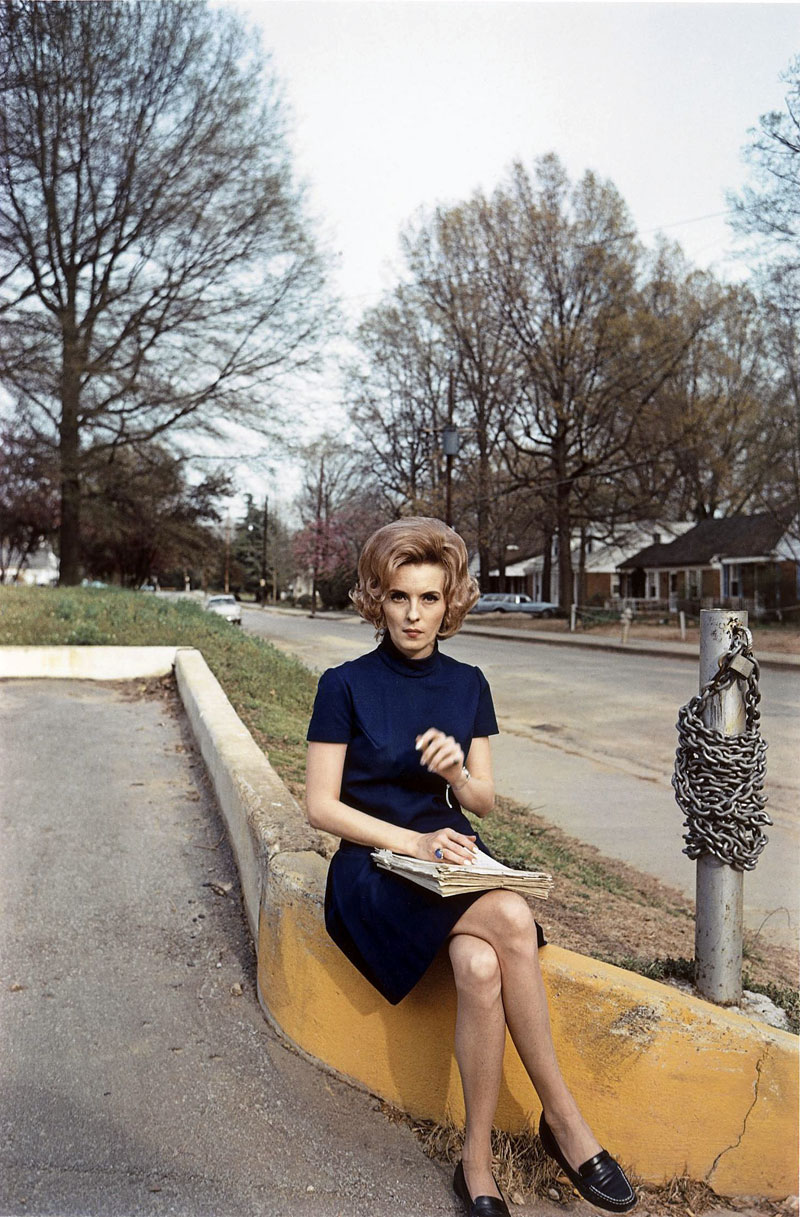
Can you say something specific about two photos you pointed out to me—the airplane cocktail and the lady sitting next to a chained-up pole?

It’s just a very simple portrait, but it also has a love of light, but also capturing fashion and style from the moment. I took a picture yesterday of just some flowers. What struck me about them is they looked like eyelashes, and right now young women are putting on long fake eyelashes. They looked like that.

As far as those older photos… You know when you plug in a hard drive you haven’t used in a while and it does that bzzz-bzzz-bzzz sound? I think that’s what it does in your brain, it goes to a different part, and I would call it the nostalgia part. It does something in your brain that actually wakes up a part of you that you have forgotten.

What about the people who are younger than 30, for whom this book will resonate?

There’s also a nostalgia for a past we never experienced. Thinking about when I was growing up listening to music from the ’70s, the thing you’ve got to remember is we do experience it, but in subtle ways.

When I was a kid, my parents were given a huge collection of comic books from a colleague whose son had gone to college, so I grew up going through all these Archie and Richie Rich comics, which were 10 and 15 years before my time. So, I had this really interesting cultural understanding of the ’60s, this hippie generation stuff that was mocked and made fun of in some ways, or referenced, and I think that kids who grew up before the ’80s still see these references in their parents’ old photos. So, we do have a remembered past.

I was in a band, and the guitar player wrote all the lyrics, because he sang them. We have a song called “Miss America” and it starts out, “Nostalgia should become a criminal offense / We’re always pining for a lost innocence / dreaming back a feeling that we never really had at all.” And I always think about that.

I grew up in a house where there were a couple of photo books. My mom bought the Helen Levitt book. It’s mostly kids in the streets. And so, it was just on our coffee table book. It’s actually a first-edition. It’s worth like five grand now.

And she also bought the first edition of On The Road, and in that book, when I found it, she has the New York Times review annotated and underlined, and just put in the front. When I bought NWA’s first album, they were on the cover of The Village Voice. My copy of Straight Outta Compton has, tucked inside, the cover article from The Village Voice.

I had some issues with my Mom when she was here. But so many things that she did were incredible, and I internalized them without even realizing it, in terms of her love of art and nature. She was a social worker, so she wasn’t an artist. But she had ideas.

In the ’80s, when the AIDS epidemic started, tons of people came back to North Carolina because they couldn’t take care of themselves. And she set up phone networks before the internet for them. This was a project she did as a social worker, was group connectivity. It was so meaningful to those people. I just think, wow, that, as a connector, what I picked up from her as well.

I read you are a fan of photographer Garry Winogrand. Can you tell me more about him?

Again, my motherfucking mom, right? I remember, I came home from college for the summer, and there was a New York Times magazine article about Garry Winogrand, and she hands it to me. She said, “You know what? I think you’d like this.” God, it made me so emotional. And not only did I like it, I was just blown away, and it had so much impact on me. If I hadn’t seen that, I don’t know that I would have had the same impulse to make that mall work.

It’s funny, because just before we talked, I was just talking to my wife a little bit about some of the stuff that was difficult about my mom, but there’s so much that was so great, too.

Is this the same wife you convinced to drop out?

I did, yeah, and we’re still together making films. So, we’ve made all of our movies together. And she has an amazing and sharp understanding of storytelling.

Tell me about what you’re working on now.

A bunch of features. We spent last year documenting the Savannah Bananas, which is a new baseball team in Savannah, Georgia. They started as a college summer league team, and did a lot of entertainment. But they found that people were still leaving early, so they created new rules to make the game go faster and be more exciting. And it’s just blowing up. It’s been wild to be a part of that ride.

Also, there’s a project I’ve been working on for over 15 years. When I had two kids, I realized they were completely different than each other, which was shocking. And so, what’s connected to that is that I was a sperm donor. I grew up in the ’70s. Nurture was everything, right? It wasn’t nature, it was all nurture. I had a psychologist father, social worker mother…There was such a vibe when I was growing up that, “If we can just nurture, and everything’s going to be wonderful.” So, when I decided to become a sperm donor after college, I thought I didn’t matter.

My roommate had been one, and I just thought, “That’s fucked up.” But then it was like, “Look, you’re just doing a mitzvah for a family in need.” And that struck me. I was like, “Okay, let me try that.” And I did it for a little bit.

Then when I was 33 or 34, a woman said to me, “You know, you’ve got to go look for your boy,” I was like, “Oh, I probably have some.” I started looking into it, and found that a lot of the donor-conceived people were mad. So, I wrote an op-ed saying it probably should not be anonymous. I’m not saying it shouldn’t happen, but it’s not fair to cut ourselves off.

So, I started this project and I found all these other people to follow. Four years ago, I was in the hospital with my mom, who I thought was dying of pneumonia. I got a text from my cousin saying, “Hey, I just got off the phone with your daughter, Holly. Do you remember you were a sperm donor?”

I’ve written a script based largely on her life. And that combined story of how she meets her sperm donor father. It’s not the same story, but it’s her experience, and my experience. It’s a mashup. It’s not a documentary, but it’s very documentary-like. Holly’s my best friend. In our film, I want the daughter I raised to play the daughter I met.

Anything else you want to say?

Art is anything you can get away with. I saw graffiti of that by Lee in DC, and I took a picture of it, and I made a T-shirt in high school, in a silkscreen class, and it just sticks with me.

We often get stuck in these ideas of what we’re supposed to be doing, and what systems are telling us we should be doing. As someone who could never accept systems, being an artist the way I have has been hard. But, if you just do what you believe in, time will be kind.

Mike Galinsky Recommends:

The Eyes of the City: a photo love letter to NY by master photographer Richard Sandler

Flying Nun Records: getting their comp Tuatara in 1988 introduced me to The Clean, and a whole world of creative pop music.

Maggot Brain Magazine: my friend Mike McGonigal’s magazine is brimming with amazing content

Tae Won Yu: one of the most thoughtful and incisive artists I know. He designed The Decline of Mall Civilization.

The Sun Magazine: I started reading The Sun in high school and it continues to broaden my understanding of the world.


Photographer reveals prize-winning image was AI-made

Photographer reveals prize-winning image was AI-made

The winner of a major international photography award has turned down his prize, after revealing that the image he submitted was generated by artificial intelligence.

German artist Boris Eldagsen’s submission – entitled ‘Pseudomnesia: The Electrician’ – was named the winner in the creative open category at the Sony World Photography Awards last month.

Mr Eldagsen said he had applied as a “cheeky monkey”, in order to find out whether competitions were prepared for AI images to enter.

“They are not,” he said.

He asked of the judges: “How many of you knew or suspected that it was AI-generated? Something about this doesn’t feel right, does it?”

Mr Eldagsen said that AI images and photography should not compete with each other in such competition.

“They are different entities,” he said. “AI is not photography, therefore I will not accept the award.”

Pseudomnesia: The Electrician (Image: Boris Eldagsen)

He has called for an open discussion on the issue, saying it is needed in order to consider “what is photography and what is not”.

Speaking to RTÉ News, Mr Eldagsen said that members of the photography community have since taken to coining the term ‘Promptography’, to describe generating images through AI.

Outlining his wider AI image collection on his website, he says that “just as photography replaced painting in the reproduction of reality, AI will replace photography”.

In response, a spokesperson for the World Photography Organisation said that during discussions ahead of the announcement, Mr Eldagsen had informed them that the piece was a “co-creation”, for which he says on his website he was “the director”.

They added Mr Eldagsen had explained to them his focus had shifted to exploring “creative possibilities of AI generators”, adding that he had “emphasised the image ‘heavily relied on his wealth of photographic knowledge'”.

“The Creative category of the Open competition welcomes various experimental approaches to image making from cyanotypes and rayographs to cutting-edge digital practices,” they said.

They added: “As such, following our correspondence with Boris and the warranties he provided, we felt that his entry fulfilled the criteria for this category, and we were supportive of his participation.

“Additionally, we were looking forward to engaging in a more in-depth discussion on this topic and welcomed Boris’ wish for dialogue by preparing questions for a dedicated Q&A with him for our website.”

“As he has now decided to decline his award we have suspended our activities with him and in keeping with his wishes have removed him from the competition.

“Given his actions and subsequent statement noting his deliberate attempts at misleading us, and therefore invalidating the warranties he provided, we no longer feel we are able to engage in a meaningful and constructive dialogue with him.”


Read more:
Why it’s so easy to fall for fake AI images


They said they recognised “the importance of this subject and its impact on image-making today”, but adding that the awards “always have been and will continue to be a platform for championing the excellence and skill of photographers and artists working in the medium”.

Mr Eldagsen has said attempts towards an online discussion were “nonsense”.

“They had so many options to use this for good. They used none of them,” he said.

The incident comes at a time when AI images pertaining to real world events have been widely circulated in recent times, from viral images of Donald Trump being arrested, to Pope Francis being pictured in a large puffer jacket.

Such images’ proximity to authenticity and plausability are what make them work so well, says Professor Alan Smeaton, founding Director of the Insight SFI Research Centre for Data Analytics.

He says people cannot detect AI images at first hand.

“We appeal or depend upon people’s intuition to believe the distinction between what is and what is not plausible. But that’s not a reliable [or] sustainable thing to depend upon,” he added.

Fiddle on fire! The Magnum Square Print Sale

Fiddle on fire! The Magnum Square Print Sale
image

Mark Power: ‘My ongoing, five-book series, Good Morning, America, will contain work made in all 50 states. Sadly, Valdez will forever be synonymous with the Exxon Valdez oil spill of 1989, which devastated much of the marine life in the surrounding area, and the town continues to be dominated by a huge oil terminal. But it’s also a place of extraordinary natural beauty, its colossal mountains tumbling into the sea, giving them the appearance of being even taller than they already are.’ Buy this print

New Magnum Square Print Sale is a lens on future hopes and fears

New Magnum Square Print Sale is a lens on future hopes and fears

For the final instalment in the Magnum Square Print Sale’s Then. Now. Next. project, Magnum photographers have invited artists beyond the agency’s roster to contribute. 

Then. Now. Next. began last May as a three-part project to celebrate the agency’s 75th anniversary. Whereas the first and second instalments focused on issues of the past and present respectively, the third chapter, titled Vital Signs, sees Magnum photographers invite artists, filmmakers, and fellow photographers to explore what’s ahead, and all the hopes, and fears that come with it. 

As part of the sale, photographers from Magnum’s roster have invited a range of guest creatives to join. They include Martin Parr, who invited Roger Deakins; Nanna Heitmann, who selected Hannah Reyes Morales; and Jim Goldberg, who chose Larry Sultan to feature on the line-up. ‘We are opening the doors and inviting our long-time friends to join the conversation,’ explains Cristina de Middel, president of Magnum Photos. ‘The invitation is just a formality, as the photography family has always shared a house – a house that is busy, and in constant renovation. As a family, we are now, once again, looking at the future with more questions than answers.’

The Magnum & Friends Square Print Sale: explore our highlights

Olivia Arthur

Billboard. Dubai, United Arab Emirates, 2013. Olivia Arthur Magnum Photos

Olivia Arthur, Billboard. Dubai, United Arab Emirates, 2013

(Image credit: Olivia Arthur/ Magnum Photos)

‘In a place where all boundaries are off when it comes to displays of wealth and excess, I find myself no longer able to distinguish between what is real and what is meant to be ironic. Is it a dream, an aspiration, or just simple reality? Anything could be next.’

Rafal Milach

The fourth day of protests against the abortion ban. Warsaw, Poland, October 2020.

Rafal Milach, The fourth day of protests against the abortion ban. Warsaw, Poland, October 2020

(Image credit: Rafal Milach/ Magnum Photos)

‘A flare fired at the largest protest since the fall of the Iron Curtain in Poland. I believe the past six years have been a formative process for the Poles. I hope the new foundations of civil society have been created.’

Alex Majoli

Alex Majoli, Scene #5547. Two friends walking down the street. Reggio Emilia, Italy, 2020.

Alex Majoli, Scene #5547. Two friends walking down the street. Reggio Emilia, Italy, 2020

(Image credit: Alex Majoli/ Magnum Photos)

‘The performance is not a collection of images but a social relationship between people, mediated by images.’

Alec Soth

Alec Soth A couple off of Nome’s beachfront. Alaska, 2015.

Alec Soth, A couple off of Nome’s beachfront. Alaska, 2015

(Image credit: Alec Soth/ Magnum Photos)

‘Embedded in the blue hour is a feeling of expectation and trepidation. This picture was taken during the endless Arctic twilight of a summer night in Alaska. One way to survive such uncertainty is companionship. Another way is with art.’ 

Larry Sultan

Larry Sultan Dad on Sofa. From the series Pictures from Home, 1984.

Larry Sultan, Dad on Sofa. From the series Pictures from Home, 1984 (Pictures from Home inspired a Broadway show, winner of a 2023 Wallpaper* Design Award)

(Image credit: Larry Sultan)

‘Family life is already a stage — home is situated as a symbol of the good life and as an extension of our desired identities. There is desire and nostalgia that can manifest itself in sliding glass doors or flagstone fireplaces.’

Sabiha Çimen

A plane flies low over students riding a train at a funfair over the weekend. Istanbul, Turkey, August 29, 2018. A plane flies low over students riding a train at a funfair over the weekend. Istanbul, Turkey, August 29, 2018.

Sabiha Çimen, A plane flies low over students riding a train at a funfair over the weekend. Istanbul, Turkey, August 29, 2018

(Image credit: Sabiha Çimen/ Magnum Photos)

‘We can imagine a future far from now in paradise, but we should always be reminded that the tiny blue marble on which we live is already a Garden of Eden, light-years away from any other possible habitable worlds.’

Gregory Halpern

Gregory Halpern, Solar Eclipse. North Carolina, USA, 2017.

Gregory Halpern, Solar Eclipse. North Carolina, USA, 2017

(Image credit: Gregory Halpern/ Magnum Photos)

‘A few days before this moment, a white supremacist infamously drove his car into a peaceful protest in Charlottesville, North Carolina. At the time, it felt that the nation was beginning to split at the seams.’

Alfredo Jaar

Studies on Happiness (Birds). Monterrey, Mexico, 2016.

Alfredo Jaar, Studies on Happiness (Birds). Monterrey, Mexico, 2016

(Image credit: Alfredo Jaar)

My project Studies on Happiness started in 1979, in Santiago de Chile, during the military dictatorship of General Pinochet. It was the fruit of my utopian idealism, which I combined with poetry – an ingenuous activity but very necessary in those times.’

Cristina García Rodero

Cristina Garcia Rodero/ Magnum Photos

Cristina Garcia Rodero, Twenty-four lies per second (Veinticuatro mentiras por segundo). FIB music festival, Castellón, Spain, 2007

(Image credit: Cristina Garcia Rodero/ Magnum Photos)

‘Music makes life feel full of colour and joy that we can experience, enjoy and share.’

Jean Gaumy

Seagulls flying past the French trawler ‘Koros.’ Ireland, 1984.

Seagulls flying past the French trawler ‘Koros.’ Ireland, 1984

(Image credit: Jean Gaumy/ Magnum Photos)

‘The birds stalk us, for hours, while we trawl the troubled waters on cold winter days. There are hundreds of them, silent, relentless – in spite of the harsh gusts of wind and violent sea. Perched on the water, with its seafoam and icy winds, the birds twitch – like crazed floats. They let us overtake them, then, flapping their wings once or twice, they catch up with us, resting on the furious water a few hundred feet in front of the bow. Theirs is a lone battle.’ (Extract, translated and edited, from Pleine Mer [Men at Sea], 2001)

Miranda Rae Barnes

Miranda Rae Barnes

Miranda Rae Barnes, Lexi’s Crown. Detroit, Michigan, 2022

(Image credit: Miranda Rae Barnes)

‘With a newspaper recording the first debutante in 1778 in New York, and the first official ball taking place in 1895 in New Orleans, Black American cotillions have a rich history that continues to thrive in the 21st century. This portrait of a debutante made in Detroit, Michigan, is a document of that enduring tradition.’

Rebecca Norris Webb

Rebecca Norris Webb Blackbirds, 2006. From the book My Dakota.

Rebecca Norris Webb Blackbirds, 2006. From the book My Dakota

(Image credit: Rebecca Norris Webb)

‘That first fall after my brother died, I was drawn to a flock of blackbirds – thousands of them – flying through the stormy Western sky as if they were one huge, dark, ravenous creature, picking clean the remains of the sunflower fields. It didn’t seem to matter how quickly I stopped the car and raised the camera to my eye. Inevitably, the dark flock vanished as soon as it had appeared.’

Zied Ben Romdhane

Zied Ben Romdhane, Kalaat Senan, Le Kef, Tunisia, 2022. Kalaat Senan, Le Kef, Tunisia, 2022.

Zied Ben Romdhane, Kalaat Senan, Le Kef, Tunisia, 2022

(Image credit: Zied Ben Romdhane/ Magnum Photos)

‘The Jérissa open-pit iron mine, according to legend, would have provided the raw materials needed to build the Eiffel Tower and the rails of the Paris Metro. Today, the villages are empty. The youth go to the capital to look for work, and the bravest work in the cactus fields – the only agriculture possible in an arid land.’

The Magnum & Friends Square Print Sale: Vital Signs runs from 17-22 April, with signed or estate-stamped prints available for one week, priced at $110/£110/€120.

All prints will be on view at the Magnum Gallery, London during the sale. magnumphotos.com (opens in new tab)

Euroluce 2023: Hélène Binet’s show at the fair casts new light on iconic architecture and more

Euroluce 2023: Hélène Binet’s show at the fair casts new light on iconic architecture and more

Hélène Binet is best known as a photographer of architecture, but she could also be described as a philosopher of light. A new exhibition at Euroluce during Salone del Mobile 2023 (18-23 April) celebrates the return of the world’s largest fair dedicated to the design of natural and artificial light. It is the chance to see photographs from Binet’s remarkable career, as well as a series of new images that mark a turn towards a freer and more playful way of working with light.

Since the 1980s, Binet has captured some of the most iconic images of architecture. Imposing strict limits on her approach by working in black and white, and only using analogue techniques, her images heightened the drama and power of buildings that defined the late 20th century. Her career developed in parallel to that of clients and collaborators such as Zaha Hadid, Peter Zumthor and Daniel Libeskind. Over time, she has formed relationships of mutual respect with the many leading architects who have turned to her to interpret their work.

‘Hélène Binet: Nature, Time and Architecture’ at Euroluce 2023

Euroluce 2023 photo exhibition by Hélène Binet

Echoes and Reveries, to Gottfried Böhm’s Centenary (2020)

(Image credit: Hélène Binet )

‘Hélène Binet: Nature, Time and Architecture’ is curated and designed by architect Massimo Curzi and will be shown as part of the cultural programme of Euroluce, the multidisciplinary lighting fair that runs alongside Salone del Mobile. It promises to be visually stunning: from the outside, a purpose-built gallery will appear as a pristine box covered with brushed aluminium, while inside, Binet’s dramatic photographs, many of them hand-printed, will be hung on a soft background of midnight blue felt, creating a muffled acoustic environment. As visitors walk into the space, the first work to appear will be a large new print featuring a building by Peter Zumthor. ‘It will be like a beam of light as you enter,’ explains Binet.

Salone del Mobile president Maria Porro describes the exhibition as a perfect expression of the aim of Euroluce, ‘to be a place for dialogue between technology and poetry, architecture and design, and light and art’. The show will provide ‘a moment of suspended time’, an opportunity for pause and reflection within the busy fair.

Hélène Binet’s life in photography and architecture

Euroluce 2023 photo exhibition by Hélène Binet

Peter Zumthor, Therme Vals, Switzerland (2006)

(Image credit: Hélène Binet )

Returning to Italy and showing her work here for the first time is an emotional moment for Binet, who has lived in London for more than 30 years: ‘I grew up in Rome, but Milan is where I became an adult,’ she says, reflecting on a period of 18 months when she worked as a photographer’s assistant in the mid 1980s. In 1986, the impact of seeing an early installation by Libeskind, The House Without Walls, at the Milan Triennale, set her mind racing with the possibilities of architecture as a subject for photography.

Euroluce 2023 photo exhibition by Hélène Binet

The Walls of Suzhou Garden, China (2018)

(Image credit: Hélène Binet )

Later that year, Binet moved to London to be with her partner, the architect Raoul Bunschoten, who was teaching at the Architectural Association (AA). Under the inspirational directorship of Alvin Boyarsky, the AA was the most exciting school of architecture in the world, with graduates and visiting lecturers including Hadid, Libeskind and John Hejduk. Spotting Binet’s potential, Boyarsky dispatched her to international locations to photograph buildings for the books he planned to publish. The photographs she took during this period set in motion her exploration of architecture and light. But whether Binet has been photographing one or the other is not always clear, a dilemma famously expressed by Louis Kahn: ‘Architecture appears for the first time when the sunlight hits a wall. The sunlight did not know what it was before it hit a wall.’

Euroluce 2023 photo exhibition by Hélène Binet

Peter Zumthor, Kolumba Diocesan Museum, Germany (2007)

(Image credit: Hélène Binet )

One of Binet’s first trips was to Athens to photograph the pathway designed by Dimitris Pikionis at the Acropolis in the 1950s. Producing a series of characteristic black-and-white square format images, Binet captured reflections of light, patterns and textures on the recycled stones that implied the traffic of people through the ages. Three of these works were shown as very large prints (1.2m x 1.2m) at Binet’s recent exhibition at the Royal Academy of Arts in London, and are echoed in a more recent series taken at Lunuganga, the country house of architect Geoffrey Bawa in Sri Lanka. Exhibited at Euroluce for the first time, the prints depict routes around Lunuganga, with steps and pathways alluding to the presence of Bawa, who died in 2003, having refined the design for 50 years. 

Binet rarely includes people in her photographs, but their spiritual and poetic presence is always strong. This effect perhaps comes from the depiction of light, which she says is a constant reminder of humanity’s need to navigate the world in both a philosophical and practical sense. In her depictions of the Jantar Mantar observatory in Jaipur, India, from 2002, light and shadow are used as instruments for spiritual guidance.

Euroluce photography exhibition by Hélène Binet

(Image credit: Hélène Binet )

Euroluce photography exhibition by Hélène Binet

A new set of images, shown in Milan for the first time, following the passing of time through the life and death of a flower

(Image credit: Hélène Binet )

Light, Binet observes, has the capacity to tell us where we are in the world and in life. Her photographs of Le Corbusier’s Couvent Sainte-Marie de La Tourette have a dramatic rhythm, measuring time as if it were a musical score through the movement of shadows across a stone floor. Whereas in more recent images shot in Korea, the light is gentle, reflecting Binet’s view of nature there as a ‘motherly presence’, protecting buildings. 

‘In my career, I’ve had a lot of discipline, but now I’m interested in following my instincts,’ says Binet. A new set of four images, being shown in Milan for the first time, follow the passing of time through the life and death of a flower. Using a macro lens, and natural light filtered through frosted glass, the images were taken in the space of one hour. Whether they are a complete break from her past work is not yet clear. ‘Hadid’s and Sergio Musmeci’s structures are seen as artificial, but they mimic the action of nature. So I think the distinction between architecture and nature is ultimately artificial,’ says Binet. Her new work is about fragility, movement and energy, but these are also increasingly the themes of architecture and design.  

‘Hélène Binet: Nature, Time and Architecture’ will be on show from 18-23 April at Euroluce, Hall 11

helenebinet.com (opens in new tab)
salonemilano.it

A version of this story appears in the May 2023 issue of Wallpaper*, available now in print, on the Wallpaper* app on Apple iOS, and to subscribers of Apple News +. Subscribe to Wallpaper* today (opens in new tab)

Euroluce 2023 photo exhibition by Hélène Binet

The Walls of Suzhou Gardens, China (2018)

(Image credit: Hélène Binet )

Euroluce 2023 photo exhibition by Hélène Binet

Lunuganga Estate, Bentota, Sri Lanka, 1998

(Image credit: Hélène Binet )

Euroluce 2023 photo exhibition by Hélène Binet

Le Corbusier’s Couvent Sainte Marie de La Tourette, France, part of The Secret of the Shadow (2002)

(Image credit: Hélène Binet )

German artist refuses prestigious photography award, admits prize-winning image was AI generated

German artist refuses prestigious photography award, admits prize-winning image was AI generated

A German-based artist has refused a prestigious photography award after he admitted that he generated the prize-winning image using artificial intelligence (AI). Boris Eldagsen said on his website that he was not accepting the prize for the creative open category, which he won at the Sony world photography awards held last week. 

The image showed two women from different generations in black and white. 

“Thank you for selecting my image and making this a historic moment, as it is the first AI-generated image to win in a prestigious international PHOTOGRAPHY competition.

How many of you knew or suspected that it was AI generated? Something about this doesn’t feel right, does it? AI images and photography should not compete with each other in an award like this. They are different entities. AI is not photography. Therefore I will not accept the award,” Eldagsen said. 

Eldagsen said that he applied as a “cheeky monkey” to find out if the competitions were prepared for AI images to enter, adding they are not. 

“We, the photo world, need an open discussion. A discussion about what we want to consider photography and what not. Is the umbrella of photography large enough to invite AI images to enter – or would this be a mistake? With my refusal of the award I hope to speed up this debate,” the German artist said. 

Eldagsen suggested donating the prize to the foto-festival in Odesa in war-torn Ukraine. 

His refusal and admission come amid an increasing debate on AI. 

According to a report by The Guardian on Monday (April 17), a spokesperson for the World Photography Organisation said that Eldagsen confirmed the co-creation of the image using AI to them before he was announced as the winner.

“In our correspondence, he (Eldagsen) explained how following ‘two decades of photography, my artistic focus has shifted more to exploring creative possibilities of AI generators’ and further emphasising the image heavily relies on his ‘wealth of photographic knowledge’. As per the rules of the competition, the photographers provide the warranties of their entry,” the spokesperson said, as per the report. 

The spokesperson said that the creative category of the open competition welcomed various experimental approaches to image making “from cyanotypes and rayographs to cutting-edge digital practices”, adding following correspondence with Eldagsen, the organisation felt his entry fulfilled the criteria for this category and the organisation was supportive of his participation. 

The spokesperson also said that now the German artist declined the award, the organisation suspended its activities with him. “Given his actions and subsequent statement noting his deliberate attempts at misleading us, and therefore invalidating the warranties he provided, we no longer feel we are able to engage in a meaningful and constructive dialogue with him.”

WATCH WION LIVE HERE

You can now write for wionews.com and be a part of the community. Share your stories and opinions with us here.