Photography

A new exhibition reflects on photography during conflict

A new exhibition reflects on photography during conflict

Conflict has been changed by photography, and photography has been changed by conflict in turn. In the past, images were typically taken by passing photojournalists and circulated by the international news media organisations that employed or commissioned them. While they still exist, nowadays these are increasingly supplemented by citizen documentation of scenes that spread across social media with a greater sense of urgency.

These evolving forms of image-based communications are shaping creative practice too, with projects like Taysir Batniji’s Disruptions placing the live nature of imagery in the centre of the frame.

Amsterdam’s Foam museum is hosting a pop-up exhibition called The Camera as a Weapon, which examines the role of the camera in times of conflict through the work of six artists and groups: Rahib Mroué, Sakir Khader, Émeric Lhuisset, Negin Ahmadi, activist group Equipe Media, and research agency Forensic Architecture.

Black and white image showing a person wearing military clothing and helmet, with a caption at the bottom that reads 'Is the camera more dangerous than your gun? Stop intimidating me'
Top: Still from 3 Stolen Cameras, 2017 © Equipe Media and RåFilm; Above: The gun versus the camera, 2021 © Sakir Khader

The exhibition’s name touches on the negative effects of photography amid conflict that are examined in the exhibition, such as disinformation and reinforcing stereotypes. Yet it seeks to illustrate the positive uses of photography, whether that’s generating awareness or capturing evidence.

The museum is also staging a one-day symposium on February 10 that will feature relevant screenings, talks and lectures, promising to tackle topics such as social media, polarisation, and how opinions and action can be dictated by everything from algorithms to photo editors.

Still of a young woman crouching next to a wall from Dream's Gate by Negin Ahmadi
Still from Dream’s Gate, 2023 © Negin Ahmadi

Although the show has a short run, Foam will continue to explore these subjects through its ongoing Photography and Conflict programme, which is set to inform the future exhibition programme and other initiatives within the museum.

Against a fraught backdrop within the European culture sector, where many organisations have stymied conversations around conflict in the last six months, the exhibition not only asks ‘What is the role of photography in times of conflict?’, but also examines the role of an arts institution in such times.

Photo by Emeric Lhuisset showing a first-person perspective photograph of a person holding a drink in one hand and a cigarette in the other
Chebab (Syria), 2012-2022 © Émeric Lhuisset

The Camera as a Weapon runs at Foam, Amsterdam until February 14; foam.org

Sony World Photography Awards 2024

Sony World Photography Awards 2024
  • Published
    6 minutes ago
A black an white image showing two local fishermen surrounded by trees and water. The light is streaming through the branches and the fishermen are reflected in the water.Image source, Kyaw Htet/Sony World Photography Awards 2024
Little girl smiling with her eyes closed surrounded by small colourful felt balls.Image source, Bibek Kunwar/Sony World Photography Awards 2024

Competitors practise for Bon Om Touk, a traditional festival that is also known as the Cambodian Water Festival.

Image source, Davuth Van/Sony World Photography Awards 2024

The warm light of the lanterns illuminates the hearts of pabbajja novices in the courtyard of Borobudur temple, Indonesia.

Image source, Dhiky Aditya/Sony World Photography Awards 2024

A SpaceX Falcon Heavy rocket transits the moon carrying the X-37B space plane into orbit. Shockwaves from the rocket cause a ripple effect across the moon.

Image source, Pascal Fouquet/Sony World Photography Awards 2024

Two European shags in black and white in the snow

Image source, Mohammad Mirza/Sony World Photography Awards 2024

The Pearl Ring Roundabout in Beijing, China

Image source, Lim Chien Ting/Sony World Photography Awards 2024

Maquoketa Art Experience opens Kurt Ullrich photography exhibit

Maquoketa Art Experience opens Kurt Ullrich photography exhibit
image

MAQUOKETA, Iowa — Local artist and author Kurt Ullrich will have his Iowa State Fair photography collection on display through March at the Maquoketa Art Experience, 124 S. Main St.

The North Gallery will include Ullrich’s photography, most notably from the Iowa State Fair. The South Gallery will host his collection of regional artists, signed lithographs and some original works of art.

#placement_661376_0_i{width:100%;margin:0 auto;}

Seal captured at Boston Fen Nature Reserve by photographer

Seal captured at Boston Fen Nature Reserve by photographer

A photographer had his dreams fulfilled when he captured a seal “resting up” in a more unlikely area of Lincolnshire.

Lee Enderby spotted the seal at Baston Fen Nature Reserve on 27 January when he was on the lookout for otters.

He snapped photos of the animal resting on the riverbank between Baston Fen and Kates Bridge, while walking along the River Glen.

Mr Enderby, from Bourne, said he captured some “interesting behaviour” from the seal, including it sitting up and yawning.

Mr Enderby, who described the nature reserve as a “good birdwatching site”, had visited the area several times before he saw the seal.

He said he “noticed something moving” and discovered the seal resting in water about 10ft (3m) deep.

“As I got nearer I realised that it was a common seal, which I never in my wildest dreams expected to see in a relatively narrow body of water,” he added.

The seal was described by the photographer as looking “healthy and well-fed”.

Despite returning to the location twice after the sighting, Mr Enderby has not caught sight of the animal again.

A spokesperson for the Lincolnshire Wildlife Trust said it was “not that unusual” to spot seals in rivers due to their “inquisitive nature”.

They said there was “likely to be fish” for the seal to feed on in the river, which is why it may have made its way to Baston Fen Nature Reserve.

It is likely it made its own way back out to sea once the food source started to run out, the spokesperson explained.

Follow BBC East Yorkshire and Lincolnshire on FacebookTwitter, and Instagram. Send your story ideas to eastyorkslincs.news@bbc.co.uk.

BPPA press photographer of the year 2023

BPPA press photographer of the year 2023
image

Alexander Black, a digital support technician, examines the internals of a machine at Sound Leisure Jukeboxes, which have been manufacturing classic 40s- and 50s-style models for more than four decades from their warehouse in Leeds, 22 August 2023

Nima Sarikhani Wins Wildlife Photographer Of The Year People’s Choice Award; All About Photo Titled ‘Ice Bed’

Nima Sarikhani Wins Wildlife Photographer Of The Year People’s Choice Award; All About Photo Titled ‘Ice Bed’

The captivating image of a polar bear nestled on a small iceberg has clinched the esteemed 2023 Wildlife Photographer of the Year People’s Choice Award. Nima Sarikhani, the talented photographer behind this striking shot, spent three days scouring the Norwegian islands to capture this breathtaking moment.

The winning snapshot: Ice Bed

Sarikhani’s winning entry, aptly titled ‘Ice Bed,’ emerged victorious after a record-breaking 75,000 individuals cast their votes. Speaking about his achievement, Sarikhani expressed his deep gratitude, stating, “I am so honored to have won this year’s People’s Choice award for Wildlife Photography of the Year, the most prestigious wildlife photography competition.” 

He further shared his hope that the image would not only evoke strong emotions but also inspire hope amidst the looming threat of climate change. “There is still time to fix the mess we have caused,” he added poignantly.

Dr. Douglas Gurr, the Director of the Natural History Museum, commended Sarikhani’s work, noting that his photograph beautifully encapsulates both the beauty and fragility of our planet. 

“His thought-provoking image is a stark reminder of the integral bond between an animal and its habitat and serves as a visual representation of the detrimental impacts of climate warming and habitat loss,” remarked Dr. Gurr.

Exploring other remarkable entries

Aside from Sarikhani’s captivating snapshot, other noteworthy submissions showcased the diverse wonders of the natural world. Entries from photographers worldwide flooded the competition’s official platform, offering glimpses into fascinating animal behavior and ecosystems. 

Advertisement

Among these, ‘The Happy Turtle’ by Tzahi Finkelstein and ‘Starling Murmuration’ by Daniel Dencescu garnered commendation for their exceptional quality and storytelling.

Exhibition and beyond

Sarikhani’s winning masterpiece, alongside other standout entries, will be prominently displayed in the Wildlife Photographer of the Year exhibition until June 30 at South Kensington in Central London. 

This exhibition offers visitors a unique opportunity to immerse themselves in the mesmerizing beauty of nature captured through the lens of talented photographers. 

In a world where the impacts of climate change are increasingly evident, Sarikhani’s photograph serves as a poignant reminder of the urgent need to preserve and protect our planet’s delicate ecosystems. 

Through the power of imagery, we are not only moved but also compelled to take action toward safeguarding the natural world for generations to come.

ALSO READ: Curious about Bhad Bhabie’s love-filled baby shower for daughter Kali Love? Peek inside

Advertisement

Pic of polar bear sleeping on ice wins Wildlife Photographer of the Year People’s Choice Award

Pic of polar bear sleeping on ice wins Wildlife Photographer of the Year People’s Choice Award
'Ice Bed' by Nima Sarikhani

‘Ice Bed’ by Nima Sarikhani (Image credit: Nima Sarikhani/Wildlife Photographer of the Year)

A striking image of a polar bear sleeping on an iceberg has won the Wildlife Photographer of the Year People’s Choice Award. Captured by amateur British photographer Nima Sarikhani, the dreamy image shows a young polar bear drifting off to sleep on a bed carved into ice.

“Sarikhani’s breathtaking and poignant image allows us to see the beauty and fragility of our planet,” said Natural History Museum director Dr Douglas Gurr.

Story continues below Advertisement

“His thought-provoking image is a stark reminder of the integral bond between an animal and its habitat and serves as a visual representation of the detrimental impacts of climate warming and habitat loss.”

Sarikhani was able to capture the polar bear in slumber after three days of searching through thick fog off Norway’s Svalbard archipelago. He was on an expedition vessel that changed course after three days to reach a location where there was still ice.

There, Sarikhani spotted two polar bears. “Just before midnight, the young male clambered onto a small iceberg and, using his strong paws, clawed away at it to carve out a bed for himself,” the Natural History Museum, which organises the photography competition, said in a press release.

“I am so honoured to have won this year’s People’s Choice award for WPY, the most prestigious wildlife photography competition. This photograph has stirred strong emotions in many of those who have seen it. Whilst climate change is the biggest challenge we face, I hope that this photograph also inspires hope; there is still time to fix the mess we have caused,” Sarikhani said.

Besides the sleepy polar bear, four other images were “highly commended”.

The Happy Turtle, by Tzahi Finkelstein

Story continues below Advertisement

The Happy Turtle, Tzahi Finkelstein Image credit: Tzahi Finkelstein/Wildlife Photographer of the Year

“A Balkan pond turtle shares a moment of peaceful coexistence with a northern banded groundling dragonfly in Israel’s Jezreel Valley.”

Aurora Jellies, by Audun Rikardsen

Aurora Jellies by Audun Rikardsen Image credit: Audun Rikardsen/Wildlife Photographer of the Year

“Moon jellyfish swarm in the cool autumnal waters of a fjord outside Tromsø in northern Norway illuminated by the aurora borealis.”

Starling Murmuration, by Daniel Dencescu

Starling Murmuration, by Daniel Dencescu Image credit: Daniel Dencescu/Wildlife Photographer of the Year

“Daniel spent hours following the starlings around the city and suburbs of Rome. Finally, on this cloudless winter’s day, the flock didn’t disappoint, swirling into the shape of a giant bird.”

Shared Parenting, by Mark Boyd

Mark Boyd, Wildlife Photographer of the Year Image credit: Mark Boyd/Wildlife Photographer of the Year

“Early in the morning, Mark watched as these lionesses groomed one of the pride’s five cubs in Kenya’s Maasai Mara.”

Nachson Mimran show at Leica Gallery London explores a decade in the life of the creative activist

Nachson Mimran show at Leica Gallery London explores a decade in the life of the creative activist

In the heart of Mayfair, London, Leica Gallery’s showcase by photographer Nachson Mimran journeys through an array of communities and landscapes in a cultural tapestry of imagery. It’s the first solo show for Mimran – creative executive officer of to.org, a philanthropic collective of creative activists – and explores a key period for the photographer. 

Football practice, Kyebando, Uganda, April 2018

Football practice, Kyebando, Uganda, April 2018

(Image credit: Courtesy of Nachson Mimran)

Titled ‘Nachson Mimran: Photographs from the Decade that Changed My Life’, the retrospective starts with imagery from 2016, inviting the viewer to follow the photographic narrative through to 2023. Nachson used his cherished Leica Monochrom cameras to capture diverse landscapes and lifestyles, across Bangladesh, Uganda, Ecuador, Senegal, the Swiss Alps, and more.

An odyssey with Nachson Mimran

Tribesmen from Turkana, Kenya. TO:Foundation has partnered with Learning Lions to support this community, massively affected by climate change. Kenya, November 2022

Tribesmen from Turkana, Kenya. TO:Foundation has partnered with Learning Lions to support this community, massively affected by climate change. Kenya, November 2022

(Image credit: Courtesy of Nachson Mimran and Leica Gallery)

The 18 prints curated by Lou Proud of Leica Gallery include intimate family portraits; group photos at refugee settlements; a portrait of  Manari Ushigua, the leader of the Sápara Nation in Naku in the Ecuadorian Amazon; football training in Uganda; and creative activists from Kyebando packing hundreds of waste plastic bags into a bottle to create a bottle brick in Mauritius.

Nachson Mimran & his daughter in an elevator in Gstaad, Switzerland, October 2022

Nachson Mimran and his daughter in an elevator in Gstaad, Switzerland, October 2022

(Image credit: Courtesy of Nachson Mimran)

Mimran’s childhood in West Africa inspired a passion for nature and humanity that guides his creative work and is evident in his photography, which simultaneously encourages and inspires solutions for the world’s most pressing climate and humanitarian concerns.

Young man with handmade frames in Kyebando, Uganda, April 2018

Young man with handmade frames in Kyebando, Uganda, April 2018

(Image credit: Courtesy of Nachson Mimran)

‘I’m honoured to collaborate with Leica on this exhibition, my first solo show, and to be sharing moments captured over the last decade on my treasured Leica Monochrom cameras.’ Said Mimran. ‘I hope that visitors to the exhibition can see my intentional use of art, culture, and creativity as a Trojan horse encouraging conversations about important topics; climate change, displacement, our attitudes to waste, and the Sustainable Development Goals.’

Footballer, Patrice Evra, photographed through Extreme E tyre in Neom, Saudi Arabia, March 2023

(Image credit: Courtesy of Nachson Mimran)

‘Nachson Mimran: Photographs from the Decade that Changed My Life’ is on until 11 February 2024.

Leica Gallery London
64-66 Duke Street, W1K 6JD

to.org

leica-camera.com

Book Review: Stephen Wilkes Day to Night

Book Review: Stephen Wilkes Day to Night
Spread the love

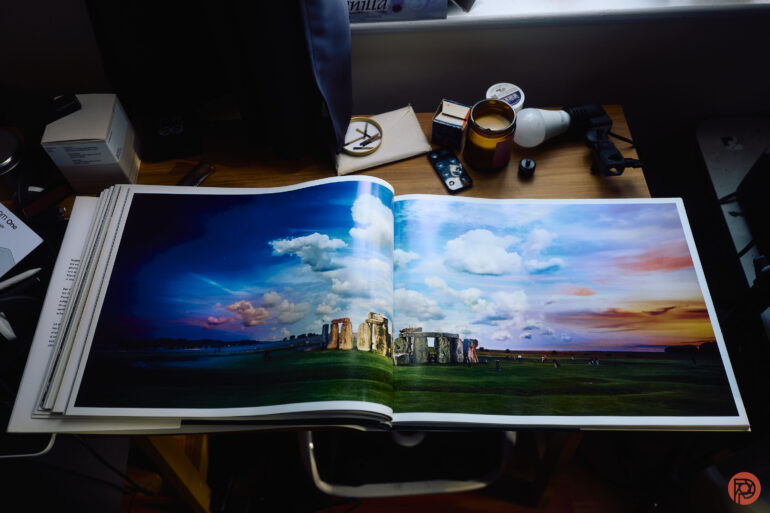
Photographer Stephen Wilkes has iconic images that everyone with the gift of eyesight has seen if you’re in the Western world. He’s well known for his landscapes that show places going seamlessly from day to night. Years ago, I purchased Stephen Wilkes Day to Night and received a signature from the great photographer too. I still remember viewing his photos in a large format on a screen. While I still believe that the print is the ultimate way to view a photo, this book does a massive injustice to the great photographer. And if you make the purchase of the book, you probably might never even bother wanting to crack it open and look at it. Though as an investment piece, it’s nice to know that it goes up in price on the secondhand market..

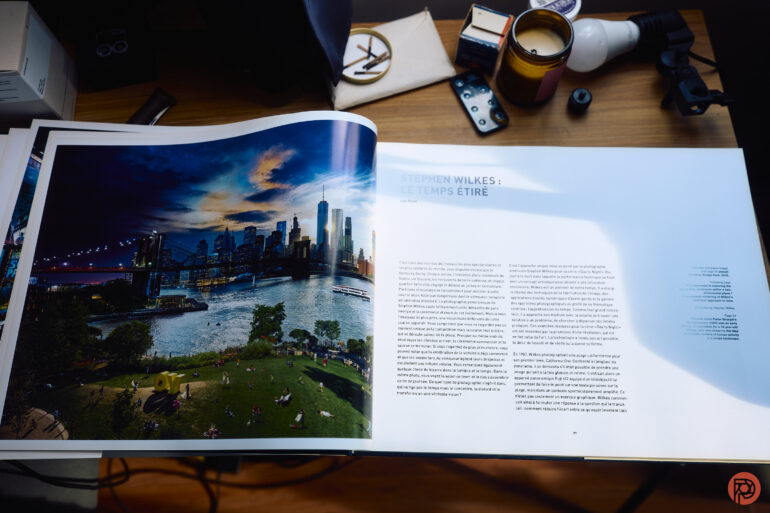
Stephen Wilkes Day to Night starts with a big, multilingual introduction if you’ve got the extra-large edition of the book. The words aren’t of Stephen talking about his work, but instead an introduction to who he is. Admittedly, I really didn’t care to read this section as I just wanted to dive in and stare at the photos with the synonymous excitement of a child looking at a picture book.

First off, you need a big coffee table to appreciate this book. With that in mind, it wouldn’t fair well at many of the tables for two that you see in restaurants. Instead, you’d need two tables put together. Even in the space of my office, I sat here struggling to give this book the real estate space that it’s wrongfully demanding. That sentence was worded with the utmost intention because the layout design is deplorable. While paging through Stephen Wilkes Day to Night, I tried concentrating on the sound of my own meditative breath to hush the voice in my head that tells me to throw this book in the trash or rip the pages out and frame them for myself.

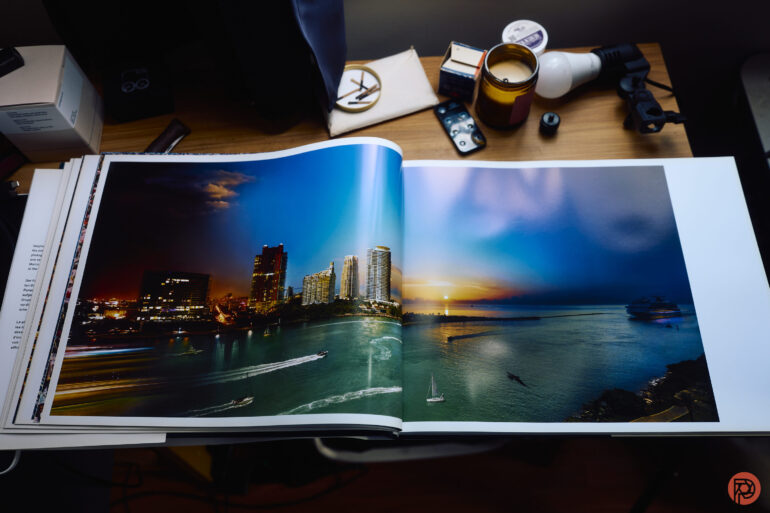
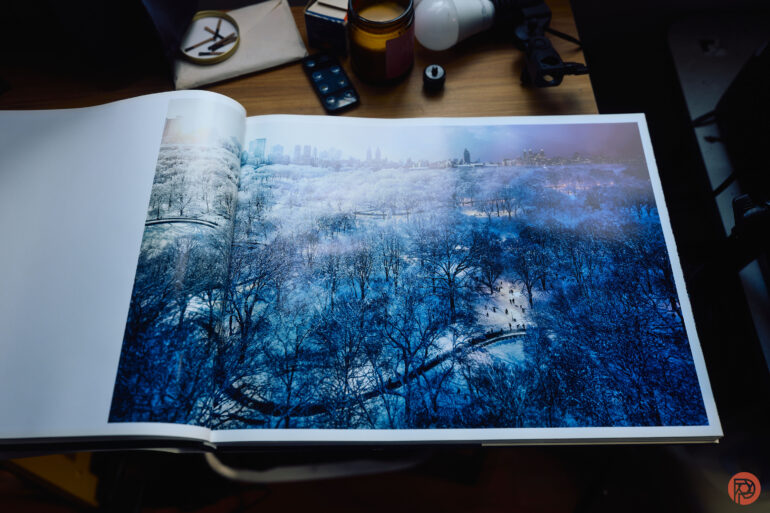
The layout violates a major rule of photography books: don’t split a photo down the middle of the book fold. It does this many times, in fact. As I paged through, I felt more frustration than I did awe from the book. Sometimes you’ll get a single page showcasing a single image. But more often than not, it splits photos between two pages — which completely ruins the image in the equivalent way of bending or folding a print.

The paper is also quite a bit on the shiny side of the luster variety. So if you’re viewing this book, make sure that it’s lit from the top of the book and that it’s elevated to soften the light and prevent reflections. I wouldn’t recommend reading it with side lighting and no direct lighting, either.

Stephen Wilkes Day to Night is heartbreaking mostly because his images are often ruined by the fold that I speak of. But that’s not all. It’s made even more heartbreaking when you zoom in on the details with a loupe or a magnifying glass. You can tell the Stephen gave incredibly sharp and well-detailed images for the print job. But instead of preserving the print, it’s handed to you like some uninterested intern who knew nothing about prints decided to fold it up and put it in their messenger bag to simply fulfill a purpose. It’s worth wanting to scream as Wilkes’ images are masterpieces that sometimes blend day and night so well that you can’t really tell that it’s happening.

And I found myself very frustrated and needing to constantly interact with the book instead of just having my eyes pour over the images distraction-free.

This book is ultimately a disappointment, and a great example of what not do with prints ever.

Telling Black stories through photography

Telling Black stories through photography

Telling Black stories through photography | Black History Month – CBS Los Angeles


Watch CBS News


Sheba Turk profiles a local organization creating an avenue for Black photographers looking to tell their stories through an artistic lens.

View CBS News In

Be the first to know

Get browser notifications for breaking news, live events, and exclusive reporting.