
Eye on America: Photographer John Fielder reflects on life’s work, conserving D.C.’s honeybees – CBS News
Watch CBS News
Be the first to know
Get browser notifications for breaking news, live events, and exclusive reporting.

Eye on America: Photographer John Fielder reflects on life’s work, conserving D.C.’s honeybees – CBS News
Watch CBS News
Be the first to know
Get browser notifications for breaking news, live events, and exclusive reporting.


In May of 1877, Indigenous leader Chief Standing Bear and the Ponca Tribe, who resisted relocation to “Indian territory” in Oklahoma, were marched there at gunpoint by the US Calvary 500 miles from their home in Nebraska. By the time they arrived, it was too late in the year to plant crops and the tribe faced a harsh winter. As a result, one-third of the Ponca died (including Standing Bear’s son and daughter) and nearly all the survivors were sick or disabled.
Standing Bear returned to Nebraska to honour his son’s last wish and bury him there, but was soon arrested for leaving the Ponca’s newly designated reservation. In his landmark 1879 trial, the chief poignantly convinced the judge that, despite the US government’s argument that Standing Bear was neither a US citizen nor a person, Native Americans were entitled to the same rights as other Americans, and he was released.
Stopping in the small town of Beatrice in south-eastern Nebraska, I stood on the Chief Standing Bear Trail, a 22-mile limestone track that twists and turns with the Big Blue River. The trail traces ancient Native American hunting and trading paths and marks the beginning of the route the Ponca were later marched on when removed from their homeland. As I looked out on the trees and farmland, I tried to imagine the gravity of their journey.

Chief Standing Bear Trail traces ancient Native American paths and is now a hiking and biking trail (Credit: Brandon Withrow)
The story of the Ponca underscores a stark but often-overlooked truth, that many of the trails we hike or bike in the US today were originally forged by Indigenous hunters and traders centuries earlier. When their lands were taken, federal and state governments turned some of these trails into roads and railways. (The Ponca’s Trail of Tears route, for instance, later became a now-defunct part of the Union Pacific railway line.)
But in recent years, tribes, states and organisations like the Rails-to-Trails Conservancy have been converting these ancient Indigenous tracks into modern bike and pedestrian routes, and breathing new life into them in the process. As Native groups are creating more slow tourism opportunities (such hiking, cycling and paddling) on their land or in areas strongly connected to Indigenous history, tribes are increasingly reclaiming their ancestral spaces.
“All these trails were trails that were here before, and most trails throughout American Indian country that people are using now for slow tourism, were our trails, wherever you go,” said Judi gaiashkibos, the executive director for the Nebraska Commission on Indian Affairs and a Ponca Tribe member. She explained that the deed to the Chief Standing Bear Trail now belongs to the Ponca, and educational kiosks and signs along the route help tell their history. Gaiashkibos hopes to attract travellers “to come hear new stories, to slow their lives down and to be connected to the land”.
Indigenous tourism is growing across North America. In Canada, it accounts for nearly $2bn of the nation’s GDP, while in the US, Native tourism is a $14bn industry. Tribes are increasingly making use of their best assets to propel this trend: their people and their land.

Indigenous tourism has been surging across the US and Canada (Credit: Juliana Swenson/Alamy)
In Washington, the nearly completed 135-mile Olympic Discovery Trail (ODT) is already becoming one of the state’s biggest non-motorised tourism attractions. Running from Puget Sound to the Pacific Ocean, it offers joggers, cyclists and hikers stunning views of the Olympic Peninsula‘s snow-capped peaks, temperate rainforests and glacial lakes. Built on a now-defunct railroad, this was originally a foot trail that connected various tribal villages. One of those tribes is the Jamestown S’Klallam Tribe.
Today, the trail travels through the Jamestown S’Klallam Tribal Government North Campus and their 7 Cedars Casino, with educational signage along the way, as well as the Native Art Gallery that sells the work of Native American artists, books and gifts. It also passes by the Jamestown S’Klallam Tribal Library, which houses books written by Native American authors and serves as a cultural resource for tribal members and guests.
“Inside the library, we’re creating some exhibit space that is allowing the tribe an opportunity to tell the tribe’s story from the tribe’s perspective, with a focus on tribal priorities not somebody else’s narrative.” said Luke Strong-Cvetich, Jamestown S’Klallam’s tribal planning director.
The tribe is also successfully cleaning up contaminated land and restoring salmon habitat along the trail. “The newly expanded Dungeness River Nature Center [is the] “crown-jewel,” said Strong-Cvetich. “It is [an] educational facility-visitor centre on the Dungeness watershed,” which is the tribe’s river and a main salmon habitat. Guests can learn about conservation and the importance of this watershed for the tribe, which has relied on a strong salmon populations for millennia.

The Olympic Discovery Trail was originally a foot trail connecting Indigenous villages (Credit: Spring Images/Alamy)
In Idaho, the Coeur d’Alene Tribe is also incorporating slow tourism to reclaim their land and story.
The tribe’s ancestral territory was once five million acres that stretched from Spokane, Washington, across the Idaho panhandle into Montana. Yet, the arrival of settlers in 1883 and the eventual Allotment Act in 1909 left them with only 345,000 acres, and their many hunting and trade routes became the corridors for interstates like I-90, or the Washington & Idaho Railroad.
When the Washington & Idaho Railroad ceased operation, a roughly 72-mile paved bike trail – The Trail of the Coeur d’Alenes – was created. The trail crosses the panhandle and the tribe oversees 15 miles of the trail. Their Coeur d’Alene Casino Resort Hotel now uses this trail as part of their cultural tourism programme, offering everything from guided hikes along ancestral paths to tribal-led canoe and kayak tours on Lake Chatcolet to Indigenous-led guided cycling excursions across the Trail of the Coeur d’Alenes (bikes are provided for guests).
“We don’t have a cultural centre,” said Wasana McGowan, who manages cultural tourism at the casino. “So what do we do? We use the lands. We use the reservation that we’re on.”

The Coeur d’Alene now offer guided hikes and tribal-led canoe and kayak tours along their land (Credit: Andriy Blokhin/Alamy)
In the American Southwest, many travellers might be familiar with Grand Canyon National Park, but a four-hour drive west is Grand Canyon West (GCW), located on the Hualapai Nation reservation. Visitors will find the same jaw-droppingly deep canyon with its soft orange and pink hues, but also the striking, horseshoe-shaped Skywalk: a glass bridge owned and operated by the Hualapai that stretches 70ft out over the canyon edge.
Visitors to GCW can explore nearby hiking trails, zipline 500ft above the floor of a side canyon and meet cultural ambassadors who explain Hualapai culture and history. Their new app also allows guests to learn on their own through videos, interviews, photos and maps.
“The tourists that visit here at Grand Canyon West, they know very little about Hualapai people and the land-base that they’re standing on,” said Loretta Jackson-Kelly, supervisor for the Grand Canyon West ambassador department. “As ambassadors, we’re the ones that relay that history and the Hualapai culture.”
But the real centrepiece of the Hualapai’s tourism offerings is another type of trail: the Colorado River.

The Hualapai River Runners lead guided rafting trips down the Colorado River that once connected various tribes (Credit: The Grand Canyon West Corporation)
For centuries, the Colorado River network connected tribes and trade. It is central to Hualapai identity and their creation story. Its oxbow curves once traced the boundary of the nation’s seven-million-acre ancestral land. But when gold was discovered in 1863, that river and its access was divided up by the US government for mining, leaving the Hualapai exiled until they secured a one-million-acre reservation in 1883.
Today, the Hualapai River Runners take guests rafting down the Colorado River and explore sacred places by hiking with tribal river guides. “The Hualapai people are immensely proud to show off their backyard… one [of the] wonders of the world: the Grand Canyon and Colorado River,” said Jackson-Kelly.
Through tourism, the river and the Hualapai’s history, like that of so many other First Nations tribes around the US, is finally being retold through Indigenous voices.
Slowcomotion is a BBC Travel series that celebrates slow, self-propelled travel and invites readers to get outside and reconnect with the world in a safe and sustainable way.
—
Join more than three million BBC Travel fans by liking us on Facebook, or follow us on Twitter and Instagram.
If you liked this story, sign up for the weekly bbc.com features newsletter called “The Essential List”. A handpicked selection of stories from BBC Future, Culture, Worklife and Travel, delivered to your inbox every Friday.


American redstart. All images © Stephanie Brown, shared with permission
“The birds are the underdogs,” says Stephanie Brown. “They co-exist with us almost invisibly in our lives if you aren’t looking for them. They’re small but full of attitude and powerful in great numbers.”
Brown returns to the tiny, yet commanding creatures in her ongoing series, The Torchbearers. Comprised of well over 100 tattoos in full color, the collection features common species like sparrows and starlings grasping lit matches in their beaks. The Troy, New York-based artist, whose practice spans drawing, painting, and the inked pieces shown here, began the series in 2019 after about a year of studying and rendering the specimens within the Field Museum’s Bird Division. She explains:
Spending time in that collection helped me understand their role not just as scientific artifacts but how these preserved bodies can help contemporary scientists in their study, often in the effort of conserving what populations are left. Looking back it feels quaint, but in 2019 it felt like the climate crisis had reached maximum volume, with the hottest years on record at the time. Around the same time, I had found an old Victorian Christmas card of these sparrows marching in a procession through the snow, holding tiny torches in the dark night, an image I immediately loved and wanted to adapt into a tattoo.
Melding these sources sparked what’s now a robust aviary that’s both an ode to the beauty and singularity of each creature and a beacon of hope. “There are so many analogies to be made,” the artist says. “The smallest light can lead the way in the darkness. It only takes a spark to start a fire; size does not matter. Natural wildfires even have a regenerative purpose: to clear crowded brush and return nutrients to the earth only to have more biodiversity return its wake.”

Bluebird and quail
While tattoos naturally fade and lose detail over time, Brown’s paintings are exemplary of her profound consideration of the animals themselves. With luminous color and delicately fringed feathers, the birds in “In the Dark” and “Chimney Swift” are elegant and active, leading the charge toward something new. These features echo the inked Torchbearers. The works are “a symbol of perseverance for the sheer willpower it takes to survive in this world either personally, socially, or environmentally—a reminder to be vigilant against the systems that exist and maybe just holding hope for a cleansing fire to free us from them and make room for a better world.”
While Brown is largely booked for tattoos at the moment—keep an eye on her Instagram for openings—she does have originals, prints, stickers, and more available in her shop. You can also see her work later this year at Antler Gallery in Portland and Living Room Gallery in Chicago.

Sparrows

Sparrows

Top left: Magpie. Top right: English robin. Bottom left: Female bluebird. Bottom right: Starling

Barnswallow

Fighting sparrows

“In the Dark”

“Chimney Swifts”
Do stories and artists like this matter to you? Become a Colossal Member today and support independent arts publishing for as little as $5 per month. The article Luminous Birds Strike Toward a Better Future in Stephanie Brown’s Tattooed Aviary appeared first on Colossal.

We all want to be better photographers, but the path to getting there is not always readily apparent. If you are feeling a little stalled out in your progress but looking to grow, check out this helpful video tutorial that features an experienced photographer sharing 10 useful tips that will put you on the path to improvement.
Coming to you from Peter Forsgard, this excellent video tutorial discusses 10 tips for improving as a photographer. A common theme worth noticing through the collection of tips is the regular practice of photography. If you are a hobbyist who has a job other than photography, it can be easy to go in spurts, starting and stopping as you have time. However, consistent practice will often be far more beneficial than bursts. If you can carve out even just 15 minutes a day, it will do a lot of good for keeping your skills sharp, and by maintaining a higher baseline, you will be better able to advance creatively and technically when you do have that time to invest in deeper exploration and practice, as you will not be working just to re-familiarize yourself with things you already know. Check out the video above for the full rundown.


… as I was going through image folders tonight, I came across quite a few photos that I had totally forgotten about ,,, and they were nice so at the top of this letter is one I especially like. There was an afternoon storm at the airport, and it was completely overcast … the clouds were pervasive, but a small hole opened up and the sun poured through giving us a rainbow and spotlighting the rocks to the east of the airport. Magic does happen here and frequently!
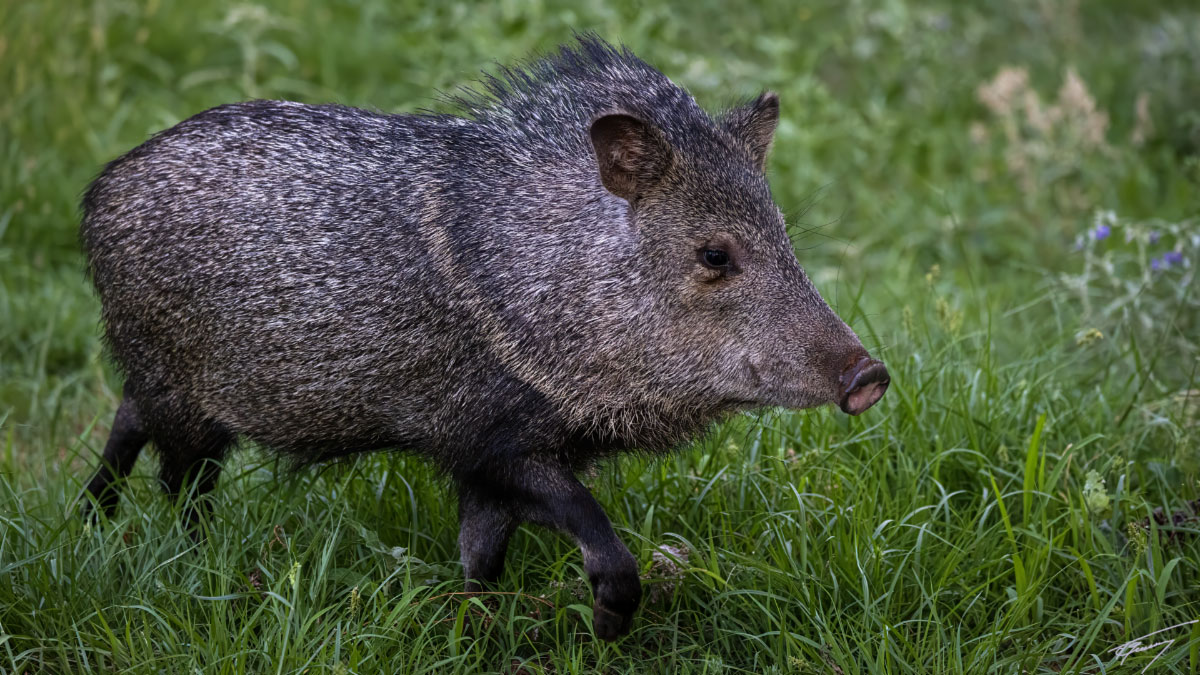
I was enjoying a cup of coffee on the deck this evening and a group of Javelinas came in for a drink at the water basin I have out for critters. Below is a photo of one of the little kids in the family as he was running up to the yard. They spent about a half hour out back and I got a lot of shots of them. They are not exactly the most beautiful of creatures, but they are out there.

Have a beautiful day as we start the new week … smile and keep breathing!
Cheers,
Ted
Though changed as are my songs from youth,
A voice within my heart still sings.
“Live thou in tenderness and truth,
And love mankind instead of things.”
And often in the crowded mart,
With wrangling. selfish slaves of men,
These words like some old song will start,
And bring me to myself again.
Often In The Crowded Mart by Max Ehrmann

###
 The easiest way to reach Mr. Grussing is by email: ted@tedgrussing.com
In addition to sales of photographs already taken Ted does special shoots for patrons on request and also does air-to-air photography for those who want photographs of their airplanes in flight. All special photographic sessions are billed on an hourly basis.
Ted also does one-on-one workshops for those interested in learning the techniques he uses. By special arrangement Ted will do one-on-one aerial photography workshops which will include actual photo sessions in the air.
More about Ted Grussing …

This is an advertisement






