About

Posts by :

BITS & BYTES: ‘Indian Theater’ at Bard College; Brian Cox at Crandell Theatre; Becket Arts Center offerings; ‘Tiny father’ at Barrington Stage Company; Community Day at the Clark; BCC Alumni at Pittsfield Suns

BITS & BYTES: ‘Indian Theater’ at Bard College; Brian Cox at Crandell Theatre; Becket Arts Center offerings; ‘Tiny father’ at Barrington Stage Company; Community Day at the Clark; BCC Alumni at Pittsfield Suns

The Hessel Museum of Art at Bard College hosts an opening reception for ‘Indian Theater: Native Performance, Art, and Self-Determination since 1969 at the Hessel Museum of Art, Bard College’

Annandale-on-Hudson— On Saturday, June 24th from 2 p.m. to 5 p.m., the Hessel Museum of Art at Bard College hosts an opening reception for “Indian Theater: Native Performance, Art, and Self-Determination since 1969 at the Hessel Museum of Art, Bard College”.

“Indian Theater” is the first large-scale exhibition of its kind to center performance and theater as an origin point for the development of contemporary art by Native American, First Nations, Métis, Inuit, and Alaska Native artists, beginning with the role that Native artists have played in the self-determination era, sparked by the Occupation of Alcatraz by the Indians of All Tribes in 1969.

asinnajaq (Inuk), Still from Rock Piece, 2015. Image ourtesy the artist.

Native artists then and now are at the vanguard of performance art practices and discourse. As part of Indian Theater, their work uses humor as a strategy for cultural critique and reflection, parses the inherent relationships between objecthood and agency, and frequently complicates representations of the Native body through signaling the body’s absence and presence via clothing, blanketing, and adornment.

In the exhibition, song, dance, and music are also posited as a basis for collectivity and resistance and a means to speak back to a time when Native traditional ceremony and public gatherings were illegal in both the United States and Canada. In addition to artworks, the exhibition includes important archival material documenting the emergence of the New Native Theater movement in Santa Fe in 1969 as well as materials directly related to the early self-determination era.

The exhibition progresses with a survey of video, performance, sculpture, painting, drawing, and beadwork that at once pay homage to the legacy of innovative Native aesthetic traditions and this continuing tradition of experimentation and performativity.

The show runs from June 24th to November 26th at the Hessel Museum of Art at Bard College. More information can be found by visiting the Hessel Museum of Art online. 

***

The Crandell Theatre presents “A Conversation Between Brian Cox and Peter Biskind”

Chatham— On Thursday, July 6th at 7 p.m., the Crandell Theatre presents “A Conversation Between Brian Cox and Peter Biskind”.

‘Succession’.

The Crandell Theatre is thrilled to announce that celebrated Succession star Brian Cox will join FilmColumbia’s Peter Biskind live on stage in a special Q+A to benefit the renovation and restoration of Chatham’s historic theater.

Cox and Biskind will discuss Cox’s “Succession” character, media titan Logan Roy, and the staggering success of the acclaimed HBO series.

Trained as a Shakespearean actor, Cox broke out in Michael Mann’s 1986 film “Manhunter” playing serial killer Hannibal Lecter before returning to his roots on the stage. He starred in many productions with the Royal National Theatre, Royal Court, and the Royal Shakespeare Company, notably playing Titus Andronicus and King Lear. His subsequent roles span across more than 200 films and television shows, including “Adaptation”, “X-Men 2”, “Rob Roy”, “Braveheart”, “Rushmore”, “Fantastic Mr. Fox”, “Zodiac”, “Rise of the Planet of the Apes”, “Coriolanus”, “Churchill”, “Penny Dreadful”, “The Big C” and “Deadwood”.

Brian Cox. Photo by David Ho.

Crandell board member and author Peter Biskind is a contributor to “Vanity Fair” and “Esquire” and the former executive editor of “Premiere”. His latest book, “Pandora’s Box: How Guts, Guile, and Greed Upended TV”, about the streaming revolution, will be released this fall. He is the author of five previous books, including the bestseller “Easy Riders, Raging Bulls: How the Sex-Drugs-and-Rock ‘n’ Roll Generation Saved Hollywood”. He is also the co-executive director and co-artistic director with Laurence Kardish of FilmColumbia, the Crandell’s signature annual festival.

The discussion is on Thursday, July 6th at 7 p.m. at the Crandell Theatre on Main Street in Chatham. Tickets are $25 per person. All proceeds from the event will benefit the restoration fund. For tickets and more information, visit the Crandell Theatre online.

***

Becket Arts Center (BAC) presents two artists’ receptions and a concert

Becket— On Saturday, June 24th, the Becket Arts Center (BAC) presents two artists’ receptions and a concert. 

By Brian DiNicola. Image courtesy of Becket Arts Center.

From 2 p.m. to 4 p.m. the main gallery hosts artists “Entitled Figure”, featuring artists participating in the second juried show of the summer. This exhibition features five artists, each inspired by the human form. The artists are Brian DiNicola, Mary Davidson, Joan Green, Mollie Kellogg and Kristine Villeneuve-Topor.

From 4 p.m. to 5 p.m., the art lounge will host a reception for artist and cafe owner Olivia Pattison.

Both shows are on view Thursday through Mondays from June 24th through July 10th. The opening receptions are free.

On Saturday, June 24th at 5 p.m., as part of BAC’s Music Brings Communities Together Program, BAC also presents singer-songwriter Louise Mosrie in concert on the art center’s lawn. Lawn chairs, coolers, and snacks are welcome to this free, all-ages event.

For more information, please visit Becket Arts Center online.

***

Barrington Stage Company Season continues with a co-world premiere production of ‘tiny father’

Pittsfield— On Tuesday, June 27th, the Barrington Stage Company Season continues with a co-world premiere production of “tiny father”, a new play by Mike Lew (Teenage Dick) and directed by Moritz von Stuelpnagel (Hand to God), co-presented by Barrington Stage Company and Chautauqua Theater Company.

Top row: Playwright Mike Lew, Director Moritz Von Stuelpnagel. Bottom row: Andy Lucien and Jennifer Ikeda. Image courtesy of Barrington Stage Company.

Daniel’s friends-with-benefits relationship leads to unexpected results when he finds himself face-to-face with becoming the father of a micro-preemie in the NICU. He knows nothing about babies, and Caroline, the night nurse, is happy to point that out. Over the course of his tiny daughter’s hospital stay, he will need to take more than a few tiny steps to find his way into becoming a father.

The production will feature Andy Lucien who has been seen on television in roles on “The Blacklist”, “Madam Secretary”, “Daredevil”, and “The Marvelous Mrs. Maisel” as Daniel; and Jennifer Ikeda from Broadway’s “Top Girls” and “Seascape”, Film’s “Advantageous”, and television’s “Elementary” as Caroline.

The performances run June 27th through July 22nd on the St. Germain Stage at the Sydelle and Lee Blatt Performing Arts Center on Linden Street in Pittsfield. Tickets are $60 and $25 for youth. There is a senior discount offered at the matinee performances.  There are post-show discussions with select cast and creative team members on July 6th and 13th. 

For tickets and more information, call the box office at 413-236-8888 or visit Barrington Stage Company online.  

***

The Clark to host its Annual Community Day

Williamstown— On Sunday, July 16th from 10 a.m. to 5 p.m., the Clark Art Institute opens its doors for Community Day, an annual day of fun for all ages. 

Image courtesy of the Clark.

Adventure around the Clark’s 140-acre campus and take advantage of free admission to the permanent collection galleries and special exhibitions, including “Edvard Munch: Trembling Earth”, “Humane Ecology: Eight Positions”, and “Elizabeth Atterbury: Oracle Bones”. 

Inspired by these exhibitions, connect with the surrounding world for an enchanting day of art, activities, food, and more. Dance to live music inspired by the sounds of nature, learn how natural pulp becomes paper, and participate in creating a collective forest full of color and magic. As always, surprising entertainment and encounters are sure to abound.

Community Day is on Sunday, July 16th from 10 a.m. to 5 p.m. at the Clark Art Institute on South Street in Williamstown.  Visitors enjoy free admission all day and from 11 a.m. to 4 p.m., there will be art-making activities, live entertainment, and more. Refreshments and select activities are available for purchase. This event happens rain or shine. For more information, visit the Clark online.

***

BCC Alumni Night with the Pittsfield Suns

Image courtesy of the Pittsfield Suns.

Pittsfield— On Saturday, July 15th at 6 p.m., Berkshire Community College (BCC) will hold an Alumni Night at the Pittsfield Suns game. The Suns will face the Westfield Starfires. The National Anthem will be sung by a BCC alum. There will also be a first pitch raffle. 

The game will be on Saturday, July 15th at 6 p.m. at Wahconah Park on Wahconah Street in Pittsfield. All BCC alums receive free admission to the game. BCC alumni also receive BOGO (buy one, get one) free admission for the entire Suns season. To view the season schedule, visit the Pittsfield Suns online.

A sculptural tour of Florida – Palm Beach Florida Weekly

A sculptural tour of Florida – Palm Beach Florida Weekly
It was a passion project for a gallery owner. And that gallery owner, Deborah C. Pollack, has penned a book that takes the reader on a sculptural tour of the Sunshine State. That book, “Florida Sculptors and Their Work: 1880-2020,” came about during the pandemic. Bored during the pandemic, Pollack spent two years researching, writing

Night-time destination campaigns to receive funding boost

Night-time destination campaigns to receive funding boost

Projects to enhance Brookvale and Freshwater as vibrant night-time destinations for locals and visitors are set to receive funding from the State Government.

Both Brookvale and Freshwater were among 21 districts across Greater Sydney that were successful in receiving funding under the State Government’s Uptown Grant Program.

The Brookvale Arts District (BAD) will receive $198,450 to support the coordination and marketing for its BAD POSTER public art exhibition.

The exhibition will feature augmented reality street posters connecting artists, audiences, and communities to enhance Brookvale’s cultural credentials.

And the DuskDown project in Freshwater, led by Freshwater based businesses, will receive $200,000 to stimulate the region’s night-time economy and re-engage the local community.

The funding will see a precinct strategy and brand developed, followed by a marketing campaign that celebrates businesses in the Freshwater area.

The Grants will allow the successful districts to hire dedicated resources to manage their combined initiatives, including events, marketing and operations.

The State Government said the funds presented an exciting opportunity for groups of businesses and creatives in the selected districts to co-ordinate their efforts and build further consumer engagement to realise their visions for vibrant local communities.

The grant program follows the successful completion of the State Government’s Uptown Accelerator late last year, in which more than two dozen district teams took part in capability and vision-building workshops.

Applications have just opened for this year’s Uptown Accelerator program. A business briefing is scheduled for 28 June, so if you would like to register or find out more, please email uptown@investment.nsw.gov.au.

Rising has yet to establish its voice – but this year’s festival gave us significant and thrilling work by First Nations artists

Rising has yet to establish its voice – but this year’s festival gave us significant and thrilling work by First Nations artists

Rising has just completed its second run across Melbourne. The newest addition to the city’s festival scene, Rising replaced the much-loved White Night festival and the much-celebrated Melbourne International Arts Festival.

As a new major arts event for a city that has a year-long calendar of significant festival activity, Rising has yet to establish what kind of intervention it is making in our cultural conversation – although its slick marketing line, “Music, Food, Art and Culture under Moonlight”, speaks to the notion of Melbourne as a wintry ethereal nighttime stage.

Led by artistic directors Hannah Fox and Gideon Obarzanek, Rising 2023 was an eclectic mix of local and international work. Some offered spectacle and thrill (Tanz and Euphoria) and some offered participation and community (The Rink and 1000 Kazoos).

But I found the highlight of Rising to be the significant and thrilling work created by First Nations artists across dance, visual art, theatre and music.

A key part of the journey of seeing work at Rising was the act of embodied witnessing.

My top three works situated witnessing as a political act. Witnessing is an act of deep listening, designed to change and shift your perspective. These works invite you to revisit what you thought you knew.

Each functioned to rethink questions of history and philosophy, to reshape notions of culture and memory, and troubled legacies of colonial violence.

Jacky

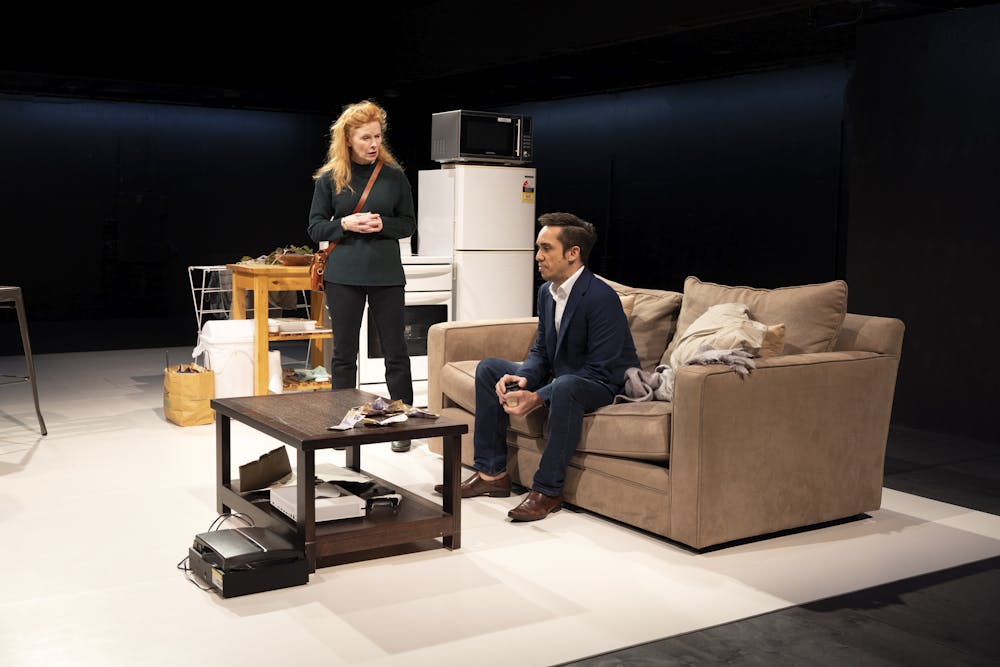
Jacky, a new play by Arrernte playwright Declan Furber Gillick, is a beautifully nuanced and performed investigation of the weight of white expectation and capitalism and its potentially dangerous impact on First Nations people.

Jacky (Guy Simon) is a young man who has moved from his community to the city with aspirations of securing a white-collar permanent job and owning an apartment. Jacky’s younger brother, Keith (Ngali Shaw), is sent by family to join him and soon upturns the ordered trajectory of Jacky’s life.

What quickly emerges is a profoundly uncomfortable look at what constitutes palatable Aboriginal behaviour by white people.

Jacky is a profoundly uncomfortable look at what constitutes palatable Aboriginal behaviour by white people.
Pia Johnson/Melbourne Theatre Company

Jacky’s well-intentioned white boss (Alison Whyte) engages in culturally incompetent behaviour when she requests Jacky pretend he is from a local family group. Jacky’s sex work client, Glen (Greg Stone), requests that Jacky participate in an act of racist role-play.

Keith challenges the social expectations of “good Aboriginal” Jacky has been relying on. He plays witness to the bind Jacky finds himself in: whether he succumbs to the demands of white expectation, or forfeits the social and material gains that are part of playing the role of “sexy Black poster boy”.

Jacky is part of the Melbourne Theatre Company’s season, playing at Arts Centre Melbourne. For me as a white audience member, the performance lays bare an act of political witnessing as Furber Gillick’s writing demands you pay attention and not look away.

Titled in reference to Jacky Jacky, an Aboriginal guide who was awarded medals for his service to NSW, the play troubles ideas of subservience and collaboration within white and First Nations relationships.

It reveals the racist and white supremacist underpinnings of ideas of Aboriginal inclusion premised upon white understandings of success in a capitalist system.


Read more:
Joyous, comic and grim: the best new Indigenous playwrights


Shadow Spirit

The exhibition Shadow Spirit brings together 30 contemporary First Peoples artists and collectives from across the country into an immersive exhibition, including 14 specially commissioned works.

Curated by Kimberley Moulton, Shadow Spirit weaves throughout the decaying and compelling site of the rooms above Flinders Street Station. Works incorporate a range of forms including light, sound, sculpture, screen and projection.

Ambitious and stunning, as you wander through the exhibition works pay tribute to AC/DC; speak to contemporary hero narratives; and feature First Nations Jedi Knight figures blinking back at you on full-size screens under expansive celestial skies.

There is a giant sculptural bandicoot spirit animal; works that map the spirits and energies of Country, waterways and skies and speak to how ancient knowledges protect land and children; and works that directly address the space between what is known and tangible, and what is felt and intuited.

A sculpture with a doll's head and petrol pump.

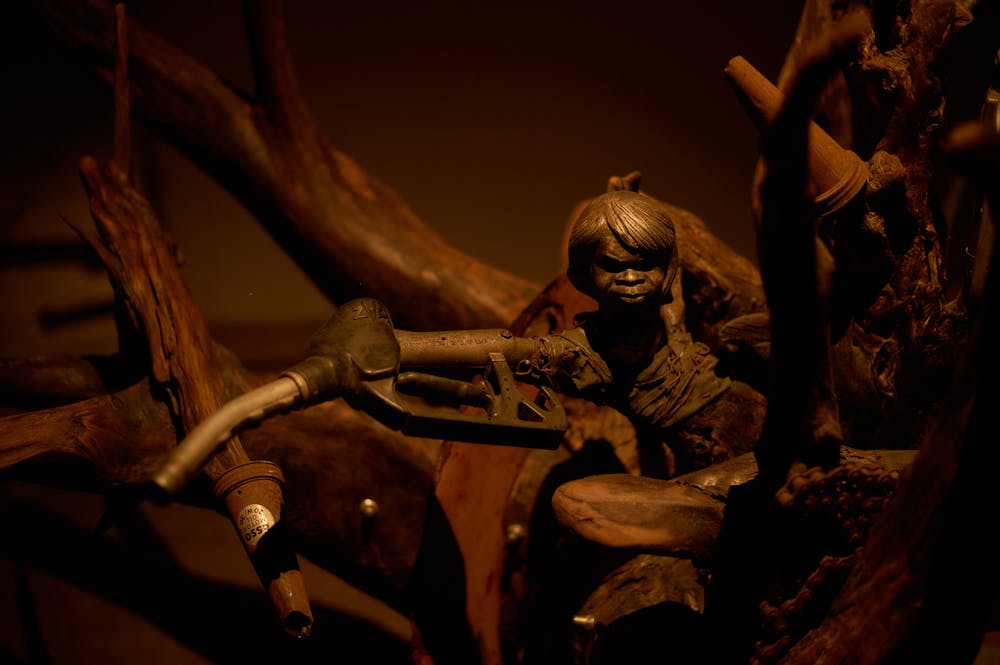
Deeply Rooted is a monstrous and confronting homage to colonial violence and destruction. Deeply Rooted, 2023, Karla Dickens – Wiradjuri.
Eugene Hyland/Rising

One stand-out moment is Wiradjuri artist Karla Dickens’ sculptural works Deeply Rooted.

These spiky works fuse together native hardwood from the artist’s Country with found objects like witches hats, steel caps, broken pieces of rabbit trap, petrol nozzles with the sculptural doll-like head of an Aboriginal child.

Together, these objects create a monstrous and confronting homage to colonial violence and destruction, and a comment on the failure of successive governments to implement meaningful policy change.

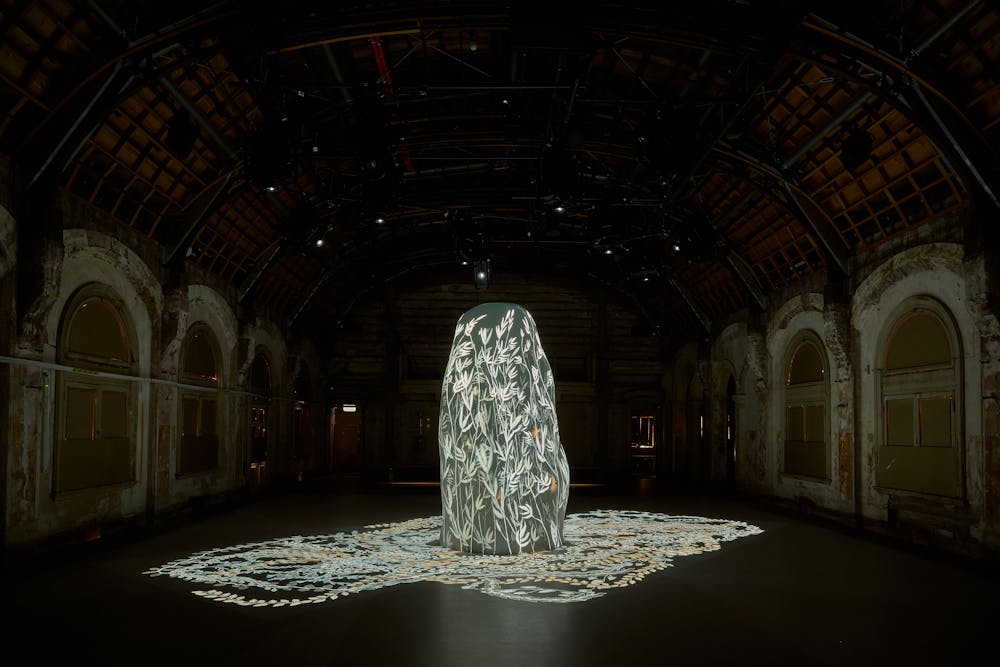
Another stunning moment is Rarrirarri in the large ballroom.

Artistic collective The Mulka Project and Mulkuṉ Wirrpanda (Yolŋu) have collaborated on an installation. A stone monolith (part Uluru and Kata Tjutu and part termite mound) rises from the centre of the room. Across this screens stunning graphic projections of floral and animal landscapes.

A sculpture with projected flowers in a dark ballroom.

Rarrirarri requires you to sit and watch it for some time. Rarrirarri, 2023, The Mulka Project and Mulkuṉ Wirrpanda (NT) – Yolŋu.
Eugene Hyland/Rising

Rarrirarri speaks clearly to desert landscapes and ceremonial and spiritual Country. It requires you to sit and watch it for some time, as the experience of passing time and a landscape of seasonal change reveals itself in the stunning moving graphics of the art work.

The exhibition’s location at the Flinders Street ballroom brings these stories of creation, ancestral knowledge, spirituality and the legacies of colonial violence into conversation with the city’s civic centre. This site is full of cultural memory as a meeting place for railway workers for over 100 years, and its deeper history as a Wurundjeri and Boon Wurrung gathering place across thousands of generations.

Shadow Spirit invites you to linger, to witness and absorb the breadth and depth of knowledge and culture and story threaded through each room in the space.

You are asked to consider your own position and history in relation to these stories, and how you connect and belong within the ancient and contemporary narratives running through the exhibition.

It is a gift to Naarm: a physical and spiritual centre for reflection and communion and gathering, a showcase of the excellence of our First Nations artists and a demonstration of art itself as a political witness.


Read more:
Bark Ladies: how women’s Yolŋu bark paintings break with convention and embrace artists’ strong personalities


Tracker

A co-production between Australian Dance Theatre and Ilbijerri Theatre, Tracker is a remarkable piece of storytelling about Wiradjuri elder Alec “Tracker” Riley.

Riley worked with the NSW police for over 40 years solving crimes to great acclaim. He was the great, great uncle of director-choreographer Daniel Riley.

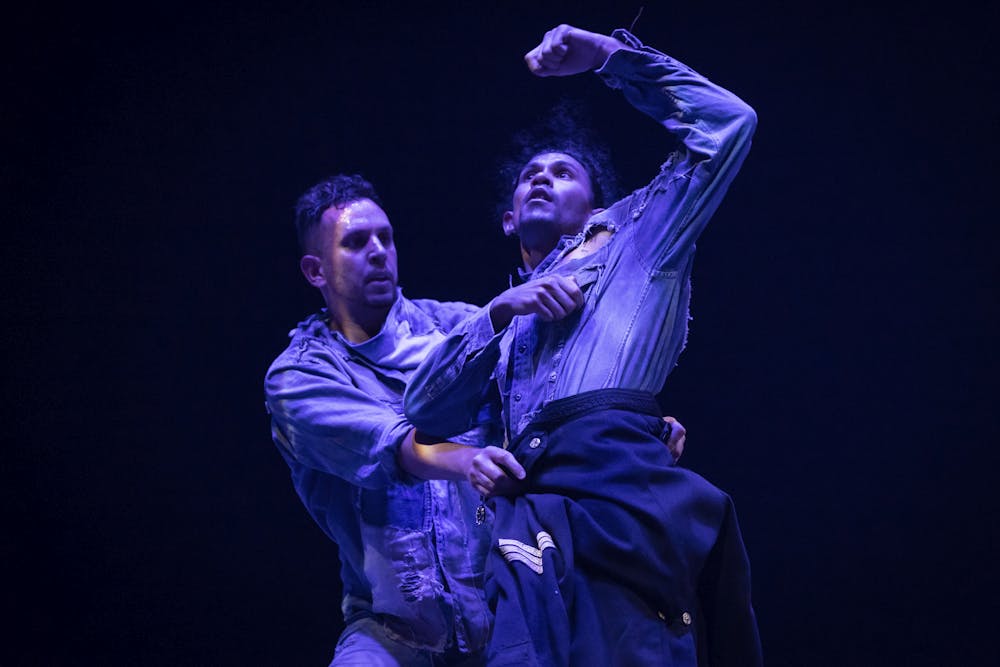
Blending contemporary dance, text, live music and a simple but effective 270-degree rotating set design of scenic painted curtains and greenery rigged around a circular ring, Tracker takes us deep into ancestral Country in the middle of the night.

Our protagonist (Ella Ferris) has travelled to reconnect with the spirit of her great great uncle prior to giving birth to her own child.

Two dancers in blue light and denim clothes.

Tracker takes us deep into ancestral Country in the middle of the night.
Pedro Greig/Rising

She seeks to understand and uncover this piece of her past in order to keep her son safe. In doing so, she reveals how our access to the truths of these stories of cultural resilience are obscured and hidden by layers of history and colonialism.

As the remarkable stories of Tracker Riley’s success in finding missing children and bringing criminals to justice are revealed, three spirit guides appear (Tyrel Dulvarie, Rika Hamaguchi and Kaine Sultan-Babij). Their poetic and synergistic movements echo, enhance and articulate the searching nature of the story.

As the audience, we bear witness to this uncovering of a piece of our nation’s past. Throughout the work, we seek to understand how this extraordinary man successfully forged a path between ancient wisdom and colonial structures – yet received no pension at the time of his retirement.

This is a powerful and ambitious story, asking us to look more closely at history and what the past can reveal about today.

Jacky is at Arts Centre Melbourne until June 24. Shadow Spirit is at Flinders Street Station until July 30.


Read more:
60 years of The Australian Ballet and 90 years of ‘Australian’ ballet: Identity asks us to reflect on Australian dance today


Mississippi River Centers Inaugural Wakpa Triennial Art Festival In Minnesota’s Twin Cities

Mississippi River Centers Inaugural Wakpa Triennial Art Festival In Minnesota’s Twin Cities

“Wakpa” is Dakota for “river.”

Even before the Dakota were on this land, there was the river. Many rivers, but one superior to all others: Ȟaȟáwakpa. White people called it the Mississippi River.

The inaugural Wakpa Triennial Art Festival takes place June 24 through September 16, 2023, throughout Minnesota’s Twin Cities, the state capital of St. Paul side-by-side with its big brother Minneapolis. Ȟaȟáwakpa winds through them both.

ADVERTISEMENT

The river makes as good a place as any to start thinking about the event.

The father of rivers shares a story common across the continent with thousands of its offspring. Native people used these waterways to participate in vast trade networks. European traders tapped into them upon arrival. As the colonizers steadily pushed Indigenous inhabitants off their land, the rivers were increasingly used for industry.

They were dammed and dredged and diked to scale up shipping and textile production and power generation. Their natural cycles of flooding were halted by white men. Concrete barriers went up. Their banks were straightened. Adjacent wetlands were pumped dry.

America’s rivers then became toilets, early residents piping their waste directly to the banks and later, civil engineers directing sewage overflow their way during times of heavy rain. Trillions of gallons of herbicide and pesticides flowed into them from farms and lawns. Toxic industrial waste. “Dilution is the solution to pollution,” the operative phrase for industry.

ADVERTISEMENT

Once a paradise for fish and birds and plants, the country’s rivers nearly died. Riverfront land was often the least valuable and least attractive in cities across America through the 20th century.

It wasn’t until the last 25 or 30 years that the value of rivers for people, not products, began to be understood and appreciated by places fortunate enough to be blessed with a river.

“I grew up here and the river used to stink like a sewer,” Colleen Sheehy, Executive Director of Public Art Saint Paul and the Project Director of Wakpa Triennial Art Festival, told Forbes.com. “It’s taken decades for us to turn back to the river. There’s a lot about the river that not only people coming from outside the Twin Cities, but people here I think will discover.”

Artist, boat builder, fisherman, former professor, clean water activist and Twin Cities native Seitu Jones is aiding in the discovery. His Wakpa Triennial project, artARK, will provide opportunity for more intimate acquaintance with the river. The 20-foot-long wooden and aluminum pontoon boat will serve as something of a research vessel with an artist/naturalist as part of the crew.

ADVERTISEMENT

ArtARK will use art and ecology to foster a greater understanding of the Mississippi River watershed and residents’ role as river stewards.

“I live two miles away from the river, one of the greatest rivers in the world, and many folks–my neighbors–will pass over the river three or four times in a day, but nobody ever gets to the river’s edge,” Jones told Forbes.com.

When the project is completed later this summer, the public will have the opportunity to tour the Mississippi River aboard the artARK. The experience will be participatory as guests can help interpret and present scientific data including pH and oxygen levels, temperature, turbidity, clarity, salinity, and observations of invertebrates, fish, birds and mammals through writing, visual art, and performance with the help of the vessel’s artist/naturalist.

“There’s been much more attention placed (on the river) as this recreational and environmental and inspirational resource (in recent years),” Jones adds.

Instead of using and abusing the Mississippi River, the Twin Cities are increasingly caring for and restoring it. A river once working for industry, is now working for people.

ADVERTISEMENT

Sewage is being treated before making its way to the river. New public parks are bringing people to the river’s edge. The once-radical possibility of removing the river’s locks and dams through town are being considered, part of a national trend returning health to riverine ecosystems and the people who live by them.

“The river going through St. Paul is stunning; there are beautiful limestone cliffs and bluffs along the river in the downtown–it’s spectacular,” Sheehy said.

Sean Sherman’s (Oglala Lakota) Owámni restaurant overlooks the river by St. Anthony falls in St. Paul. Sherman, “The Sioux Chef,” was named one of Time magazine’s 100 most influential people for 2023 due to his ongoing efforts promoting Indigenous food ways.

Reservations at the restaurant are extremely hard to come by, planning should be made months in advance. While waiting for a table, enjoy views of the river, thankfully, now, without the sewer smell.

ADVERTISEMENT

A Thriving Arts Community

The Wakpa Triennial will feature over 40 public events and programs, community-based performances, and temporary public art installations throughout the metro area. Most will be free to attend. In addition to sites along the river and in parks, new commissions will be found in galleries, museums, and alternative spaces indoors and out.

Why now?

Sheehy believes the Twin Cities’ arts community has finally grown to a level where it can support an event of this ambition.

ADVERTISEMENT

“I’m old enough to have seen (the Twin Cities’ art scene) develop from the major institutions to this wonderful density of small organizations that are connected to communities and neighborhoods and specific artistic disciplines,” Sheehy explained. That development extends to artists. “From being a place where a lot of artists would move away to pursue careers in New York, L.A., and now we’re a place where artists are thriving.”

Wakpa also furthers a national and global trend.

These kinds of biennials and triennials have been increasing as efforts to lift up an art scene (and) create exciting new work that gets people out traversing a city, learning more about the city,” Sheehy said.

Discovery is a major goal for Wakpa.

“When I’ve gone to these kinds of art festivals in other cities, they’ve been a beautiful way of learning a city because typically, if I traveled to another city, I’ll go to the big museums, but I don’t necessarily get into the neighborhoods,” Sheehy said.

ADVERTISEMENT

You are on Native Land

Minnesota, along with parts of South Dakota, North Dakota, Nebraska and Canada are the ancestral homelands to the Dakota people. Scandinavians found it in the late 19th century. They were given free land taken from the Dakota to farm and homestead.

Minnesota is still often associated with these Nordic immigrants–look at the Minnesota Vikings football helmet. More residents of Norwegian and Swedish ancestry continue living there than any other state.

ADVERTISEMENT

But St. Paul also has the largest Hmong community in an urban area in the United States. Minneapolis has the largest Somali population outside of Mogadishu.

In the 1950s, 60s and 70s, a federal program known as the Indian Relocation Act incentivized tens of thousands of Native people from across America to leave their reservations and move to cities for greater economic opportunity. It was another government effort to disassociate Native people from their land and culture under the guise of “progress,” and Minneapolis was a major relocation hub.

To this day, it has one of the largest Native populations of any American city.

“There are these cultural communities that people can experience and help to dispel the idea that we’re this all-white German Scandinavian area,” Sheehy said. “There’s a lot of diversity that is adding so much to our understanding, our experiences of city and art and food and customs.”

The Wakpa name was selected only after consultation with Dakota leaders and artists.

Of the more than 100 Minnesota-based artists contributing to the festival, a majority are people of color.

ADVERTISEMENT

Organizational partners include Wakan Tipi Center which honors sacred Dakota sites in the area, Oyate Hotanin, an Indigenous arts organization, the Asian Economic Development Association, Center for Hmong Arts and Talent, the contemporary Native American art gallery All My Relations Gallery and the Hmongtown Marketplace.

And the Philando Castile Peace Garden.

Philando Castile and George Floyd and Duante Wright…

ADVERTISEMENT

George Floyd was murdered by a white police officer in Minneapolis, not Mississippi. The Twin Cities prides itself on being one of the most progressive and educated communities in America, yet, police murder has been the area’s defining attribute since Floyd’s death was witnessed worldwide.

It wasn’t an isolated incident. Cops in the Twin Cities have an outrageous record of unwarranted violence against minorities.

Philando Castile was a young Black man shot and killed by police in the metro area in 2016. The longtime employee of the St. Paul Public School System perished sitting in his car after being pulled over for a broken taillight.

ADVERTISEMENT

Minneapolis police rampaged in the days after Floyd’s murder. They were heard on their own body cam footage enjoying “hunting” peaceful protestors.

Like Castile, Duante Wright was a young Black man killed by police while sitting in his car after being pulled over in suburban Minneapolis for a traffic stop. His death occurred during the trial of Floyd’s murderers in 2021.

A damning report from the Department of Justice released on June 16, 2023, found the Minneapolis Police Department for years has engaged in a pattern of excessive force and racial bias among other civil rights abuses.

ADVERTISEMENT

“We’re still struggling to recover and rebuild,” Sheehy said of the demonstrations following Floyd’s murder. “Not only physically rebuild, but to rebuild what future we want here that’s based on equity and inclusion, and to address these sadly persistent disparity gaps that exist in the Twin Cities, and in Minnesota, between white communities and communities of color.”

Wakpa Triennial leans in, placing these conversations and sites front and center.

“One node of the triennial in Minneapolis is around Minnehaha and Lake Street, it’s called the Longfellow neighborhood, it’s the location of the third precinct building that was burned, that was the focus of a lot of demonstrations. That’s the precinct Derek Chauvin worked at,” Sheehy explains.

Chauvin is the officer who choked Floyd to death.

“The building wasn’t burned to the ground, but it’s standing empty with a fence around it for these three years,” Sheehy said. “There’s a lot of rethinking and rebuilding in that node because there were a number of important small cultural businesses and organizations whose buildings burned and it’s an opportunity to come to that neighborhood, think about what happened there, and learn more about how the neighborhood is rebuilding.”

ADVERTISEMENT

Artists and the arts community will be key to that effort.

Rebuilding a community following Floyd’s murder, and Wright’s, and Castillo’s.

And rehonoring Native homelands.

And restoring a river.

Travel Wisconsin: Native American Culture

Travel Wisconsin: Native American Culture

Wisconsin is home to 11 federally recognized Tribes, each with their own distinct traditions and cultural heritage. Tribes welcome the public to experience rich traditions throughout the year, with many unique events and opportunities in the summer. Here’s to experiencing Wisconsin’s Native culture. 

Visit Bayfield County to experience Ojibwe culture (Bayfield County) 

Discover natural beauty and the artwork of Native artists when visiting Bayfield County this summer.  

The Red Cliff Band of Lake Superior Chippewa established Frog Bay Tribal National Park, which was the first tribal national park in the country. The park protects 300 acres of land and 4,000 feet of shoreline on Lake Superior. When you visit, you’ll find nearly 2 miles of rustic trails, interpretive signs, bridges and a view of five of the Apostle Islands. 

Head over to Madeline Island afterward to learn about Ojibwe culture. Dine at the newly opened restaurant in La Pointe, Miijim, where you can enjoy Indigenous comfort dishes with a French twist on small plates. The dishes feature locally foraged and Native-grown foods while offering a unique exploration into Indigenous Miijim, meaning “food” in Ojibwe. 

Explore the Madeline Island Museum, which is operated by the Wisconsin Historical Society, and has a featured exhibit with works from an internationally recognized Ojibwe artist, as well as an exhibit showcasing beadwork from Native youth. For a place to stay when you visit, rent a campsite at the Buffalo Bay Campground. The lakeside campground offers panoramic views of Lake Superior and the Apostle Islands and is next to the Legendary Waters Resort and Casino with all its modern conveniences. 

Visit Lac du Flambeau for outdoor recreation and cultural experiences throughout the summer (Vilas County) 

Fish the famous Flambeau Chain with a Native American guide, paddle the areas 71 miles of rivers and streams or catch glimpses of wildlife and the many birding opportunities on the Powell Marsh – 12,000 acres of wetlands and one of the top birding destinations in Wisconsin.  

Visit the George W. Brown, Jr. Ojibwe Museum & Cultural Center for exhibits dovetailing the old ways and the new ways into a holistic picture of Ojibwe life and history. Book in advance to take advantage of their guided tours, programs and events. Take in one of the weekly Waaswaaganing Indian Bowl Pow Wows happening every Tuesday until August 15.  

For more than 70 years, the Lac du Flambeau Band of Lake Superior Chippewa have been educating visitors and sharing Ojibwe culture through pow wows at the Indian Bowl. They have even been visited by President Dwight Eisenhower. Today, you’ll experience a beautiful permanent pow wow venue that honors heritage and tradition while creating space for contemporary expression of Native culture. 

When you’re visiting Lac du Flambeau, book a room at Lake of the Torches Resort Casino to extend your stay. Time your visit with a Native American arts and craft show that’s happening at Lake of the Torches on July 29 where you can browse a variety of handcrafted goods. 

See smoke dancing and more at the annual Oneida Pow Wow (Outagamie County) 

The Oneida Pow Wow is a powerful way to experience Native American culture and celebrate the tribe’s past, present and future! The popular event is taking place the weekend of June 30-July 2 at the Norbert Hill Center in Oneida. 

You’ll be amazed by the incredible talent during the dance and drum contests. Competitors of all ages travel to the pow wow to show off their skills in several traditional dances, including Oneida’s own smoke dance style. When there’s downtime between competitions, check out the dozens of booths surrounding the dance area. Vendors will be selling Native American-made crafts, food and more. 

Start your summer getaway at TravelWisconsin.com