
We spoke to LA artist Beatriz Cortez about her artwork based on Ilopango, one of the most calamitous volcanic events in human history.
Nomadic Volcano Sculpture Lands at Storm King


If you love Black New Orleans culture as much as I do, you’ve got to see a wonderful Black photographers exhibit at the Ashé Cultural Arts Center.
Even if you’re only mildly curious about the Black New Orleans experience, the exhibit is a perfect way to begin exploring — and understanding — Black New Orleans.
Anyone who has seen Mardi Gras and second-lines, traveled Black neighborhood streets or attended Black funerals and wondered about the photographs taken there by Black photographers definitely needs to see the exhibit, which ends June 3.
The COVID-19 pandemic was a difficult time for New Orleans and the world. We all felt the doom and gloom, and we lost too many lives.
Yet, some good things happened during the pandemic. One of them was an idea that hit local poet Kalamu ya Salaam one day early in 2020. He called his high school friend, Eric Waters, to talk about it.
New Orleans photographer Eric Waters is one of a group of organizers of a photography exhibit at the Ashe’ Cultural Arts Center at 1712 Oretha Castle Haley Boulevard in New Orleans. Waters took the “Young Boy in a Bowl Hat” photograph years ago. It’s part of an exhibit of more than 120 images by more than 70 Black photographers open through June 3, 2023.
“He said he wanted to do a book about Black photography here,” Waters told me. “He said, ‘Think of a name.’ Then he told me, ‘I’ve got a name: Seeing Black.'”
As I walked through the exhibit with the two friends recently, Waters recalled wondering why his high school classmate had asked him to think of a name when he already had an excellent one in mind. They graduated from St. Aug in 1964. Photography didn’t become an important part of their lives until later.
“Seeing Black: Photography in New Orleans, 1840 & Beyond” has blossomed from ya Salaam’s brainstorm into a wide-ranging, multimedia exhibit of Black photographic talent.
For those not familiar with him, ya Salaam is a writer at his core. I got to know him through his work with The Black Collegian magazine in the 1970s. He’s an activist, a historian, an author, a filmmaker, a scholar and more. He’s a griot and baba, or elder and father, to many.
Waters is a renowned New Orleans-based photographer. His work has focused on Black New Orleans culture, customs and people. He’s one of few artists with an insider’s perspective of Black Masking Indians culture.
His “Seeing Black” dream includes a core team of Waters, phenomenal photographer Girard Mouton III and Shana M. griffin, a feminist activist, artist and curator of the “In the Spirit of Black” photo exhibit at Ashe’ and the “First Frame” exhibit at the New Orleans African American Museum.
First Frame is a look at the photography of Floresine Perrault Collins and early Black photographers. Collins, known as the first Black woman photographer in New Orleans, focused on African American dignity and pride rather than enslaved people and other stereotypes. The First Frame exhibit closes June 4.
The much larger exhibit at Ashé includes about 120 images by more than 70 Black photographers. I’ve been a visual art and photography aficionado (and a bit of a collector) for decades. To my knowledge, the Ashé exhibit is the first to pull together such a diverse group of Black photographers.
Two photographers featured in the Ashé exhibit were recognized as documentary photographers of the year by the Louisiana Endowment for the Humanities — L. Kasimu Harris, whose Vanishing Black Bars exhibit garnered national attention; and Abdul Aziz, who documents what he calls “human conflict.” His “Hail Caesar” photograph shows a man with his face covered during a 2020 Movement for Black Lives protest in New Orleans.
The Ashé exhibit also includes work by Ellis Marsalis III, a Baltimore-based photographer with deep New Orleans roots as the son of legendary musician Ellis Marsalis Jr. Also included are photographs by Freddye Hill, a retired Dillard University professor known to many local culture bearers.
Will Horton, an award-winning filmmaker and visiting professor at Loyola University, lost his negatives and all his high-end photography equipment during Hurricane Katrina. When Waters told him they wanted him to be in the Ashé exhibit, he reached out to past subjects who might still have a negative or photograph of his.
You can see Horton’s photos at Ashé. He said he is “honored” to be in the same exhibit as those he considers masters and mentors.
The original Black photography book concept has become something much bigger. The “Seeing Black” book is scheduled to be published by University of New Orleans Press this fall. It will include many of the photographs you can see now at Ashé. Look for the book; don’t wait to see the exhibit.
I’ve been thrice, and I’m going back soon. I hope to see you there.


In recent years, we have seen budget full frame cameras become more affordable while medium format prices have become competitive with upper-level full frame options. At the same time, APS-C cameras have continued to grow in capabilities and performance, and micro four thirds is enjoying a resurgence. So, should a new photographer follow the old wisdom of using a larger sensor for the best image quality or consider the benefits of a smaller system? This great video makes a case for the latter.
Coming to you from Robin Wong, this interesting video makes a case for using smaller camera systems, like those from Fujifilm and OM System. It used to be that if you wanted professional image quality, you prioritized sensor size above almost everything else. However, in recent years, the image quality we have seen from APS-C and micro four thirds cameras has gotten to the point that the difference is often negligible in a lot of situations. And as such, it is worth considering the advantages of these smaller systems. Perhaps the most obvious are their smaller footprints and weights, but there is much more to it than portability. Both Fujifilm and OM System offer robust user experiences and feature sets that can’t be found on any other cameras, and you may find that those better suit your needs and desires than any full frame or medium format system. Check out the video above for Wong’s full thoughts.


… in the image above, a Cliff Swallow is exiting his nest which was about 25 feet above me under an overhang in the cliff; the opening to the nest is very small so they enter and exit with their wings tucked … kinda like a torpedo. Below is a shot of one of the adult Red Tail Hawks exiting the nest in search for more food for the kids and the three of them are lined up on the edge of the nest wishing her good skill in getting them another quick meal … maybe five or six weeks and they will begin making their own kills … sustenance is only available to creatures if they expend the effort to get it!


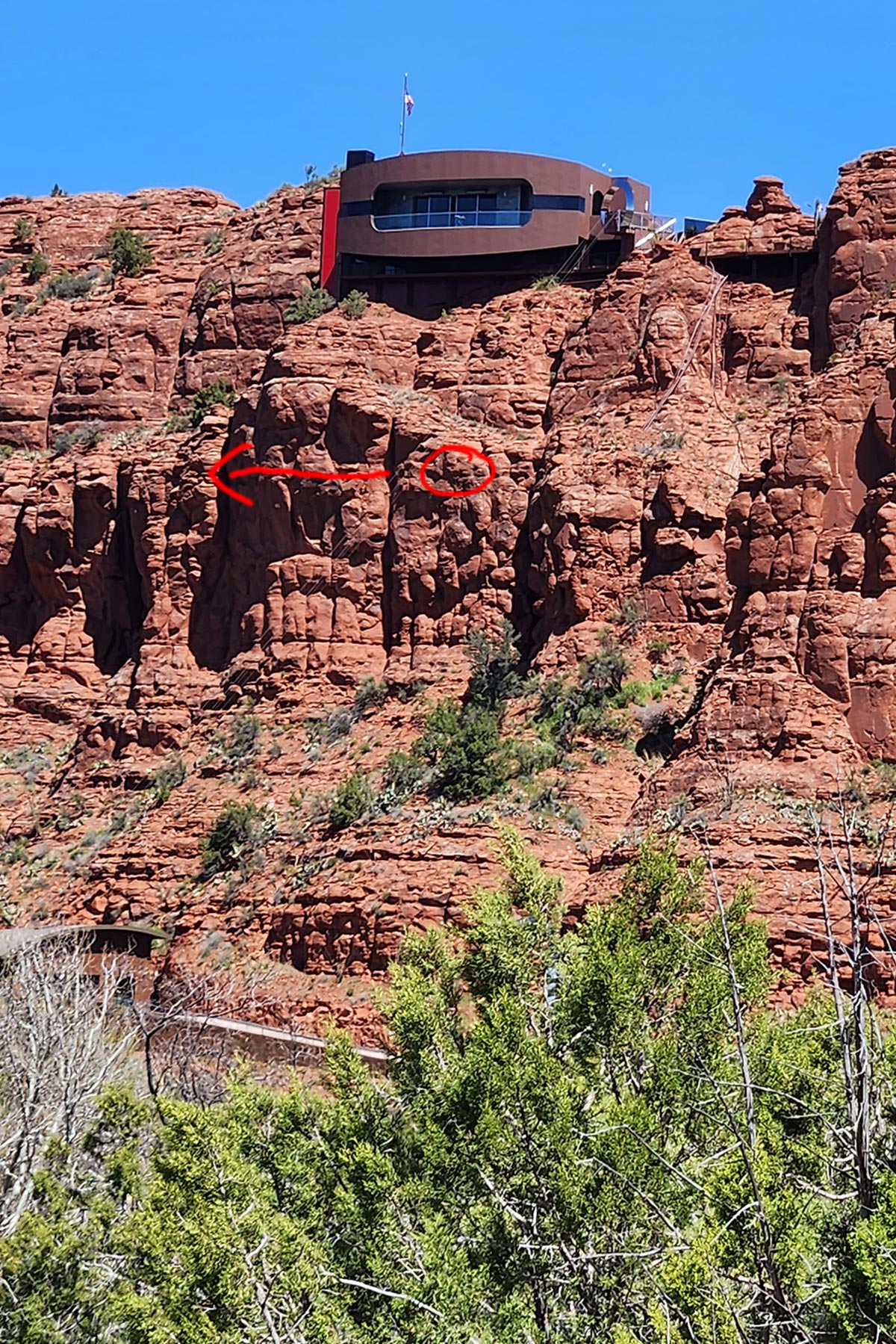
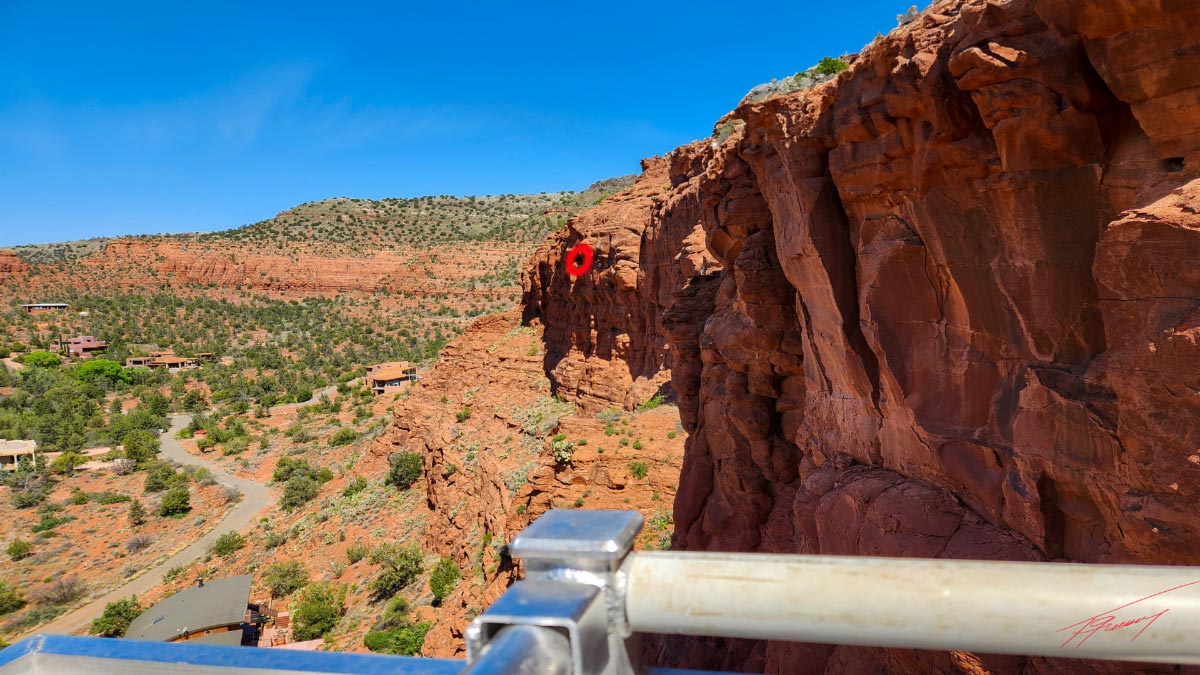
As promised last night the three photos below show you where I am when I am getting these shots of the Red Tail family (and the swallows too). The top image is a shot looking across a field at my friends home on top of the cliff … it is 200 feet above the ground. I drew a red circle where I stop the gondola and the arrow points to the direction I am shooting at the nest. The shot below that is a shot from the gondola looking at the nest which I drew a red circle around … it is about 400 to 500 feet from where I am. The direction you are looking is NNW. The last image is looking up the cables towards the docking station at the top. It is a very cool place!



Time to wrap the day as I resume it in about four hours … have a beautiful day … keep breathing and smile for we are here.
Cheers,
Ted
I ask no odds of any man,
I am not one that follies sway.
I am the source of my rewards,
I do my work each day.
The fruit of trees, the grain of fields,
Wherever use and beauty lurk—
The good of all the world belongs
To him who does his work.

It matters not if rich or poor.
This is the future’s great command,
Who does not work shall cease to eat;
Upon this rock I stand.
Though work bring naught of power
nor wealth
Spare me from want of common needs,
And give a share of manly health,
A few good friends of honest deeds;
And till death’s peaceful slumber nears
A life of undishonored years.
Work by Max Ehrmann
###
 The easiest way to reach Mr. Grussing is by email: ted@tedgrussing.com
In addition to sales of photographs already taken Ted does special shoots for patrons on request and also does air-to-air photography for those who want photographs of their airplanes in flight. All special photographic sessions are billed on an hourly basis.
Ted also does one-on-one workshops for those interested in learning the techniques he uses. By special arrangement Ted will do one-on-one aerial photography workshops which will include actual photo sessions in the air.
More about Ted Grussing …


All images © Yau Hoong Tang, shared with permission
In Negative Space, Yau Hoong Tang derives imaginative and expansive storylines from minimal visuals. As its name suggests, the ongoing series plays with the relationship between presence and absence, layering optical illusions, embedded imagery, and other narrative cues within a single work.
The Kuala Lumpur-based illustrator is fond of weaving together several plots. In one work, an ink splatter also becomes wildlife inhabiting the world, with in another, a creature appears as a flying goose or a fox depending on where the viewer focuses. “I love using negative space in my illustrations as it creates more dynamics to an artwork and opens up a visual conversation,” he tells Colossal. “Its thought provoking nature invites viewers to discover the hidden meanings and spark imagination.”
While Negative Space is created digitally, Tang is currently working on a new collection that returns to more traditional, analog mediums. Shop limited-edition prints, and find more of his playful illustrations on Behance and Instagram.


Do stories and artists like this matter to you? Become a Colossal Member today and support independent arts publishing for as little as $5 per month. The article Playful Illustrations by Yau Hoong Tang Layer Optical Illusions into Imaginative Stories appeared first on Colossal.


Vital Impacts has announced the winners of its Vital Impacts Environmental Photography Grants. Two winning photographers will each receive $20,000 grants to help them document solution-based environmental initiatives in their communities.
Vital Impacts is a women-led non-profit organization that supports grassroots efforts to protect people, wildlife, and habits. The organization is led by award-winning photographer Ami Vitale and visual journalist Eileen Mignoni.
The two Vital Impacts Environmental Photography Grand recipients are Musuk Nolte of Mexico and Peru and Tailyr Irvine of the Salish and Kootenai tribes in western Montana.

Honorable mention designations were also awarded to photographers Ingmar Björn Nolting (Germany), Daylin Paul (South Africa), Fatma Fahmy (Saudi Arabia, based in Egypt), and Edgar Kanaykõ Xakriabá (Xakriabá Indigenous people, Brazil).
The Vital Impacts’ grants program is designed to encourage visual storytellers to “create long-term documentary photography projects with local communities who are working to protect the environment and wildlife.”

“Environmentalists, Indigenous peoples, and scientists have been sounding the alarm about the biodiversity crisis for more than half a century, yet no meaningful action has been taken. As photographers, we are in a unique position to inform and influence change, but pressing the shutter is just the start. For images to have significance, they need to tell a story and reach people,” explains Vitale.


She goes on to say that Vital Impacts hopes that its grants and mentorship programs will help support new ways of seeing and thinking about ongoing issues. This year, Vital Impacts received 372 submissions from 68 countries for its grants.
Peruvian-Mexican photographer Musuk Nolte aims to use photography to tell stories of social issues, including memory and environmental depredation. His project will examine how Peruvian communities utilize traditional water harvesting practices to improve water access. Nolte will also look at how communities are using plants and other methods to deal with climate change.

“This is such a beautiful hopeful story on ancestral water harvesting practices; instead of focusing on scarcity and despair, we get to learn that there are ways to combat climate change one shrub at a time. We also get to learn that solutions have existed for a long time — this story will give a voice to experts and amplify their knowledge in ways that will resonate at a larger scale,” says judge Sabine Meyer, Photography Director, National Audubon Society.

David Barreda, Senior Photo Editor, National Geographic, is excited to see how Nolte tells the story of the centuries-old relationship that indigenous communities in the Andes have water resources. “By centering local expertise, Nolte amplifies the voices and wisdom of the Indigenous people, offering nuanced perspectives that are often overlooked in mainstream narratives surrounding environmental conservation,” Barreda adds.

Tailyr Irvine is a Salish and Kootenai photojournalist born and raised on the Flathead Indian Reservation in Montana. She focuses on visual representations of the complex issues facing the communities comprising Native America. Each community faces unique issues, and Irvine’s project will examine how indigenous populations navigate changing stewardship of public lands, many of which were stolen from tribal nations.

“Tailyr Irvine’s proposal is not only an important national story, it very well may lead to larger understanding in how members of society understand tribal rights internationally,” says David Barreda. “As Salish and Kootenai herself, Irvine’s intimate understanding of the community and its nuances will allow her to pursue this story in more than a simple visual documentation. Irvine’s existing body of work details such subtle and complex stories, I fully expect this project, in her hands, to bring her to new heights in storytelling and a more wide-spread understanding of the real-world experiences of her community.”
Vital Impacts is also offering a mentorship program to 50 applicants for the Vital Impacts Environmental Grant. Each mentee will be paired with an editor or leading environmental photographer and be aided over 12 months to help each mentee work on developing their photographic projects.


Mentees will also participate in the Vital Impacts lecture series, which features monthly talks that will help connect and inspire participants. Mentorship recipients hail worldwide, including the United States, Peru, Mexico, Spain, Kenya, Saudi Arabia, and more.
Image credits: Vital Impacts | Individual photographers credited in captions





